Gold Is Money: Understanding gold

JustWolves is an educational platform and is not a SEBI-registered investment advisor. Trading financial instruments involves significant risk of loss and may not be suitable for all investors. Past performance is not indicative of future results. Read our full disclaimer →
In this article · 16 sections
For 5,000 years, every major civilisation on Earth independently reached the same conclusion about what to use as money. Egyptians and Romans, Chinese dynasties and Ottoman sultans, across different continents, different languages, different gods — they all chose gold. Then on a Sunday night in August 1971, a US president interrupted a popular television programme to announce that the dollar would no longer be convertible into gold. Fifty-five years later, that suspension is still described as temporary. A 1971 dollar now buys roughly what 12 cents bought then. This is not a story about gold going up. It is a story about paper money going down — and what that quiet, compounding destruction of purchasing power means for every person who earns a salary, saves diligently, and plans for retirement.

Why Every Civilisation Chose Gold — The 4 Properties
Out of 118 elements on the periodic table, humanity did not randomly land on gold as money. The choice was the independent conclusion of every major culture across thousands of years. Gold was not selected because pharaohs liked the way it looked. It was selected because it has a unique combination of four properties that no other element shares in the same configuration.
The 4 Properties That Made Gold Humanity's Universal Money
Non-Corrosive
Gold does not rust, tarnish or react with air or water. A gold coin retrieved from a shipwreck after 400 years on the ocean floor looks essentially the same as when it was minted. Iron corrodes. Copper tarnishes. Gold endures.
Divisible
Gold can be melted, cut or shaped into coins, bars or tiny flakes without altering its fundamental properties. Every piece has exactly the same purity as the whole — making it ideal for transactions of any size.
Malleable
One ounce of gold can be hammered into a sheet covering 100 square feet or drawn into wire thinner than a human hair. This workability allowed gold to be formed into any shape required by any civilisation at any period in history.
Scarce
Gold cannot be synthesised, manufactured or printed. It must be physically extracted from the earth and there is a hard, natural ceiling on how much exists. This is the single most important property — and the one paper currency lacks entirely.
All the Gold Ever Mined Fits in About 4.5 Olympic Swimming Pools
Take every ounce of gold ever mined in human history. Every pharaoh's tomb, every central bank vault, every wedding ring worn by every person alive today, every Olympic medal, every electronics component, every bar stored in Fort Knox and the Bank of England. Melt it all down into one single solid cube.
That cube would fit inside about four and a half Olympic-sized swimming pools. For eight billion people, across all of recorded civilisation spanning thousands of years, that is the entire accumulated gold supply of the human race. The number is not large. It is this tangible, physical scarcity that gives gold a property no government can replicate with a printing press.
Gold's Scarcity by the Numbers
~4.5 pools
Total volume of all gold ever mined in human history
~1–2%
Annual increase in global gold supply through new mining
~13x
Growth in US broad money supply from 1981 to 2021
Gold Is Not an Investment — It Is Money
This is the distinction that most financial commentary — and most people who buy gold — get wrong. An investment is something that generates cash flow. A rental property produces rent. A stock produces earnings. A bond pays interest. These instruments grow your wealth because they create output.
Gold does none of these things. It sits in a vault and pays no dividend, generates no revenue, and does not compound. If you buy gold expecting it to grow your wealth in the way a well-run business or a productive piece of property does, you will be disappointed.
What gold does is something entirely different and, in some ways, more fundamental. It is a store of value — a measuring stick for everything else. It reveals whether the money in your pocket and your bank account is actually holding its purchasing power, or slowly being eroded by the actions of people you did not vote for and decisions you were not consulted about.
The Roman Centurion Test: 2,000 Years of Purchasing Power
Two thousand years ago, a Roman centurion — a senior professional soldier, the equivalent of middle-management military rank — earned approximately one ounce of gold per month. That monthly salary bought a high-quality toga, a leather belt and a pair of sandals: a complete, well-made outfit at the standard expected of his rank.
One ounce of gold today buys a well-tailored suit, quality leather shoes, a belt and a shirt — an equivalent complete high-quality outfit at a similar social standard. Not the cheapest option available, not the most extravagant, but the kind of clothing that signals competence and status in its era.
Gold did not appreciate over 2,000 years. It did not "perform well." The purchasing power of one ounce of gold remained essentially constant across Roman emperors, the fall of Rome, the medieval period, the Ottoman Empire, the British Empire, two world wars, and the entire modern era. What changed is that every paper currency that existed during those 2,000 years was eventually debased, inflated away, or collapsed entirely. Gold just sat there — holding its value while everything else fluctuated around it.
Gold didn't go up over 2,000 years. It stayed the same. It's the dollar that moved. Gold is just sitting there, telling you the truth about your currency.
The Bretton Woods System — When Every Dollar Was Backed by Gold
Before 1971, the US dollar was not a piece of paper. It was a receipt — a legally enforceable claim on a specific amount of physical gold. You could walk into a bank, present your dollars, and receive gold in exchange. The paper was a convenience for handling heavy metal. The money was the gold.
This system was formalised after World War Two in 1944, when 44 nations met in Bretton Woods, New Hampshire. The agreement established that the US dollar would be pegged to gold at exactly $35 per ounce, and every other major currency would be pegged to the dollar. The entire global financial system was anchored to one physical thing that could not be printed, could not be faked, and could not be inflated away by any single government's spending decision.
The result was a period of remarkable monetary stability. Prices across the developed world remained relatively predictable. The American middle class was built during this era. Workers' wages bought roughly the same bundle of goods from one decade to the next. The gold standard was the foundation that made this stability structurally possible.
The Nixon Shock: How the Dollar's Anchor Was Cut Forever

The Vietnam War was expensive — far more expensive than US gold reserves could support at the fixed $35/oz peg. The Great Society domestic programmes of the 1960s added further pressure. To fund both simultaneously, the US government was printing more dollars than it had gold to back. The math was visibly breaking down.
Other countries noticed. France, under President Charles de Gaulle, decided to call the bluff publicly. In the mid-1960s, France sent a naval vessel to New York to physically collect its gold from the US Federal Reserve vault. This was not a metaphor. A warship arrived in New York to load gold bars. Other nations began lining up behind France to make similar demands. It was a run on the most powerful central bank in human history.
From Gold Standard to Fiat Currency: The Complete Timeline
Bretton Woods Agreement
44 nations agree: the US dollar is pegged to gold at $35 per ounce. All other major currencies are pegged to the dollar. The global monetary system anchors to physical gold held in US vaults.
The Gold Standard Era
Monetary stability underpins the post-war economic boom. Prices remain relatively stable. The American middle class expands significantly. The gold anchor prevents governments from spending beyond their gold reserves.
Vietnam and Overspending
The Vietnam War and Great Society domestic programmes require far more spending than US gold reserves can support. The US prints dollars in excess of its gold backing. Other nations begin questioning whether the US has enough gold to honour all outstanding dollar claims.
France Sends a Warship
French President Charles de Gaulle publicly questions the dollar's credibility and sends a naval vessel to New York to physically collect France's gold from the Federal Reserve. Britain and other nations begin lining up to do the same. A full-scale run on US gold reserves begins.
The Nixon Shock
President Nixon appears on television — interrupting a popular Sunday evening programme — to announce the "temporary" suspension of dollar-to-gold convertibility. In one speech, the 27-year Bretton Woods system is ended. The link between the dollar and physical gold is severed. 55 years later, the suspension is still in effect.
COVID-Era Money Printing
The US broad money supply grows by about 40% between February 2020 and the end of 2021. It stood at about $1.6 trillion in 1981 and reaches about $21.7 trillion in 2021, a roughly 13-fold increase over four decades, with a sharp acceleration during the pandemic.
Russia Sanctions Moment
The US and Western allies freeze approximately $300 billion of Russia's foreign dollar reserves following the invasion of Ukraine. Central banks worldwide begin reassessing the risk of holding dollar-denominated reserves — and sharply accelerate gold purchases.
Record Central Bank Buying
Central banks purchase over 1,000 tons of gold annually — setting successive records. Poland, China, India, Turkey, Kazakhstan and Brazil lead purchases. Investment banks raise gold price targets to $5,000–$6,000 per ounce and beyond.
What Fiat Currency Actually Means
The word fiat is Latin for "let it be" — from the same root as John Lennon's song, and the same construction as "let there be light." Fiat currency is money that has value because the government declares that it has value. Not because it is backed by a physical asset. Not because it represents a claim on anything tangible. Simply because the authority of the state says it is so, and requires its citizens to use it for taxes and legal transactions.
Before 1971, a dollar was a receipt for gold. After 1971, a dollar became a promise — backed by the government's credibility, its taxing authority, and implicitly by the capability of its military. The critical practical difference: under a gold standard, spending more than you have requires acquiring more gold. Under fiat, spending more than you have requires only creating more money.
This change removed the natural constraint on government spending and money creation. The result, in the 55 years since 1971, has been a monetary expansion that would have been structurally impossible under gold. The US broad money supply grew from about $1.6 trillion in 1981 to about $21.7 trillion by 2021, roughly a 13-fold increase in four decades. During the COVID-19 response alone, it grew by about 40% in under two years.
US Money Supply: The Scale of Expansion
$1.6T
US broad money supply in 1981
$21.7T
US broad money supply in 2021 — roughly 13× the 1981 level
+40%
Growth in US broad money from February 2020 to December 2021
The 88% Purchasing Power Collapse
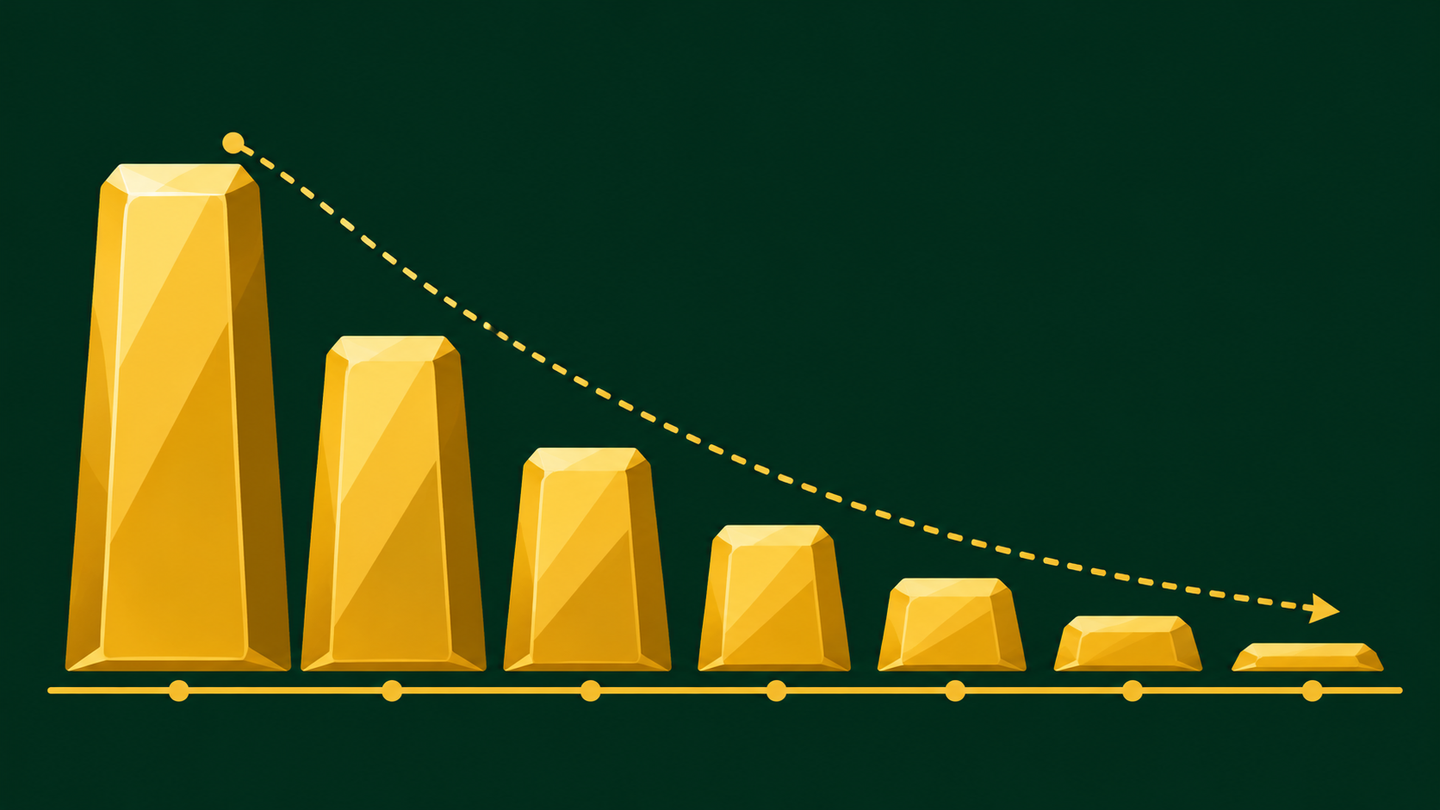
The result of 55 years of unconstrained money creation is quantifiable. A dollar in 1971 had 100 cents of purchasing power — it could buy 100 cents worth of goods and services. That same dollar today has the purchasing power of about 12 cents. It has lost roughly 88% of its value since the gold link was severed.
This is not a number invented by gold advocates. It is derived from the US government's own Consumer Price Index data — the official measure of inflation that the same government uses to set monetary policy. By that measure, prices have risen roughly eightfold since 1971. A dollar today buys about what 12 cents bought then.
The Dollar's Purchasing Power Decline Since 1971
100¢
Purchasing power of $1 in 1971 — the year dollar-gold convertibility ended
Baseline
~12¢
Purchasing power of that same $1 today — after 55 years of fiat currency
−88% lost
~8×
How much prices have risen since 1971 in nominal dollar terms (CPI-based)
Price inflation
Inflation Is Not Prices Going Up — It Is Money Going Down
The most important reframe in monetary literacy is this: inflation is not prices going up. Inflation is your money going down. Prices do not spontaneously become more expensive. What changes is the purchasing power of the unit you are measuring with. When more units are chasing the same goods, each unit buys less.
This distinction matters practically. If you frame inflation as "prices rising," the remedy seems to be wage increases and price controls. If you frame it correctly as "money losing purchasing power," the actual cause becomes visible: the increase in money supply that dilutes the value of every unit already in circulation. New money created by the government is effectively a hidden tax on everyone who holds the existing money.
The Hidden Wealth Transfer: Who Wins and Who Loses From Inflation
Inflation does not affect all people equally. It systematically transfers purchasing power from one group to another in ways that are rarely discussed in mainstream economic commentary.
The losers are savers and wage earners — people who hold cash in bank accounts and earn income denominated in the eroding currency. If you have ₹10 lakh in a savings account earning 3% interest and inflation is running at 6%, your real purchasing power is declining by 3% per year, every year, quietly and invisibly.
The winners are borrowers and asset owners — people who have taken on debt (whose real burden shrinks as the currency weakens) and people who own productive assets like real estate, equities, and gold. Their nominal values rise with inflation, increasing their apparent wealth even if their real purchasing power has not grown. The result is a steady transfer of wealth from the working and saving class to the asset-owning class — not through any individual decision or visible transaction, but through the slow mechanism of monetary debasement.
Who Wins and Who Loses From Inflation
Loses
Savers holding cash · Wage earners · Fixed-income pensioners · Anyone whose wealth is denominated in the weakening currency
Wins
Borrowers (real debt burden shrinks) · Asset owners — real estate, equities, commodities, gold · Anyone whose wealth is in hard assets
What Central Banks Are Actually Doing With Gold

For decades, the official position of central bankers and finance ministers in the developed world was consistent: gold was a "barbarous relic," an outdated holdover from a pre-modern monetary system, with no legitimate role in a sophisticated 21st-century financial architecture. This position was stated repeatedly in official communications, academic papers, and public speeches.
What those same institutions were doing in practice, particularly from 2022 onwards, is the direct opposite. Central banks collectively bought more than 1,000 tonnes of gold in each of 2022, 2023 and 2024, roughly double the pace of the previous decade, and kept buying in 2025. The gap between what central banks say about gold and what they are buying with it is one of the more instructive contradictions in contemporary finance.
Three Reasons Central Banks Are Buying Record Gold
Reason 1: De-Dollarisation
A growing number of countries — particularly in the emerging markets and BRICS bloc — are actively reducing their dependence on the US dollar as the world's reserve currency. Dollar reserves have declined as a share of global central bank holdings from over 70% in 2000 to under 60% today, and the decline is continuing.
Gold is the natural beneficiary of this shift. It has no foreign policy. It cannot be weaponised by another country. It cannot be printed by a rival government to inflate away its value. It is geopolitically neutral in a way that no national currency can be.
Reason 2: The Sanctions Risk — The Russia Lesson
In February 2022, following Russia's invasion of Ukraine, the US and Western allies froze approximately $300 billion of Russia's foreign currency reserves held primarily in US dollars and dollar-denominated assets. With a single policy decision, a sovereign nation's savings — accumulated over decades — became inaccessible.
Every central bank in the world drew the obvious conclusion: if it happened to Russia, it could happen to any country that takes an action the United States and its allies consider unacceptable. Dollar reserves held in Western financial institutions are vulnerable to sanctions in a way that physical gold stored domestically is not. Gold in your vault cannot be frozen by a click of a mouse in Washington or Brussels.
Reason 3: The US Debt Trajectory
The United States national debt has reached approximately $36 trillion as of 2025, growing at a pace of roughly $1 trillion every 100 days. Interest payments on that debt have become the largest single item in the US federal budget — exceeding defence spending. The trajectory is not sustainable by conventional analysis.
Central bankers can read a spreadsheet. They are not making public statements about dollar risk — doing so would be diplomatically explosive — but their allocation decisions tell the story clearly. Shifting reserves from dollar assets to physical gold is a hedge against a scenario in which the 54-year-old fiat experiment faces increasing instability.
Three Reasons Central Banks Are Buying Gold
De-Dollarisation
Reducing dependence on US dollar reserves — from 70%+ in 2000 to under 60% today and falling. Gold is geopolitically neutral.
Sanctions Hedge
$300B of Russian dollar reserves frozen in 2022. Physical gold stored domestically cannot be frozen, sanctioned or digitally seized by a foreign government.
Debt Trajectory
$36 trillion US national debt growing at ~$1 trillion every 100 days. Central banks are quietly hedging against long-term dollar instability through gold allocation.
Gold in a Portfolio: Instruments and Allocation Frameworks
Sovereign wealth funds, central banks, and family offices — the most sophisticated institutional pools of capital — typically hold between 5% and 15% of their assets in gold or gold-related instruments. Not 0%, which leaves the portfolio entirely exposed to currency debasement. Not 50% or 90%, which concentrates risk inappropriately. The 5–15% range reflects a portfolio insurance function: enough to provide meaningful protection during monetary stress, not so much that the portfolio sacrifices productive growth assets.
Gold exposure can be accessed through four distinct categories of instruments, each with different risk profiles and practical trade-offs.
Gold Exposure Instruments — Key Differences
Physical Gold
Coins and bars held directly. No counterparty risk — you hold the asset. No credit event can make it disappear. Trade-offs: storage costs, insurance, illiquidity for large positions. Best for core long-term holdings.
Gold ETFs
Funds such as GLD and IAU track gold prices without requiring storage. Low-cost, liquid, tradeable. Trade-off: you hold a financial claim on gold, not gold itself — counterparty risk from the issuing institution applies.
Mining Stocks
Equity in gold-producing companies — a leveraged play on the gold price. When gold rises, profitable miners typically rise more. When gold falls, miners can fall further. Adds company-specific operational and geopolitical risk.
Silver
Dual-role metal: monetary store of value and industrial input (electronics, solar panels, medical devices). Supply is declining. Gold-to-silver ratio near 62 — approximately historical average. Higher volatility than gold.
Physical gold is the most straightforward hedge against monetary debasement — you hold an asset that has preserved purchasing power for 5,000 years and cannot be created by any government. ETFs provide convenience and liquidity for investors who prioritise ease of trading over direct ownership. Mining stocks offer higher upside in strong gold markets but carry company-specific risks beyond the gold price itself.
Silver deserves specific attention for its dual industrial and monetary role. Unlike gold, silver is consumed by industrial processes — once used in solar panels or electronics, it is not easily recovered. COMEX inventories of physical silver have been declining significantly. This combination of monetary and industrial demand with shrinking physical supply creates a different dynamic than gold alone.
Gold in Rupees: What 19 Years of Real Prices Show
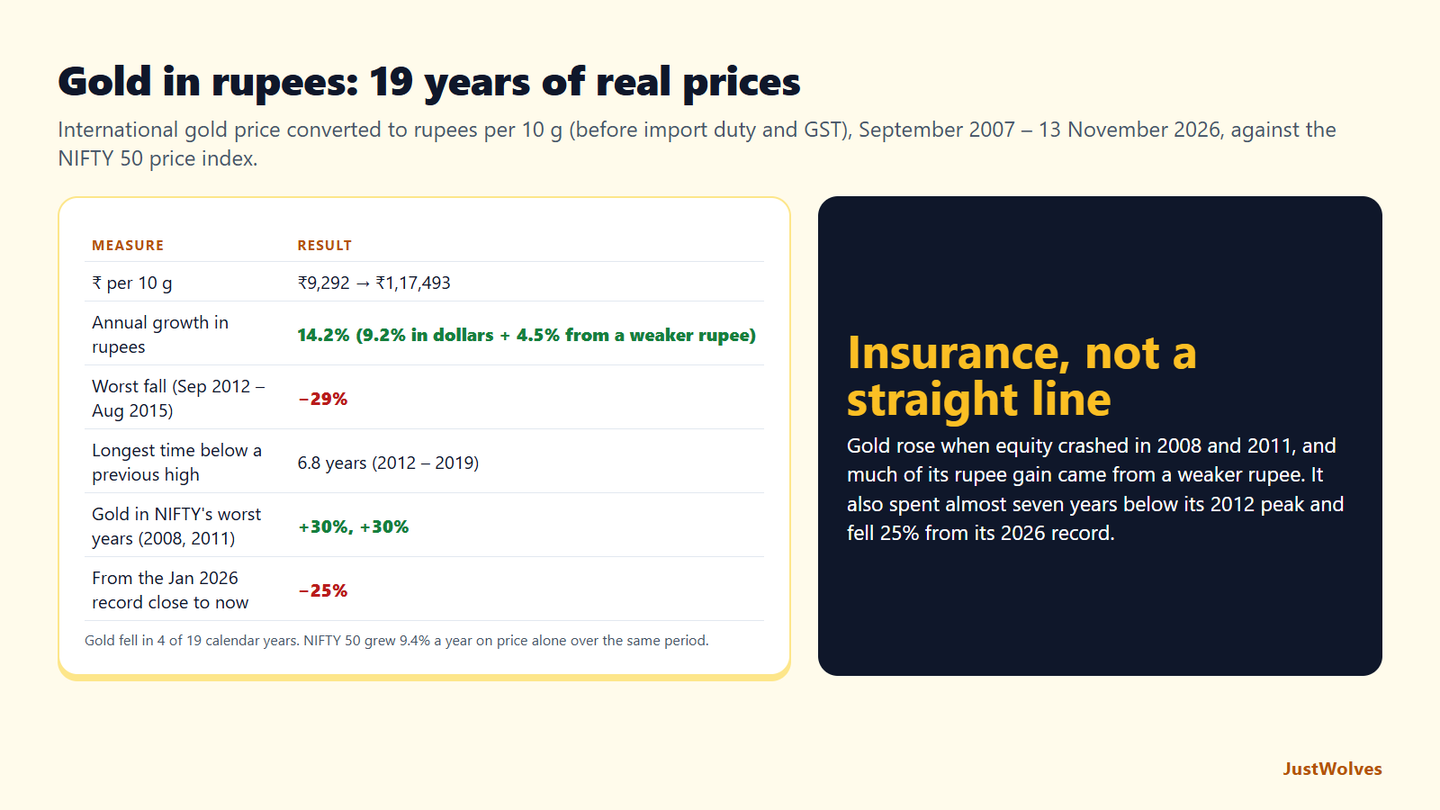
The history in this article is about the dollar. For an Indian saver, the useful question is what gold has done in rupees. JustWolves measured it on real prices from September 2007 to 13 November 2026: the international gold price converted to rupees per 10 g at each day's exchange rate. That excludes Indian import duty and GST, which have varied over the years, so the price you paid in India was higher, but the pattern is the same.
Real prices: gold in rupees per 10 g, yearly, 2008 – November 2026
Step 1 of 4
Insurance when it was needed
In 2008, as the NIFTY 50 fell 52%, gold in rupees rose 30%. In 2011, when the NIFTY 50 fell 25%, gold rose another 30%. By the end of 2011 it had nearly doubled from early 2008.
- What to observe
- Gold did its job in equity crashes.
- Condition
- That is the case for holding some.
| Measure | Result |
|---|---|
| Price per 10 g | ₹9,292 → ₹1,17,493 |
| Annual growth in rupees | 14.2% a year |
| …of which from the gold price in dollars | 9.2% a year |
| …of which from the rupee weakening (₹40.4 → ₹94.0 per dollar) | 4.5% a year |
| Worst fall | −29% (Sep 2012 – Aug 2015) |
| Longest time below a previous high | 6.8 years (Sep 2012 – Jun 2019) |
| Calendar years with a loss | 4 of 19 |
| In the NIFTY 50's worst years (2008, 2011) | +30% and +30% |
| From the record close of 29 Jan 2026 to 13 Nov 2026 | −25% |
Gold behaved like insurance in equity crashes. In 2008 and 2011, the NIFTY 50's two worst years, gold in rupees rose 30% each time. That is the strongest real-world case for the 5–15% allocation this article describes.
Much of the rupee return came from the rupee. Of gold's 14.2% a year in rupees, about 4.5 percentage points came from the rupee weakening against the dollar. For Indian savers, gold has been a hedge against both inflation and a falling currency.
It was never a straight line. Gold fell 29% from its 2012 peak and took almost seven years to recover it. And after a record close of $5,318 an ounce on 29 January 2026, it fell 25% in under ten months. A store of value is not the same as a smooth one, which is why this article warns against extreme allocations.
Common Mistakes About Gold and Money
Mistakes to Eliminate
- Thinking cash in a savings account is "safe": cash earning 2–3% interest while inflation runs at 5–6% is a guaranteed annual loss of purchasing power — slow, invisible, and compounding
- Treating gold as an investment that should generate returns: gold is a store of value, not a cash-flow generator — its job is to preserve purchasing power, not to grow it like a business or rental property
- Ignoring the 1971 structural change: the rules of money changed 55 years ago and most people were never told — understanding this context is foundational to any serious financial plan
- Confusing gold's nominal price rise with gold "going up": gold prices rising in dollar terms usually reflects the dollar going down, not gold becoming more valuable — the Roman centurion still earns one ounce per month
- Going to extremes: holding 0% gold leaves you entirely exposed to currency debasement; holding 90% gold sacrifices the productive growth potential of equities and other assets — institutional frameworks suggest 5–15%
- Holding ETFs and assuming it is the same as physical gold: an ETF is a financial claim that can be subject to counterparty failure, trading halts, or fund closure — physical possession is a fundamentally different risk profile
- Ignoring silver's dual role: silver is both a monetary metal and an industrial input consumed by the clean energy transition — declining physical inventories make it a distinct opportunity alongside gold
- Dismissing central bank gold buying as irrelevant: when the institutions that manage the global monetary system start accumulating record quantities of the asset they publicly called obsolete, the signal is worth understanding
Key Takeaways
Gold, Fiat Currency and the 1971 Monetary Shift
- Gold has 4 unique properties that made it humanity's universal money: non-corrosive, divisible, malleable, and — most critically — genuinely scarce. It cannot be printed.
- All gold ever mined in human history fits in about 4.5 Olympic swimming pools — for 8 billion people. This scarcity is the foundation of its monetary value.
- Gold is not an investment — it is money. It does not generate cash flow. It preserves purchasing power. A Roman centurion's monthly ounce-of-gold salary bought the same quality outfit as one ounce buys today.
- Before 1971, every dollar was a receipt for gold under the Bretton Woods system. The $35/oz peg anchored the entire global financial system to physical gold.
- The Nixon Shock of August 15, 1971, severed the dollar's gold link in a Sunday night TV announcement. The "temporary" suspension is 55 years old.
- Fiat currency — money backed by government promise alone — removes the constraint on money creation. The US broad money supply grew roughly 13 times from 1981 to 2021.
- US broad money grew about 40% in under two years during the COVID-19 response, and a burst of inflation followed.
- A 1971 dollar buys about what 12 cents bought then: a loss of roughly 88% of its purchasing power over 55 years, by official inflation data.
- Inflation transfers wealth from savers and wage earners to borrowers and asset owners — a systematic, invisible redistribution through monetary policy.
- Central banks bought more than 1,000 tonnes of gold a year in 2022, 2023 and 2024, about double the previous decade's pace, driven by de-dollarisation, sanctions risk, and the US debt trajectory.
- Institutional gold allocations typically range from 5–15% of a portfolio — financial insurance, not a speculation. 0% leaves you fully exposed; extreme concentration sacrifices productive assets.
- Physical gold, ETFs, mining stocks and silver each offer different risk profiles for gold exposure — understanding the differences matters as much as the allocation decision itself.
Frequently Asked Questions
Why did every civilisation choose gold as money instead of other metals?
Gold possesses a unique combination of four properties no other element shares in the same configuration: it is non-corrosive (survives centuries without degrading), divisible (can be cut into any size without losing properties), malleable (can be shaped into any form), and genuinely scarce (cannot be manufactured or synthesised). The most critical property is scarcity — the natural supply grows at only 1–2% per year, which prevents governments or institutions from creating more to fund spending. No other naturally occurring material combines all four properties in the same way.
What happened on August 15, 1971, and why does it still matter?
On that date, US President Nixon announced the suspension of dollar-to-gold convertibility — ending the Bretton Woods system under which every dollar was backed by physical gold at $35 per ounce. Before 1971, creating more dollars required acquiring more gold. After 1971, creating more dollars required only a political decision. The result over the following 55 years: the broad US money supply grew many times over, about 13-fold from 1981 to 2021 alone, and the 1971 dollar lost roughly 88% of its purchasing power. The date matters because it represents the structural change that explains the inflation, wealth inequality, and financial instability of the subsequent half-century.
If gold doesn't generate returns, why should anyone hold it?
Gold's function is not to generate returns — it is to preserve purchasing power. An investment generates cash flow (rent, earnings, interest). Gold does neither. What it does is serve as a monetary standard that has held its value across 5,000 years and every major civilisation. The Roman centurion's monthly ounce-of-gold salary bought the same quality of clothing 2,000 years ago as it buys today. The dollar from 1971 buys about 12% of what it bought then. Gold's role in a portfolio is insurance against monetary debasement — not a growth asset, but a preservation of real value.
Why are central banks buying record quantities of gold if they called it a "barbarous relic"?
Three documented reasons: (1) De-dollarisation — reducing dependence on US dollar reserves as geopolitical trust in the dollar as a neutral reserve currency declines; (2) Sanctions risk — after $300 billion of Russian dollar reserves were frozen in 2022, every central bank reassessed the vulnerability of holding reserves in another country's currency; (3) US debt trajectory — at $36 trillion and growing at approximately $1 trillion every 100 days, the sustainability of US fiscal policy is a legitimate concern for long-term reserve managers. Physical gold stored domestically cannot be sanctioned, frozen, or inflated away by a foreign government.
What is the difference between holding physical gold and a gold ETF?
Physical gold — coins or bars held directly — means you own the metal itself. There is no counterparty: no financial institution can fail, freeze, or close in a way that affects your gold. The trade-offs are storage costs, insurance requirements, and relative illiquidity for large positions. A gold ETF like GLD or IAU gives you price exposure to gold through a financial instrument. It is cheaper to hold and completely liquid. The trade-off is counterparty risk: you hold a claim on gold held by a financial institution, which introduces a layer of trust. In a normal financial environment the difference is minimal; in a financial crisis scenario, direct ownership and a financial claim have materially different risk profiles.
What percentage of a portfolio should be in gold?
This is a question for a qualified financial advisor with knowledge of your specific circumstances. As an educational reference point: sovereign wealth funds, family offices, and central bank reserve managers — the most sophisticated institutional allocators — typically hold between 5% and 15% of assets in gold or gold-equivalent instruments. This range reflects gold's role as portfolio insurance rather than a primary growth vehicle. Holding 0% provides no protection against currency debasement; concentrating heavily in gold sacrifices the compounding potential of productive assets like equities and real estate.
How has gold performed in rupees over the long term?
On real prices from September 2007 to November 2026, the international gold price in rupees rose from about ₹9,292 to ₹1,17,493 per 10 g, or 14.2% a year. About 4.5 percentage points a year came from the rupee weakening against the dollar. Gold also fell 29% between 2012 and 2015 and 25% from its January 2026 record.
Does gold protect a portfolio when stocks crash?
It did in India's worst recent equity years. In 2008, when the NIFTY 50 fell 52%, and in 2011, when it fell 25%, gold in rupees rose about 30% each year. It does not rise in every bad year: in 2015 and 2026 both fell.
Topics