How to Manage Your Money Like the Top 1%

JustWolves is an educational platform and is not a SEBI-registered investment advisor. Trading financial instruments involves significant risk of loss and may not be suitable for all investors. Past performance is not indicative of future results. Read our full disclaimer →
In this article · 15 sections
Here is the uncomfortable truth about wealth: the richest people in the world are overwhelmingly entrepreneurs, investors, and inheritors of assets — not salaried employees who earn the most. The variable that separates people who build wealth from those who merely earn well is ownership. If you do not own something that grows while you sleep — a business, an investment portfolio, a productive asset — you are working entirely for money rather than money working for you. The 25-15-50-10 rule is a complete money management system designed to change that. It tells you exactly how to split every rupee you earn between building wealth, protecting yourself, covering your real needs, and enjoying life — without guilt, without confusion, and without depending on a high income to get started.

Why Earning More Doesn't Make You Rich
Studies consistently show that a large proportion of high-earning professionals — people earning ₹15–₹30 lakh annually in India's major cities — live paycheck to paycheck. Their salaries are high. Their lifestyles are expensive. Their net worth is low. This is not a coincidence and not a character flaw. It is a structural problem: they earn well but own nothing that compounds.
The richest people in any economy share one characteristic — they own assets. Entrepreneurs own businesses. Investors own productive financial assets. Inheritors of wealth own trusts and property. The returns from owning assets — business profits, investment returns, rental income — have historically grown faster than wages. Every year you spend purely as a salary earner without building ownership in some asset, the wealth gap between you and asset owners widens.
The solution is not to stop being an employee. It is to simultaneously become an owner — of a growing investment portfolio, of real productive skills that command increasing income, and eventually of business assets if your goals extend that far. The 25-15-50-10 rule is the operating system that makes this transition achievable on any income level.
If you don't own something that grows, you are working entirely for money. The 25-15-50-10 rule is how you start owning things — regardless of what you currently earn.
Who Actually Builds Wealth: The Ownership Reality
Asset Owners
Entrepreneurs, investors, and property owners — returns compound independently of time spent working. Wealth scales without a ceiling.
Salary Earners
Income is tied directly to hours worked. No ownership compounding. Income stops when work stops. Wealth ceiling is limited by time available to work.
The 25-15-50-10 Rule: A Complete Overview

The 25-15-50-10 rule is a money allocation framework that divides every rupee of income into four purposeful buckets. It is not a budget in the traditional sense — it does not prescribe what you spend on groceries or how much your rent should cost. It sets the proportions that, when followed consistently, build wealth regardless of your income level.
The rule works at any income. On a ₹30,000 monthly salary or a ₹3 lakh monthly salary, the proportions remain the same. As your income grows, each bucket grows proportionally — meaning your wealth builds faster at higher incomes without requiring a change in the system. Consistency with the proportions matters more than the absolute amount.
The Four Buckets of the 25-15-50-10 Rule
25% — Growth
Money invested in assets that grow. Index funds, equity SIPs, gold, REITs, or productive skills. This is the bucket that builds long-term wealth.
₹15,000 on ₹60k salary
15% — Stability
Emergency fund and financial safety net. 5 months of core expenses in a liquid, zero-risk account. Prevents wealth destruction during life emergencies.
₹9,000 on ₹60k salary
50% — Essentials
Genuine needs only — housing, food, utilities, transport, healthcare. Not subscriptions you forgot about, not lifestyle upgrades. Needs vs wants discipline.
₹30,000 on ₹60k salary
10% — Rewards
Guilt-free spending on experiences and things that genuinely improve your life. Not optional — this bucket prevents burnout and makes the system sustainable long-term.
₹6,000 on ₹60k salary
The 25%: Put Your Money to Work
The 25% growth bucket is the most important part of the entire rule. This is the money that works while you sleep — growing in the background, compounding year after year, building the asset ownership that eventually gives you financial freedom. Every rupee in this bucket is being put to work independently of your time or effort.
Most people invert this logic: they pay all their expenses first and invest whatever is left. Whatever is left is usually nothing, or close to it. The 25% rule inverts the sequence — invest first, live on the rest. When investing is automatic and non-negotiable, it happens consistently. When it is left to willpower and whatever is remaining at the end of the month, it almost never happens consistently.
The Compound Growth Proof
To understand why starting early matters more than investing more, consider two investors — Arjun and Priya.
Arjun starts a ₹5,000/month SIP at age 22 and invests consistently until age 62 — a 40-year horizon. Total amount physically invested: ₹24 lakh. At a 12% CAGR, Arjun's corpus at age 62 is approximately ₹5.9 crore.
Priya starts at age 32 — 10 years later — but invests ₹7,000/month to compensate for the later start. She also invests until age 62 — a 30-year horizon. Total physically invested: ₹25.2 lakh (₹1.2 lakh more than Arjun). At the same 12% CAGR, Priya's corpus at age 62 is approximately ₹2.45 crore.
The Compound Growth Proof: Arjun vs Priya at 12% CAGR
₹5.9 Crore
Arjun — ₹5,000/month from age 22 to 62 (40 years). Total invested: ₹24 lakh. Started earlier, invested less per month.
+₹3.45 crore advantage
₹2.45 Crore
Priya — ₹7,000/month from age 32 to 62 (30 years). Total invested: ₹25.2 lakh. Invested ₹1.2 lakh more — but 10 years later.
Started 10 yrs late
Arjun invested ₹1.2 lakh less and ended with ₹3.45 crore more. The entire difference was created by 10 additional years of compounding. This is not theory — it is straightforward compound interest mathematics applied over realistic horizons. The most expensive financial mistake most people make is waiting until they earn "enough" to start investing. There is no such threshold. Start with whatever you can afford today.
Real Prices: Ten Years of the 25% Bucket
The examples in this article assume a steady 12% a year. Real markets do not move steadily. The chart below follows a real ₹10,000 monthly SIP in the NIFTY 50 from November 2016 to November 2026, including the 2020 crash, when the whole investment was briefly worth less than what had been put in.
Real prices: ten years of a ₹10,000 monthly growth bucket in the NIFTY 50, 2016–2026
Step 1 of 4
The habit starts
In November 2016 a salaried investor starts putting ₹10,000 a month, the 25% growth bucket of a ₹40,000 take-home, into the NIFTY 50. By the end of 2019 the index is at 12,168 against an average cost of about 10,350.
- What to observe
- The line is the SIP's average cost per unit.
- Condition
- Automate it and leave it alone.
What to Invest In: The Growth Asset Spectrum
Not all growth assets carry the same risk or reward. Think of them on a spectrum: lower risk, steadier returns at one end; higher risk, potentially higher returns at the other. Beginners should always start from the lower-risk end and move toward higher risk only with knowledge, experience, and a financial safety net firmly in place.
The Growth Asset Spectrum — Low to High Risk
Index Funds
Lowest-effort, market-matching returns. Nifty 50/500 direct-plan SIP. 0.1–0.2% expense ratio. No research. Ideal starting point for all investors.
Low risk
Gold (ETF/fund)
Store of value and portfolio hedge. Gold ETFs and gold funds track the gold price; existing SGBs still pay 2.5% interest, but no new SGBs have been issued since February 2024. 10–15% portfolio allocation.
Low-Medium risk
High-Income Skills
Learning a skill that directly increases earning power — data analysis, coding, copywriting, financial modelling. Fastest ROI of any investment when applied.
Medium (time cost)
Equity MF (Active)
Professionally managed mid-cap, flexi-cap or small-cap funds. Potential to beat the benchmark. Higher expense ratio, fund manager risk. For experienced investors.
Medium-High risk
REITs
Listed real estate investment trusts (Embassy, Mindspace, Nexus). Dividend income + property appreciation. Equity-level liquidity. From ₹300–400/unit.
Medium risk
Alternatives
Cryptocurrency, P2P lending, invoice discounting, angel investing. Extremely high risk and complexity. Only for investors with all other bases fully covered.
Very High risk
For the 25% growth bucket, the practical starting allocation for most salaried investors in India is: a Nifty 500 direct index fund SIP as the core holding (60–70% of the growth bucket), a gold ETF or gold fund as a hedge (10–15%), and the remainder directed toward an ELSS fund for tax saving if on the old regime. This three-instrument structure gives diversification, low cost, tax efficiency, and market-beating long-term return potential without complexity.
Tax-Advantaged Accounts in India
Tax-advantaged investment vehicles reduce the effective cost of investing by either deferring or eliminating tax on returns. Used correctly, they meaningfully increase your final corpus. India has several such instruments — choosing the right ones depends on your tax regime and investment horizon.
Indian Tax-Advantaged Investment Options
ELSS
Section 80C deduction up to ₹1.5L (old regime). 3-year lock-in per SIP instalment. Equity returns + immediate tax saving. Best 80C option for long-term investors.
80C: up to ₹45k saving
PPF
Public Provident Fund. EEE status (Exempt-Exempt-Exempt). 7.1% current rate, sovereign guarantee. 15-year lock-in. Best for risk-averse long-term savers.
Fully tax-free
NPS
National Pension System. Additional ₹50,000 deduction under 80CCD(1B) over and above ₹1.5L 80C limit. Partial equity exposure. Lock-in until age 60.
Extra ₹50k deduction
SGB
Sovereign Gold Bond. No new issues since February 2024. Bonds bought at the original issue and held to redemption: no capital gains tax; 2.5% annual interest (taxable). Bonds bought on the exchange are taxable on redemption.
Zero LTCG on maturity
ULIPs
Unit Linked Insurance Plans. Combine insurance and investment but carry high charges (1.35–2.25%) for the first 5 years. Generally inferior to term plan + mutual fund.
Usually avoid
How to Start Investing Practically
Knowing what to invest in and actually starting are two different challenges. The biggest barrier for most people is not lack of knowledge — it is the friction of getting started and automating the habit so it continues without willpower.
Setting Up Your 25% Growth Investment System
Step 1: Open a direct-plan investment account
Use the registrars' joint investor portal (free, covers all fund houses), a direct-plan investing platform, or the fund house's own website. Complete your one-time KYC using Aadhaar and PAN on a KYC registration agency or registrar website if not already done. Always select "Direct Plan" — not regular — to avoid paying distributor commission embedded in the expense ratio.
Tip: Direct vs Regular plan: the only difference is the expense ratio. The direct plan of the same fund is always 0.5–1% cheaper per year, which compounds into lakhs of rupees over a 20-year horizon.
Step 2: Build a simple three-fund portfolio
For the growth bucket, start with three instruments: (1) A Nifty 500 direct index fund SIP as the core — captures 500 companies at 0.1–0.2% expense ratio. (2) A gold ETF or gold fund for 10–15% of the growth bucket — provides portfolio hedge and long-term store of value. (3) An ELSS SIP for Section 80C tax saving if on the old regime. Three instruments, fully diversified, extremely low cost.
Tip: Avoid spreading across 8–10 funds. Over-diversification with small amounts creates complexity without added protection. Three well-chosen instruments provide better risk-adjusted returns than ten mediocre ones.
Step 3: Automate the 25% on payday
Set up an auto-debit or bank standing instruction that transfers your 25% growth allocation on the same day your salary is credited — or the next business day. The SIP debit should be scheduled for 2–3 days after salary credit. When investing is automatic, it is non-negotiable. When it is manual, life always finds a reason to skip it.
Step 4: Activate a 10% annual Step-Up SIP
All major SIP platforms offer a step-up feature that automatically increases your monthly SIP by a fixed percentage each year. Set it to 10%. A ₹3,000/month SIP with a 10% annual step-up becomes ₹7,776/month in 10 years — without any manual action. This aligns investment growth with salary increments and dramatically accelerates long-term corpus accumulation.
Tip: A ₹3,000/month SIP with 10% annual step-up at 12% CAGR over 25 years produces approximately ₹2.8 crore. The same SIP without the step-up produces approximately ₹90 lakh. The step-up feature alone creates over ₹1.9 crore of additional wealth.
Step 5: Do not watch it daily — review once per year
Set one annual review date. Check: expense ratio unchanged? Fund manager continuity confirmed? 3-year rolling performance on track? If all fine, make no changes. The compounding J-curve requires patience. Investors who check daily and adjust frequently consistently underperform those who automate and review annually. Your portfolio growing slowly is not a problem — it is the process.
The 15%: Your Financial Safety Net
The 15% stability bucket is the part of the rule most people either skip entirely or underestimate. This money does not grow your wealth directly — it protects the wealth you are building from being destroyed by life's inevitable emergencies.
Without a stability fund, a single unexpected event — a job loss, a hospitalisation, a major home repair, a family emergency — forces you to do one of three things: take a personal loan at 18–24% interest, redeem your equity investments at whatever the current market price is (which may be a bear market low), or drain your credit cards. All three are wealth-destroying outcomes that wipe out months or years of careful investment growth.
The goal of the 15% bucket is to build a stability fund equal to five months of your core monthly expenses. Once built, this fund sits in a liquid, accessible, zero-risk account — not invested in equity, not in a long-term FD, not in any instrument with a lock-in or market exposure. It simply waits, earning a modest return, ready to absorb any shock without touching your investment portfolio.
How to Calculate and Build Your Stability Fund
Calculating your target stability fund requires one step: identify your monthly baseline — the total of your core unavoidable expenses. This includes rent or home loan EMI, groceries and household essentials, utility bills, transport, health insurance premiums, and any other genuinely non-negotiable monthly cost. Exclude all discretionary spending — subscriptions, dining out, entertainment, clothing. Multiply your monthly baseline by five.
Stability Fund Calculation — Example at ₹60,000 Monthly Salary
₹25,000
Estimated monthly baseline (rent ₹12k + groceries ₹5k + utilities ₹2k + transport ₹3k + insurance ₹3k).
Monthly baseline
× 5
Five months of baseline is the target stability fund — enough to handle job loss, medical emergency, or major unexpected cost.
Multiplier
₹1.25L
Target stability fund for this example. Set aside from 15% of monthly salary (₹9,000/month) — fully built in approximately 14 months.
~14 months to build
Three Rules for Where to Keep Your Stability Fund
Step 1: Rule 1 — It must be instantly accessible
The stability fund must be reachable within 24 hours, no exceptions. Do not lock it in a 1-year FD that charges an early withdrawal penalty. Do not put it in a 3-month notice savings account. Do not invest it in a debt mutual fund with a 3-day redemption cycle if you might need it on the same day. High-yield savings accounts (offered by many online banks) and liquid mutual funds (T+1 redemption) are the correct vehicles.
Tip: Many scheduled banks now offer savings accounts with interest rates of 4–7% — significantly above the 3–4% of traditional savings accounts. Check offerings from IDFC First Bank, RBL Bank, and AU Small Finance Bank for current rates.
Step 2: Rule 2 — It must carry zero market risk
This is not negotiable. Your stability fund must never be exposed to equity, commodity, or any market-linked risk. When an emergency arrives, the market may be in a correction. You need the full amount available at that exact moment, not a depleted amount because your "safe investment" fell 15% last month. Liquid mutual funds investing only in government securities and overnight instruments are the highest-quality option for slightly better returns with near-zero risk.
Step 3: Rule 3 — It must still earn something
Keeping your stability fund in a zero-interest account means inflation silently reduces its real value every year. A 4–6% high-yield savings account or liquid mutual fund means your stability fund keeps pace with or slightly beats inflation while waiting. This is not about maximising returns — it is about not losing purchasing power unnecessarily while maintaining full liquidity and zero risk.
Tip: Liquid mutual funds in direct plans currently yield approximately 6.5–7% — higher than most savings accounts and without any lock-in. Redemption proceeds arrive in your bank account within one business day.
Build the stability fund systematically: once the 25% growth bucket is automated, direct the full 15% of your monthly salary into your high-yield savings or liquid fund account until the five-month target is reached. Once fully funded, two options present themselves: redirect the 15% into additional investments (effectively raising your growth allocation to 40%), or maintain a smaller ongoing contribution to the stability fund to account for lifestyle cost increases over time. Either approach is valid.
The 50%: Essentials — Needs, Not Your Ego

The 50% essentials bucket is the one most people find both the most obvious and the most difficult to implement. It is obvious because everyone agrees that rent, groceries, and utilities are essential. It is difficult because the boundary between "essential" and "lifestyle" has been systematically blurred by marketing, social media, and social comparison.
Essential spending covers what keeps you alive, healthy, housed, and functionally employed: rent or home loan EMI, groceries and household supplies, utility bills (electricity, water, gas, internet), basic transport to work, health insurance, and clothing that is genuinely needed. Everything else is either discretionary or lifestyle spending — and it belongs in the 10% rewards bucket, if it fits.
The uncomfortable reality for most urban Indians earning between ₹8–₹25 lakh: they are spending 65–80% of income on what they classify as "essentials." That classification includes a new car on EMI every 4 years, streaming services multiplying to 6 platforms, dining out 3–4 times per week, and a housing upgrade driven by wanting a better address rather than a genuine space need. None of these are essentials. They are lifestyle choices that masquerade as necessities when you are not paying attention.
Shrink Your Two Biggest Expenses
In most Indian urban households, housing and transport together account for 40–60% of monthly spending. Reducing these two categories by even 10–15% creates more financial room than eliminating every small expense combined. Attack the big items first.
Housing — Your Most Negotiable Large Cost
Rent is not a fixed price. Landlords in most Indian cities would rather retain a reliable tenant at a slightly lower rate than go through the process of finding a new one — which involves weeks of vacancy, listing fees, agent commissions, and uncertainty. When your lease comes up for renewal, negotiate. Request a freeze for one year or a modest reduction. In many cases, this works.
For those at the beginning of a career or actively building their stability fund: house-sharing, co-living spaces, or choosing a slightly farther location with better transport links are all valid ways to reduce housing costs without long-term consequences. Every ₹3,000/month saved on rent, invested in your 25% SIP at 12% CAGR, becomes approximately ₹1 crore over 25 years. The decision of where to live is a multi-crore financial decision.
Transport — The EMI Trap That Destroys Wealth
A new car on EMI is one of the most effective wealth-destruction mechanisms available to an Indian professional. A ₹10 lakh car financed at 9% over 5 years costs approximately ₹12.5 lakh in total payments — and the car is worth ₹4–5 lakh by the end of the loan. The ₹8.5 lakh net cost could have been a ₹10 lakh SIP lump sum that grows to ₹33 lakh over 15 years.
The correct approach to personal transport is to buy the most reliable used car that fits your actual needs — not the newest one that fits your aspirational identity — and to pay cash or use only short-term, low-cost financing. In walkable areas or cities with good metro coverage (Mumbai, Delhi, Bengaluru, Chennai, Hyderabad), eliminating a personal car entirely is a serious financial decision worth evaluating. The savings compound dramatically.
The Purchase Decision Framework — Use Systems, Not Willpower
Step 1: Is this an impulse purchase?
If you thought of this purchase in the last 48 hours and did not have it on a planned list: it is an impulse purchase. Do not buy it now. Apply the 7-day rule — wait 7 days and ask the question again. If you still want it after 7 days, proceed to the next question. Most impulse purchases are forgotten within 48–72 hours, which tells you they were not genuine needs.
Tip: Keep a "deferred purchases" note on your phone. When you feel the urge to buy something, add it to the list with the date. Review the list weekly. You will find that 60–70% of items on the list no longer feel important after a week.
Step 2: Are you buying for the brand or the value?
Wealthy people do not pay for brands. They pay for value. If an unbranded or lesser-known product does the same job as the branded version — buy the unbranded version. The brand premium is a marketing cost you are choosing to pay with no functional benefit. The exception is genuine quality: a ₹6,000 pair of shoes worn 200 times is better value than a ₹600 pair worn 10 times. Chase quality, not logos.
Step 3: Will this genuinely improve your life?
A conscious, deliberate answer of "yes" — this purchase will meaningfully improve my health, productivity, relationships, or quality of life — is the green light to proceed. If the honest answer is "no, but I want it" — that is the rewards bucket speaking, not the essentials bucket. Move the purchase to your 10% reward allocation and buy it guilt-free when that budget has room. Do not raid the essentials budget for desires.
The 10%: Guilt-Free Rewards
The 10% rewards bucket is not a concession to weakness. It is a strategic requirement. People who eliminate all discretionary spending as part of a financial discipline regime overcompensate within 2–3 months — the suppressed desire for enjoyment surfaces as a burst of spending that wipes out weeks of careful saving.
The 10% rewards budget solves this: it creates a ring-fenced, pre-authorised space for enjoyment. When you spend from this bucket, there is no guilt because the money was planned for this purpose. The discipline budget (75%) is untouched. Your wealth is still building. You are enjoying the present while securing the future — which is the actual goal of money management.
The most valuable categories for rewards spending are experiences over things. A weekend trip, a concert, a cooking class, a sport or hobby — these create memories, new skills, and genuine quality of life improvements that outlast the experience. By contrast, physical products purchased for enjoyment typically deliver a short dopamine spike and then become background clutter. Invest your 10% in experiences and genuine quality-of-life improvements, not objects.
High-Value vs Low-Value Reward Spending
High-Value Rewards
Experiences: travel, dining with people you care about, concerts, learning a new skill, sport, hobby equipment used regularly. Creates lasting memory and genuine quality of life.
Low-Value Rewards
Impulse objects: fast fashion, gadgets used twice, home décor that fills space, subscriptions that gather digital dust. Temporary dopamine hit with no lasting value.
What the 25% Bucket Earned on Real Prices: Our Test
To check the 12% assumption used in this article, JustWolves ran a ₹10,000 monthly SIP on real NIFTY 50 prices from three different start dates, each ending on 13 November 2026, with each instalment bought on the first trading day of the month. We used the price index, which excludes dividends (roughly 1–1.5% a year more) and fund costs.
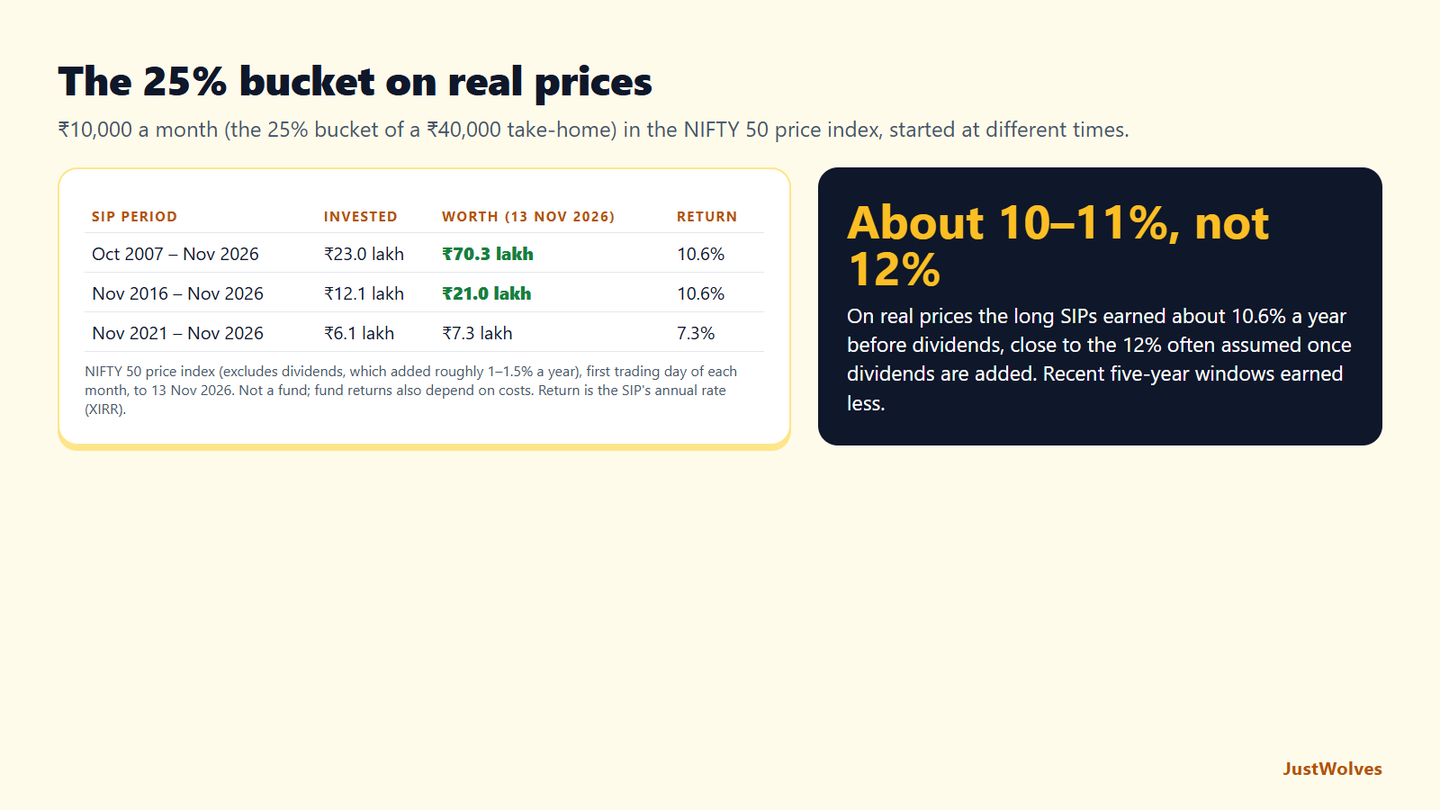
| SIP period | Invested | Worth on 13 Nov 2026 | Annual return |
|---|---|---|---|
| Oct 2007 – Nov 2026 (19 years) | ₹23.0 lakh | ₹70.3 lakh | 10.6% |
| Nov 2016 – Nov 2026 (10 years) | ₹12.1 lakh | ₹21.0 lakh | 10.6% |
| Nov 2021 – Nov 2026 (5 years) | ₹6.1 lakh | ₹7.3 lakh | 7.3% |
The long-run assumption is close, not exact. Over ten and nineteen years, the real SIPs earned 10.6% a year on prices alone. Adding dividends brings that close to the 12% used in this article's examples, before the small costs of an index fund. So the Arjun and Priya comparison is reasonable as an illustration, not a promise.
Short windows vary a lot. The five-year SIP that began in November 2021 earned only 7.3% a year, because it bought through the 2024 peak and the 2026 fall. That is exactly why the 15% stability bucket exists: it keeps the 25% bucket invested through years like these instead of being raided.
Starting early mattered more than starting well. The SIP begun in October 2007, just before the 2008 crash, still turned ₹23 lakh into ₹70.3 lakh. The time in the market did the heavy lifting.
The 25-15-50-10 Rule in Practice
To make the rule concrete, here is how it applies to a ₹60,000 take-home monthly salary — a figure representative of a mid-career professional in an Indian tier-1 city:
25-15-50-10 Applied to ₹60,000 Monthly Take-Home
₹15,000
25% Growth — Automated SIP: ₹10,000 Nifty 500 index fund (direct), ₹3,000 ELSS SIP (old regime), ₹2,000 Gold ETF SIP. Invested on payday via auto-debit.
Invested first
₹9,000
15% Stability — Transferred to high-yield savings or liquid fund on payday until 5-month target of ₹1.25 lakh is reached. Then redirected to growth.
Saved second
₹30,000
50% Essentials — Rent ₹12,000, groceries ₹6,000, utilities + internet ₹3,000, transport ₹4,000, health insurance ₹2,000, other genuine needs ₹3,000.
Spent third
₹6,000
10% Rewards — Guilt-free spending on dining, experiences, entertainment, or anything that genuinely makes life more enjoyable. Zero guilt, no accounting.
Enjoyed last
How Your Financial Life Changes Year by Year with the Rule
Foundation Built
Stability fund reaches its target (₹1.25 lakh in this example). Emergency financial anxiety disappears. Investment habit is automated and running without willpower. You feel calmer about money than you did earning the same salary before the rule.
Growth Accelerates
The stability fund is complete. The 15% bucket redirects into investments — your effective growth allocation rises to 40%. Step-up SIPs are increasing your monthly investment automatically with each passing year. Your portfolio value may already exceed your annual salary.
Compounding Becomes Visible
Investment returns in good years now add a meaningful amount to your portfolio independently of your new SIP contributions. The J-curve is beginning. You see the portfolio growing at a pace that is noticeably faster than what you are putting in. This is the compounding effect becoming tangible.
Financial Optionality Emerges
Your investment portfolio has grown to a size where the returns — even in conservative years — are meaningful relative to your salary. You could take a pay cut for a more purposeful job, take a career break, or reduce working hours — without financial crisis. This is the optionality that asset ownership creates. It is not retirement. It is freedom.
Financial Independence
With consistent application of the rule, a ₹60,000/month salaried professional investing ₹15,000/month with a 10% annual step-up at 12% CAGR accumulates approximately ₹8–₹10 crore over 25 years. At a safe withdrawal rate of 4% annually, this corpus generates ₹32–₹40 lakh per year — without touching the principal. Work becomes optional.
Key Takeaways
The 25-15-50-10 Money Management Rule — Everything That Matters
- Wealth is built through ownership, not earning. People who own assets that compound independently of their time — investment portfolios, businesses, productive skills — build wealth. People who only earn salaries do not
- The 25-15-50-10 rule: invest 25% for growth, save 15% for stability, live on 50% for essentials, reward yourself with 10%. Apply from every month's take-home salary, in that order
- Pay yourself first — move the 25% and 15% on payday automatically before any spending. When it is automatic, it is non-negotiable. When it is manual, life always finds a way to skip it
- Starting early matters more than investing more: Arjun investing ₹5,000/month from age 22 ends with ₹5.9 crore. Priya investing ₹7,000/month from age 32 ends with ₹2.45 crore. Arjun invested ₹1.2 lakh less and ended with ₹3.45 crore more — because of 10 extra years of compounding
- For the growth bucket: start with a Nifty 500 direct-plan index fund SIP + gold ETF or gold fund + ELSS (old regime). Three instruments, diversified, low cost, tax efficient
- The stability fund target = 5 months of your core monthly expenses, held in a high-yield savings account or liquid direct mutual fund. This fund must be instantly accessible, carry zero market risk, and earn at least 4–6% to stay ahead of inflation
- Never invest your stability fund in equity or any market-linked instrument — when emergencies arrive, the market may be down. You need 100 cents on the rupee, immediately
- The 50% essentials cap is deliberately tight. It forces the distinction between genuine needs and lifestyle inflation. Every rupee saved from essentials compounds — housing and transport are the two highest-impact categories to address first
- The car EMI trap: a ₹10 lakh new car financed at 9% over 5 years costs ₹12.5 lakh total, depreciating to ₹4–5 lakh. The same ₹10 lakh invested as a lump sum at 12% CAGR becomes ₹33 lakh over 15 years
- The 10% rewards budget is not a concession — it is a strategic requirement. Pre-authorised guilt-free spending prevents the overcompensation binge that destroys months of saving discipline
- The purchase decision framework: is it an impulse buy? (7-day wait rule) → brand or value? → will it genuinely improve your life? Run every non-essential purchase through these three questions
- At ₹60,000/month with the rule applied consistently: approximately ₹8–₹10 crore accumulated over 25 years. At 4% safe withdrawal rate: ₹32–₹40 lakh per year in passive income — financial independence from a median professional salary
Frequently Asked Questions
What if I cannot save 25% — is a lower percentage worth it?
Yes — absolutely. The 25-15-50-10 proportions are targets, not prerequisites. If your current fixed expenses genuinely consume more than 75% of your income, start with whatever you can: 10% to growth, 5% to stability, adjust over time as income grows. The most important principle is to start something, automate it, and increase it with every salary increment. Waiting until you can "afford" the full 25% is the same as waiting indefinitely.
Is the 25-15-50-10 rule better than the 50-30-20 rule?
The 50-30-20 rule allocates 50% to needs, 30% to wants, and 20% to savings. The 25-15-50-10 rule is more specific and more aggressive on wealth-building. The critical difference is the distinction between growth investing (25%) and emergency saving (15%) — the 20% savings bucket in the 50-30-20 rule blends these, which often means the emergency fund never gets fully funded and investment happens inconsistently. Separating the two buckets with explicit allocations produces better outcomes.
Where should I keep my stability fund in India?
High-yield savings accounts from banks like IDFC First Bank, AU Small Finance Bank, or RBL Bank offer 5–7% on savings balances with full liquidity. Alternatively, liquid mutual funds in direct plans (SBI Liquid, Nippon Liquid, HDFC Liquid) currently yield 6.5–7% with T+1 redemption — your money arrives the next business day. Both are appropriate. Avoid locking the stability fund in FDs with premature withdrawal penalties, and never put it in equity or any market-linked instrument.
My rent is 40% of my take-home salary. How can I keep essentials at 50%?
If rent alone is 40% of take-home, you have ₹10 of every ₹100 left for all other essentials — which is unsustainable. The options are: negotiate the rent at renewal, find a roommate or house-sharing arrangement, or move to a slightly farther location with lower rental costs. Housing at 40% of take-home is also worth evaluating against buying — at certain price-to-rent ratios and with a sufficient down payment, an EMI may be lower than rent for the same quality accommodation. This is a high-priority problem to solve because it structurally prevents wealth building.
How do I handle irregular income with the 25-15-50-10 rule?
Apply the rule to every income receipt, not just salary. When a freelance payment, annual bonus, or commission arrives, immediately apply the same proportions: 25% invested, 15% to stability fund (if not yet complete), 50% to expenses, 10% for rewards. The proportions do not change with income irregularity. What changes is the timing — you may receive large amounts infrequently rather than monthly amounts consistently. Automate what you can as fixed SIPs and treat irregular income as lump sum top-ups to each bucket.
What if I have existing debt (personal loan, credit card balance)?
High-interest debt (credit card balance at 36–42% annually, personal loans at 12–18%) must be prioritised over the growth bucket because no investment consistently returns 36–42%. Redirect the 25% growth bucket to aggressive debt repayment until high-interest debt is eliminated. Once cleared, switch to the rule as described. The stability fund (15%) should still be built simultaneously — without a safety net, new emergencies will create new debt immediately. For low-interest debt such as a home loan at 8.5–9%, the standard 25% growth allocation can coexist with the EMI, which sits in the 50% essentials bucket.
Is 12% a realistic return for an equity SIP in India?
As a long-run planning number it is close. On real NIFTY 50 prices, ₹10,000 monthly SIPs over 10 and 19 years to November 2026 earned about 10.6% a year on prices alone, and dividends added roughly 1–1.5% a year. Shorter periods varied widely: the five years to November 2026 earned 7.3%.
Topics