India's New Income Tax Rules 2026: Everything That Has Changed

JustWolves is an educational platform and is not a SEBI-registered investment advisor. Trading financial instruments involves significant risk of loss and may not be suitable for all investors. Past performance is not indicative of future results. Read our full disclaimer →

In this article · 18 sections
The Income Tax Act 1961 served India for 65 years. From 1st April 2026, it has been replaced by a new law — simpler in structure, smarter in enforcement, and more generous to salaried individuals. But it is also tougher on traders, social media flexers, and those with undisclosed foreign assets. If you are still operating on old rules, this is your wake-up call.

The Death of the 1961 Act
The Income Tax Act 1961 had grown to hundreds of sections, many of them lettered additions such as 80C or 115BAC. Even experienced chartered accountants struggled with its complexity. The new law condenses everything into 536 sections — a meaningful step toward clarity. Simpler language means fewer disputes, fewer court cases, and easier compliance.
The restructuring also eliminates the longstanding "previous year vs assessment year" confusion that tripped up millions of filers every year.
The Tax Year Concept: No More AY vs FY Confusion
Under the old system, you earned income in one year — the "previous year" — and paid tax on it the next year, called the "assessment year." From 1st April 2026, this is replaced by a single concept: the Tax Year. Income earned from 1st April 2026 to 31st March 2027 is simply Tax Year 2026–27. The year you earn and the year you file are the same.
New Tax Slabs 2026–27

The new tax regime is now the default. If you do not actively choose the old regime while filing, you are automatically placed in the new regime. The government's intent is clear: the old regime is being phased out gradually.
New Regime Tax Slabs, Tax Year 2026–27
0%
Up to ₹4 lakh
5%
₹4 lakh – ₹8 lakh
10%
₹8 lakh – ₹12 lakh
15%
₹12 lakh – ₹16 lakh
20%
₹16 lakh – ₹20 lakh
25%
₹20 lakh – ₹24 lakh
30%
Above ₹24 lakh
Zero Tax Up to ₹12.75 Lakh: How It Works
The confusion between ₹12 lakh and ₹12.75 lakh resolved: for a salaried employee, gross salary of ₹12.75 lakh minus the ₹75,000 standard deduction leaves taxable income of exactly ₹12 lakh. Under Section 87A, taxable income up to ₹12 lakh qualifies for a ₹60,000 rebate — which offsets the full tax liability. Net tax payable: zero.
Worked Examples: What You Pay Under the New Regime
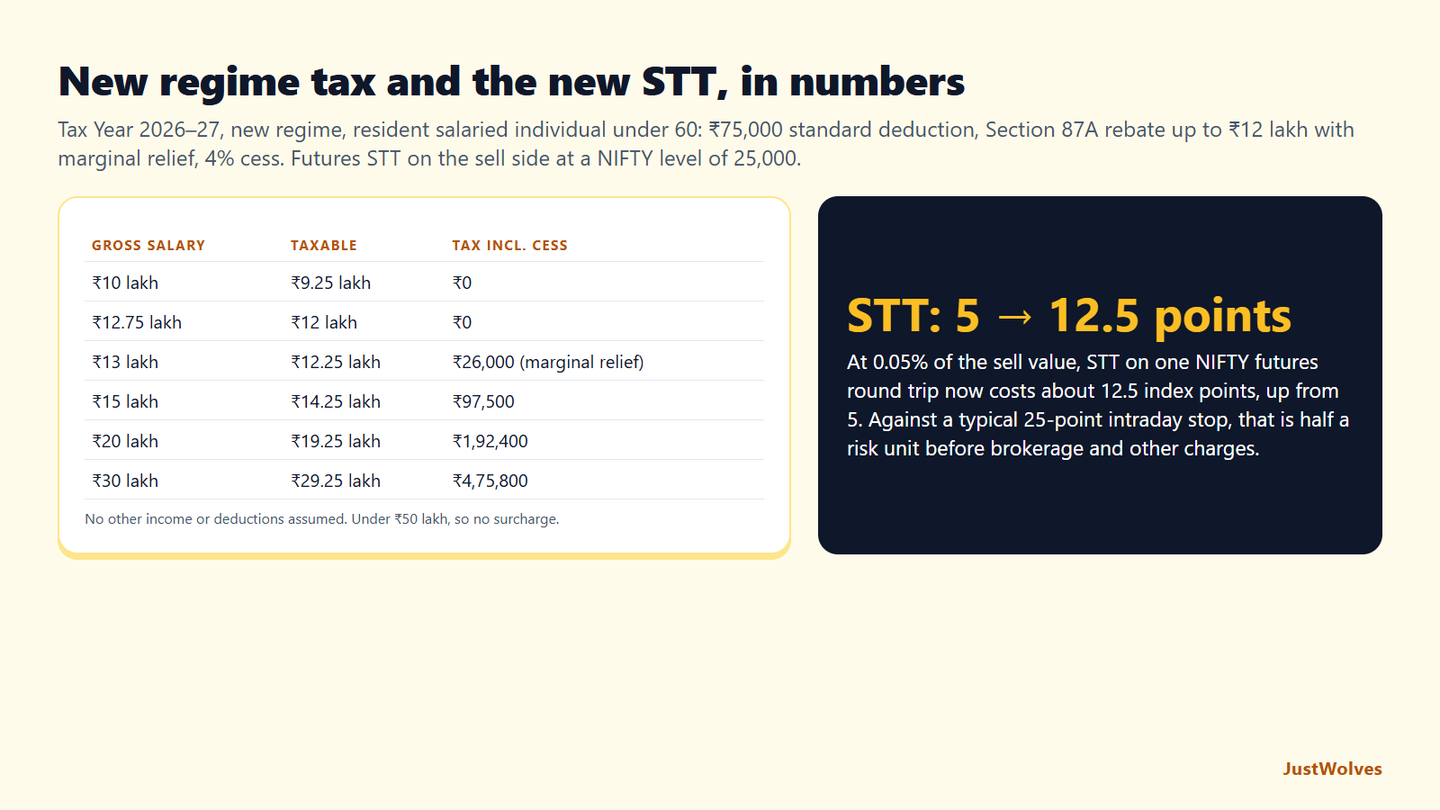
Here is the tax under the new regime for a resident salaried individual under 60 with no other income, after the ₹75,000 standard deduction, the Section 87A rebate, marginal relief and the 4% health and education cess. Incomes under ₹50 lakh pay no surcharge.
| Gross salary | Taxable income | Tax before rebate | Tax payable incl. cess |
|---|---|---|---|
| ₹10,00,000 | ₹9,25,000 | ₹32,500 | ₹0 (rebate) |
| ₹12,75,000 | ₹12,00,000 | ₹60,000 | ₹0 (rebate) |
| ₹13,00,000 | ₹12,25,000 | ₹63,750 | ₹26,000 (marginal relief) |
| ₹15,00,000 | ₹14,25,000 | ₹93,750 | ₹97,500 |
| ₹20,00,000 | ₹19,25,000 | ₹1,85,000 | ₹1,92,400 |
| ₹25,00,000 | ₹24,25,000 | ₹3,07,500 | ₹3,19,800 |
| ₹30,00,000 | ₹29,25,000 | ₹4,57,500 | ₹4,75,800 |
The ₹13 lakh row shows marginal relief at work. Taxable income of ₹12.25 lakh would attract ₹63,750 of slab tax, but marginal relief limits the tax to the ₹25,000 by which income exceeds ₹12 lakh. Without it, a ₹25,000 raise would cost ₹66,300 in tax: more than the raise itself.
Above the relief zone, the slabs work normally. At ₹15 lakh of salary the effective rate is 6.5%; at ₹30 lakh it is about 15.9%. If you have deductions available only in the old regime, such as HRA, home-loan interest or 80C investments, compare both regimes before you choose: the old regime can still win for some taxpayers with large deductions.
Senior Citizen Benefits
From the 2025–26 financial year, banks and post offices deduct TDS on a senior citizen's interest only when it exceeds ₹1,00,000 a year, up from ₹50,000. That is a threshold for tax deducted at source, applied per bank, not an exemption: the interest is still part of your income.
The deduction for senior citizens' deposit interest under the old regime remains ₹50,000 a year. At a 7% FD rate, a senior can hold about ₹14.3 lakh in one bank before TDS starts, but the interest above ₹50,000 is still taxable at the applicable rate, and under the new regime the old-regime interest deduction does not apply at all.
Old Regime Allowance Updates
Several allowances under the old regime had not been revised for two to three decades. They have now been significantly increased.
Revised Old Regime Allowances
₹3,000/month
Children Education Allowance per child (max 2)
Was ₹100/month
₹9,000/month
Hostel Allowance per child
Was ₹300/month
₹200/meal
Tax-free meal voucher limit
Was ₹50/meal
₹15,000/year
Employer gift tax-free limit
Was ₹5,000
For a family with two children using the Children Education Allowance, the annual tax-free allowance jumps from ₹2,400 to ₹72,000. The Hostel Allowance increase from ₹300 to ₹9,000 per child per month is similarly significant for parents with children in boarding schools.
New Metro Cities for HRA Deduction
HRA deduction rates are 50% of basic salary for metro residents and 40% for non-metro residents. Previously only Delhi, Mumbai, Kolkata, and Chennai had metro status. From 1st April 2026, Bengaluru, Pune, Hyderabad, and Ahmedabad are officially added.
For an employee in Bengaluru with a basic salary of ₹5 lakh, the claimable HRA deduction increases from ₹2 lakh (40%) to ₹2.5 lakh (50%) — an additional ₹50,000 of tax-free income per year, provided your HRA received and rent paid are high enough for this limit to be the lowest of the three HRA tests. HRA exemption is available only under the old regime.
Capital Market Changes: STT and Share Buybacks

Higher STT — bad news for active traders
STT on the sale of options has increased from 0.1% to 0.15%. STT on futures sales has increased from 0.02% to 0.05% — a 2.5× jump. For intraday and scalping traders running dozens of trades per day, the cumulative STT cost now raises the break-even point of every strategy. You must make more gross profit per trade simply to cover the higher transaction costs.
This is deliberate policy — the government's intent is to reduce short-term speculative activity and encourage longer-term investing. If you are an active derivatives trader, factor the higher STT into your strategy assessment. Many scalping strategies that were marginally profitable before may no longer be viable.
Share buyback proceeds now taxable
From 1 October 2024, buyback proceeds were taxed in the shareholder's hands as dividend income, at slab rates. From 1 April 2026 that changes again: buyback proceeds are taxed as capital gains, short-term or long-term depending on how long you held the shares, with your cost of acquisition deducted. Promoters pay an additional amount on top, taking their effective rate to about 22% for corporate promoters and 30% for others. For most minority shareholders in higher tax brackets, capital gains treatment is cheaper than the dividend treatment it replaces.
What the New STT Means for an F&O Trader
STT is charged on the sell side: 0.05% of the contract value for futures, and 0.15% of the premium for options. Converting that into index points makes the impact easy to see.
NIFTY futures. At a NIFTY level of 25,000, STT on one futures round trip is 0.05% × 25,000 = 12.5 index points, up from 5 points at the old rate. That is before brokerage, exchange charges, GST, stamp duty and slippage.
NIFTY options. On an option sold at a premium of ₹150, STT is 0.15% × 150 = 0.23 points, up from 0.15. Small per trade, but it adds up for traders who buy and sell many times a day.
Why it matters for intraday strategies. In our tests of intraday NIFTY strategies on 5-minute charts, a typical stop was 20 to 30 index points. With futures STT alone now 12.5 points, costs can take half of a 25-point risk before the trade starts. Strategies that were marginally profitable at the old rates can become loss-making. Before trading derivatives intraday in 2026–27, recalculate each strategy's break-even with the new STT, as the warning above says, and prefer setups where the stop is several times your total round-trip cost.
Sovereign Gold Bonds: Only RBI-Issued SGBs Remain Tax-Free
The tax-free redemption benefit applies only to SGBs bought at the original issue and held until redemption. SGBs bought from the stock exchange as secondary market trades are now explicitly taxable on redemption — treated as capital gains.
Beyond the personal tax impact, this rule reduces the attractiveness of exchange-traded SGBs for buyers, which will likely reduce liquidity and widen bid-ask spreads on the exchange. If you need to sell an exchange-purchased SGB in an emergency, you may not get a fair price.
Digital Records, Search Powers and Your Lifestyle
The new Act spells out that, during a formal search, tax officers can access electronic records, including email accounts, cloud storage and other digital spaces. The government has clarified that these powers mirror the old Act's search provisions and apply only in search operations, not in routine return processing or regular scrutiny.
What has changed in practice is the volume of data the department already has. Your Annual Information Statement (now Form 168) shows high-value transactions reported by banks, brokers, property registrars and others, such as large deposits, share and mutual fund trades, property purchases and foreign remittances. A return that does not match that data is far more likely to be questioned than one that does.
New Filing Deadlines and Form Names
Staggered deadlines reduce server load during peak filing season.
ITR Filing Deadlines 2026–27
31st July
ITR 1 and ITR 2 — salaried and basic investment income
31st August
ITR 3 and 4 — business or professional income, no audit required
New Form Names
Old Form vs New Form
Form 130
Formerly Form 16 — Salary TDS
Form 168
Formerly Form 26AS — Tax Credit
Form 124
Formerly Form 12BB — Investment Declaration
TCS Rationalisation
Revised TCS Rates
2%
Overseas tour packages (was 5% or 20%)
2%
Education and medical remittances (was 5%)
0%
NRI property TDS via PAN (was TAN-based process)
A flat 2% TCS on all overseas tour packages replaces the confusing 5%/20% dual-rate system. NRI property buyers can now deduct TDS using PAN-based challans instead of applying for a TAN — a significant administrative simplification. A one-time, six-month disclosure scheme lets small taxpayers, such as students and young professionals who have worked abroad, declare small undisclosed foreign income or assets and settle them. Separately, failing to report non-immovable foreign assets worth less than ₹20 lakh in total no longer leads to prosecution.
Penalties for Updated Returns
Additional Tax on Updated Returns Filed in 2026–27
70%
Updating FY 2021–22 returns
60%
Updating FY 2022–23 returns
50%
Updating FY 2023–24 returns
An updated return (ITR-U) lets you correct under-reported income for up to four years after the end of the assessment year, but you pay additional tax on top of the tax and interest due: 25% in the first year, 50% in the second, 60% in the third and 70% in the fourth. If you file an updated return for 2021–22 income during Tax Year 2026–27, the additional tax is 70% of the tax and interest you owe. On ₹1 lakh of unpaid tax and interest, that is ₹70,000 extra. The cheapest correction is always the first one: file accurately on time.
Key Takeaways
Key Takeaways
- The Income Tax Act 1961 is replaced by the 536-section Income-tax Act, 2025 from 1 April 2026.
- No more assessment year vs previous year: income from 1 April 2026 to 31 March 2027 is simply Tax Year 2026–27.
- The new regime is the default; opt for the old regime explicitly or you are placed in the new one.
- Zero tax for salaried employees up to ₹12.75 lakh gross in the new regime, with marginal relief just above ₹12 lakh of taxable income.
- Senior citizens: banks deduct TDS on interest only above ₹1 lakh a year per bank; the interest deduction under the old regime is still ₹50,000.
- Bengaluru, Pune, Hyderabad and Ahmedabad join the 50% HRA category (old regime only).
- STT on futures: 0.05% (was 0.02%); on options premium: 0.15% (was 0.1%). About 12.5 NIFTY points per futures round trip.
- Buyback proceeds are now taxed as capital gains in shareholders' hands, not as dividends.
- SGB redemption is tax-free only for bonds bought at original issue and held to redemption.
- Filing deadlines: ITR-1 and ITR-2 by 31 July; ITR-3 and ITR-4 without audit by 31 August.
- Updated returns carry additional tax of 25% to 70% of the tax and interest due, rising with each year of delay.
Frequently Asked Questions
Do I need to do anything to stay in the old tax regime?
Yes. You must explicitly opt for the old regime while filing your ITR or while submitting Form 124 to your employer. If you take no action, you are automatically placed in the new regime from Tax Year 2026–27.
I earn exactly ₹12.75 lakh gross. Do I pay zero tax?
Yes, if you are a salaried employee under the new regime. The ₹75,000 standard deduction reduces taxable income to ₹12 lakh exactly. The Section 87A rebate of ₹60,000 offsets the full tax at that level. If your taxable income exceeds ₹12 lakh, the full rebate no longer applies, but marginal relief limits your tax to the amount by which your income exceeds ₹12 lakh, until about ₹12.7 lakh of taxable income.
I live in Bengaluru. Can I claim 50% HRA now?
Yes. Bengaluru is now officially a metro city for HRA purposes from Tax Year 2026–27. Update your Form 124 with your employer immediately if you are in the old regime. In the new regime, HRA is not separately deductible.
How does higher STT affect my options trading profitability?
Every options trade now costs 0.15% STT instead of 0.1% on the sell side. For traders making many trades per day, the cumulative cost is higher and the break-even point for each strategy rises. Recalculate your expected profit per trade with the new STT included before continuing active options trading.
Will the Income Tax Department check my social media?
Not as part of routine processing. Access to digital records is part of the search powers, which apply during formal search operations. Mismatches are far more likely to come from your Annual Information Statement (Form 168), where banks, brokers and registrars report your high-value transactions. Keep your return consistent with that data.
What is marginal relief under the new tax regime?
If your taxable income is slightly above ₹12 lakh, you lose the full Section 87A rebate, but marginal relief caps your tax at the amount by which your income exceeds ₹12 lakh. For example, at ₹12.25 lakh of taxable income you pay ₹25,000 plus cess instead of ₹63,750. The relief ends at about ₹12.7 lakh of taxable income.
How much STT do I pay on a NIFTY futures trade now?
STT on futures is 0.05% of the sell-side contract value from 1 April 2026. At a NIFTY level of 25,000, that is about 12.5 index points per round trip, up from 5 points at the old 0.02% rate, before brokerage and other charges.
Topics