Mutual Fund Taxation in India: What Every Investor Must Know

JustWolves is an educational platform and is not a SEBI-registered investment advisor. Trading financial instruments involves significant risk of loss and may not be suitable for all investors. Past performance is not indicative of future results. Read our full disclaimer →

In this article · 11 sections
Most mutual fund investors make decisions based entirely on returns and ignore tax. That is a mistake. A fund that delivers 18% CAGR but triggers large capital gains every time you rebalance can net you less than a 16% CAGR fund managed tax-efficiently. Understanding how mutual fund gains are taxed is not optional — it is part of the return calculation.

Why Tax Planning Matters for Investors
Every time you sell a mutual fund unit — whether to rebalance, exit an underperforming fund, or switch to a better one — a tax event is created. If you do not plan for this, you can end up paying far more tax than necessary, significantly reducing the actual money that stays in your portfolio.
Tax planning for mutual fund investors does not mean avoiding tax illegally. It means structuring your buy, sell, and SIP decisions to stay within the exemptions available to you and to defer taxable events wherever possible. The government has given investors a meaningful annual exemption on equity gains — using it systematically is simply smart investing.
Short-Term vs Long-Term Capital Gains

The tax rate on your mutual fund gains depends entirely on two things: what type of fund it is and how long you held it before selling.
Capital Gains Tax at a Glance
20%
Equity STCG (held < 12 months)
12.5%
Equity LTCG (held ≥ 12 months)
Slab rate
Debt fund gains bought after 1 April 2023 (any holding period)
For equity mutual funds and equity ETFs, gains on units held for less than 12 months are short-term capital gains (STCG) taxed at 20%. Gains on units held for 12 months or more are long-term capital gains (LTCG) taxed at 12.5%.
For debt mutual funds, the gains are added to your income and taxed at your applicable income tax slab rate — regardless of how long you held them, for units bought on or after 1 April 2023. Units bought before that date and held for more than 24 months are taxed at 12.5% as long-term gains. This makes the tax treatment of debt funds significantly less favourable than equity funds for investors in the 30% tax bracket.
Gold ETFs are not equity funds for tax purposes, but listed gold ETFs become long-term after 12 months and are then taxed at 12.5%, without the ₹1.25 lakh exemption, which applies only to equity. Gains within 12 months are taxed at your slab rate. Gold mutual funds, however, have a 24-month holding period requirement to qualify for LTCG treatment. This difference in holding period — 12 months versus 24 months — is one of the key reasons gold ETFs are considered marginally more tax-efficient than gold mutual funds.
The ₹1.25 Lakh LTCG Exemption
Long-term capital gains of up to ₹1.25 lakh per financial year on equity mutual funds and stocks are completely tax-free. This is a combined limit across all your equity investments — not ₹1.25 lakh per fund or per transaction.
This exemption is one of the most powerful tools available to a retail investor for tax-efficient portfolio management. Used strategically every year, it allows you to harvest gains, rebalance your portfolio, and exit underperforming funds — all without paying a single rupee in LTCG tax.
How to Use the ₹1.25 Lakh Exemption Each Year
Step 1: Calculate your unrealised LTCG across all equity holdings
Before the end of each financial year, calculate the long-term gains you would realise if you sold your equity mutual fund units and stocks. Your platform's capital gains statement or the registrars' consolidated statement shows this for every fund.
Tip: Do this in February or early March — before the financial year ends on March 31.
Step 2: Sell units up to ₹1.25 lakh of LTCG
If your unrealised LTCG is ₹2 lakh, sell enough units to realise ₹1.25 lakh of that gain. The remaining ₹75,000 stays unrealised and rolls forward.
Step 3: Immediately reinvest the proceeds
Buy back the same fund units with the proceeds. Your cost basis is now reset to the current price. When you eventually sell these units in the future, the gain is calculated from this new higher base — permanently reducing your future tax liability.
Tip: This strategy is called tax loss harvesting or gain harvesting. Done annually, it eliminates a significant portion of your lifetime LTCG liability.
Step 4: Repeat every financial year
Over 20 years of consistent SIPs, the compounding effect of annually harvesting ₹1.25 lakh of tax-free gains and resetting your cost basis can save lakhs in taxes compared to doing nothing.
₹1.25 lakh of tax-free LTCG every year is a gift the government gives every equity investor. Most investors leave it entirely unused.
Real Prices: Seven Years of Harvesting on a NIFTY 50 SIP
Here is the harvesting strategy above applied to a real ₹25,000 monthly SIP in a NIFTY 50 tracker from April 2019 to November 2026. Each 31 March, long-term units were sold and immediately bought back, realising gains up to that year's exemption: ₹1 lakh until 2023–24 and ₹1.25 lakh from 2024–25. Step through to see what it saved.
Real prices: harvesting LTCG every March on a ₹25,000 monthly NIFTY 50 SIP, 2019–2026
Step 1 of 4
A bad first March
A ₹25,000 monthly SIP starts in April 2019. On 31 March 2020 the NIFTY 50 has just crashed to 8,598, below the SIP's average cost, and no units are yet a year old: there is nothing to harvest.
- What to observe
- The exemption cannot be carried forward.
- Condition
- Use it when the gains are there.
How Much Does Tax Harvesting Save? A Real Worked Example
JustWolves calculated the example lot by lot, on real NIFTY 50 prices, using the first-in, first-out rule: each monthly instalment is its own lot with its own date and cost, and the oldest lots are sold first. We used the exemption limits in force each year, and today's rates for the final tax: 12.5% on long-term gains above ₹1.25 lakh and 20% on short-term gains. Cess, exit loads and transaction costs are excluded.
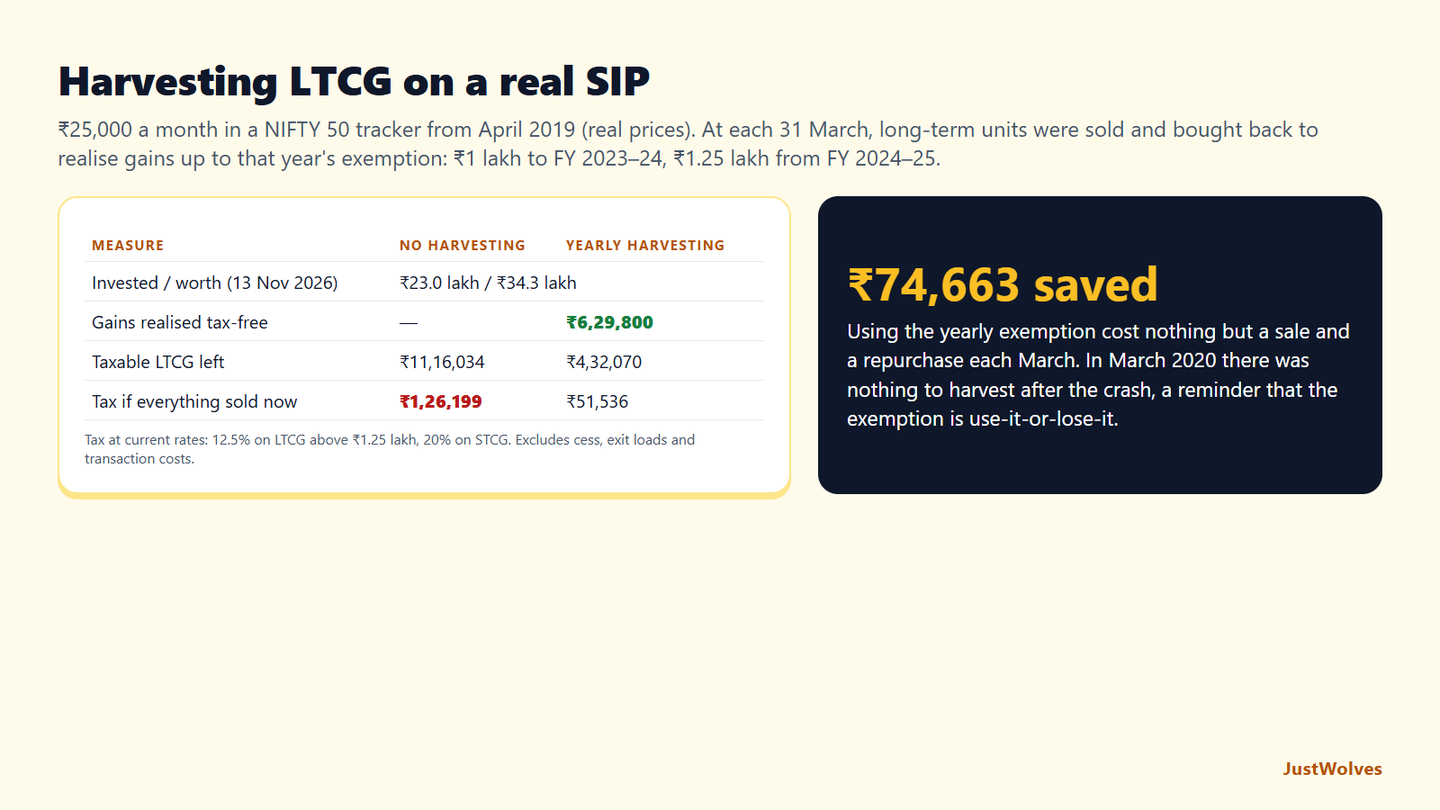
| Measure | No harvesting | Harvest every 31 March |
|---|---|---|
| Invested / value on 13 Nov 2026 | ₹23.0 lakh / ₹34.3 lakh | ₹23.0 lakh / ₹34.3 lakh |
| Gains realised tax-free along the way | — | ₹6,29,800 |
| Long-term gains left at exit | ₹11,16,034 | ₹4,32,070 |
| Short-term gains left at exit | ₹11,598 | ₹65,762 |
| Tax if everything is sold now | ₹1,26,199 | ₹51,536 |
The saving was ₹74,663, about 59% of the tax. Harvesting did not change what the investor owned; it only raised the recorded cost of the units each March. That converted ₹6.3 lakh of future taxable gains into gains that were never taxed.
The exemption is use-it-or-lose-it. In March 2020 there was nothing to harvest: the crash had wiped out the gains. Every year in which you leave the exemption unused is gone for good, which is why this article suggests doing it every February or March.
There are small costs. Each harvest is a sale and a purchase. On a direct index fund held for over a year there is usually no exit load, but check yours, and remember that the repurchased units start a new 12-month clock before they count as long-term again.
Gold ETF vs Gold Mutual Fund: The Tax Difference
Both gold ETFs and gold mutual funds ultimately hold the same underlying asset — physical gold. Their returns are nearly identical. The meaningful difference between them is tax treatment and accessibility.
Gold Investment Tax Comparison
12 months
Gold ETF — LTCG holding period
24 months
Gold Mutual Fund — LTCG holding period
A gold ETF qualifies for the lower 12.5% LTCG tax rate after just 12 months of holding. A gold mutual fund requires 24 months of holding to qualify for LTCG treatment. If you sell a gold mutual fund before the 24-month mark, the gain is added to your income and taxed at your slab rate — which for a 30% bracket investor means more than double the tax compared to a gold ETF sold after 12 months.
Gold ETFs also allow intraday trading during market hours and do not require a minimum investment amount beyond one unit. The trade-off is that gold ETFs require a demat account. Gold mutual funds do not — they can be bought directly through any fund house or platform without a demat account.
Neither gold instrument charges 3% GST or making charges, which apply to physical gold. Neither has storage or insurance risk. For investors with a demat account, gold ETFs are the marginally superior option purely on tax grounds.
Tax on Portfolio Rebalancing
Portfolio rebalancing — selling the overweight asset to buy the underweight one — is fundamentally sound investing. The problem is that selling almost always creates a taxable event. This is one of the most important reasons why rebalancing is harder in practice than in theory.
Consider a simple example: you start with a 90% equity and 10% gold allocation. Gold rises 50% over a year, shifting your ratio to 86-14. To rebalance back to 90-10, you need to sell ₹45,000 worth of gold. If that gold was held for more than 12 months in an ETF, you will pay 12.5% LTCG on the gain component of those units. If you held it for less than 12 months, you pay your slab rate.
The tax does not make rebalancing wrong — it makes planning for it essential. The key is to know the exact tax liability before selling and to use the available exemptions and strategies to minimise it.
SIP Redirection: The Tax-Free Rebalancing Strategy
When rebalancing would trigger a large capital gains tax bill, there is a cleaner alternative: redirect your SIPs instead of selling.
If your mid-cap allocation has grown from 25% to 35% and you want to bring it back to 25%, do not sell mid-cap units and buy large-cap units. Instead, stop your mid-cap SIP entirely and increase your large-cap SIP by the same amount. Over 6 to 12 months, the new SIP money naturally rebuilds the large-cap proportion while the mid-cap allocation stays flat or grows more slowly.
No units are sold. No taxable event is created. The rebalancing happens gradually through where new money flows — not through selling existing holdings.
SIP Redirection in Practice
Step 1: Identify which fund category is overweight
Check your current allocation split on your fund platform or consolidated account statement. Note which category has drifted above your target — mid-cap, small-cap, or gold.
Step 2: Stop the SIP in the overweight fund
Pause or stop the SIP in the fund whose allocation has grown beyond your target. Do not sell existing units.
Tip: Most platforms allow you to pause a SIP without cancelling it. This preserves your existing holding and its holding period for future LTCG qualification.
Step 3: Increase the SIP in the underweight fund
Redirect the same monthly amount to the fund category that is underweight. If you stopped a ₹5,000 mid-cap SIP, add ₹5,000 to your large-cap or international SIP.
Step 4: Monitor and restore after 6 to 12 months
Check your allocation again after 6 to 12 months. Once the ratio is back near your target, you can resume the original SIP if desired or leave the redirected allocation in place.
How to Exit Funds Tax-Efficiently
If you have a cluttered portfolio with 20 or 40 funds and want to consolidate, do not sell everything at once. Doing so may trigger a large one-time tax bill that significantly reduces the capital you have to reinvest.
The tax-efficient exit process works in stages. First, identify the funds you want to keep. For every other fund, stop the SIP immediately — today. Second, check the capital gains and tax payable on each fund you want to exit. If a fund has gains well above ₹1.25 lakh, do not sell the entire position this financial year. Sell enough units each year to stay within the LTCG exemption.
Third, increase SIPs in your target funds to build the correct allocation. Within 12 to 24 months, your target funds will represent the majority of your portfolio. The legacy funds will still exist but will no longer be receiving new money and will be slowly wound down through annual tax-free LTCG harvesting.
Balanced Advantage Funds: Built-In Tax Efficiency
A balanced advantage fund (BAF) automatically shifts its allocation between equity and debt based on market valuations — increasing debt when markets are expensive and increasing equity when they are cheap. This is automatic rebalancing.
The key tax advantage: all the buying and selling that happens inside the fund is done by the fund manager, not by you. When a mutual fund manager sells equity within the fund and buys debt, that transaction has no direct tax implication for you as the investor. You only pay tax when you sell your own units in the BAF.
This means a BAF investor gets the benefit of continuous rebalancing between equity and debt — potentially hundreds of internal transactions per year — without ever triggering a personal capital gains event. Compare this to manually rebalancing a separate equity fund and debt fund, where every rebalancing sale creates a taxable event for you.
Inside a mutual fund, the manager can buy and sell freely. You only pay tax when you sell your own units. Balanced advantage funds use this to deliver rebalancing with zero personal tax cost.
Key Takeaways
Mutual Fund Tax — What Every Investor Should Know
- Equity STCG (held < 12 months) is taxed at 20%; equity LTCG (held ≥ 12 months) is taxed at 12.5%
- Debt fund gains are taxed at your income slab rate regardless of holding period
- Gold ETFs qualify for LTCG after 12 months; gold mutual funds require 24 months
- ₹1.25 lakh of LTCG per year on equity is completely tax-free — use this exemption every year without fail
- Harvest gains annually by selling up to ₹1.25 lakh of LTCG and immediately reinvesting to reset your cost basis
- Each SIP instalment has its own holding period; FIFO means older units are sold first
- SIP redirection is the cleanest way to rebalance — no units sold, no taxable event created
- Check the tax liability in a capital gains statement before selling any fund — never rebalance blind
- Balanced advantage funds handle equity-debt rebalancing internally with no personal tax cost to you
- Exit cluttered portfolios gradually — use the annual ₹1.25 lakh exemption to unwind over multiple years
Frequently Asked Questions
How is tax calculated on SIP redemptions?
Each SIP instalment is treated as a separate purchase with its own date and cost. When you redeem, the oldest units are sold first (FIFO). Units held for 12 months or more attract LTCG at 12.5%; units held for less than 12 months attract STCG at 20%. If you started a SIP 3 years ago and redeem today, the first 12+ months of instalments will be LTCG; any instalments from the last 12 months will be STCG.
Is the ₹1.25 lakh LTCG exemption per fund or per investor?
It is per investor per financial year — across all equity mutual funds and listed equity stocks combined. If you earn ₹80,000 of LTCG from a Nifty index fund and ₹60,000 from selling shares, your total is ₹1.40 lakh. Only ₹1.25 lakh is exempt; you pay 12.5% on the remaining ₹15,000.
Why are debt mutual funds taxed differently from equity funds?
Debt mutual fund gains were previously taxed at a lower rate with indexation benefit. This was changed and debt fund gains are now taxed at your applicable income tax slab rate, similar to fixed deposits. This makes debt funds less tax-efficient than equity funds for investors in higher tax brackets, though they can still be useful for tax brackets where the slab rate is lower.
Do I pay tax when switching between funds within the same AMC?
Yes. Switching from one fund to another — even within the same fund house — is treated as a redemption and a fresh purchase for tax purposes. Any gain on the switched-out units is a taxable capital gain. The only exception is switching within the same fund from direct to regular plan or vice versa.
How do I check the exact tax I owe before selling a mutual fund?
Download a capital gains statement from your investing platform or the registrars. These statements show the exact capital gains (STCG and LTCG separately) and the approximate tax payable for each fund based on your actual purchase dates and prices. Always check this before selling, especially for large redemptions.
Does gold ETF vs gold mutual fund matter much for small investors?
For smaller amounts and shorter horizons, the 12-month vs 24-month holding period difference matters significantly. If you need to sell gold within 12 to 24 months, a gold mutual fund sale in that window is taxed at your slab rate while a gold ETF sale after 12 months is taxed at only 12.5%. For long-term investors who hold gold for 3 or more years, the practical difference is smaller — both qualify for LTCG at that point.
How much tax can LTCG harvesting save?
In our worked example on real NIFTY 50 prices, a ₹25,000 monthly SIP from April 2019 harvested ₹6.3 lakh of gains tax-free over seven years. Selling everything in November 2026 would have cost ₹51,536 in tax instead of ₹1,26,199: a saving of ₹74,663, before cess.
Is the ₹1.25 lakh LTCG exemption available on gold ETFs?
No. The ₹1.25 lakh exemption applies to long-term gains on equity shares and equity-oriented funds. Listed gold ETFs held for more than 12 months are taxed at 12.5% on the whole long-term gain, and gains within 12 months at your slab rate.
Topics