The 5 Psychological Enemies Silently Destroying Your Trades

JustWolves is an educational platform and is not a SEBI-registered investment advisor. Trading financial instruments involves significant risk of loss and may not be suitable for all investors. Past performance is not indicative of future results. Read our full disclaimer →
In this article · 6 sections
Enemy 1: Loss Aversion
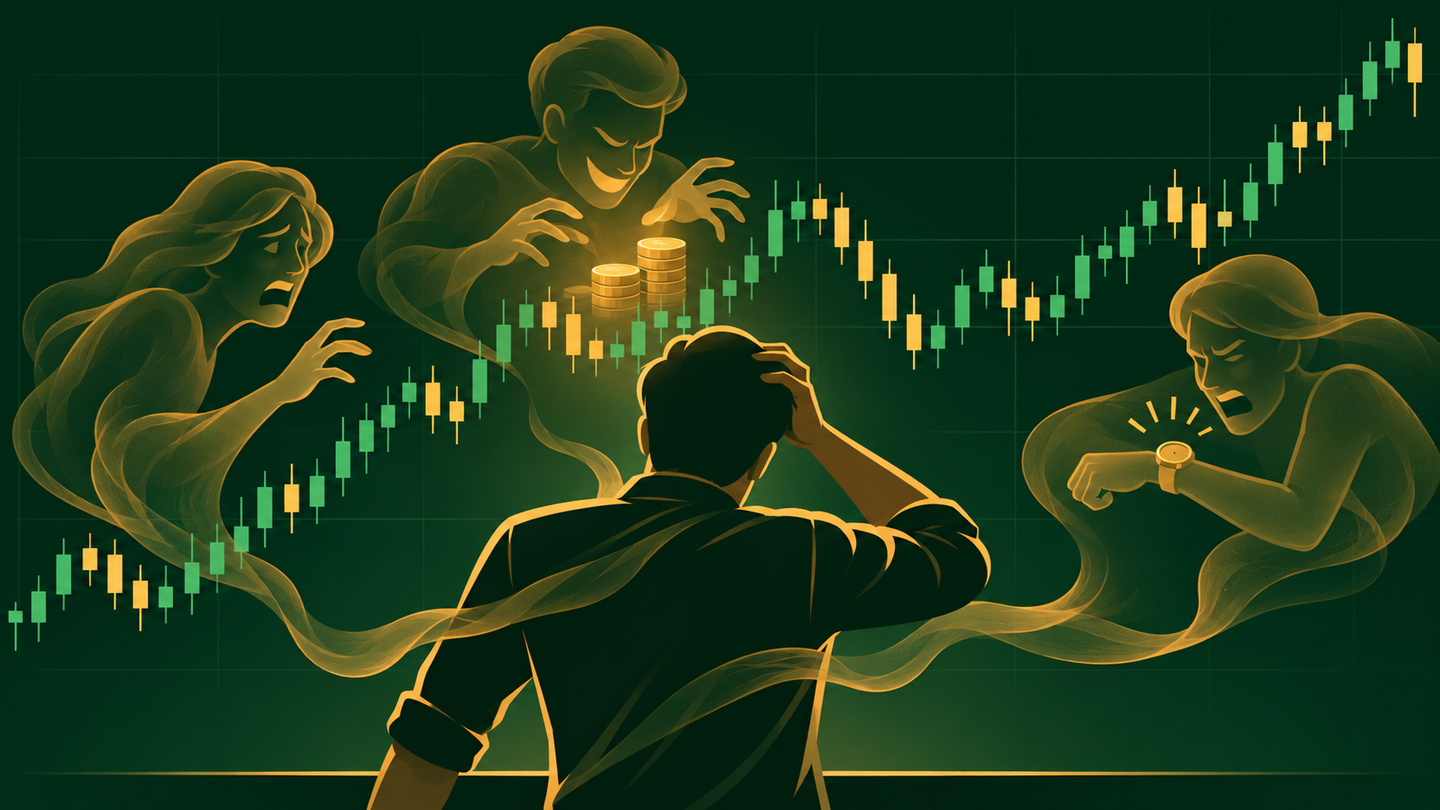
Research into how people make decisions under risk has found something counterintuitive: a loss feels roughly twice as strong as a gain of the same size. Losing ₹1,000 hurts about as much as winning ₹2,000 pleases. This is not a character flaw; it is how almost everyone's mind weighs risk. In trading, it does real damage.
Here's how it plays out: your analysis is correct. The price dips 15 points against you, as it often does before moving your way. Every instinct says "exit before it gets worse". You exit. The price reverses and runs to your exact target. You stare at the screen having been right about everything except your own psychology.
The even more dangerous form: your stop-loss is 60 points away, the price is already down 35 points, and instead of holding, you move the stop lower. What was a ₹1,000 loss becomes ₹10,000.
"The loss didn't happen because your analysis was wrong. It happened because loss aversion scared you out of a good trade."
Real Prices: The Trade Loss Aversion Would Have Closed
The chart below shows a real NIFTY 50 trade from 30 October 2026, taken on a simple EMA trend rule with a 1:3 reward-to-risk. Within five minutes of entry, it was half-way to its stop. Step through it and ask yourself honestly what you would have done.
Real prices: the trade loss aversion would have closed, NIFTY 50, 30 October 2026
Step 1 of 4
A plan before the trade
On 30 October 2026 the NIFTY 50 bases at 22,914 at 10:30 am. At 10:55 EMA 7 crosses above EMA 17 and both start to rise: the trader's plan says longs only, on a strong trigger candle.
- What to observe
- The rules are fixed before any money is at risk.
- Condition
- Wait for the trigger.
Enemy 2: Confirmation Bias
Once you have an opinion on a trade, your mind starts collecting evidence for it and quietly discarding evidence against it. A bullish trader sees the higher low and ignores the resistance just above. A bearish trader notices every red candle and explains away the green ones as "just a pullback".
The danger is not having a view; you need one to trade. The danger is that confirmation bias makes your view feel more certain than the chart justifies, so you size up, skip the stop, or hold on after the setup has clearly failed. The fix is to deliberately look for the case against your trade before you enter, while you are still neutral.
Enemy 3: Overconfidence
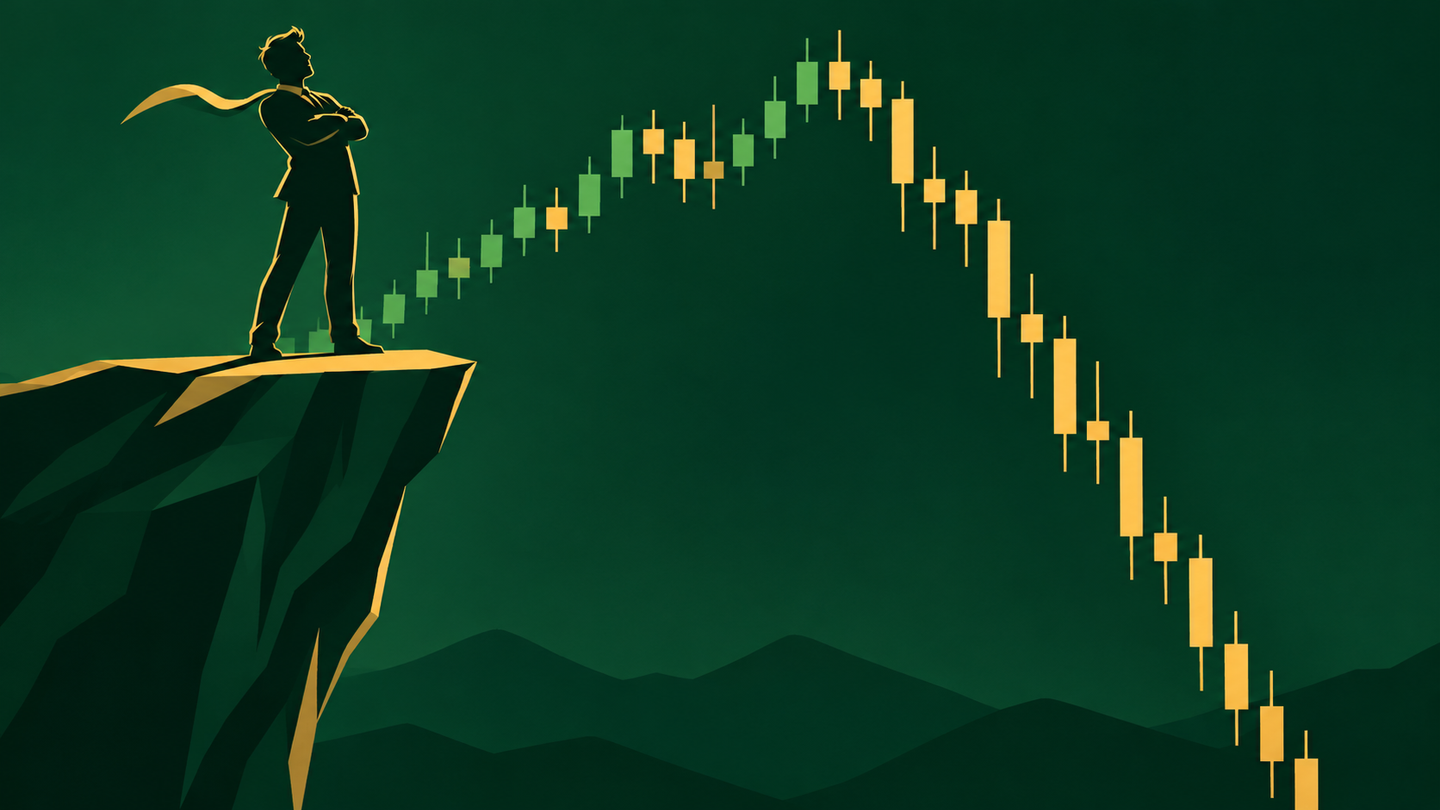
Four profitable trades in a row and the brain starts whispering: "I've figured this out." Overconfident traders tend to trade more often, and every extra trade adds costs. In our test below, the trade taken right after a run of four winners did worse than average, not better. More trades means more brokerage, more emotional fatigue, and more exposure to randomness mistaken for skill.
Overconfidence evolves in stages: first you start trading on gut feel without proper setups, then you scale up position sizes dangerously fast, and finally — most insidiously — when losses come, you blame the market rather than your own process.
Enemy 4: Herd Mentality
When all retail traders pile into the same direction, institutional players — the ones with deeper pockets and better information — are often on the exact opposite side. When Telegram groups are flooded with screenshots of a running stock, when Twitter is buzzing, when Shorts are showing the same setup everywhere — that's often the moment the smart money is distributing, not accumulating.
The irony is stark: when excitement about a level peaks, the market is often closest to reversal. If every retail trader bought calls at resistance, who sold them those calls?
Enemy 5: Revenge Trading
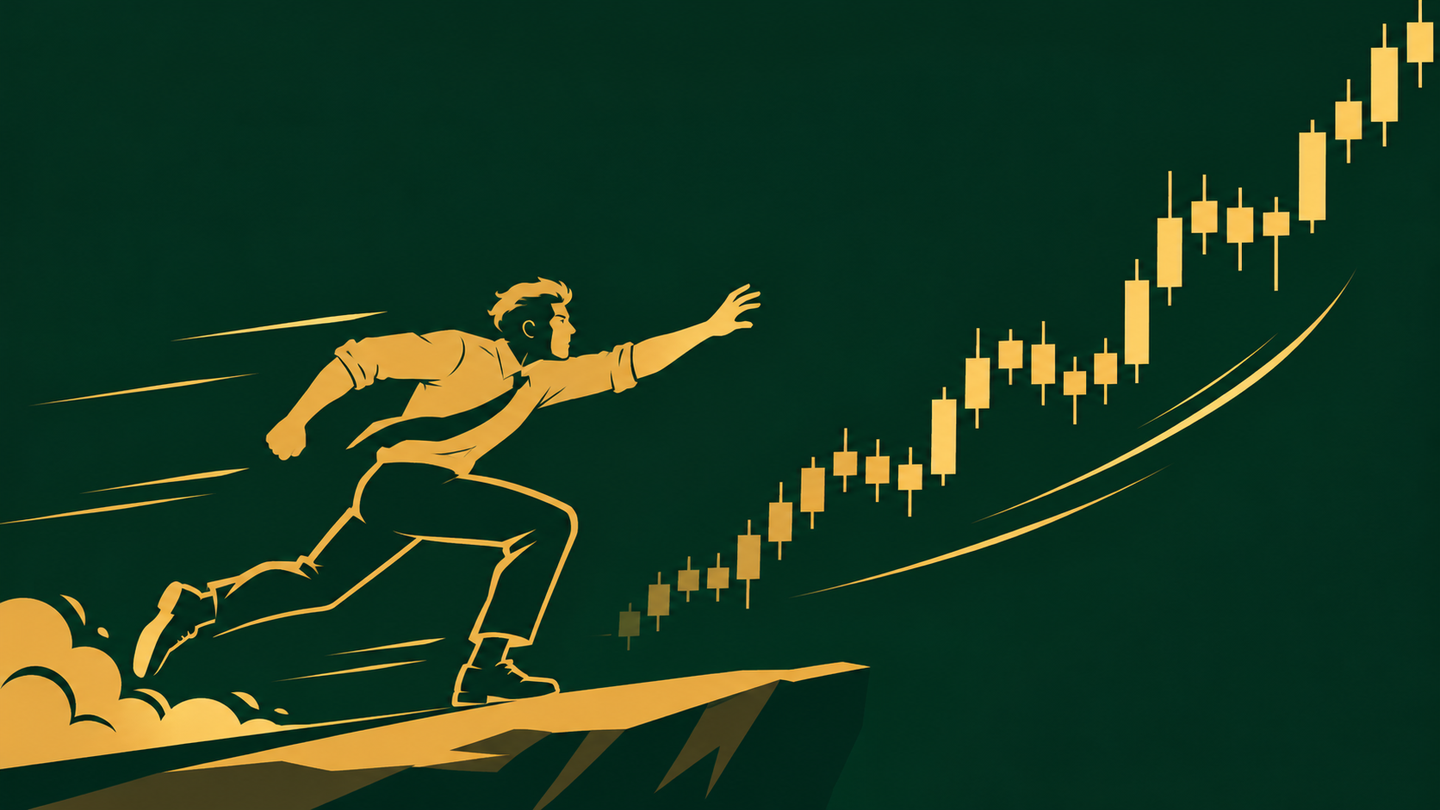
This is the most dangerous trap of all — and it's most dangerous precisely because it hits when you're emotionally weakest. After a bad loss, three psychological forces conspire: the Sunk Cost Fallacy ("I've already lost so much, I need to win it back"), Ego Protection ("the market was wrong, not me"), and Emotional Dysregulation (anxiety spiraling, rational thinking collapsing). In this state, decisions are almost always wrong.
You keep entering trades without setups. Each new loss deepens the spiral. By end of day, a small manageable loss has become a capital-destroying disaster.
"Have you come to the market to make money — or to prove yourself right?"
What These Enemies Cost: Our Test on 2,524 Real Trades
Psychology is usually discussed in stories. JustWolves measured it instead. We took a simple, rule-based intraday strategy, the EMA 7/17 slope and trigger-candle setup from our scalping posts, and applied it to real 5-minute prices for the NIFTY 50 and 10 large NSE stocks from August to November 2026: 2,524 trades with a 1R stop and a 3R target. Each instrument was treated as one trader taking its own signals in time order. Then we changed only the behaviour, never the entries, to see what each emotional habit would have done to the same trades.
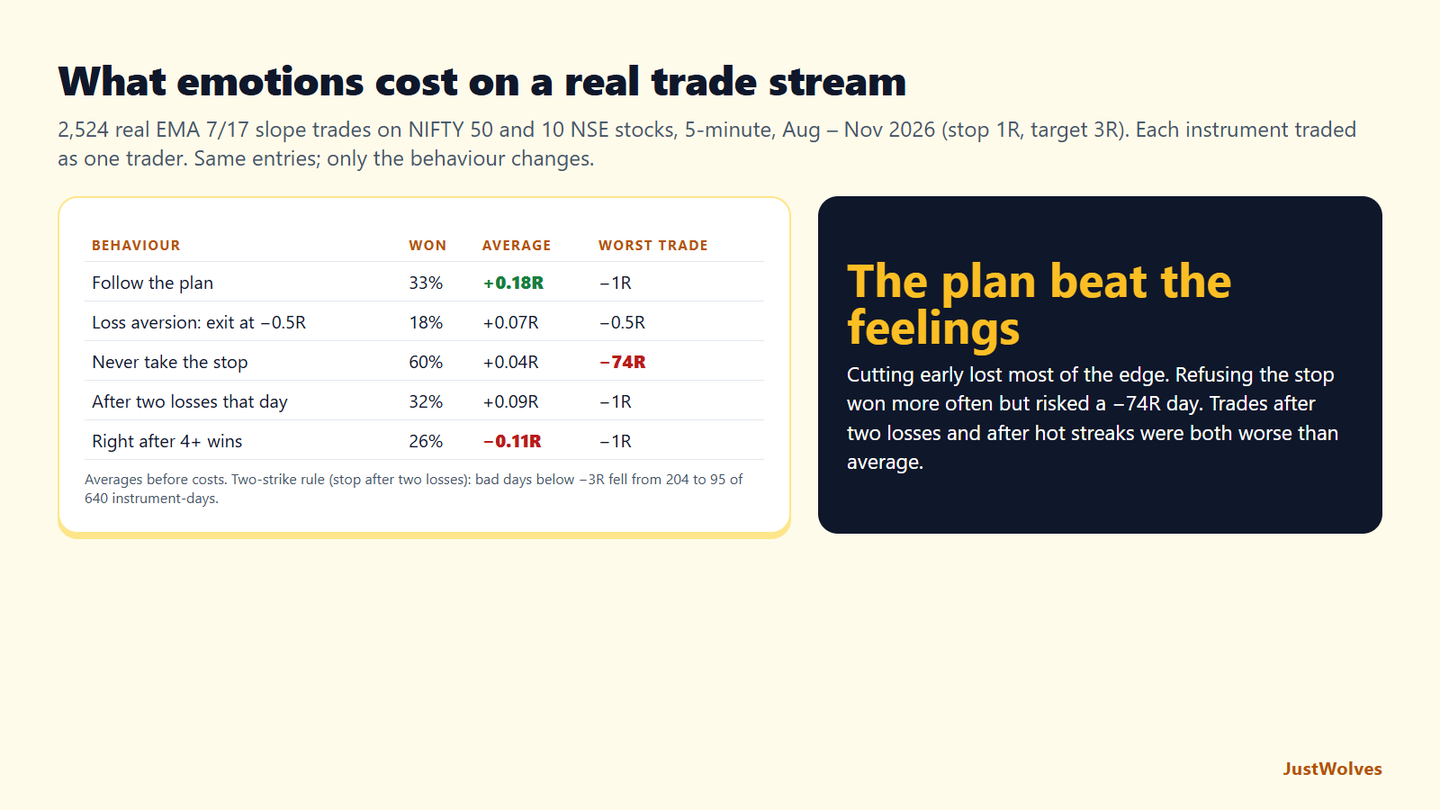
| Behaviour | Won | Average per trade | Worst trade |
|---|---|---|---|
| Follow the plan: 1R stop, 3R target | 33% | +0.18R | −1R |
| Loss aversion: exit whenever 0.5R against | 18% | +0.07R | −0.5R |
| Widen the stop once, to 2R | 47% | +0.23R | −2R |
| Never take the stop: hold to 3R or the close | 60% | +0.04R | −74R |
| Revenge: trades after two losses that day | 32% | +0.09R | −1R |
| Overconfidence: trades right after 4+ wins | 26% | −0.11R | −1R |
Loss aversion cost most of the edge. 2,063 of the 2,524 trades went at least half-way to their stop at some point, which is normal for a tight intraday stop. Of those, 261 went on to hit the full 3R target. Exiting early on every scary dip cut the average from +0.18R to +0.07R per trade and the win rate from 33% to 18%.
Never taking the stop felt better and was far worse. Holding every losing trade until the close turned 60% of trades into winners, which feels wonderful. But the average fell to +0.04R and the worst single trade lost 74 times the planned risk: a stock that kept trending against the position all day. One trade like that can wipe out months of careful work.
Widening the stop once is a different strategy, not a rescue. Moving the stop to 2R a single time raised the average slightly in this sample, while doubling the worst loss. If a wider stop works better, decide that in advance and size the position for it. Moving it in the moment, again and again, is how a planned 1R loss becomes a 74R one.
Revenge trading and overconfidence both showed up. Trades taken after two losses on the same day averaged +0.09R, half the +0.22R of trades taken earlier in the day. Trades taken right after four straight winners averaged −0.11R: a hot streak said nothing about the next trade.
The two-strike rule worked. Stopping each instrument for the day after two losing trades cut the number of days worse than −3R from 204 to 95 out of 640, and the worst day from −15.4R to −6.4R. The rule in this article is simple, and the data supports it.
Key Takeaways
- Loss aversion makes a loss feel about twice as strong as an equal gain. Set the stop before the trade, then let it, not your fear, decide.
- In our test on 2,524 real NSE trades, exiting whenever a trade was half-way to its stop cut the average result from +0.18R to +0.07R before costs.
- Refusing to take the stop won more often (60% of trades) but produced a single loss of 74R. One such trade can undo months of work.
- Confirmation bias: argue the opposite case and write both plans before you enter.
- Overconfidence: in our test, trades taken after four straight winners did worse than average. Streaks do not predict the next trade.
- Revenge trading: trades taken after two losses in a day did worse, and a two-strike rule halved the number of very bad days.
What is loss aversion in trading?
Loss aversion is the tendency to feel a loss about twice as strongly as a gain of the same size. In trading it shows up as closing good trades at the first dip, or refusing to take a planned stop. In our test on 2,524 real NSE trades, exiting whenever a trade was half-way to its stop cut the average result from +0.18R to +0.07R per trade.
Does the two-strike rule really help?
In our test, yes. Stopping for the day after two losing trades cut the number of days worse than −3R from 204 to 95 out of 640 instrument-days, and the worst day from −15.4R to −6.4R. Trades taken after two losses that day also performed worse than earlier trades.
Should I trade bigger after a winning streak?
Not because of the streak. In our test, trades taken right after four straight winners averaged −0.11R, worse than the average trade. Increase size only on the evidence of many trades, as this article suggests, not on a run of recent wins.
Is it ever right to move a stop-loss?
Moving a stop further away during a trade turns a planned loss into an unplanned one. If your data shows a wider stop works better, set it before the trade and size the position for it. In our test, never taking the stop led to a single trade losing 74 times the planned risk.