
Overnight and Gap Risk
JustWolves is an educational platform and is not a SEBI-registered investment advisor. Trading financial instruments involves significant risk of loss and may not be suitable for all investors. Past performance is not indicative of future results. Read our full disclaimer →
What you'll learn
- A gap opens beyond the previous close, so a stop order can fill far worse than its price
- Common causes: company results and announcements, RBI and global events, and overnight moves in global markets
- Swing traders can't avoid gaps, but they can plan for them: event calendars, position caps and diversification
- Size positions so a plausible gap loss is survivable, not just the planned stop loss
- Many traders reduce or exit positions before scheduled results
In this article · 15 sections
The main risk that separates swing trading from day trading is the overnight gap. Between the 3:30 pm close and the next morning's open, news can arrive, global markets can move and a stock can open well beyond your stop. The stop order then fills at the open, not at your price. This lesson explains what causes gaps, why stops don't fully protect you, and the practical ways swing traders limit the damage.
What You Will Learn
- What causes gaps
- Why stops can fill far from their price
- How to plan around scheduled events
- How to size and hedge for gap risk
Before You Start
What Causes Gaps
| Type | Examples | Scheduled? |
|---|---|---|
| Company-specific | Quarterly results, guidance, management changes, regulatory orders | Results usually scheduled; others not |
| Domestic macro | RBI policy decisions, Union Budget, inflation data | Scheduled |
| Global | Overnight moves in US and Asian markets, central bank decisions abroad | Partly scheduled |
| Sector news | Policy changes, commodity price moves | Often unscheduled |
Before the cash market opens, the pre-open session from 9:00 to 9:15 am IST shows where a stock is likely to open. Many traders also watch GIFT Nifty futures overnight as a guide to the likely opening direction of the broader market.
Why Stops Don't Fully Protect You
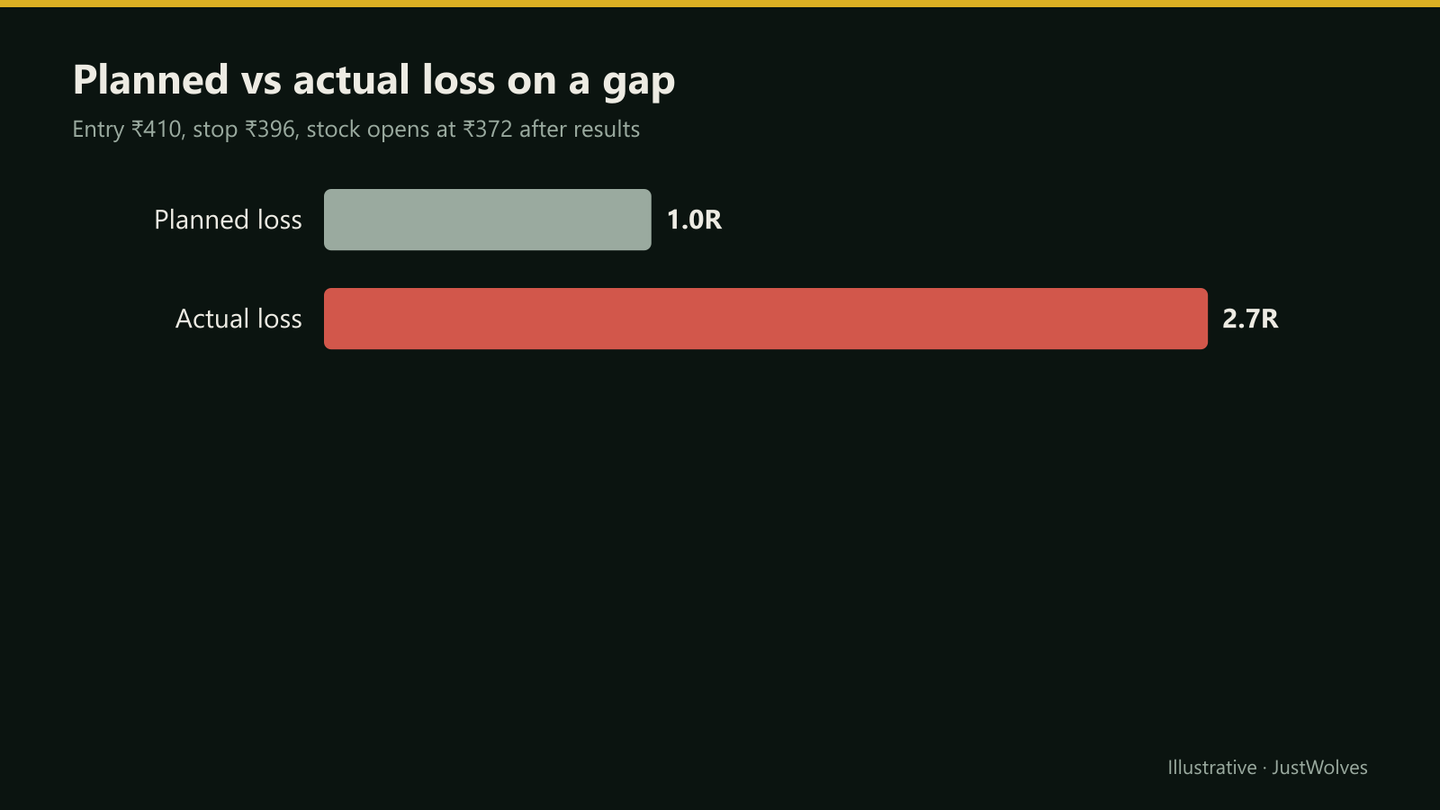
A stop-loss order becomes active only when the stock trades at the stop price. If a stock closes at ₹410 and opens at ₹372, it never trades between those prices, so a stop at ₹396 fills at or near ₹372.
Stock-specific price bands and circuit limits can make this worse: a stock that hits its lower band may have few buyers, and sell orders may not fill until the band is lifted or buying returns.
Real Prices: A Weekend Gap Through a Stop
Vikram's example in this lesson uses a results gap. The chart below shows a weekend gap on real Asian Paints prices in April 2025: a swing long taken on a Friday, and a Monday open below the stop.
Real prices: a weekend gap through a swing stop, Asian Paints, April 2025
Step 1 of 4
A pullback setup on a Friday
In late March 2025 Asian Paints climbs above its rising 50-day average, then pulls back to ₹2,292 on 2 April near its 20-day EMA. On 3 April it closes strongly at ₹2,349.
- What to observe
- A textbook pullback trigger.
- Condition
- The next trading day is a Friday.
Managing Scheduled Events
- Check the results calendar for every stock you hold or plan to buy. Exchanges and company websites publish board meeting dates.
- Decide in advance: exit before results, reduce size, or hold with a smaller position sized for a larger gap.
- Note macro dates such as RBI policy announcements and the Union Budget, especially for rate-sensitive sectors like banks and real estate.
- Avoid new entries in the session or two before a stock's results unless that's your deliberate strategy.
Sizing for Gaps
Position sizing from the stop controls the planned loss, but not the gap loss. A second check helps: cap each position's value at a set share of the account, often 10–25%, so that even a 10–15% gap in one stock costs a manageable fraction of capital.
Diversification helps too. Five positions in five different sectors are less likely to gap against you at the same time than five positions in one sector. Heavily correlated positions behave like one large position on a bad morning. Swing Position Sizing and Portfolio Heat covers this.
Hedging
For stocks in the F&O segment, a protective put limits the downside of a long position below the strike, at the cost of the premium. Some traders hedge a group of long positions with Nifty puts before major events, though this only offsets market-wide moves, not stock-specific gaps.
Hedging costs money every time, so most swing traders use it selectively, before known events, rather than continuously. The Futures & Options course explains protective puts.
Practical Example
Hypothetically, Vikram holds 285 shares of a mid-cap stock bought at ₹410, with a stop at ₹396 (₹14 risk, about ₹4,000 in total). The company reports results after the close; the stock opens at ₹372 and his stop fills there. His loss is ₹38 a share, about ₹10,830, or 2.7 times his planned risk.
Reviewing the trade, he adds two rules: check the results calendar before every entry, and either exit or halve any position before a scheduled result.
How Often Do Gaps Break the Plan? Our Test
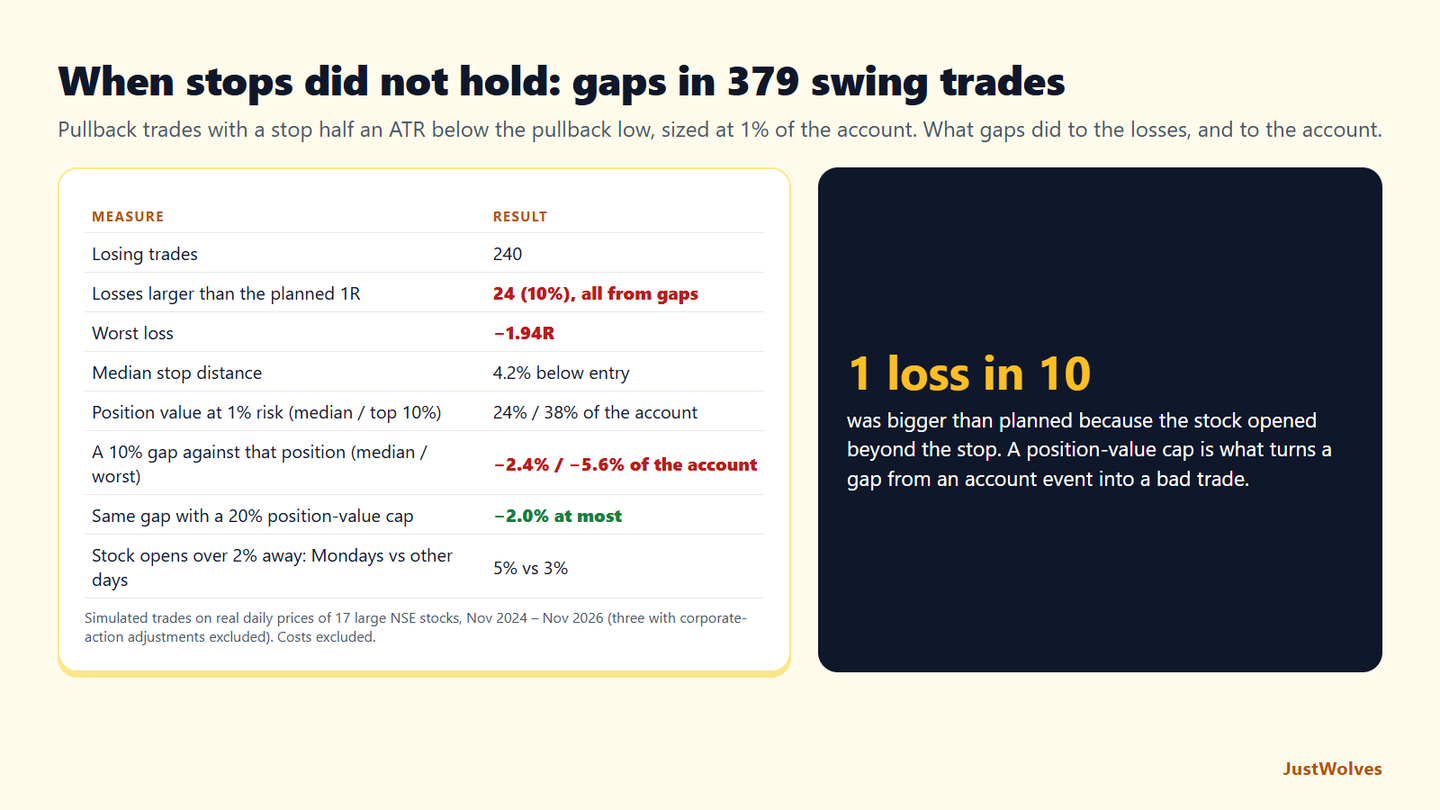
JustWolves measured gap risk on the 379 simulated pullback trades used throughout this module, on about two years of daily prices for 17 large NSE stocks (November 2024 to November 2026). Each trade had a stop half an ATR below the pullback low and was sized at 1% of the account. We counted the losses that exceeded the planned 1R, measured how large each position was as a share of the account, and estimated what a 10% gap would cost with and without this lesson's position-value cap. We also compared how often stocks opened more than 2% away from the previous close on Mondays and on other days.
| Measure | Result |
|---|---|
| Losing trades | 240 |
| Losses larger than the planned 1R | 24 (10%), every one caused by a gap |
| Worst loss | −1.94R |
| Position value at 1% risk | Median 24% of the account; top 10% above 38% |
| Cost of a 10% gap against the position | Median 2.4% of the account; worst 5.6% |
| Same gap with a 20% position-value cap | At most 2.0% of the account |
| Stocks opening more than 2% away: Mondays vs other days | 5% vs 3% |
Gaps were the only reason losses exceeded the plan. One losing trade in ten lost more than 1R, and in every case the stock had opened beyond the stop, as on 7 April 2025 in the chart above. The worst lost almost twice the planned risk. That is the arithmetic of this lesson's stops section: an order cannot fill at a price the market never trades.
Position size was where gaps did their damage. Because swing stops were often only about 4% below entry, sizing at 1% risk produced positions worth a quarter of the account, and in one trade in ten more than 38%. A 10% gap against a position that large costs several percent of the account in one morning. A 20% position-value cap, as this lesson suggests, limits the same gap to 2%.
Mondays gapped more often, with 5% of stock opens more than 2% away from Friday's close against 3% on other days. Weekends carry two days of news; this lesson's event rules, checking results dates and macro events before holding through them, apply to weekends too.
Common Mistakes
- Assuming stops guarantee the exit price.
- Not checking results dates.
- Concentrating in one sector.
- Oversized positions sized only from the stop.
- Adding to positions just before known events.
Professional Insight
Many experienced swing traders treat the results calendar as part of their trade plan, not an afterthought. Some never hold through results; others hold only with a reduced position they could lose a large part of without harm. Either way, the decision is made before the event, not on the morning of the gap.
Risk Considerations
- Gap losses can be several times planned risk.
- Price bands can delay exits.
- Unscheduled news can't be planned for, only sized for.
Important Terminology
| Term | Meaning |
|---|---|
| Gap | An open well above or below the previous close. |
| Pre-open session | 9:00–9:15 am IST, when opening prices are discovered. |
| Price band | A limit on how far a stock can move in a session. |
| Protective put | A put option bought to limit losses on a long position. |
| Correlation | The tendency of positions to move together. |
What is gap risk in swing trading?
The risk that a stock opens far beyond your stop because of news or market moves while the market is closed.
Does a stop loss protect me from gaps?
Not fully. If the stock opens beyond your stop, the order fills at or near the opening price.
Should I hold swing trades through results?
Many traders exit or reduce size before results. If you hold, size the position for a large gap.
How can I reduce gap risk?
Check event calendars, cap position size, diversify across sectors and hedge selectively.
What causes stocks to gap?
Company results and announcements, macro events like RBI decisions, and moves in global markets.
How often do gaps make swing losses bigger than planned?
In our test of 379 simulated pullback trades on 17 NSE stocks, about one losing trade in ten lost more than the planned 1R, every one because the stock opened beyond the stop. The worst lost about 1.9 times the planned risk.
Are Monday gaps bigger in Indian stocks?
Slightly more frequent, in our data. On 17 large NSE stocks, about 5% of Monday opens were more than 2% away from Friday's close, against about 3% on other days, because weekend news has two days to accumulate.
Practical Exercise
Measure gap risk.
Your task
Step 1: Pick five stocks you trade
Look back over two years.
Step 2: Find the largest gaps
Especially on results days.
Step 3: Calculate the cost
What would each gap have cost at your usual position size?
Step 4: Set rules
A position cap and a results-day rule.
Check Your Understanding
If a stock gaps below your stop, the order fills:
Related Lessons
Previous: Targets, Partial Exits and Trailing Stops. Next: Swing Position Sizing and Portfolio Heat. See also Stop Placement for Swing Trades.