
Market Structure Shift (MSS) vs Change of Character (CHoCH)
JustWolves is an educational platform and is not a SEBI-registered investment advisor. Trading financial instruments involves significant risk of loss and may not be suitable for all investors. Past performance is not indicative of future results. Read our full disclaimer →
What you'll learn
- MSS and CHoCH both describe the first structural break against the prevailing trend
- Educators define them differently; many use MSS for a break that comes with displacement
- Displacement means a strong, one-sided move, often leaving a fair value gap
- What matters is a consistent definition in your own rules
- Neither signal confirms a reversal on its own
In this article · 17 sections
Read enough SMC and ICT material and you'll see both 'change of character' and 'market structure shift' used for what looks like the same thing. Sometimes they are the same; sometimes the author means something more specific. This lesson sorts out the common definitions, explains the role of displacement, and helps you settle on one consistent rule.
What You Will Learn
- How MSS and CHoCH are commonly defined
- What displacement means and how to recognise it
- Why the distinction matters for your rules
- How to choose and apply a consistent definition
Before You Start
Read Valid Change of Character: 3 Criteria first.
Two Names, Overlapping Ideas
In much SMC content, CHoCH means the first close against the trend beyond the protected swing (lesson 02.01.04). MSS is a term more associated with ICT material, where it usually describes a break of a recent swing with displacement, often after a liquidity sweep.
In practice, some educators use the terms interchangeably, some treat MSS as a stronger, confirmed CHoCH, and some apply MSS to shorter-term swings used for entries. There's no official standard.
| CHoCH (common SMC usage) | MSS (common ICT usage) | |
|---|---|---|
| What breaks | The protected external swing against the trend | A recent swing against the prior move, often a short-term one |
| Strength required | A candle close beyond the level | A close with displacement |
| Typical context | Any trend change warning | After a liquidity sweep, at a key level |
| Typical use | Bias change on the mapped timeframe | Entry trigger, often on a lower timeframe |
Displacement
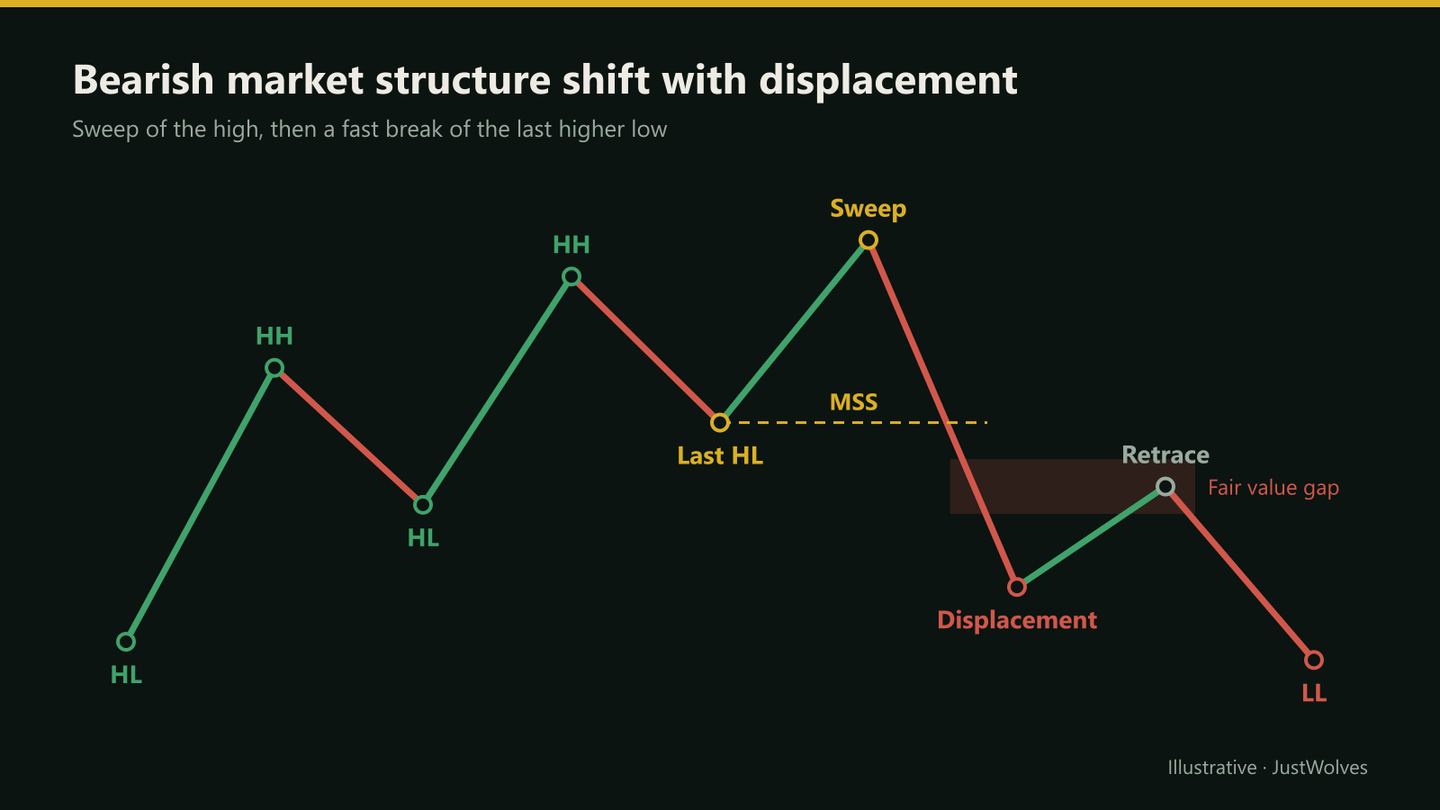
Displacement describes a strong, one-sided move: large-bodied candles in one direction with little overlap, often leaving a fair value gap (a gap between the wicks of the first and third candles of a three-candle sequence, covered in lesson 02.03.02).
Displacement is used as evidence that the break was decisive rather than a slow drift. A structural break with displacement is generally treated as more meaningful than one made by small, overlapping candles.
Why the Distinction Matters
If one source's 'MSS' requires displacement and another's 'CHoCH' doesn't, the same chart can produce a signal under one definition and not the other. For your own trading, the important thing isn't which name you use but that your rule is precise and consistent, so that your backtests and live trades follow the same logic.
A Practical Definition to Use
- CHoCH (bias): the first candle close against the trend beyond the protected external swing on your analysis timeframe. It changes your bias to neutral.
- MSS (trigger): on your entry timeframe, after a liquidity sweep at a higher-timeframe zone, a close beyond the most recent swing with displacement (large-bodied candles and a fair value gap). It's your entry trigger.
- Write your definitions in your trading plan and don't change them mid-trade.
The Practical Definition on a Chart
The chart below applies the definitions above to one sequence: the CHoCH changes the bias, and the gap left by the same move turns it into an MSS entry trigger.
A bearish MSS: sweep, displacement, gap, entry
Step 1 of 5
A sweep of the session high
At a 1-hour supply zone, price trades through the session high (1.0912) to 1.0915 and closes back below it.
- What to observe
- Buy stops taken at a higher-timeframe level.
- Condition
- Watch the last higher low at 1.0898.
Does the Displacement Requirement Matter? Our Test
The main practical difference between a plain CHoCH and an MSS, as defined here, is displacement: the break leaves a fair value gap. JustWolves tested whether that makes a difference, on about two years of real 4H data for EUR/USD, GBP/USD, USD/JPY and gold. For every change of character (swings of two candles each side, break on a close), we checked whether the breaking move left a fair value gap, then recorded whether the next structure break confirmed the new direction.
| Break type | Cases | Confirmed by the next break |
|---|---|---|
| Break left a fair value gap (MSS by this course's definition) | 318 | 61% |
| Break without a gap (plain CHoCH) | 195 | 50% |
The distinction is not just vocabulary. Breaks with displacement were confirmed noticeably more often; breaks without a gap behaved like a coin flip. That supports the practical rule in this lesson: let a plain CHoCH change your bias to neutral, but wait for a break with displacement before treating it as an entry trigger.
Remember what "confirmed" means here: the next structure break went the same way. It is a measure of follow-through, not a trading result, and 39% of breaks with a gap still turned back. Stops beyond the sweep remain essential.
Step by Step: Applying MSS as an Entry Trigger
Bearish example
Step 1: Higher-timeframe context
Price is at an HTF supply zone, or the HTF structure has made a CHoCH.
Step 2: Sweep
On the entry timeframe, price trades above a recent high or equal highs.
Step 3: Displacement break
Price drops through the last higher low with large-bodied candles, leaving a fair value gap.
Step 4: Entry
Sell limit in the fair value gap or at the origin of the displacement.
Step 5: Stop and target
Stop above the sweep high; target the next liquidity below or at least 2R.
Practical Example
Hypothetically, EUR/USD reaches a 1-hour supply zone. On the 5-minute chart it sweeps the session high at 1.0912, then drops in two large candles through the last higher low at 1.0896, leaving a gap between 1.0899 and 1.0893.
Tanvi, whose plan defines this as an MSS, places a sell limit at 1.0897 with a stop at 1.0916 and a target at the previous day's low, 1.0855: 19 pips of risk for 42 pips of reward. On a similar chart without displacement, her rules say no trade.
Write Your Definitions Down
Because educators use these terms differently, the most useful thing you can do is fix your own definitions in writing and apply them to every chart. A practical template:
- Swing size: how many candles on each side make a swing on your analysis timeframe.
- CHoCH: a candle close (not a wick) beyond the protected swing, against the trend. Effect: bias becomes neutral.
- MSS: a CHoCH-type break whose move leaves a fair value gap. Effect: an entry trigger in the new direction, only at a planned location.
- Timeframes: which chart decides bias, and which provides the trigger.
With those four lines written down, two traders looking at the same chart will label the same events, and your backtest results will mean something.
The Psychology of Labels
Arguments about whether something is "really" an MSS or a CHoCH usually happen after the trade, when the label is being used to explain the result. Decide the label before the next candle closes, by your written definition, and log it. If the trade loses, the question is whether the definition was applied correctly, not whether a different name would have made it a winner.
Common Mistakes
- Arguing about names instead of writing a definition.
- Calling any break an MSS without displacement.
- Using lower-timeframe MSS to override higher-timeframe structure.
- Entering on the break candle at its worst price rather than on a retrace.
- Changing definitions to fit a trade after the fact.
Professional Insight
Experienced traders care about the behaviour, not the label: a decisive break after a failed push beyond an obvious level, at a meaningful location, is a classic reversal signature that predates SMC by decades. Name it whatever you like; define it precisely and test it.
Risk Considerations
- Lower-timeframe triggers fail more often and are sensitive to spreads.
- Displacement during news may reverse quickly.
- Inconsistent definitions make backtests meaningless.
Important Terminology
| Term | Meaning |
|---|---|
| MSS | Market structure shift: commonly, a break of recent structure with displacement. |
| CHoCH | Change of character: the first break against the trend. |
| Displacement | A strong one-sided move with large-bodied candles. |
| Fair value gap | A gap between the wicks of candles one and three in a three-candle move. |
| Entry timeframe | The lower timeframe used to time entries. |
What is a market structure shift?
Commonly, a break of recent structure against the prior move, made with displacement, often after a liquidity sweep.
Is MSS the same as CHoCH?
They overlap and some educators use them interchangeably. Others treat MSS as a stronger, displacement-confirmed break used as an entry trigger.
What is displacement in trading?
A strong, one-sided move with large-bodied candles and little overlap, often leaving a fair value gap.
Which should I use, MSS or CHoCH?
Either, as long as your definition is precise, written down and applied consistently.
Where do I enter after an MSS?
Commonly on a retrace into the fair value gap or the origin of the displacement, with a stop beyond the sweep.
What is the difference between MSS and CHoCH?
Definitions vary between educators. In this course, a CHoCH is the first close against the trend beyond the protected swing, which changes bias; an MSS is the same kind of break made with displacement that leaves a fair value gap, which is used as an entry trigger.
Does displacement make a structure break more reliable?
In our test on two years of real 4H data, breaks that left a fair value gap were confirmed by the next structure break 61% of the time, against 50% for breaks without a gap.
Practical Exercise
Write and apply your definitions.
Your task
Step 1: Write two definitions
Your CHoCH (bias) and MSS (trigger), in one sentence each.
Step 2: Find ten breaks
On 5- or 15-minute charts at higher-timeframe zones.
Step 3: Classify
Which meet your MSS definition (with displacement) and which don't?
Step 4: Track
Record what happened after each.
Check Your Understanding
What does MSS usually add to a basic structure break?
Related Lessons
Previous: Valid Change of Character. Next module: Liquidity, starting with What Is Liquidity in SMC?. See also the ICT Trading course.