
Bull Call Spread: A Defined-Risk Bullish Strategy
JustWolves is an educational platform and is not a SEBI-registered investment advisor. Trading financial instruments involves significant risk of loss and may not be suitable for all investors. Past performance is not indicative of future results. Read our full disclaimer →
What you'll learn
- A bull call spread buys a call and sells a higher-strike call with the same expiry
- The sold call reduces the cost, and therefore the breakeven, but caps the profit
- Maximum loss = net debit paid; maximum profit = strike difference − net debit
- Breakeven = lower strike + net debit
- It suits a moderately bullish view with a target near the upper strike
In this article · 16 sections
Buying a call gives unlimited upside but carries the full premium and its time decay. A bull call spread trades some of that upside for a lower cost: you buy one call and sell another at a higher strike. The result is a position with a defined maximum loss, a defined maximum profit and a lower breakeven. This lesson explains how it works, how to choose strikes and how to manage it.
What You Will Learn
- How a bull call spread is built
- How to calculate maximum profit, loss and breakeven
- How to choose strikes and expiry
- When the strategy fits and how to manage it
Before You Start
How It's Built
- Buy one call at a lower strike (often ATM).
- Sell one call at a higher strike (OTM), same underlying and expiry, same quantity.
- You pay a net debit: the premium of the bought call minus the premium of the sold call.
The Numbers
| Measure | Formula |
|---|---|
| Net debit | Premium paid − premium received |
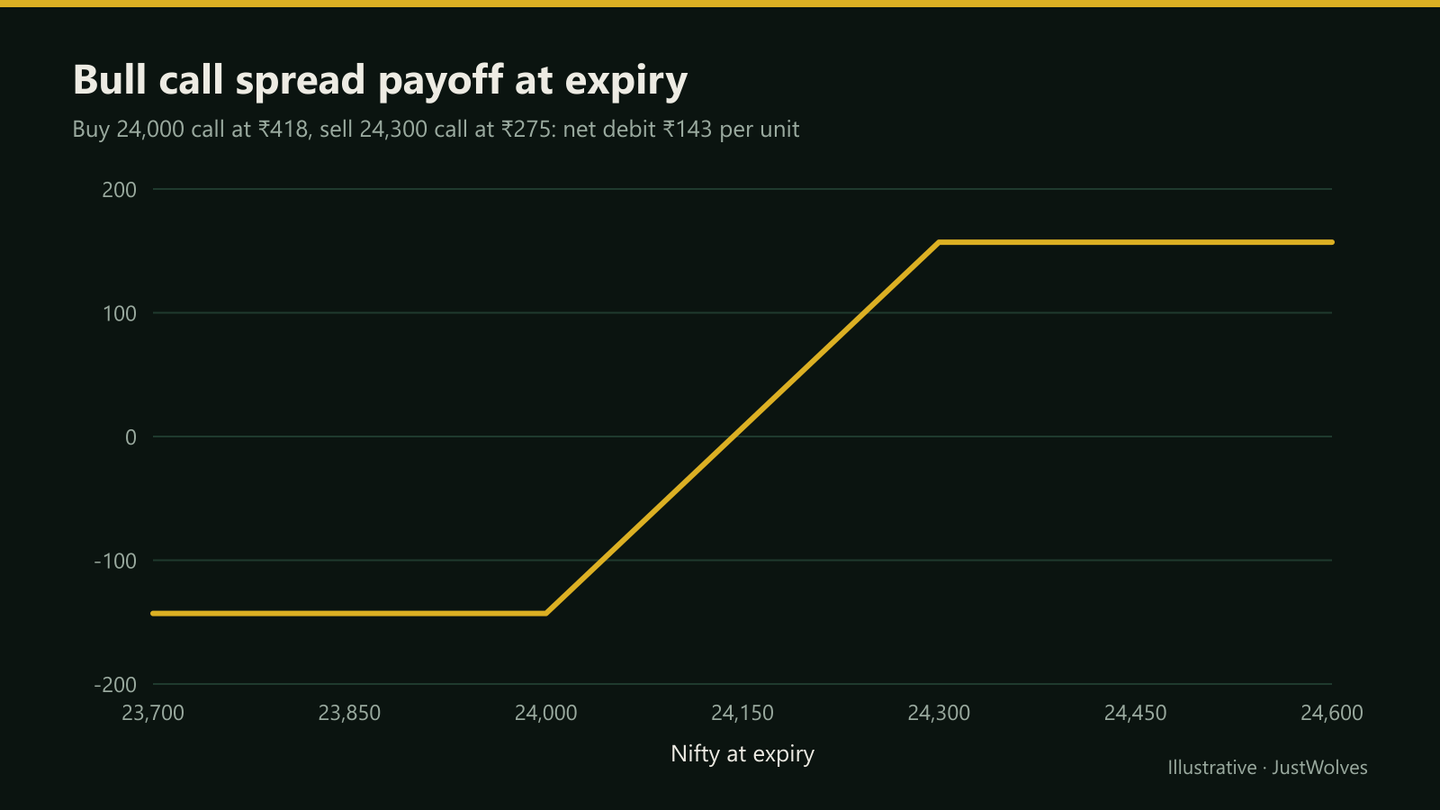
| Maximum loss | Net debit (if price is at or below the lower strike at expiry) |
| Maximum profit | (Higher strike − lower strike) − net debit (at or above the higher strike) |
| Breakeven | Lower strike + net debit |
Why Use a Spread Instead of a Call
| Long call | Bull call spread | |
|---|---|---|
| Cost | ₹418 | ₹143 |
| Breakeven | 24,418 | 24,143 |
| Profit at 24,300 | −₹118 | +₹157 |
| Profit at 24,800 | +₹382 | +₹157 |
| Maximum loss | ₹418 | ₹143 |
The spread wins for moderate moves; the outright call wins for large ones. The sold call also offsets part of the time decay and volatility exposure of the bought call, so the spread is less sensitive to IV changes.
Choosing Strikes and Expiry
- Lower strike: often ATM or slightly ITM, to keep the breakeven close.
- Higher strike: near your realistic target, often a resistance level on the chart.
- Width: wider spreads cost more and offer more profit; narrower spreads are cheaper with a smaller cap.
- Expiry: enough time for the move, as with any bought option.
Managing the Trade
Spreads rarely reach maximum profit until close to expiry, because the sold call keeps some time value while the underlying is near the upper strike. Many traders take profit at 60–80% of the maximum rather than waiting. If the view is invalidated, closing both legs together limits the loss to less than the full debit.
Real Prices: The Spread and the Call Side by Side
The chart below follows a bull call spread through a real month of NIFTY 50 prices in August and September 2025, with the bought call's value alone shown for comparison. Both are modelled each day with a standard pricing model; the index moves are real.
Real NIFTY prices: a bull call spread vs the call alone, August–September 2025
Step 1 of 4
Building the spread
On 13 August 2025 NIFTY closes at 24,619. A trader buys the 24,600 call expiring on 15 September, modelled at 386 points, and sells the 24,900 call. The net debit is 148 points (₹9,620 per lot), the maximum loss; the maximum value is 300.
- What to observe
- Breakeven at expiry: 24,600 + 148 = 24,748.
- Condition
- Compare with buying the call alone for 386.
How the Greeks Change
Because the spread is long one call and short another, its Greeks partly cancel. Its delta is lower than the bought call's alone, so it gains less per point at first; its theta and vega are smaller too, so it's less hurt by time decay and falling volatility. As the price approaches the upper strike near expiry, the short call's effect grows and the spread's value converges on its maximum.
Practical Example
Hypothetically, Nifty is at 24,000, in an uptrend, with resistance near 24,300. Anand buys one lot of the 30-day 24,000 call at ₹418 and sells one lot of the 24,300 call at ₹275. His net debit is ₹143 × 65 = ₹9,295, which is also his maximum loss.
His maximum profit is (300 − 143) × 65 = ₹10,205 if Nifty is at or above 24,300 at expiry, and his breakeven is 24,143. Two weeks later, Nifty is at 24,280 and the spread is worth about ₹182, well short of its ₹300 maximum value because the sold call still has time value. He closes it for a profit of (182 − 143) × 65 = ₹2,535.
Spread or Call? Our Two-Year Test
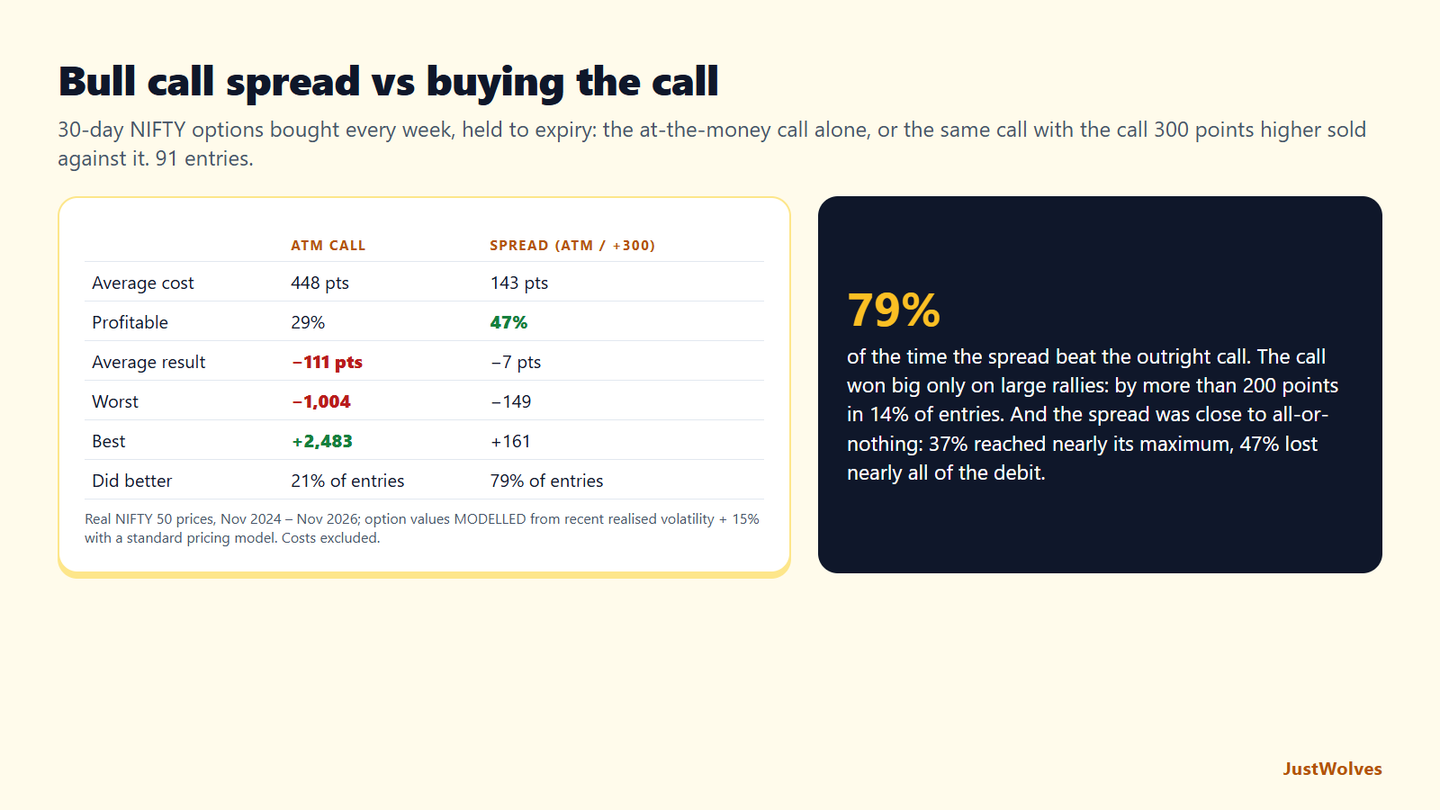
This lesson says the spread wins for moderate moves and the outright call for large ones. JustWolves measured how often each happened on about two years of real NIFTY 50 prices (November 2024 to November 2026). Each week we bought an at-the-money call with about 30 days to expiry, and separately the same call with the call 300 points higher sold against it. Both were held to expiry, with values modelled from recent volatility; 91 entries in all.
| ATM call | Spread (ATM / +300) | |
|---|---|---|
| Average cost | 448 points | 143 points |
| Profitable | 29% | 47% |
| Average result | −111 points | −7 points |
| Worst / best | −1,004 / +2,483 | −149 / +161 |
| Reached at least 90% of maximum value | n/a | 37% |
| Lost at least 90% of the debit | 49% | 47% |
| Did better | 21% of entries | 79% of entries |
The spread did better than the call in 79% of entries, and lost far less on average. It was profitable more often because its breakeven was closer, about 143 points above the strike instead of 448. The call came out ahead only when NIFTY rallied hard: it beat the spread by more than 200 points in 14% of entries, with a best result of nearly 2,500 points that the spread could never match.
Held to expiry, the spread was close to all-or-nothing. In 37% of entries it reached nearly its maximum value, and in 47% it lost nearly all of its debit. That is what a 300-point-wide spread on an index that often moves more than 300 points in a month looks like: most outcomes land beyond one strike or the other.
Exiting early confirmed the lesson's warning about maximum profit. When we closed both versions after 10 trading days instead of at expiry, the spread never reached 90% of its maximum value in any entry, because the sold call still held time value. Its average loss was 14 points against 65 for the call. If you plan to exit early, size your profit target to what a spread can realistically be worth before expiry, not to its maximum.
Common Mistakes
- Placing the upper strike far beyond any realistic target.
- Legging in badly, selling the upper call first.
- Expecting maximum profit before expiry.
- Using the spread for a large expected move, where an outright call would do better.
- Ignoring costs on two legs.
Professional Insight
Experienced traders often prefer spreads when implied volatility is high, because the sold option recovers part of the expensive premium. The spread turns an option purchase into a defined bet on a specific range, which matches how most chart-based targets are set.
Risk Considerations
- The net debit can be lost entirely.
- Profit is capped, even if the market rallies far.
- Execution risk on two legs.
Important Terminology
| Term | Meaning |
|---|---|
| Bull call spread | Long lower-strike call, short higher-strike call. |
| Net debit | The net premium paid to open the spread. |
| Spread width | The difference between the two strikes. |
| Legging in | Entering the legs one at a time. |
| Debit spread | A spread opened for a net payment. |
What is a bull call spread?
A strategy that buys a call and sells a higher-strike call with the same expiry, for a net debit.
What is the maximum loss on a bull call spread?
The net debit paid.
When should I use a bull call spread?
When you expect a moderate rise to around the upper strike, especially when implied volatility is high.
Is a bull call spread better than buying a call?
It's cheaper with a lower breakeven, but caps profit. It does better for moderate moves; a call does better for large ones.
Do I need margin for a bull call spread?
Brokers usually block less than for a naked short call, since the bought call covers the sold one. Check your broker's requirement.
How often does a bull call spread make money?
In our test of 30-day NIFTY spreads, at the money and 300 points higher, on two years of real prices with modelled premiums, the spread was profitable at expiry in 47% of entries, against 29% for buying the call alone. Costs were excluded.
Can a bull call spread lose the whole debit?
Yes. If the underlying finishes at or below the lower strike at expiry, both calls expire worthless and the full debit is lost. In our NIFTY test, that, or nearly that, happened in 47% of entries held to expiry, which is why sizing by the debit matters.
Practical Exercise
Build a spread.
Your task
Step 1: Find a bullish setup
With a clear resistance target.
Step 2: Choose strikes
ATM lower strike, upper strike near the target.
Step 3: Calculate
Net debit, maximum profit and breakeven per lot.
Step 4: Compare
With buying the ATM call alone at three possible expiry prices.
Check Your Understanding
A bull call spread buys:
Related Lessons
Previous: Option Buying: Strategies and Risks. Next: Bear Put Spread. See also How to Read an Option Payoff Diagram.