
Futures vs Options: Key Differences
JustWolves is an educational platform and is not a SEBI-registered investment advisor. Trading financial instruments involves significant risk of loss and may not be suitable for all investors. Past performance is not indicative of future results. Read our full disclaimer →
What you'll learn
- Futures oblige both sides; options give the buyer a right and the seller an obligation
- Futures have a linear payoff; long options have a curved, limited-loss payoff
- Futures need margin; option buyers pay premium, option sellers post margin
- Options lose time value as expiry approaches; futures don't decay in the same way
- The right instrument depends on your view of direction, size of move, time and volatility
In this article · 15 sections
Futures and options both let you trade an index or stock with leverage, but they behave very differently. A futures position moves point for point with the underlying. A bought option has limited loss but must overcome time decay. This lesson puts the two side by side so you can see which suits which kind of trading view.
What You Will Learn
- The key structural differences
- How the payoffs compare
- Capital, cost and time decay
- Which instrument suits which view
Before You Start
Read Futures Contracts Explained and What Is Options Trading? first.
Side by Side
| Futures | Options (buyer) | Options (seller) | |
|---|---|---|---|
| Obligation | Both sides obliged | Right, no obligation | Obliged if exercised |
| Upfront cost | Margin | Premium | Margin (receives premium) |
| Payoff | Linear | Curved; loss capped at premium | Profit capped at premium |
| Time decay | None in the same sense | Works against | Works in favour |
| Maximum loss | Large | Premium paid | Large; unlimited for short calls |
Payoffs Compared
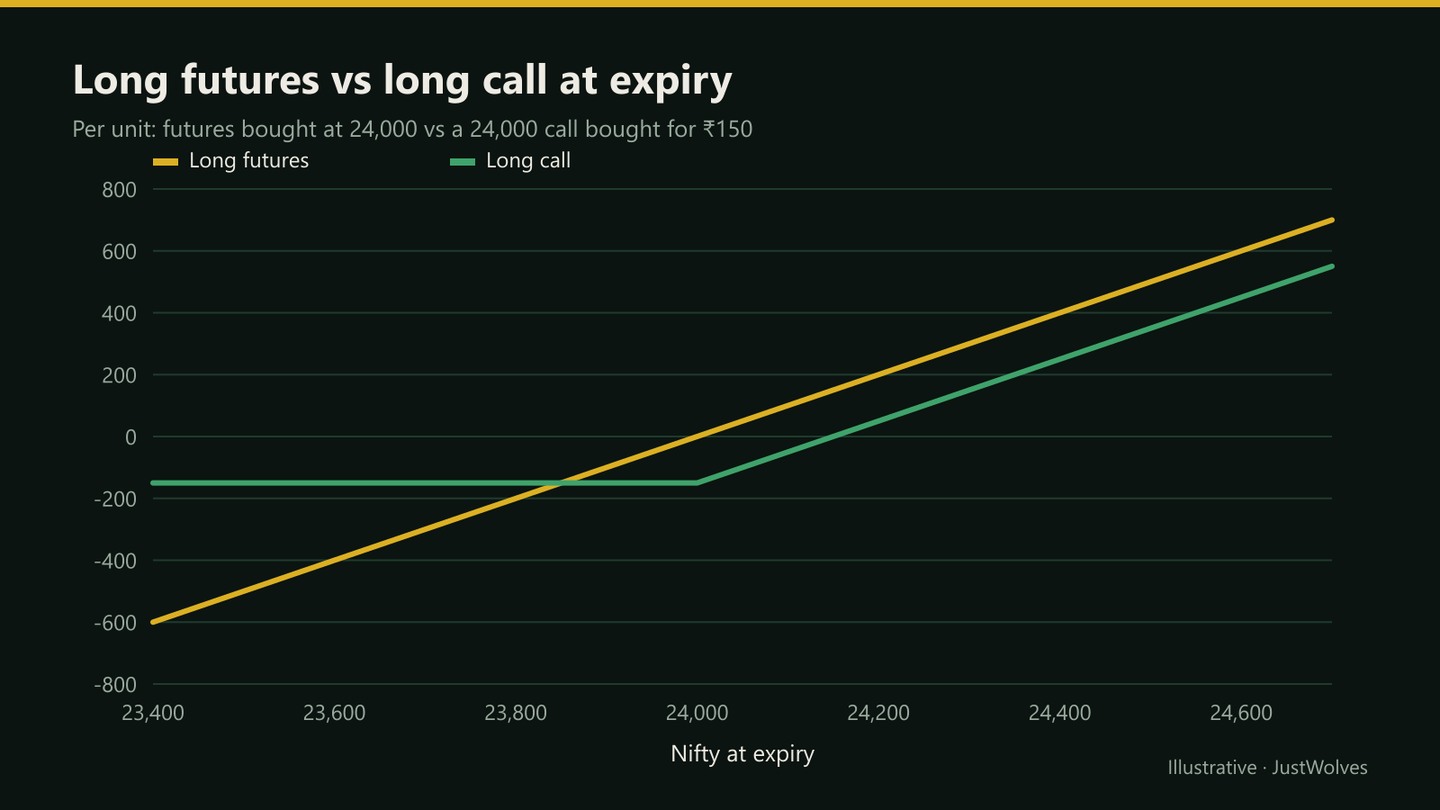
Above the strike, the call lags the futures by exactly the premium paid. Below it, the call's loss stops at the premium while the futures loss keeps growing. That's the trade-off: options buy protection with a cost that's paid whether or not it's needed.
Real Prices: Futures vs a Call at Equal Risk
The chart below uses real daily NIFTY 50 prices from October and November 2026 to run this lesson's equal-risk comparison on a real week. Historical option prices are not in our dataset, so the call premium is modelled from recent volatility; the index moves are real.
Real NIFTY prices: futures with a stop vs a call, at equal risk, October–November 2026
Step 1 of 4
A bullish view
By 27 October 2026 NIFTY has held above about 22,370 for two weeks and closes at 22,750. A trader expects a rise within a week and compares two ways to take it, at equal risk.
- What to observe
- Same view, two instruments.
- Condition
- Compare at equal rupee risk, as this lesson recommends.
Time and Volatility
A futures position doesn't lose value just because time passes. An option does: part of its premium is time value, which shrinks as expiry approaches. An option buyer therefore needs the move to happen soon enough, and large enough, to beat that decay.
Options are also sensitive to volatility. When expected volatility rises, premiums rise; when it falls, they fall, even if the underlying doesn't move. Futures prices don't depend on volatility in this way. Both effects are covered in Module 06.02.
Which Suits Which View?
| Your view | Often considered |
|---|---|
| Directional, steady move, tight stop available | Futures |
| Directional, large move expected soon, want capped loss | Buying options |
| Expect little movement or falling volatility | Selling options (advanced; see Option Selling course) |
| Protecting an existing portfolio | Buying puts, or selling futures |
Costs and Practicalities
Trading costs differ too. In India, securities transaction tax (STT) is charged at different rates on futures and options, and options are charged on premium rather than contract value. Brokerage and exchange charges also apply per order or per lot. For frequent traders, these costs can be a meaningful share of results, so include them when comparing the two.
Liquidity matters as well. Near-month Nifty futures and near-the-money Nifty options are usually very liquid, with tight bid-ask spreads. Far-dated contracts and far out-of-the-money options can have wide spreads, which quietly add to the cost of every trade. For most retail traders, sticking to liquid contracts is one of the simplest ways to keep costs down, whichever of the two instruments they finally choose to trade.
Practical Example
Hypothetically, Nifty is at 24,000 and Ravi expects a rise to 24,500 within a week. Option A: buy one futures lot at 24,000 with a stop at 23,850, risking 150 × 65 = ₹9,750. Option B: buy one lot of the 24,000 call at ₹150, also risking ₹9,750, the whole premium.
If Nifty reaches 24,500, the futures gain 500 × 65 = ₹32,500 and the call, at expiry, gains (500 − 150) × 65 = ₹22,750. If Nifty first dips to 23,800 and then rallies to 24,500, the futures stop is hit for −₹9,750, while the call, with no stop, would still finish with the ₹22,750 gain.
Futures or Options at Equal Risk? Our Test
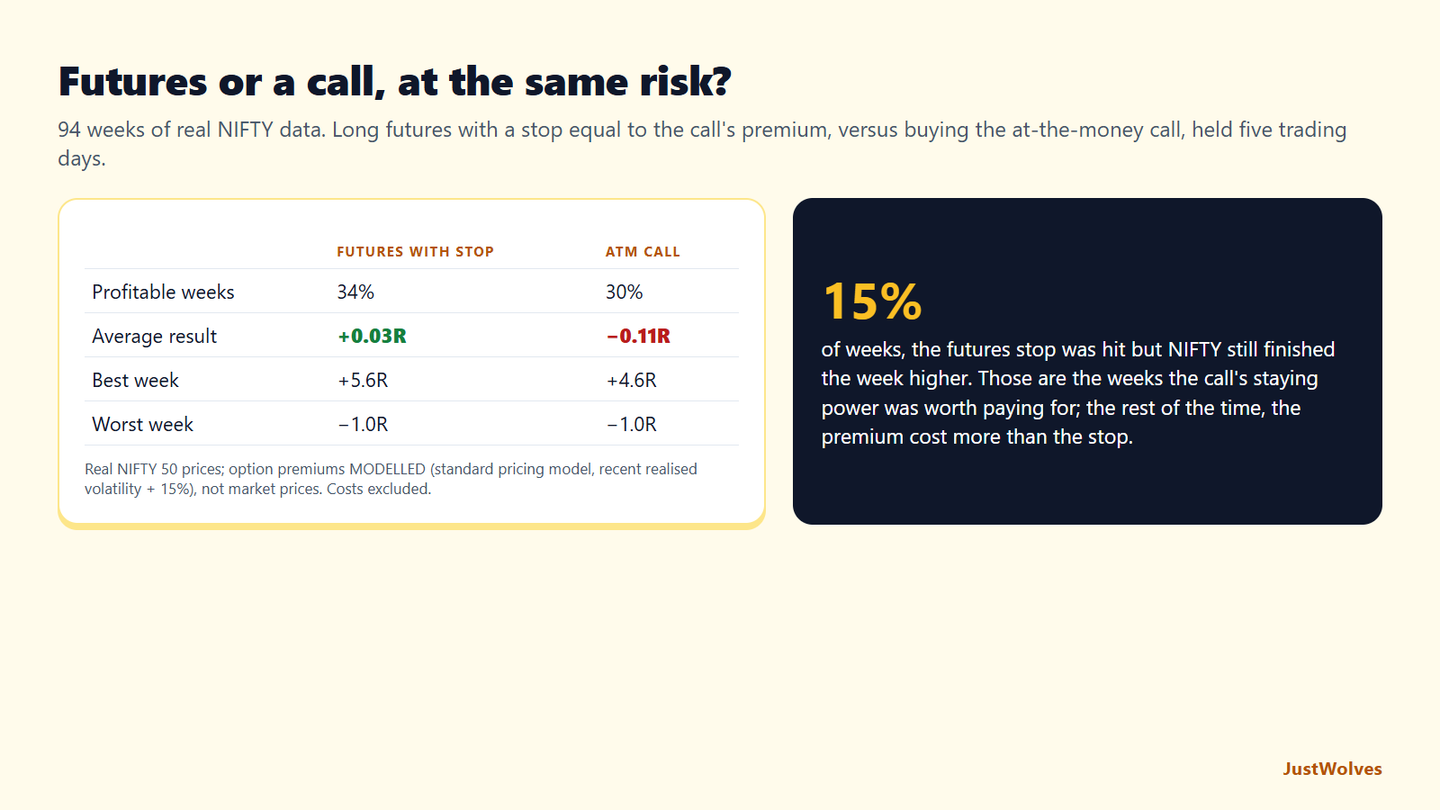
This lesson's professional insight is to compare instruments at equal risk. JustWolves ran that comparison on 94 weeks of real NIFTY 50 prices (November 2024 to November 2026). Each week: buy the at-the-money call (premium modelled with a standard pricing model from recent realised volatility plus 15%) or buy NIFTY futures with a stop the same number of points below the entry as the premium, so both risk the same amount. Both were held for five trading days. Results are in R, where 1R is the premium.
| Futures with stop | At-the-money call | |
|---|---|---|
| Profitable weeks | 34% | 30% |
| Average result | +0.03R | −0.11R |
| Best week | +5.6R | +4.6R |
| Worst week | −1.0R | −1.0R |
| Weeks the futures stop was hit but NIFTY finished higher | 14 of 94 (15%) |
At equal risk, futures with a stop did slightly better on average than the call in this period: +0.03R against −0.11R. The call's advantage, staying power through an adverse move, paid off in the 15% of weeks when NIFTY dipped through the futures stop and then rallied, as in the October 2026 example. In most other weeks the premium, which decays whatever happens, cost more than the stop did.
That matches the trade-off described in this lesson: futures give more reward per point; options give staying power at the cost of the premium. Neither is better in general. If your entries are precise and you can place a sensible stop, futures (or a smaller futures position) may be the cheaper way to express a view. If the move you expect could come after a sharp dip, or around an event where gaps are likely, the call's defined loss may be worth its cost.
Two cautions. The premiums here are modelled, not traded; real premiums before events are often higher, which would make calls look worse. And the test covers long trades in one two-year period.
Common Mistakes
- Choosing options only because they're cheaper.
- Ignoring time decay on bought options.
- Selling options for 'steady income' without understanding the tail risk.
- Using futures without stops and treating margin as the risk.
- Comparing instruments without equal risk.
Professional Insight
Experienced traders compare instruments at equal risk, as in the example above, rather than equal capital. That makes the real trade-off visible: futures give more reward per point; options give staying power through adverse moves at the cost of the premium.
Risk Considerations
- Futures: large losses without stops.
- Option buying: frequent total loss of premium.
- Option selling: rare but very large losses.
Important Terminology
| Term | Meaning |
|---|---|
| Linear payoff | Profit or loss changes one-for-one with price. |
| Time value | The part of an option's premium that decays with time. |
| Volatility | How much the underlying is expected to move. |
| Equal risk | Comparing positions that risk the same amount. |
| Hedge | A position that offsets risk in another. |
What is the difference between futures and options?
Futures oblige both sides to trade at a set price; options give the buyer a right, not an obligation, in exchange for a premium.
Which is riskier, futures or options?
It depends on the side. Option buyers risk only the premium; futures traders and option sellers can lose far more.
Why are options cheaper than futures?
An option buyer pays only the premium, while futures need margin. Cheaper doesn't mean better; options also decay with time.
Should beginners trade futures or options?
Neither should be traded before understanding the risks. Many beginners find small, defined-risk option positions easier to control, but time decay works against them.
Do futures have time decay?
Not in the way options do, though the basis to spot narrows as expiry approaches.
Is it better to trade NIFTY futures or options?
Neither is better in general. In our 94-week test at equal risk, futures with a stop averaged +0.03R per week against −0.11R for an at-the-money call (with modelled premiums). The call did better only in weeks when NIFTY dipped sharply first and then rallied, about 15% of weeks.
Practical Exercise
Compare at equal risk.
Your task
Step 1: Pick a view
For example, Nifty up 1.5% in a week.
Step 2: Futures plan
Entry, stop and rupee risk for one lot.
Step 3: Option plan
A call whose premium per lot equals that risk.
Step 4: Compare outcomes
At three possible expiry levels.
Check Your Understanding
Who has an obligation in a futures contract?
Related Lessons
Previous: What Is Options Trading?. Next module: Strike Price, Expiry and Moneyness. See also Position Sizing.