
Option Buying: Strategies and Risks
JustWolves is an educational platform and is not a SEBI-registered investment advisor. Trading financial instruments involves significant risk of loss and may not be suitable for all investors. Past performance is not indicative of future results. Read our full disclaimer →
What you'll learn
- Buying options suits views of a sizeable move, soon, ideally when implied volatility isn't elevated
- The buyer must overcome time decay and possibly falling IV, not just get the direction right
- Choose strike and expiry from the size and timing of the expected move
- Size positions so that losing the entire premium is an acceptable loss
- Set exit rules in advance for both profits and losses; don't simply hold to expiry
In this article · 15 sections
Buying calls and puts is how most traders start with options. The appeal is clear: limited loss, large potential gain, and a small upfront cost. The reality is harder: time decay works against every bought option, and many expire worthless. This lesson covers when option buying makes sense, how to choose strike and expiry, how to size and exit, and the risks you need to accept.
What You Will Learn
- When buying options fits a trading view
- How to choose strike and expiry
- How to size option purchases
- Exit rules and the main risks
Before You Start
Read Option Greeks: Theta, Vega and Rho and Strike Price, Expiry and Moneyness first.
When Buying Makes Sense
- A sizeable move is expected: large enough to beat the premium paid, not just a drift in the right direction.
- Soon: within a period that leaves room before expiry, because time decay accelerates near the end.
- IV isn't stretched: buying when implied volatility is already high means paying extra, and a later volatility drop can offset gains.
- Defined risk is needed: for example, trading around an event where a futures stop could be skipped by a gap.
The Buyer's Three Hurdles
| Hurdle | Why it matters |
|---|---|
| Direction | The underlying must move the right way |
| Size | The move must exceed the extrinsic value paid |
| Timing | It must happen before decay erodes the premium |
Choosing Strike and Expiry
| View | Strike | Expiry |
|---|---|---|
| Moderate move expected within days | ATM or slightly ITM | Next two to four weeks |
| Large move expected, timing uncertain | Slightly OTM | One to two months |
| Hedge against a sharp fall | OTM put | Covering the risk period |
As a rule of thumb, choose an expiry at least two to three times longer than you expect the trade to take. That reduces the impact of accelerating decay if the move takes longer than planned.
Sizing by Premium
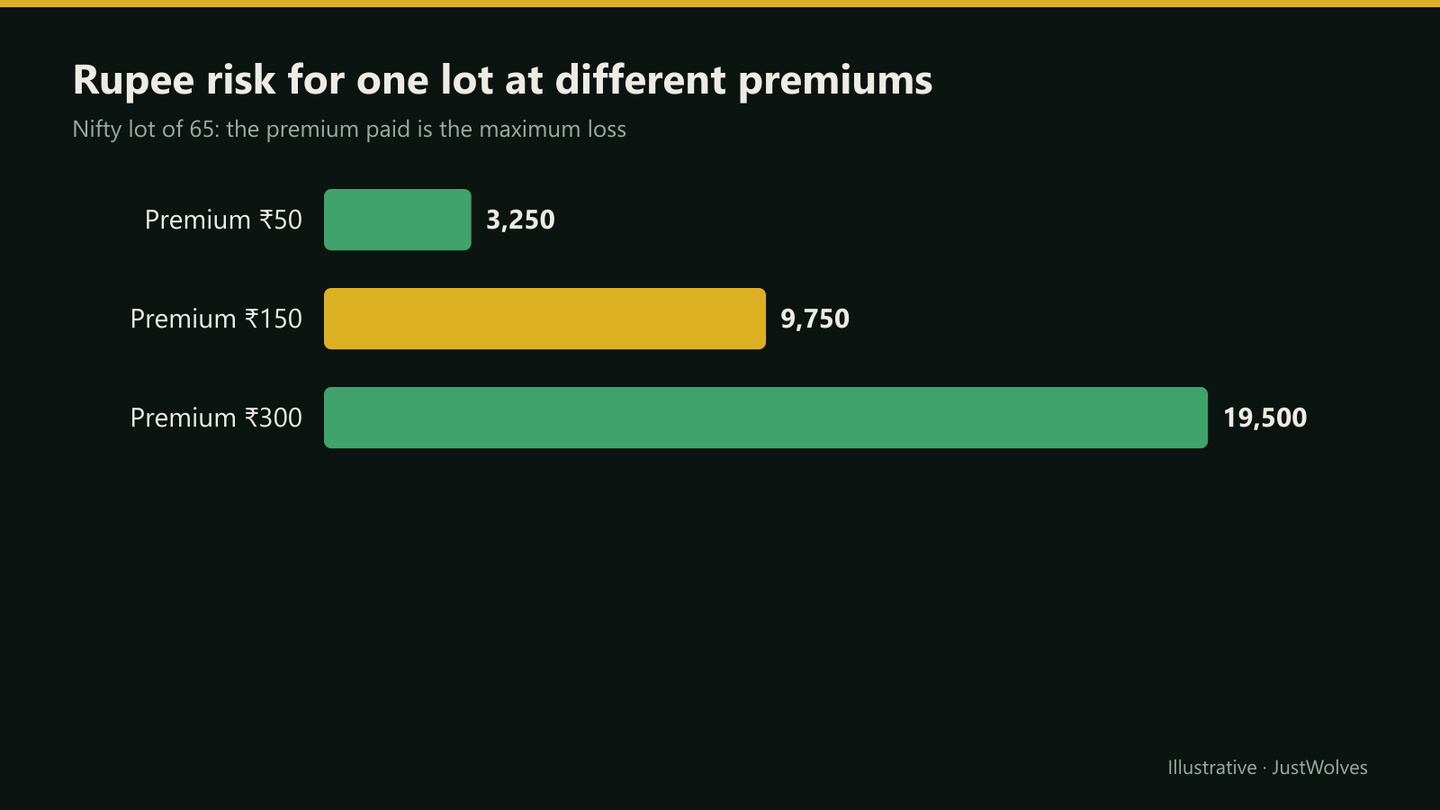
With bought options, the maximum loss is the premium, so many traders size by assuming they could lose all of it. If you risk 1% of a ₹5,00,000 account (₹5,000) per trade, you can afford an option position costing up to ₹5,000 if you hold with no stop, or more if you use a stop at, say, 50% of the premium.
With a 50% premium stop, a position costing ₹10,000 risks about ₹5,000. Gaps can push losses beyond the stop, so leave a margin of safety in your sizing.
Exit Rules
- Profit target: a premium level or an underlying level, set before entry.
- Premium stop: for example, exit if the option loses 40–50% of its value.
- Underlying stop: exit if the chart invalidates the view, regardless of premium.
- Time stop: exit if the move hasn't started within a set number of days, before decay accelerates.
Real Prices: A Premium Stop, Then a Rally
Exit rules have costs as well as benefits. The chart below uses real NIFTY 50 prices from September and October 2025, with a one-month call valued each day by a standard pricing model, to show a case where a 50% premium stop protected the trader for a week and then cost them the trade.
Real NIFTY prices: a premium stop, then a rally, September–October 2025
Step 1 of 4
The purchase
On 19 September 2025 NIFTY closes at 25,327. A trader buys the 25,350 call expiring in about a month, modelled at 336 points (₹21,840 per lot of 65), with a rule to exit if the premium halves.
- What to observe
- Defined risk: the most that can be lost is ₹21,840.
- Condition
- Plan: exit below 168.
Practical Example
Hypothetically, Nifty is at 24,000 after a pullback to support in an uptrend. Lalitha expects a move to 24,400 within a week. India VIX is moderate. She buys one lot of the 24,000 call with 30 days to expiry at ₹418, costing ₹27,170.
Her rules: exit if the premium falls to ₹250 (a ₹10,920 loss, about 2% of her ₹5,50,000 account), take profit if Nifty reaches 24,400, and exit after seven sessions if neither happens. Nifty reaches 24,400 on day four and the call trades at ₹640, a gain of ₹14,430.
How Often Do Bought Options Pay? Our Test
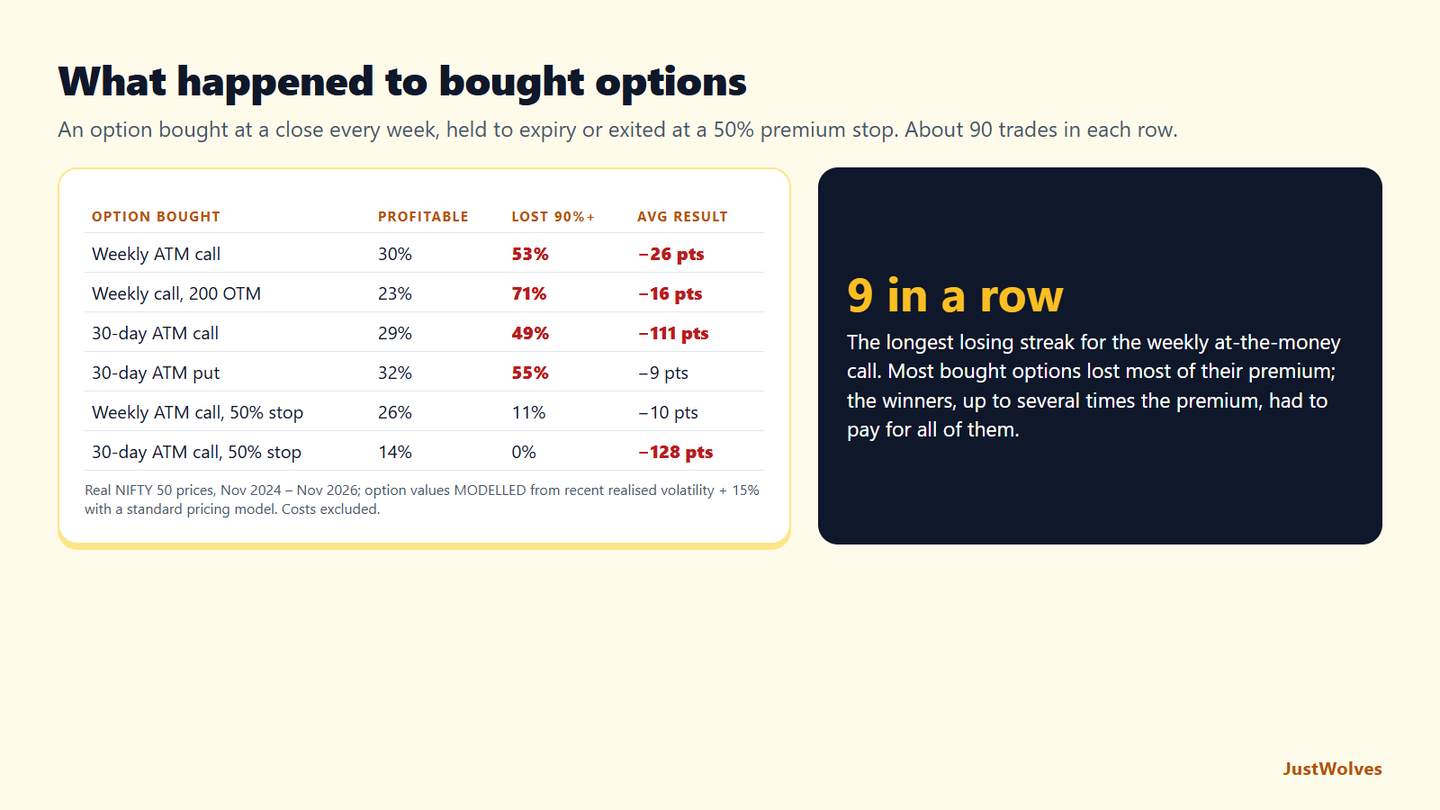
This lesson says a large share of bought options lose some or all of their premium. JustWolves measured how large, on about two years of real NIFTY 50 prices (November 2024 to November 2026). Each week we bought one option at a close, either a weekly option or one with about 30 days to expiry, and either held it to expiry or exited when its value fell 50%. Option values were modelled from recent volatility; there are about 90 trades in each row.
| Option bought | Profitable | Lost 90% or more | Average result |
|---|---|---|---|
| Weekly ATM call, held | 30% | 53% | −26 points |
| Weekly call 200 points OTM, held | 23% | 71% | −16 points |
| 30-day ATM call, held | 29% | 49% | −111 points |
| 30-day ATM put, held | 32% | 55% | −9 points |
| Weekly ATM call, 50% premium stop | 26% | 11% | −10 points |
| 30-day ATM call, 50% premium stop | 14% | 0% | −128 points |
About seven in ten bought options lost money, and around half lost nearly everything. Out-of-the-money options were cheaper but worse: the weekly call 200 points out of the money lost 90% or more of its premium in 71% of weeks. The best winners were several times the premium, which is why the average loss per trade was modest compared with the frequency of losses. That is the profile this lesson describes: frequent small losses, occasional large wins.
The 50% premium stop helped weekly options and hurt monthly ones. On weekly calls it cut the near-total losses from 53% to 11% of trades and improved the average result. On 30-day calls, where the option had time to recover, the stop was hit in 82% of trades and turned many eventual winners into losers, as in the chart above, cutting the share of profitable trades from 29% to 14%. A premium stop is not automatically right; it should match how long the trade idea needs. An underlying stop, based on the chart, avoids exiting just because time decay and a small move have shrunk the premium.
Losing streaks were long. The weekly at-the-money call lost nine weeks in a row at one point, and the 30-day options had streaks of 11 or more. Sizing by premium, as this lesson recommends, is what makes that survivable: at 1% risk per trade, nine straight full losses cost about 9% of the account; at 5% per trade they cost about 37%.
Common Mistakes
- Buying cheap far OTM options hoping for a jackpot.
- Buying just before events when IV is high.
- Holding to expiry instead of exiting on plan.
- Averaging down on losing options.
- Sizing by lots rather than by rupee risk.
Professional Insight
Experienced option buyers tend to be selective, buying when volatility is relatively cheap and a catalyst or technical setup suggests a move is likely soon. They accept frequent small losses as the cost of occasional large gains, and they keep each position small enough that a string of losses doesn't matter.
Risk Considerations
- Total loss of premium is common.
- Time decay and IV crush work against buyers.
- Liquidity can be poor in far strikes.
Important Terminology
| Term | Meaning |
|---|---|
| Long call / long put | A bought call or put. |
| Premium stop | An exit when the option loses a set percentage of its value. |
| Time stop | An exit after a set period if the move hasn't happened. |
| Catalyst | An event expected to move the underlying. |
| Breakeven | Strike ± premium at expiry. |
Is option buying profitable?
It can be for disciplined traders, but many bought options lose money because buyers must overcome time decay and get direction, size and timing right.
Which options should I buy?
Match strike and expiry to the size and timing of the move you expect. ATM or slightly ITM options with some time remaining suit many views.
Should I hold options until expiry?
Usually not. Exiting on predefined targets and stops avoids the steepest time decay.
How much should I risk on an option trade?
Many traders risk 0.5–2% of their account per trade, sizing so that losing the whole premium is acceptable.
Why did my option lose value when the market moved my way?
Time decay or a fall in implied volatility outweighed the price move.
How often do bought options make money?
In our test on two years of real NIFTY prices with modelled premiums, weekly at-the-money calls were profitable in 30% of weeks and 30-day at-the-money calls in 29% of trades, before costs. About half lost 90% or more of their premium.
Should I use a stop loss on the option premium?
It depends on the holding period. In our NIFTY test, a 50% premium stop reduced losses on weekly options but hurt 30-day options, where it was hit in most trades and cut many eventual winners. A stop based on the underlying chart is often a better fit for longer-dated options.
Practical Exercise
Paper-trade five option buys.
Your task
Step 1: Write a view
Direction, target and timeframe for each.
Step 2: Choose strike and expiry
Using this lesson's guidelines.
Step 3: Set exits
Target, premium stop and time stop.
Step 4: Track
Record outcomes and which hurdle failed in the losers.
Check Your Understanding
Option buying suits a view of:
Related Lessons
Previous module: Put-Call Ratio. Next: Bull Call Spread. See also Position Sizing.