
What Are Derivatives? Futures, Options and How They Work
JustWolves is an educational platform and is not a SEBI-registered investment advisor. Trading financial instruments involves significant risk of loss and may not be suitable for all investors. Past performance is not indicative of future results. Read our full disclaimer →
What you'll learn
- A derivative is a contract whose value depends on something else, called the underlying
- The main types are forwards, futures, options and swaps; Indian retail traders mostly use exchange-traded futures and options
- Derivatives are used to hedge risk, to speculate and to arbitrage price differences
- Most derivatives are leveraged: a small amount of money controls a large position
- Leverage magnifies losses as much as gains, which is why risk management matters more here than anywhere else
In this article · 15 sections
Futures and options, often shortened to F&O, are among the most actively traded instruments in Indian markets. Both are derivatives: contracts whose value comes from something else, such as the Nifty 50 index or a company's shares. This first lesson of the course explains what derivatives are, the main types, who uses them and why, and the one feature, leverage, that makes them both useful and dangerous.
What You Will Learn
- What a derivative is and what 'underlying' means
- The main types of derivatives
- Exchange-traded versus over-the-counter contracts
- Why derivatives are used, and the risks of leverage
Before You Start
No prior knowledge of derivatives is needed. A basic understanding of how shares and indices are traded helps. Risk Management Basics is useful background for everything in this course.
What a Derivative Is
A derivative is a financial contract whose value is derived from the price of something else. That something is called the underlying. It can be a share, a stock index such as the Nifty 50, a currency pair, a commodity such as gold, or an interest rate.
When the underlying moves, the derivative's value moves too, in a way defined by the contract. A Nifty futures contract gains value when the Nifty rises; a Nifty put option generally gains value when the Nifty falls.
The Main Types
| Type | What it is | Where it trades |
|---|---|---|
| Forward | A private agreement to buy or sell at a fixed price on a future date | Over the counter (privately) |
| Future | A standardised forward traded on an exchange | Exchanges such as NSE and BSE |
| Option | The right, but not the obligation, to buy or sell at a fixed price | Exchanges, and over the counter |
| Swap | An agreement to exchange cash flows, such as fixed for floating interest | Mostly over the counter, used by institutions |
Retail traders in India mostly use exchange-traded futures and options on indices and stocks. The rest of this course focuses on those two.
Exchange-Traded vs Over-the-Counter
Exchange-traded derivatives have standard terms set by the exchange: contract size, expiry dates and settlement rules. A clearing corporation stands between buyer and seller, so neither side depends on the other paying up. In India, equity derivatives trade on NSE and BSE, regulated by SEBI.
Over-the-counter (OTC) derivatives are negotiated privately between two parties, usually banks and companies. Their terms can be customised, but each side carries the risk that the other fails to pay.
Why Derivatives Are Used
- Hedging: reducing an existing risk. An investor holding a portfolio of Indian shares can buy Nifty put options to limit losses in a sharp fall; an importer can lock in a currency rate.
- Speculation: taking a view on price direction or volatility with less capital than buying the underlying outright.
- Arbitrage: profiting from small price differences between related markets, such as a stock and its futures contract.
Leverage: The Defining Feature
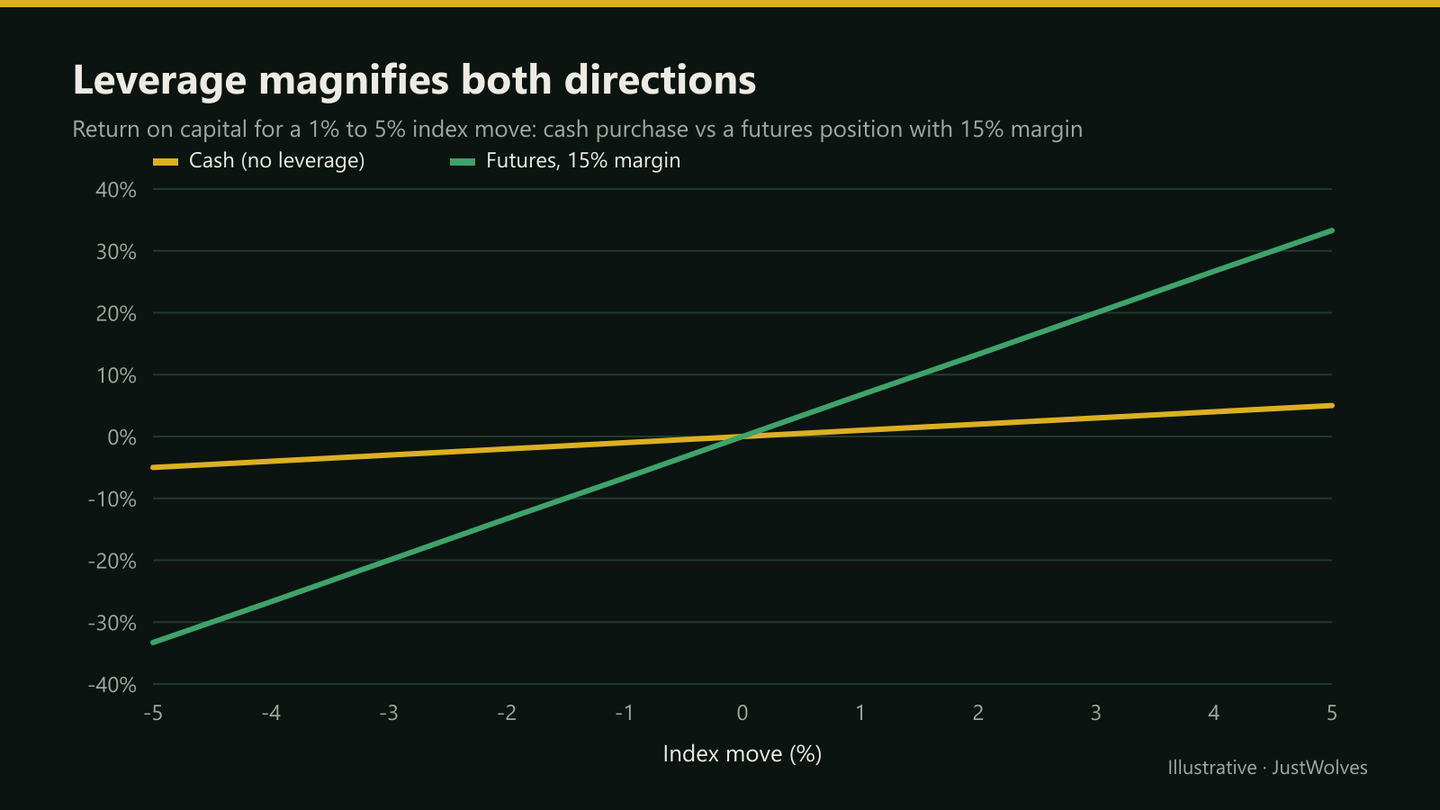
With most derivatives, you don't pay the full value of the position. A futures position requires only a margin, a fraction of the contract's value; an option buyer pays only the premium. That means a small amount of money controls a large exposure.
Leverage works both ways. A 1% move in the underlying can be a much larger percentage gain or loss on the money you put up. With futures and sold options, losses can exceed the money initially deposited.
Real Data: A NIFTY Futures Lot Through a Sharp Fall
The chart below uses real daily NIFTY 50 index data from March and April 2025, a period that included the worst five-day fall in our two years of data. Step through it to see what leverage means in rupees for one futures lot.
Real data: one NIFTY futures lot through a sharp fall, March–April 2025
Step 1 of 3
The position
Imagine one long NIFTY futures lot (65 units) bought at the close of 28 March 2025, 23,519. The contract is worth about ₹15.3 lakh; with margin of 15% as an illustration, the trader posts about ₹2.3 lakh.
- What to observe
- A large exposure for a modest deposit.
- Condition
- Every NIFTY point is worth ₹65.
Practical Example
Hypothetically, Nifty is at 24,000. Buying Nifty exposure worth ₹15,60,000 (one lot of 65 units) in the cash market would mean buying the underlying shares outright. With Nifty futures, a trader might instead post margin of roughly ₹2,30,000 (about 15%, as an illustration).
If Nifty rises 2% to 24,480, the position gains 480 × 65 = ₹31,200. On ₹15.6 lakh that's 2%; on ₹2.3 lakh of margin it's about 13.6%. If Nifty falls 2% instead, the loss is also ₹31,200, again about 13.6% of the margin.
How Large Are Real NIFTY Moves on Leveraged Money? Our Data
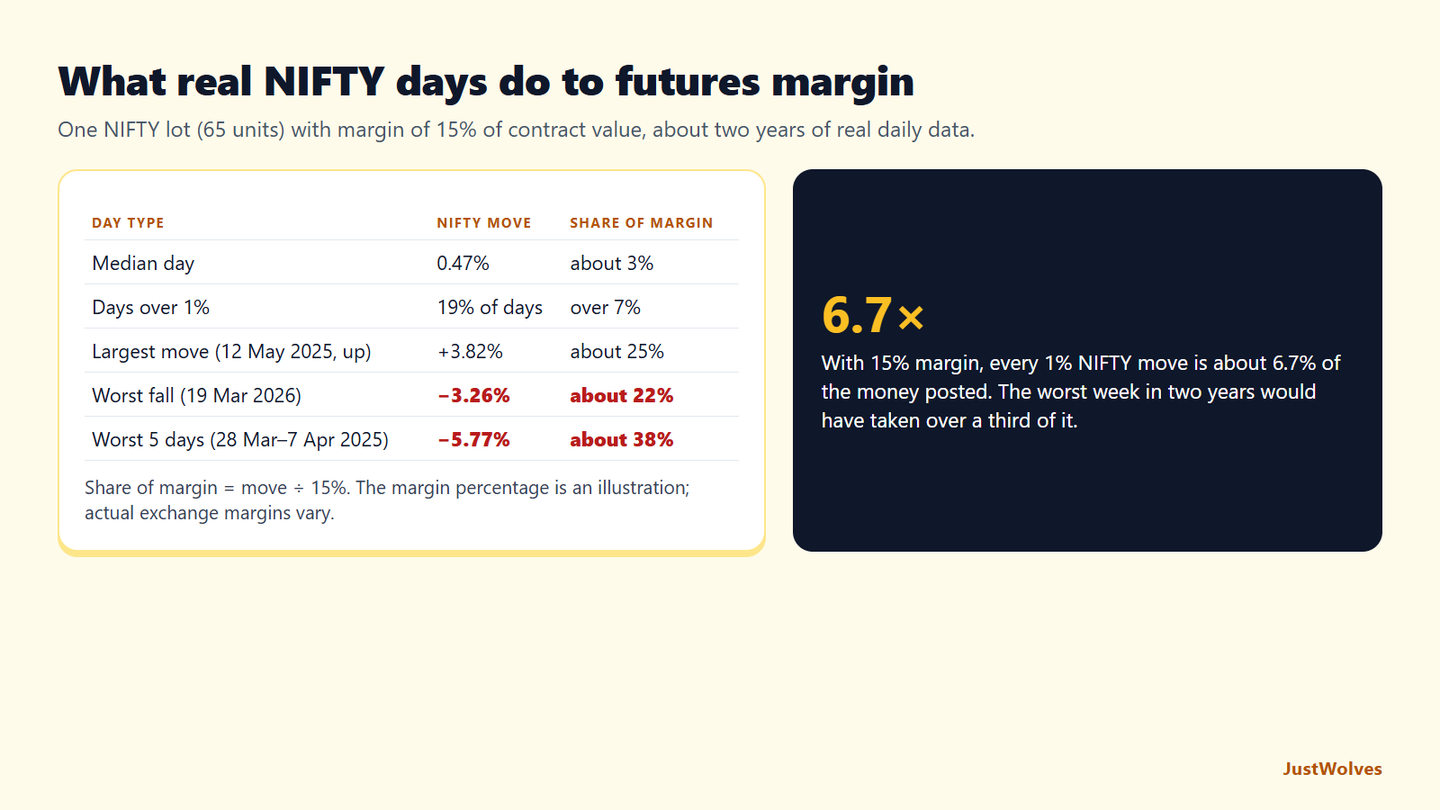
JustWolves measured about two years of real daily NIFTY 50 closes (November 2024 to November 2026) and expressed each day's move as profit or loss on one futures lot of 65 units, compared with an illustrative margin of 15% of the contract value. Actual exchange margins vary with volatility; the point is the scale, not the exact percentage.
| Day type | NIFTY move | Per lot (approx.) | Share of 15% margin |
|---|---|---|---|
| Median day | 0.47% | ±₹7,600 | about 3% |
| A move of more than 1% | 19% of all days | over ₹15,000 | over 7% |
| Largest single-day move (12 May 2025) | +3.82% | about +₹59,600 | about 25% |
| Worst single-day fall (19 Mar 2026) | −3.26% | about −₹50,400 | about 22% |
| Worst five days (28 Mar – 7 Apr 2025) | −5.77% | about −₹88,300 | about 38% |
This puts numbers on this lesson's leverage section. On an ordinary day, a NIFTY futures lot gains or loses only about 3% of the margin. But roughly one day in five moves more than 1%, and the extremes are large: a single bad day cost over a fifth of the margin, and the worst week over a third.
Two practical consequences follow. First, the margin is not the risk: a trader who sizes positions by how many lots the margin allows, rather than by the full contract value, as the mistakes list warns, can lose a large share of the account in a week that is not even unusual by historical standards. Second, leverage can force you out at the worst time. In the March–April 2025 example, a trader with no spare funds would have faced margin calls near the low, while the market recovered within two weeks.
Common Mistakes
- Focusing on the margin, not the exposure: the risk is on the full contract value.
- Assuming options buyers can't lose much: premiums can, and often do, go to zero.
- Starting with derivatives before understanding the underlying market.
- Ignoring costs: brokerage, STT and other charges add up with frequent trading.
Professional Insight
Institutions use derivatives mostly to manage risk: hedging portfolios, currency exposure and interest rates. Speculation exists too, but within strict position limits and risk controls. Beginners tend to see derivatives the other way round, as a way to multiply returns, which is how many of them get hurt.
Risk Considerations
- Leverage magnifies losses.
- Losses can exceed deposits in futures and short options.
- Time limits: derivatives expire, unlike shares you can hold indefinitely.
Important Terminology
| Term | Meaning |
|---|---|
| Derivative | A contract whose value depends on an underlying asset. |
| Underlying | The asset, index or rate a derivative is based on. |
| Exchange-traded | Standardised contracts traded on an exchange. |
| OTC | Over-the-counter: privately negotiated contracts. |
| Leverage | Controlling a large position with a small amount of capital. |
What are derivatives in simple words?
Contracts whose value comes from something else, such as a share, an index or a currency.
What is F&O trading?
Trading futures and options, the two main exchange-traded derivatives in Indian equity markets.
Are derivatives risky?
They're leveraged, so losses can be large and fast. They can also reduce risk when used for hedging.
Who regulates derivatives in India?
SEBI regulates exchange-traded securities derivatives, which trade on exchanges such as NSE and BSE.
Can I lose more than I invest?
With futures and sold options, yes. Option buyers can lose at most the premium paid.
How much can one NIFTY futures lot gain or lose in a day?
In our two years of real data, the median daily move was about 0.47%, roughly ±₹7,600 on a 65-unit lot. The largest single-day move was +3.82% (about ₹59,600) and the worst fall −3.26% (about ₹50,400).
Practical Exercise
Calculate leverage.
Your task
Step 1: Note the Nifty level
From today's market.
Step 2: Contract value
Multiply by the current lot size from NSE's website.
Step 3: Assume a margin
Check your broker's margin calculator for one Nifty futures lot.
Step 4: Compute
What percentage of your margin would a 1% Nifty move be?
Check Your Understanding
A derivative's value depends on:
Related Lessons
Next: Futures Contracts Explained. See also Leverage and Margin Risk.