
Leverage and Margin Risk: How Margin Calls Happen and How to Avoid Them
JustWolves is an educational platform and is not a SEBI-registered investment advisor. Trading financial instruments involves significant risk of loss and may not be suitable for all investors. Past performance is not indicative of future results. Read our full disclaimer →
What you'll learn
- Leverage lets you control a position worth more than the money you put up, magnifying gains and losses alike
- The move that wipes out your margin is roughly 100% ÷ leverage
- Effective leverage is position value ÷ account equity, and it is the number that matters
- A margin call happens when losses push your equity below the margin required; brokers can close positions without asking
- Size positions from your stop and risk per trade, never from the margin available
In this article · 14 sections
Leverage is the reason futures, options and forex attract so many new traders: a small deposit controls a large position. It is also the reason so many of them lose money quickly. Leverage itself is just arithmetic. The danger comes from letting the margin a broker allows decide how big your positions are.
What You Will Learn
- What leverage and margin are, and how they relate
- How much a price move has to be to wipe out your margin at different leverage levels
- What a margin call is, and how mark-to-market settlement works in Indian F&O
- How to measure your effective leverage and keep it under control
Before You Start
Read Position Sizing and the 1% Rule first. The Forex course lesson on leverage and margin basics (01.01.07) and the Futures & Options lesson on futures margin (06.01.03) cover the mechanics in more detail; this lesson focuses on the risk.
Leverage and Margin in Plain Terms
Margin is the deposit a broker or exchange requires before you can hold a leveraged position. It is collateral, not the cost of the trade and not the most you can lose.
Leverage is the size of the position compared with the money backing it. If ₹1,80,000 of margin controls a contract worth ₹15,60,000, the leverage on that margin is about 8.7×.
Leverage multiplies everything: a 1% move in the underlying becomes roughly an 8.7% gain or loss on the margin posted.
| Leverage | Move that wipes out the margin |
|---|---|
| 1× (no leverage) | 100% |
| 2× | 50% |
| 5× | 20% |
| 10× | 10% |
| 30× | 3.33% |
| 100× | 1% |
| 500× | 0.2% |
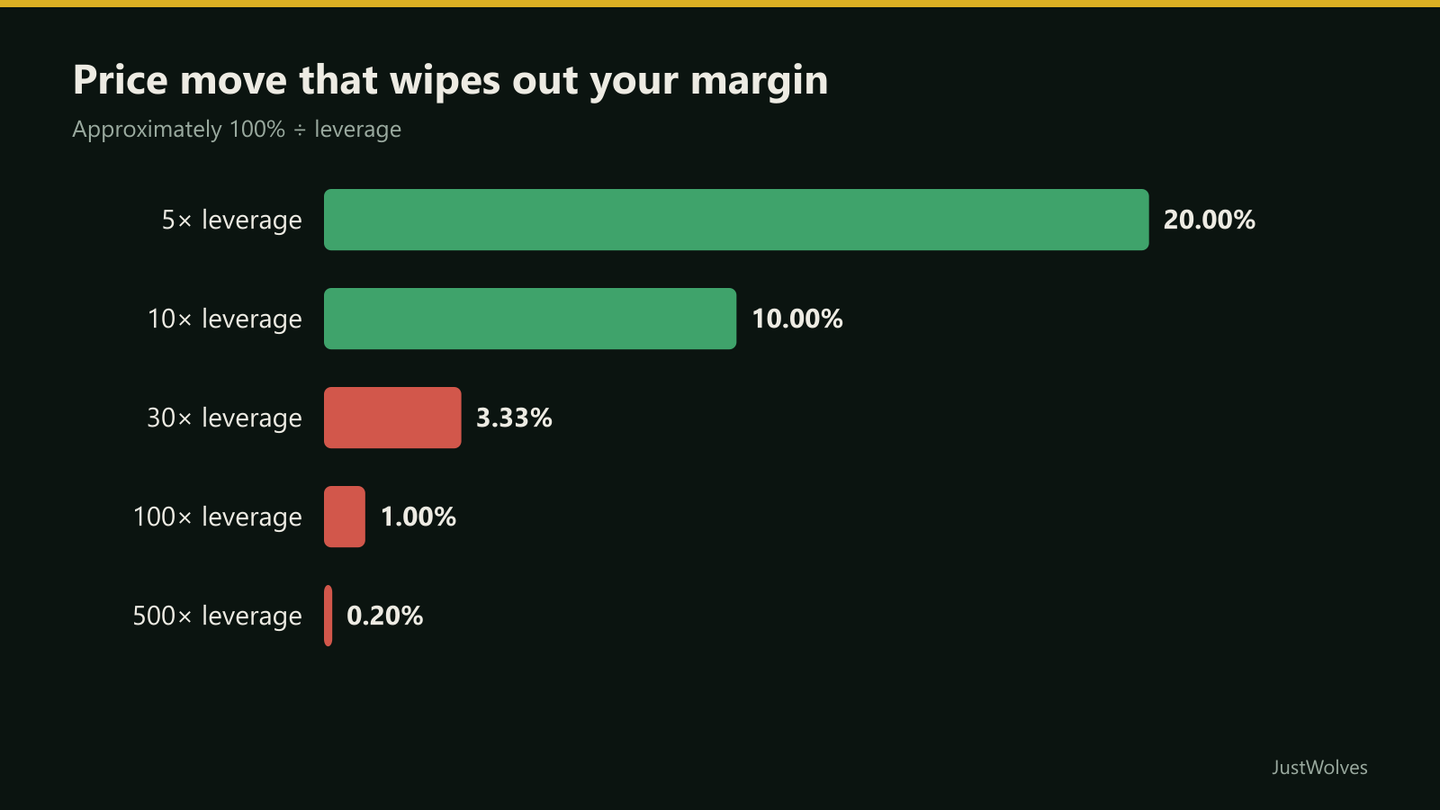
The bottom of that chart is why high-leverage offshore forex apps are so destructive, apart from being illegal for Indian residents (see Is Forex Trading Legal in India?): at 1:500, a 0.2% move, smaller than many ordinary intraday swings, wipes out the deposit.
Effective Leverage: The Number That Matters
Leverage on margin describes one position. What decides your risk is effective leverage: the total value of all your positions divided by your whole account equity.
Suppose your account holds ₹5,00,000 and you buy one Nifty futures lot. At an illustrative Nifty level of 24,000 and a lot size of 65, the contract is worth ₹15,60,000. Your effective leverage is 15,60,000 ÷ 5,00,000 = 3.1×. A 1% Nifty move changes your account by about 3.1%.
Buy three lots and effective leverage becomes about 9.4×: a 1% move is now ₹46,800, or 9.4% of the account. The margin system may well allow it. Your risk plan almost certainly shouldn't.
How Mark-to-Market and Margin Calls Work
Indian exchange-traded futures are marked to market every day: at the end of each session, the day's profit or loss is credited to or debited from your account in cash, based on the settlement price. Losses are taken from your balance immediately, not when you close the position.
If those debits push your account equity below the margin required to hold your positions, you have a margin shortfall, the situation commonly called a margin call. You must add funds or reduce positions. Brokers can, and in fast markets do, close positions themselves without waiting for you, and exchanges levy penalties on margin shortfalls.
For intraday trading, SEBI's peak-margin rules require brokers to collect the full upfront margin even on positions closed the same day, which has limited the very high intraday leverage once common in India. Check your broker's current margin requirements; they vary by instrument and over time.
A Gap Example
You hold one Nifty futures lot (contract value about ₹15,60,000) with ₹1,80,000 of margin (an illustrative figure; actual margins vary). Overnight news sends Nifty 3% lower at the open.
What happens
Step 1: The loss
3% of ₹15,60,000 is ₹46,800, debited in the day's mark-to-market.
Step 2: Relative to margin
₹46,800 is 26% of the ₹1,80,000 margin posted, from one opening gap.
Step 3: Relative to your plan
If your stop was 60 points below entry, you planned to lose 60 × 65 = ₹3,900. The gap cost twelve times that.
Step 4: The margin check
If your remaining free cash can't cover the lower equity plus any increase in margin, you face a shortfall and possible forced square-off.
Real Prices: The Day Leverage Is Tested
The gap example above uses an illustrative 3% move. The chart below shows a real one, much larger: NIFTY 50 around the 2024 election results, when the index fell 8.7% from the previous close to its low on 4 June.
Real prices: an 8.7% fall from the previous close, and what it does to leverage, NIFTY 50, 31 May – 6 June 2024
Step 1 of 4
A gap up
NIFTY 50 ends 31 May 2024 at 22,547.9 and opens on 3 June at 23,337.9, about 3.5% higher, staying near that level all day and ending at 23,305.9.
- What to observe
- A large gap in the trader's favour, or against them, depending on the side.
- Condition
- Results day is the next session.
Controlling Leverage, Step by Step
Rules that keep leverage in its place
Step 1: Size from the stop, not the margin
Use the position-sizing formula. Margin only tells you whether you're allowed to take the trade, never how big it should be.
Step 2: Cap effective leverage
Set a ceiling on total position value ÷ account equity, for example 3× for overnight index futures, and calculate it before adding a position.
Step 3: Keep free margin
Leave a cash buffer, for example at least half the margin in use, to absorb mark-to-market debits and margin increases.
Step 4: Stress-test gaps
Before holding overnight, calculate the loss from a 3–5% gap. If it would breach your daily or weekly limit badly, reduce size.
Step 5: Avoid unlimited-risk positions without a plan
Short options and naked futures can lose far more than the margin. The Option Selling course covers hedging and maximum-loss planning.
How Big Are NIFTY's Gaps and Falls? Our Data
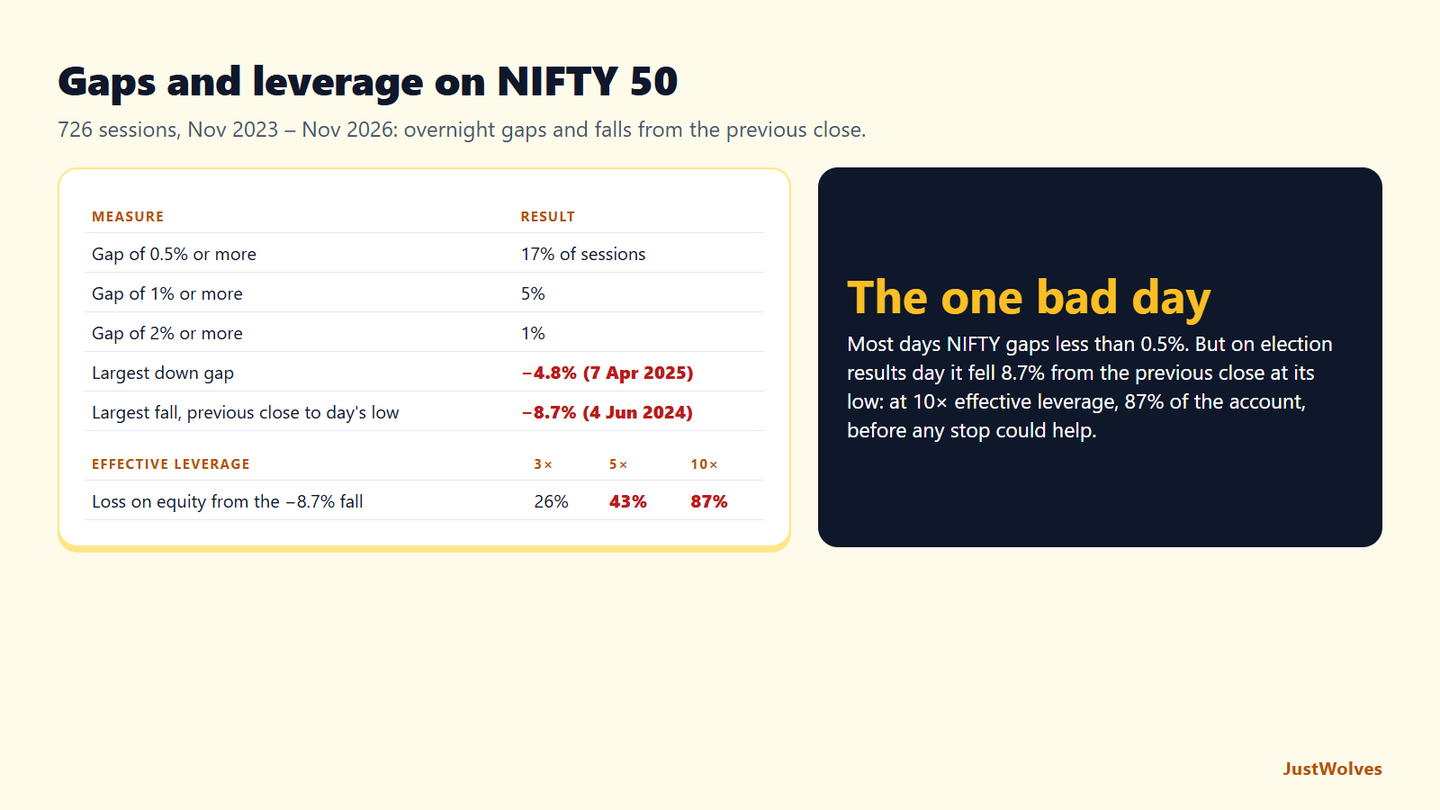
To put this lesson's formula into real numbers, JustWolves measured NIFTY 50's overnight gaps and its largest falls from the previous close to the day's low over 726 sessions, November 2023 to November 2026, using hourly data. We then calculated what the largest fall would mean for an account at different effective leverage, the total position value divided by account equity.
| Measure | Result |
|---|---|
| Sessions with an overnight gap of 0.5% or more | 17% |
| Gap of 1% or more | 5% |
| Gap of 2% or more | 1% |
| Largest down gap | −4.8% (7 April 2025) |
| Largest fall, previous close to the day's low | −8.7% (4 June 2024) |
| Effective leverage | Loss on equity at the −8.7% low |
|---|---|
| 3× | 26% |
| 5× | 43% |
| 10× | 87% |
Most days are quiet; one day decides. NIFTY opened more than 1% away from the previous close on only 5% of sessions. A trader using high leverage could go months without a problem. Then, on 4 June 2024, the index fell 8.7% from the previous close to its low. At 10 times effective leverage, that is almost the whole account, in a single session.
Gaps bypass stops. The largest overnight gap, −4.8% on 7 April 2025, happened before any stop could trade. As the Stop-Loss lesson's data showed, gaps through stops are a regular event, and leverage multiplies their cost.
Effective leverage is the number to control. This lesson's formula, the move that erases the equity is about 100% divided by leverage, gives 33% at 3 times, 20% at 5 times and 10% at 10 times. NIFTY's largest fall in three years was 8.7%. Keeping effective leverage at a level where that kind of day is painful but survivable is what the professional insight in this lesson means by controlling notional exposure as well as risk per trade.
Common Mistakes
- Treating margin as the maximum loss. Losses can exceed the margin posted.
- Using all available margin. It leaves no room for mark-to-market losses or margin increases.
- Ignoring effective leverage. Several 'small' positions can add up to high leverage.
- Holding leveraged positions through big events without a plan. Results, policy announcements and global news can gap prices.
- Chasing high leverage offshore. Beyond the legal problem, the arithmetic makes ruin likely.
Advanced Insight
Experienced traders often express their risk in two numbers at once: risk per trade (from the stop) and notional exposure (effective leverage). The first controls normal losses; the second controls the damage from events the stop can't handle, such as gaps, halts and sudden margin increases. A position can pass the first test and fail the second, which is exactly what happens in the gap example above.
Risk Considerations
- Losses beyond margin: futures and short options can lose more than the margin deposited, leaving a debit balance you owe.
- Liquidity: in fast markets forced square-offs may happen at poor prices.
- Correlation: leveraged positions in related instruments compound each other (lesson 12.02.06).
Important Terminology
| Term | Meaning |
|---|---|
| Margin | Collateral required to open and hold a leveraged position. |
| Leverage | Position value compared with the money backing it. |
| Effective leverage | Total value of all positions ÷ total account equity. |
| Mark-to-market (MTM) | Daily settlement of profits and losses on futures based on the settlement price. |
| Margin call / shortfall | When equity falls below the margin required; you must add funds or reduce positions. |
| Forced square-off | A broker closing your positions because of a margin shortfall. |
| Notional exposure | The full market value of a leveraged position, not just the margin posted. |
What is a margin call?
A demand to add funds or reduce positions because losses have pushed your account equity below the margin required. If you don't act, the broker can close positions for you.
Can I lose more than my margin?
Yes. Futures and short option positions can lose more than the margin deposited, especially through gaps, leaving you owing the broker.
What is a safe level of leverage?
There's no universally safe level, but keeping effective leverage modest (for example below 3× on overnight index futures) and sizing every trade from its stop keeps most leverage risk under control.
How does mark-to-market work in India?
At the end of each trading day, profits and losses on futures positions are settled in cash using the exchange's settlement price, so losses are debited from your account immediately.
Is high leverage forex trading allowed in India?
Leveraged forex or CFD trading with offshore brokers is not permitted for Indian residents under FEMA. Legal currency trading happens through exchange-traded currency derivatives.
What was NIFTY's biggest one-day fall recently?
In our three years of hourly data, the largest fall from the previous close to the day's low was 8.7%, on 4 June 2024, election results day. The largest opening gap down was 4.8%, on 7 April 2025.
How much leverage is safe for trading NIFTY futures?
There is no single safe level, but the arithmetic is clear: at 10 times effective leverage, NIFTY's 8.7% fall on 4 June 2024 would have cost 87% of equity; at 3 times, 26%. Many traders keep effective leverage low enough that the worst historical day is survivable.
Practical Exercise
Use your own positions, or this example: account ₹6,00,000, holding 2 Nifty futures lots (lot 65) at 24,000, plus ₹1,50,000 of shares.
Your task
Step 1: Calculate notional exposure
Value of the futures (price × lot size × lots) plus the shares.
Step 2: Calculate effective leverage
Total exposure ÷ account equity.
Step 3: Stress-test a 3% fall
Assume everything falls 3%. What is the loss in rupees and as a percentage of the account?
Step 4: Compare with your limits
Would that breach your daily or weekly loss limit? What would you change?
Check Your Understanding
At 20× leverage, roughly what adverse move wipes out the margin?
Related Lessons
Previous: Daily and Weekly Loss Limits. Next: Portfolio Exposure and Correlation Risk (12.02.06). See also Is Forex Trading Legal in India?.