
Fear and Greed in Trading: How They Distort Every Stage of a Trade
JustWolves is an educational platform and is not a SEBI-registered investment advisor. Trading financial instruments involves significant risk of loss and may not be suitable for all investors. Past performance is not indicative of future results. Read our full disclaimer →
What you'll learn
- Fear and greed are normal reactions; the damage comes from letting them change a plan mid-trade
- Fear causes missed entries, early exits and moved stops; greed causes oversizing, chasing and stretched targets
- Each stage of a trade (before, during, after) has its own typical fear and greed mistakes
- Market-wide fear, such as a spike in India VIX, signals larger moves, not direction
- Fixed rules for size, entry, exit and review keep both emotions in check
In this article · 15 sections
Every trader feels fear and greed. Fear of losing money, of being wrong, of missing out; greed for a bigger win, a faster win, one more trade. These feelings are not a character flaw. They are how human brains respond to risk and reward. The problem starts when they quietly rewrite a plan you made with a clear head. This lesson shows where each one strikes and how to keep it from deciding for you.
What You Will Learn
- The different forms fear and greed take in trading
- How they distort decisions before, during and after a trade
- What market-wide fear and greed look like, and what they do and don't tell you
- Practical rules and habits that keep both in their place
Before You Start
Read Trading Psychology: The 5 Mental Traps first. This lesson goes deeper into the two emotions behind most of those traps.
The Many Faces of Fear
Fear in trading is rarely panic. It is usually quieter:
- Fear of losing money: hesitating on valid setups, or exiting early at the first red candle.
- Fear of being wrong: moving a stop rather than admitting the trade failed, because a stop-out feels like a verdict on you.
- Fear of missing out (FOMO): jumping into a move after it has already run, with no plan (covered in depth in lesson 12.03.03).
- Fear of giving back profit: closing a winner far short of its target because a small pullback feels like a threat.
Notice that some fears make you trade too little and others too much. Fear is not simply caution.
The Many Faces of Greed
- Oversizing: increasing position size after a few wins, or to make a trade 'worth it'.
- Moving targets further away: a target reached becomes a target missed because you wanted more.
- Adding to positions without a plan: buying more because it's going up, not because a rule says so.
- Chasing: entering far from your planned level because the move looks too good to miss.
- Overtrading: taking marginal setups because more trades feel like more chances.
Greed is most dangerous after success. A good week makes larger size and looser rules feel justified, just before the inevitable losing streak arrives.
Fear and Greed at Each Stage of a Trade
| Stage | Fear makes you… | Greed makes you… | Rule that helps |
|---|---|---|---|
| Before entry | Skip valid setups after losses | Take marginal setups, size up | Written setup criteria and fixed risk per trade |
| Entering | Wait for 'more confirmation' and enter late | Chase price far from your level | Limit orders at planned prices; no entry beyond a set distance |
| During the trade | Exit at the first pullback; move the stop | Remove the target; add impulsively | Exit plan decided before entry; alerts instead of screen-watching |
| After a loss | Freeze, or trade too small to matter | Revenge trade to win it back | Daily loss limit and a reset routine |
| After a win | Stop trading to 'protect' the gain | Increase size, loosen rules | Size changes only by written rule |
Market-Wide Fear and Greed
Whole markets swing between fear and greed too. In fearful markets volatility rises, ranges widen and gaps are bigger. In greedy markets, rallies stretch and dips get bought quickly.
In India, India VIX measures the market's expectation of Nifty volatility over the next 30 days, derived from Nifty option prices. A rising VIX means traders expect bigger moves. It does not tell you which direction prices will go, and 'buy when fear is high' is a slogan, not a trading rule.
Real Prices: What a Fearful Market Looks Like
This lesson describes how whole markets swing between fear and greed. The chart below shows a real fearful phase on NIFTY 50 in March and April 2026: repeated gaps of more than 2%, wide daily ranges and a sharp snap-back.
Real prices: a fearful market in daily candles, NIFTY 50, February–April 2026
Step 1 of 4
Fear arrives
NIFTY 50 trades near 25,500 in late February 2026, then on 2 March opens 2.1% below the previous close, at 24,659.
- What to observe
- In this lesson's terms, the market is shifting from greed to fear.
- Condition
- Daily ranges start to widen.
Step by Step: Keeping Fear and Greed in Check
A routine for every trade
Step 1: Decide everything before entry
Entry level, stop, target or exit method, and position size, written down.
Step 2: Size so a loss doesn't hurt
If a stop-out would ruin your day, the position is too big. Halve it.
Step 3: Use alerts, not attention
Set price alerts at your stop and target, then close the chart.
Step 4: Change nothing mid-trade without a rule
The only reasons to act are the conditions you wrote down before entry.
Step 5: Name the emotion after each trade
In your journal, record what you felt at entry, during and at exit. Patterns appear within a few weeks.
Practical Example
After three winning days, Priya feels she has the market figured out. She doubles her usual size and moves her target from ₹1,480 to ₹1,520 "because momentum is strong". Price reaches ₹1,482, pulls back, and her doubled position is stopped out for −2R instead of a planned +2R. Greed turned a winning trade into a losing one twice over.
The next morning, fear takes over: she skips two valid setups, both of which work. Her journal shows the pattern clearly. Her new rule: size changes only after 20 trades, and targets are never moved further away once set.
Does Market Fear Change the Odds? Our Test
This lesson's callout suggests using fear gauges to adjust size. JustWolves tested whether the market's mood actually changed results, using a real trade stream: every close above the prior 20-day high on 17 large NSE stocks from November 2024 to November 2026, with a stop below the previous five days' low, a 2R target and delivery costs of 0.25% per round trip. We measured NIFTY 50's 20-day realised volatility on each entry day and split the 419 trades into thirds: calm, middle and volatile.
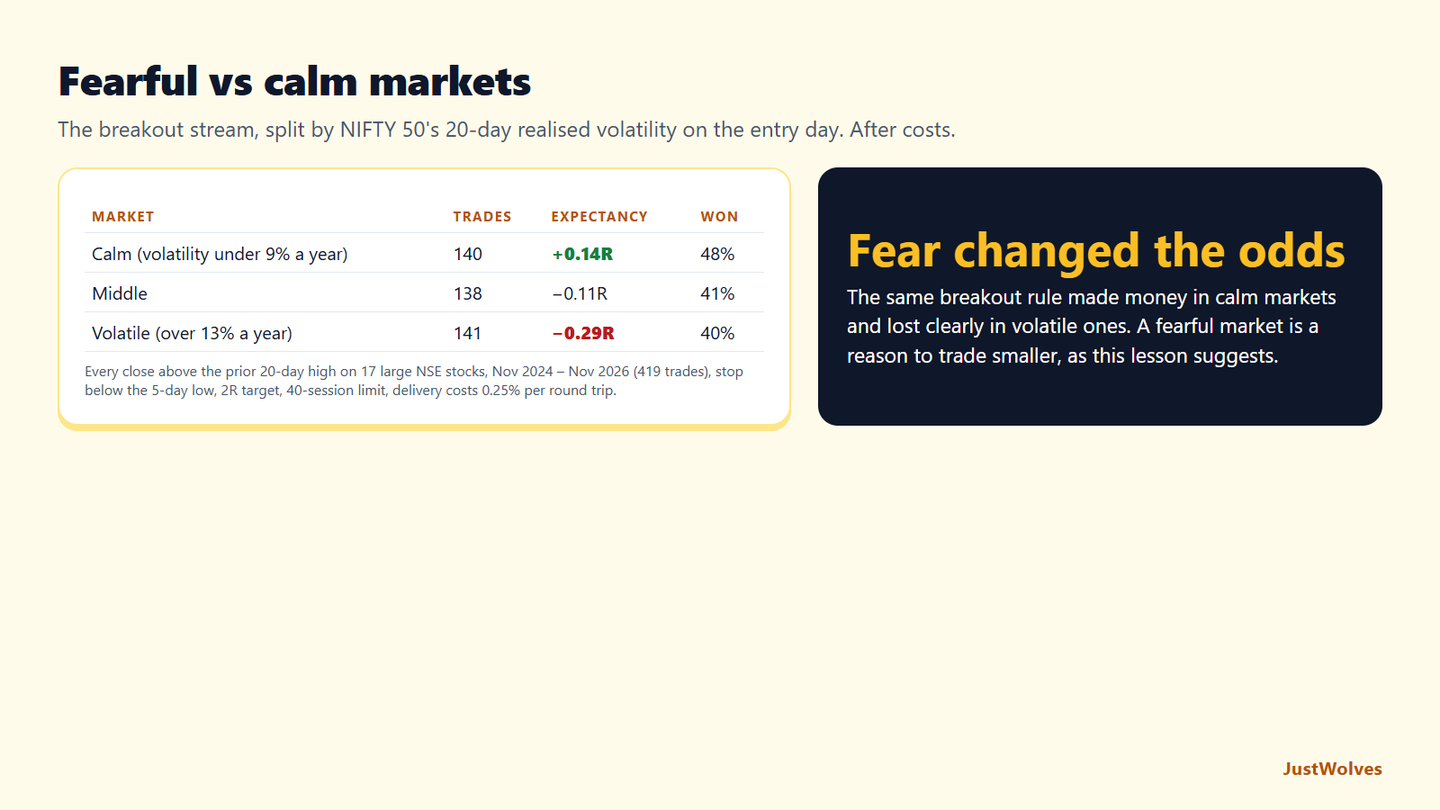
| NIFTY 20-day volatility at entry | Trades | Expectancy | Won |
|---|---|---|---|
| Calm: under 9% a year | 140 | +0.14R | 48% |
| Middle | 138 | −0.11R | 41% |
| Volatile: over 13% a year | 141 | −0.29R | 40% |
The market's mood changed the odds. The same breakout rule averaged +0.14R in calm markets and −0.29R in volatile ones: a difference of more than 0.4R per trade, from nothing but the environment. In fearful markets, ranges were wider and reversals sharper, so breakouts failed more often and stops were hit more easily.
Greed is most dangerous after calm. This lesson notes that greed grows after success. In this data, success came in calm markets; a trader who scaled up after a good calm run would have carried that larger size into the next volatile phase, where the same setups lost. Priya's story in this lesson is that pattern on a single trade.
Use fear for sizing, not prediction. Volatility did not say which way the market would go next, but it did say how reliable the setups were likely to be. Smaller size when volatility is high, or wider stops with proportionally smaller positions, is the practical response, as this lesson's callout suggests.
Common Mistakes
- Treating fear as caution. Fear can push you into bad trades (FOMO) as well as out of good ones.
- Loosening rules after wins. Success is when greed is strongest.
- Using market fear as a buy signal. High volatility means larger moves, not cheap prices.
- Trying to feel nothing. The aim is to act on the plan despite the feeling, not to eliminate it.
- Not recording emotions. Without a journal, the same pattern repeats unnoticed.
Professional Insight
Many professionals deliberately keep position size small enough to be boring. Boredom is a good sign: it means no single trade carries enough emotional charge to override the plan. If a trade makes your heart race, it's usually telling you about your position size, not about the market.
Risk Considerations
- Emotional decisions concentrate risk at the worst moments: after streaks and in volatile markets.
- Leverage amplifies emotion: the larger the swings in rupees, the stronger the fear and greed.
- Financial pressure (trading money you need) makes both emotions harder to manage.
Important Terminology
| Term | Meaning |
|---|---|
| FOMO | Fear of missing out: entering a move impulsively because others seem to be profiting. |
| Chasing | Entering far beyond your planned level after price has already moved. |
| Oversizing | Taking a position larger than your risk rules allow. |
| India VIX | An index of expected Nifty volatility over the next 30 days, based on option prices. |
| Emotional journal | Notes on how you felt during each trade, used to spot recurring patterns. |
How do I control fear in trading?
Keep each trade's risk small enough that a loss doesn't hurt, decide your exit plan before entry, and use alerts instead of watching every tick.
How do I stop being greedy in trading?
Fix your position size and targets before entry, and change size only by a written rule, never after a run of wins.
What is India VIX?
An index of the volatility the options market expects in the Nifty over the next 30 days. Higher values mean bigger expected moves in either direction.
Is it good to buy when everyone is fearful?
Not as a rule on its own. Fearful markets can keep falling. Use your own setups and risk rules; treat high fear as a reason to adjust size.
Why do I exit winning trades too early?
Usually fear of giving back profit, a form of loss aversion. A pre-set exit plan and alerts instead of screen-watching help.
Do trading setups work worse in volatile markets?
Breakouts did in our NSE data. Entries made when NIFTY 50's 20-day volatility was above 13% a year averaged −0.29R per trade after costs, against +0.14R when it was below 9%.
How should I adjust for a fearful market?
Mainly through size. Wider ranges mean stops are hit more easily, so many traders cut position size or widen stops with proportionally smaller positions. Our data suggests the same setups are less reliable in volatile phases.
Practical Exercise
For your next 10 trades (or a review of your last 10), keep a three-line emotion log per trade.
Your task
Step 1: Before entry
Rate your confidence 1–5 and note any fear or excitement.
Step 2: During
Note any urge to change the plan and whether you acted on it.
Step 3: After
Record whether you followed the plan and how you felt about the result.
Step 4: Review
After 10 trades, compare trades where you changed the plan with those where you didn't, in R.
Check Your Understanding
Which behaviour is driven by greed?
Related Lessons
Previous: Trading Psychology: The 5 Mental Traps. Next: FOMO, Revenge Trading and Overtrading (12.03.03). See also Trailing Stops and Taking Profit for deciding exits in advance.