
Patience and Realistic Expectations in Trading: Escaping the Quick-Money Trap
JustWolves is an educational platform and is not a SEBI-registered investment advisor. Trading financial instruments involves significant risk of loss and may not be suitable for all investors. Past performance is not indicative of future results. Read our full disclaimer →
What you'll learn
- The quick-money mindset makes traders abandon good positions and chase moving ones
- Patience is a deliberate choice not to act when nothing in your plan has changed
- Alerts and fixed review times remove most of the temptation to interfere
- Don't move capital from slow positions to fast ones mid-trade; let each trade reach its stop or target
- Realistic expectations come from your own measured results, not from screenshots
In this article · 17 sections
Most traders arrive with a picture of trading built from social media: big wins, fast. That picture creates a mindset in which a position that hasn't moved for a week feels like a mistake and a stock running without you feels like a loss. Patience isn't a personality trait you either have or don't. It's a set of habits that stop that mindset from making your decisions.
What You Will Learn
- Why the quick-money mindset damages good trades
- Practical habits that build patience: alerts, review times and written rules
- The capital-reallocation trap, and the rule that avoids it
- How to set realistic expectations for your own trading
Before You Start
Read Trading Psychology: The 5 Mental Traps first. Examples here use swing trades, but the habits apply to every timeframe.
Where the Quick-Money Mindset Comes From
Many new traders in India start with intraday options, introduced through videos and screenshots of large one-day profits. The content is persuasive because it is selective: the losing days, and the accounts that didn't survive, are rarely shown. SEBI's 2024 study of the F&O segment found that about nine in ten individual traders lost money between FY22 and FY24.
Coming from that environment, any trade that takes weeks feels slow, and slow feels wrong. That feeling is the problem this lesson addresses.
How the Quick-Money Mindset Damages Trades
You buy a stock at ₹100 with a stop at ₹92 and a six-week target of ₹130. After two weeks it's at ₹104: moving the right way, slowly. Meanwhile another stock on your watchlist has risen 12% in three days. You sell the first position to buy the second, which promptly pulls back, while the first reaches ₹130 a month later without you.
Nothing about the original trade was wrong. The setup was valid, the stop wasn't hit and the target was reachable. The only thing that changed was your patience. Repeated over a year, this pattern alone can turn a profitable strategy into a losing one.
Patience Is a Decision Not to Act
Patience doesn't mean doing nothing; it means not acting when there is no valid reason to act. That's harder than it sounds, because inaction feels wrong when money is on the line. Every day without a new trade feels wasted; every day a position doesn't move feels like dead capital.
The fix is to make the reasons to act explicit. If you've written down that you act only when the stop is hit, the target is reached, or a specific new fact changes the thesis, then every other urge is easy to recognise for what it is.
Step by Step: Building Patience Into Your Process
Habits that do the waiting for you
Step 1: Set alerts before the trade opens
Place price alerts at your stop and target the moment you enter. The alert tells you when to act; until it fires, there's nothing to decide.
Step 2: Fix your review times
For swing trades, review once after the close (after 3:30 pm, when the daily candle is complete) and optionally at the open to check for gaps. Not hourly, and not live.
Step 3: Use a three-question review
Is the stop intact? Has the target been reached? Is there new information that changes the thesis? If all three are 'no', close the chart.
Step 4: Write your rules on paper
Entry, exit, sizing and when you're allowed to change a plan. A rule you can see is harder to break than one you remember.
Step 5: Keep trading part-time
Swing trading doesn't need full-time screen-watching. Keeping your main income removes the pressure to make every trade pay the bills.
The Capital-Reallocation Trap
With several positions open, a specific temptation appears: move money from positions that are flat into ones that are moving. It feels like backing winners. In practice it means selling valid setups at their least exciting moment and buying others after their move, often near a short-term high.
| Situation | Action |
|---|---|
| Stop-loss hit | Exit. Look for a new setup to redeploy the capital. |
| Target reached | Exit. Deploy the freed capital on a new setup. |
| Flat, stop and target intact | Hold. Flat is not failed. |
| Another position moving fast | Don't sell the flat one to buy more of the mover. |
| New fundamental event against the thesis | Reassess the affected position on its own merits. |
Real Prices: Slow, Then Done
The slow-position example in this lesson is hypothetical. The chart below shows a real one: a Mahindra & Mahindra breakout in July 2025 that went nowhere for five weeks, tempting a switch to faster stocks, and then reached its target.
Real prices: a slow trade that reached its target, Mahindra & Mahindra, July–September 2025
Step 1 of 4
The trade
Mahindra & Mahindra closes at ₹3,257.2 on 22 July 2025, above its 20-day high. The stop goes below the recent lows at ₹3,066.3 (1R ≈ ₹191) and the 2R target is ₹3,639.1.
- What to observe
- A plan with a stop and a target.
- Condition
- Now the waiting begins.
Setting Realistic Expectations
There is no standard return for trading. Results vary widely between traders and between years, and most active traders lose money. Rather than adopting a target from someone else's screenshots, build your expectations from your own data.
Take your expectancy from your journal or backtest (lesson 12.01.05), multiply it by how many trades you take, and compare the result with a simple benchmark such as a Nifty index fund held over the same period. If your results after costs don't beat that benchmark over a meaningful sample, that's important information, not a failure of patience.
Comparing Yourself to Others
Comparing your results with what others post is one of the fastest ways to abandon a sound plan. You see their best trades, not their losses, their position sizes or their account balance. The only useful comparisons are with your own plan (did you follow it?) and with an honest benchmark (did it beat simply investing?).
Practical Example
Meghna holds three swing positions. After ten days, one is flat, one is up 8% and one is up 5%. She feels the urge to sell the flat one and add to the 8% winner. Instead she runs her three-question review: the flat position's stop is intact, its target isn't reached and nothing fundamental has changed. She closes the chart.
Over the next three weeks, the 8% stock pulls back and is stopped at breakeven, while the flat one reaches its target. Her written rule saved her from turning a winning position into a missed one.
Do Slow Trades Deserve Patience? Our Test
JustWolves tested this lesson's reallocation trap on 17 large NSE stocks from November 2024 to November 2026. Slow trades: from every breakout above the prior 20-day high (stop below the previous five days' low, 2R target), we took those still open after 10 sessions and within 0.3R of the entry price, and followed what happened if they were held to their stop, target or the 40-session limit. Fast stocks: we recorded what happened after buying at the next open following any 8%+ rise in three days, the kind of move that makes a slow position feel like a mistake.
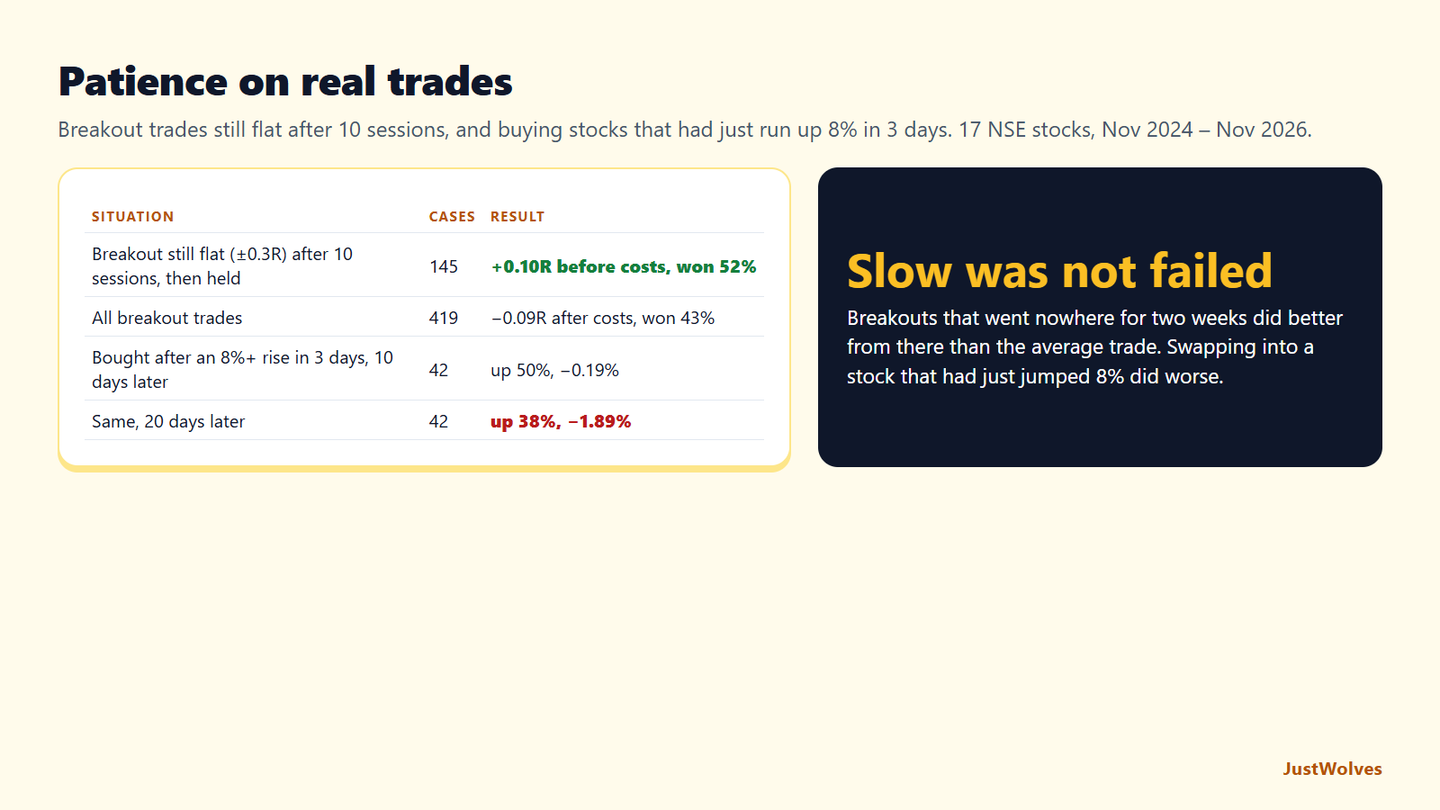
| Situation | Cases | Result |
|---|---|---|
| Breakout still flat (±0.3R) after 10 sessions, then held | 145 | +0.10R before costs, won 52%, 11% reached 2R |
| All breakout trades, for comparison | 419 | −0.09R after costs, won 43% |
| Bought after an 8%+ rise in 3 days: 10 days later | 42 | up 50% of the time, average −0.19% |
| Same, 20 days later | 42 | up 38% of the time, average −1.89% |
Slow was not failed, as this lesson says. Breakouts that were still flat after two weeks went on to win 52% of the time and averaged +0.10R before costs, better than the strategy as a whole. A trade that has not hit its stop has not been proved wrong, and selling it because it is boring gave up a slightly better-than-average position.
The faster stock was the worse buy. Stocks bought after an 8% rise in three days were up only 38% of the time 20 days later and averaged a loss of almost 2%. That is the reallocation trap in this lesson in numbers: selling a valid, quiet position to buy something after its move has already happened.
Expectations come from your own records. The samples here are modest, 145 and 42 cases over two years, and they describe one strategy. But they support this lesson's main point: realistic expectations come from measured results, and most of a disciplined trader's time is spent waiting for setups and for trades to reach their stop or target.
Common Mistakes
- Checking positions constantly. Each look is a chance to make a bad decision on unchanged information.
- Swapping slow positions for fast ones. It usually means selling low and buying high.
- Expecting fast results from a slow strategy. Swing trades are designed to take weeks.
- Measuring success by others' screenshots. Measure it against your own plan and a benchmark.
- Trading to replace an income too soon. Financial pressure destroys patience.
Professional Insight
Experienced swing traders often describe most of their job as waiting: waiting for a setup to form, waiting for an entry level, waiting for a trade to reach its stop or target. They design their routines so the waiting happens without them, through alerts, scheduled reviews and written rules, because they know their own impatience is the biggest threat to their results.
Risk Considerations
- Patience is not holding losers. A position that hits its stop must be closed; patience applies only while the plan is intact.
- Overnight and weekend gaps are part of holding longer; size swing positions for them (lesson 09.04.03).
- Thesis changes (results, regulatory news) are a legitimate reason to reassess; boredom is not.
Important Terminology
| Term | Meaning |
|---|---|
| Quick-money mindset | Expecting profits within hours or days and treating slow trades as failures. |
| Price alert | A notification when price reaches a level you set, used instead of watching the screen. |
| Thesis | The reason you took the trade; the plan is valid while it holds. |
| Capital reallocation | Moving money from one open position to another before either reaches its stop or target. |
| Benchmark | A simple alternative, such as an index fund, to judge your results against. |
How do I become more patient in trading?
Remove the decisions you don't need to make: set alerts at your stop and target, review positions only at fixed times, and write down the only reasons you're allowed to act.
How often should I check my swing trades?
Once after the market closes is usually enough, plus an optional check at the open for gaps. Constant checking invites impulsive changes.
Should I sell a flat stock to buy one that's moving?
Not if the flat position's stop and target are intact and its thesis hasn't changed. Swapping usually means selling a valid setup and buying after a move.
What returns should I expect from trading?
There's no reliable standard. Use your own expectancy and trade count to estimate it, and compare the results with an index fund over the same period.
Should I quit my job to trade full-time?
Not until you have a long, measured track record that beats a simple benchmark after costs. Keeping your income removes the financial pressure that undermines patience.
Should I sell a trade that is not moving?
Not just for being slow. In our NSE data, breakout trades still within 0.3R of entry after 10 sessions went on to win 52% of the time if held, better than the 43% for all trades. Exit only if the plan is broken.
Is it a good idea to switch into stocks that are rising fast?
Our data suggests not. Buying 17 large NSE stocks after an 8% or larger rise in three days led to an average loss of 1.89% over the next 20 days, with the stock higher only 38% of the time.
Practical Exercise
For the next two weeks, run a patience experiment on your open positions.
Your task
Step 1: Set alerts on every open trade
At the stop and the target.
Step 2: Choose fixed review times
Write them down, for example 3:45 pm daily, and only open your charts then.
Step 3: Log every urge
Each time you want to check or change a position outside a review time, note it and what triggered it.
Step 4: Compare
At the end, count the urges and note how many trades would have been changed for the worse had you acted.
Check Your Understanding
A swing position is flat after two weeks; its stop and target are intact. What does a patient plan say?
Related Lessons
Previous: FOMO, Revenge Trading and Overtrading (12.03.03). Next: Discipline, Emotional Control and Trading Routines (12.03.05). See also What Is Swing Trading?.