
Trading Discipline and Routines: How to Follow Your Plan When It Counts
JustWolves is an educational platform and is not a SEBI-registered investment advisor. Trading financial instruments involves significant risk of loss and may not be suitable for all investors. Past performance is not indicative of future results. Read our full disclaimer →
What you'll learn
- Discipline is mostly design: routines and checklists that make the right action the easy one
- A trading day has three phases (before, during and after the session), each with its own routine
- Judge yourself on process goals you control, not on daily profit
- Track a weekly rule-adherence score alongside your P&L
- Thinking in probabilities makes single losses easier to accept and rules easier to follow
In this article · 16 sections
Almost every trader knows their rules. The hard part is following them on the day the market is fast, the last two trades lost, and the next setup looks almost right. Discipline isn't a matter of being tougher than other people. It comes from routines and checklists that make the right action the default, and from measuring yourself on whether you followed them.
What You Will Learn
- Why discipline depends more on design than on willpower
- Practical routines for before, during and after the trading session
- How process goals and a rule-adherence score keep you honest
- How thinking in probabilities makes discipline easier
Before You Start
Read Trading Psychology: The 5 Mental Traps and FOMO, Revenge Trading and Overtrading. This lesson turns their fixes into a daily system.
Discipline Is Designed, Not Summoned
Willpower is unreliable exactly when trading demands it: when you're tired, frustrated or excited. A disciplined trader doesn't rely on resisting every temptation. They reduce the number of temptations they face and decide in advance what to do when one appears.
In practice that means three things: fewer decisions during the session (most are made beforehand), visible rules (written down, in front of you), and a review that checks whether the rules were followed, not just whether money was made.
The Three Routines
| Phase | Purpose | What to do |
|---|---|---|
| Before the session | Decide while calm | Check the calendar for events, mark key levels, write the setups you'll consider with entry, stop and target, set risk limits, check your own state. |
| During the session | Execute, don't decide | Take only listed setups, place stops immediately, use alerts, apply the trade cap and loss limit, pause after any loss. |
| After the session | Learn | Log every trade with screenshots, score rule adherence, note emotions, write one lesson for tomorrow. |
Step by Step: A Pre-Trade Checklist
Answer yes to all before entering
Step 1: Is this setup on my written list?
If not, it's not a trade.
Step 2: Are entry, stop and target defined from the chart?
You should be able to say all three before clicking.
Step 3: Is the size calculated from the stop?
Risk within your per-trade limit, rounded down.
Step 4: Am I within today's limits?
Trade count and daily loss limit both still allow it.
Step 5: Am I in a fit state to trade?
Not angry, rushed, distracted or trying to recover a loss.
Five questions take under a minute. Most undisciplined trades fail at least one of them, and simply having to answer them out loud is often enough to stop the trade.
Process Goals, Not Profit Goals
"Make ₹2,000 today" is a poor goal: you can't control it, and chasing it encourages exactly the behaviour that loses money. Process goals are the things you do control: took only listed setups, placed every stop at entry, respected the trade cap, journaled every trade.
Over many trades, a good process produces whatever your strategy's edge allows. On any single day, results are mostly noise.
The Weekly Rule-Adherence Score
At the end of each week, score each trade against your checklist: one point for each rule followed. Your adherence score is points earned ÷ points possible. Track it next to your weekly P&L.
| Trade | Rules followed | Result |
|---|---|---|
| 1 | 5 / 5 | +2.0R |
| 2 | 5 / 5 | −1.0R |
| 3 | 3 / 5 (moved stop, oversized) | −2.4R |
| 4 | 5 / 5 | +1.6R |
| 5 | 4 / 5 (not on setup list) | +0.5R |
Over a few weeks the pattern usually becomes obvious: weeks with high adherence tend to look like your backtest; weeks with low adherence don't. That gives you something concrete to improve that doesn't depend on the market.
Thinking in Probabilities
Discipline is easier when you stop judging single trades. Your edge exists only across many trades; any individual trade is close to a coin flip with a known payoff. A loss isn't evidence that the plan is wrong, any more than a win proves it right.
Traders often describe this as thinking of each trade as one of the next hundred. With that view, taking the stop-loss on trade 37 is simply part of executing the series, not a personal defeat.
Real Prices: The Cost of One Broken Rule
This lesson's callout says a trade that follows the rules and loses is a good trade. The chart below shows why, on a real ITC breakout from December 2025: the stop took a 1R loss on 1 January 2026; ignoring it would have meant almost 9R.
Real prices: what one skipped stop would have cost, ITC, December 2025 – February 2026
Step 1 of 4
A small, defined risk
ITC closes at ₹407.4 on 23 December 2025, just above its 20-day high. The stop goes below the previous five days' low with a small buffer, ₹398.3: about ₹9 of risk, 1R.
- What to observe
- A rule-based trade with a defined loss.
- Condition
- The rule: exit when the stop is hit, no exceptions.
Practical Example
Karthik's journal shows he's profitable in about half his weeks. He starts scoring adherence. Over eight weeks, his four best weeks average 94% adherence; his four worst average 71%, with most broken rules being trades taken after two losses and stops moved further away.
He adds two lines to his pre-session routine: "two losses = done" and "stops are only ever tightened". His adherence rises above 90% and his weekly results become steadier. His strategy didn't change, only his execution.
What Breaking Rules Did to Real Trades: Our Test
JustWolves replayed the same 419 real entries, every close above the prior 20-day high on 17 large NSE stocks from November 2024 to November 2026, under three kinds of behaviour: rules followed (stop below the previous five days' low, 2R target, 40-session limit); no stop, exiting only at the target or the time limit; and moving the stop one ATR lower the first time it was hit. Delivery costs of 0.25% per round trip were included. We also counted how often a month was profitable even with every rule followed.
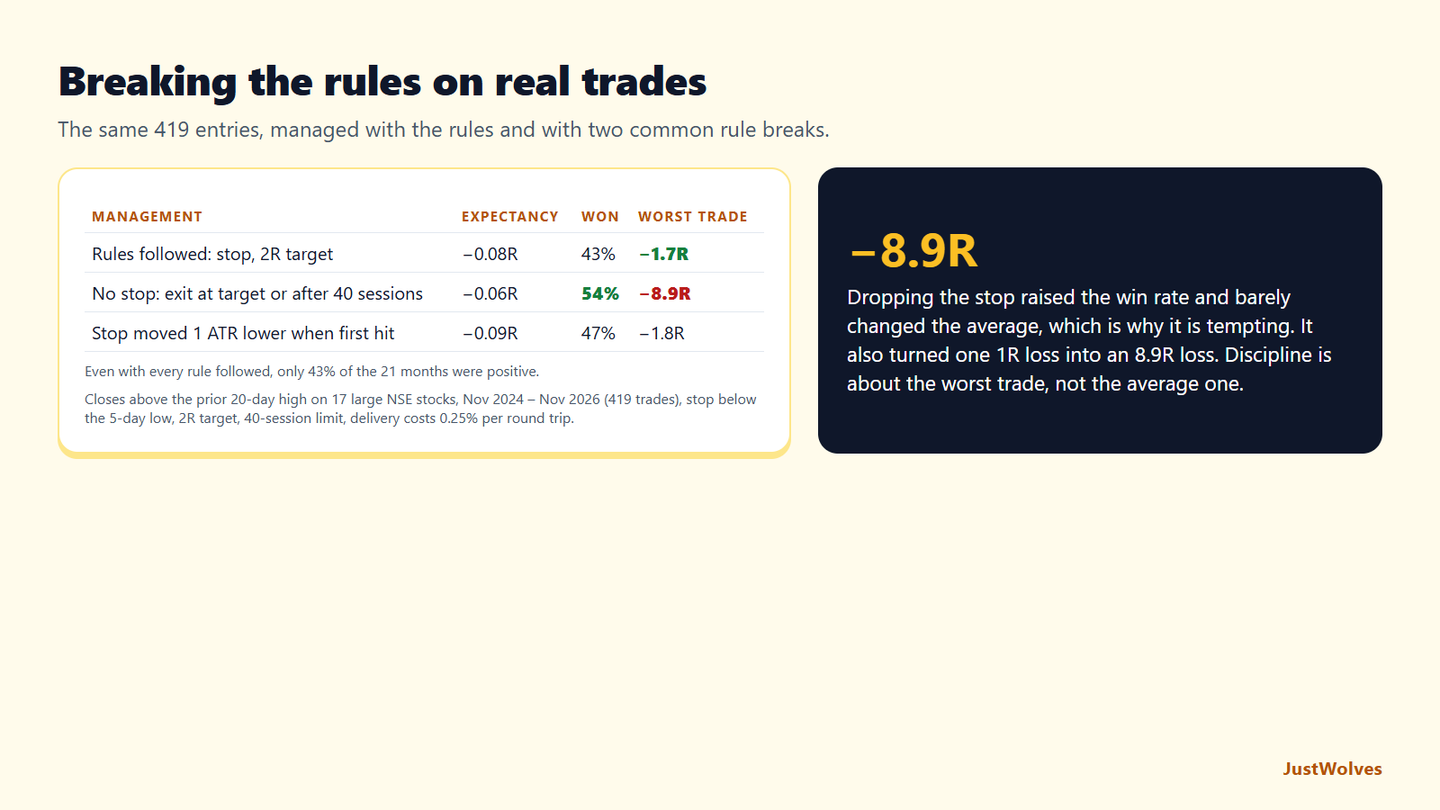
| Management | Expectancy | Won | Worst trade |
|---|---|---|---|
| Rules followed: stop and 2R target | −0.08R | 43% | −1.7R |
| No stop: target or 40-session exit only | −0.06R | 54% | −8.9R |
| Stop moved one ATR lower when first hit | −0.09R | 47% | −1.8R |
Breaking the stop rule looked harmless on average. Without stops, more trades eventually recovered: the win rate rose from 43% to 54% and the average barely changed. That is exactly why the habit is tempting, and why willpower alone does not stop it. The record seems to reward it most of the time.
The worst trade is what discipline protects. Without stops, the largest single loss was 8.9R, against 1.7R with them. One trade like ITC can erase months of work, and a trader who has been "rewarded" for ignoring stops on smaller trades is the one most likely to hold it. Moving the stop once did little harm here, but it is the first step towards not having a stop at all.
Outcomes are noisy even when you do everything right. With every rule followed, only 43% of months were profitable. That is the reason this lesson recommends process goals and adherence scores: judged month by month on P&L, a disciplined trader will often feel they are failing. Judged on adherence, they can see they are doing their job.
Common Mistakes
- Relying on motivation. It fades; routines don't.
- Rules that live only in your head. Write them where you can see them.
- Judging days by P&L alone. Score the process as well.
- Skipping the post-session review after a bad day. That's when it's most valuable.
- Too many rules. Five clear rules you follow beat twenty you don't.
Professional Insight
Many professional trading desks review traders on process metrics (adherence to risk limits, trade selection, execution) as well as P&L, precisely because P&L over short periods is dominated by luck. Holding yourself to the same standard is one of the clearest differences between treating trading as a business and treating it as entertainment.
Risk Considerations
- Discipline can't fix a strategy without an edge. Check expectancy separately (lesson 12.01.05).
- Rigid rules in changed conditions: review rules monthly, never mid-session.
- Fatigue erodes discipline: long screen time increases rule-breaking; limit session length.
Important Terminology
| Term | Meaning |
|---|---|
| Trading routine | A fixed sequence of actions before, during and after each session. |
| Pre-trade checklist | Questions every trade must pass before entry. |
| Process goal | A goal about your actions that you control, such as placing every stop at entry. |
| Outcome goal | A goal about results, such as a daily profit, which you don't directly control. |
| Rule-adherence score | The share of your trading rules you actually followed over a period. |
| Thinking in probabilities | Judging a strategy over many trades rather than by any single outcome. |
How do I become more disciplined in trading?
Write a short set of rules, run a pre-trade checklist on every trade, use fixed daily routines, and score how well you followed your rules each week.
What should a trading routine include?
Before the session: plan setups and limits. During it: execute only planned trades with stops and alerts. After it: journal every trade and score your adherence.
Why do I break my trading rules?
Usually under stress, after losses, wins or boredom. Fewer in-session decisions, visible rules and hard limits reduce how often that happens.
What are process goals in trading?
Goals about your actions, such as taking only planned setups or placing every stop immediately, rather than about profit, which you can't control on any given day.
Is a losing trade a bad trade?
Not if it followed your rules. A rule-following loss is part of executing an edge; a rule-breaking win is the more dangerous outcome.
What happens if I trade without a stop-loss?
In our test on 419 real NSE breakout trades, removing stops slightly raised the win rate and left the average almost unchanged, but the worst single loss grew from 1.7R to 8.9R. The rule protects against the rare trade that keeps falling.
How often should a disciplined trader have losing months?
Often. In our NSE breakout stream, with every rule followed, only 43% of months were profitable. Monthly P&L is noisy, which is why process goals and adherence scores are better measures of discipline.
Practical Exercise
Build your own discipline system this week.
Your task
Step 1: Write five rules
Covering setups, stops, size, daily limits and your state.
Step 2: Turn them into a checklist
Five yes/no questions to answer before every trade.
Step 3: Write your three routines
Before, during and after the session, a few lines each.
Step 4: Score one week
At week's end, calculate your adherence score and compare rule-following trades with rule-breaking ones in R.
Check Your Understanding
Which of these is a process goal?
Related Lessons
Previous: Patience and Realistic Expectations. This completes the Trading Psychology module. Next module: Testing and Evaluation, starting with How to Keep a Trading Journal (12.04.01).