
Expiry Day Behaviour in F&O
JustWolves is an educational platform and is not a SEBI-registered investment advisor. Trading financial instruments involves significant risk of loss and may not be suitable for all investors. Past performance is not indicative of future results. Read our full disclaimer →
What you'll learn
- On expiry day, options lose their remaining time value and converge to intrinsic value
- Gamma is extreme for near-the-money options, so premiums can multiply or collapse within minutes
- Index options settle in cash against the index's final settlement price
- Since late 2024, SEBI rules add extra margin on short options on expiry day and remove calendar-spread margin benefits
- Most retail losses on expiry day come from oversized positions in cheap, short-dated options
In this article · 15 sections
Expiry day is when an option's remaining time value disappears and it becomes worth exactly its intrinsic value. For the nearest contract, that turns the day into a concentrated version of everything covered in this course: extreme gamma, collapsing theta, cash settlement and tight margin rules. This lesson explains what happens on expiry day and why it's riskier than it looks.
What You Will Learn
- What happens to option prices on expiry day
- Why gamma and theta are extreme
- How settlement prices are set
- The expiry-day margin rules
Before You Start
Read Option Greeks: Delta and Gamma and Option Greeks: Theta, Vega and Rho first. Expiry days for Nifty options fall on Tuesdays (as of November 2026; see Contract Specifications).
Time Value Disappears
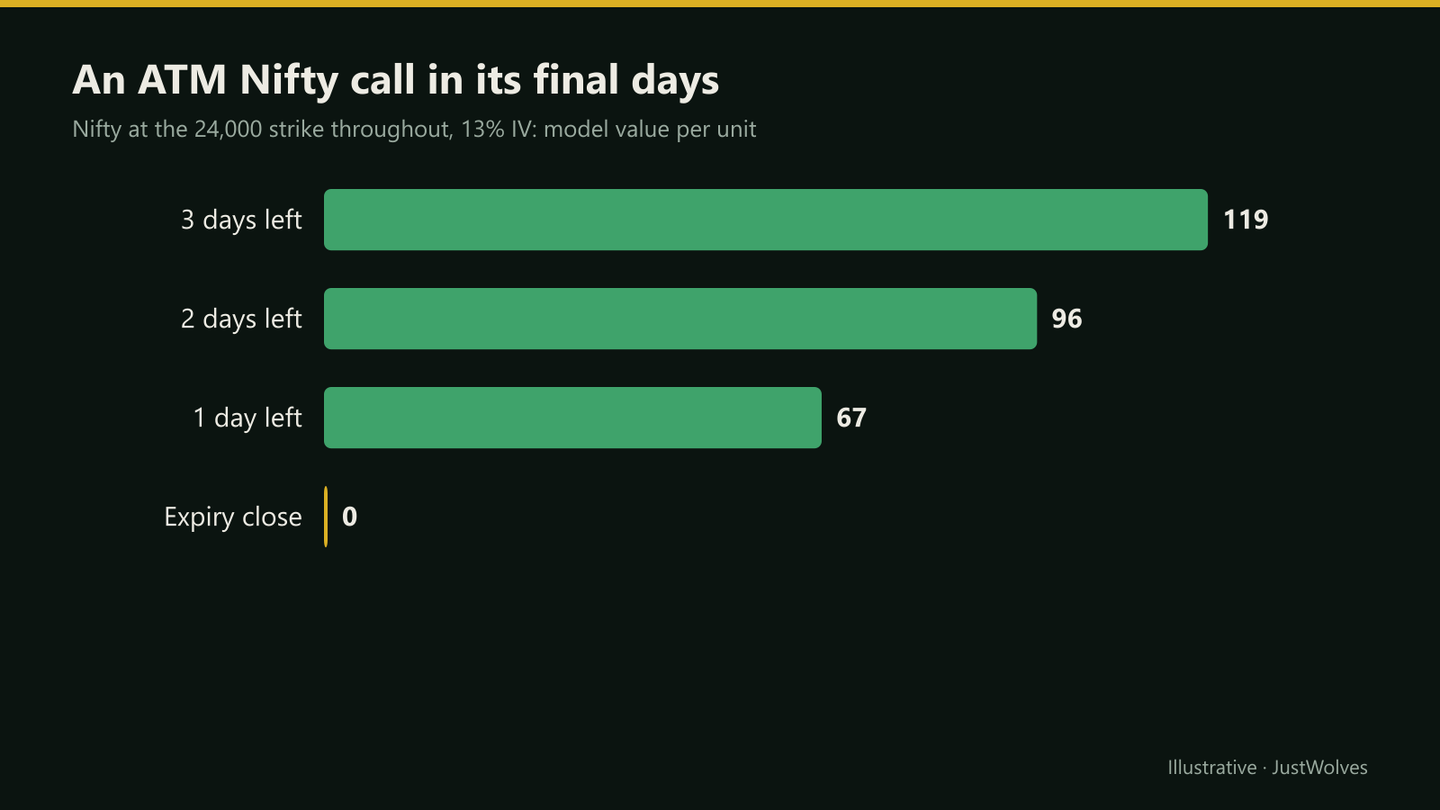
With hours left, an option's extrinsic value is small but drops quickly. By the close, OTM options are worth zero and ITM options are worth only their intrinsic value. A model ATM Nifty call that was worth about ₹119 with three days left and ₹67 with one day left ends at zero if Nifty closes exactly at the strike.
Extreme Gamma
Near expiry, an ATM option's delta can swing from near 0 to near 1 over a small move in the index. An option trading at ₹20 can be worth ₹120 after a 100-point move, or ₹0 if the index moves the other way. That's why expiry-day options attract speculative buying: small premiums, large potential multiples.
The same gamma works against sellers. A short option that looked safe in the morning can lose many times the premium collected if the index moves sharply in the afternoon.
Real Prices: A Late Move on Expiry Day
The chart below uses real hourly NIFTY 50 prices from Monday 24 and Tuesday 25 August 2026, an expiry day, with the 24,250 call valued at each hourly close. It shows this lesson's warning about sellers in practice: an option that looked worthless at 2:15 pm settled at nearly 40 times that value.
Real NIFTY prices: a late move on expiry day, 24–25 August 2026 (IST)
Step 1 of 4
A quiet expiry morning
On Tuesday 25 August 2026, an expiry day, NIFTY drifts between about 24,115 and 24,190 through the morning, below Monday's close of 24,219. The 24,250 call is about 100 points out of the money.
- What to observe
- Nothing suggests a large move.
- Condition
- Out-of-the-money calls are losing value by the hour.
Settlement Price
Index options are cash-settled at expiry against a final settlement price based on the underlying index's closing value on expiry day, as defined in NSE's contract specifications. ITM options are settled for their intrinsic value; OTM options expire worthless.
Because settlement depends on the closing value, positions held into the close carry the risk of a late move. Stock options and futures are physically settled, as covered in the next lesson, which brings additional obligations for anyone holding them into expiry.
Expiry-Day Margin Rules
SEBI's October 2024 circular on equity index derivatives introduced two expiry-specific measures: an additional extreme loss margin on short options on expiry day (from 20 November 2024), and the removal of calendar-spread margin benefits for positions involving contracts expiring that day (from 1 February 2025). Sellers therefore need more margin on expiry day than on other days, and brokers may restrict new short positions late in the session.
Rolling Before Expiry
Traders who want to keep a position beyond the current expiry usually roll it a day or more before expiry day: close the expiring contract and open the same position in the next one. Rolling early avoids expiry-day gamma, the extra margin on short options and settlement costs, at the price of paying the difference between the two contracts plus trading charges on both legs.
Practical Example
Hypothetically, on expiry morning Nifty is at 24,020 and the 24,100 call trades at ₹25. Mukesh buys four lots for ₹6,500, attracted by the low price. By 2 pm Nifty rises to 24,140 and the call is worth ₹60; he doesn't sell.
Nifty slips back to 24,080 by the close. The 24,100 call expires worthless and the whole ₹6,500 is lost. A planned exit at ₹50 would have turned the same trade into a gain of (50 − 25) × 65 × 4 = ₹6,500.
What Happens on Real Expiry Days? Our Data
JustWolves measured 26 NIFTY expiry days, the Tuesdays from May to November 2026 (or the Monday before when Tuesday was a holiday), using real hourly prices, and compared them with the 99 other trading days in the same period. We also modelled two calls bought at the end of the first hour on each expiry day, one at the money and one 100 points out of the money, and held them to the close.
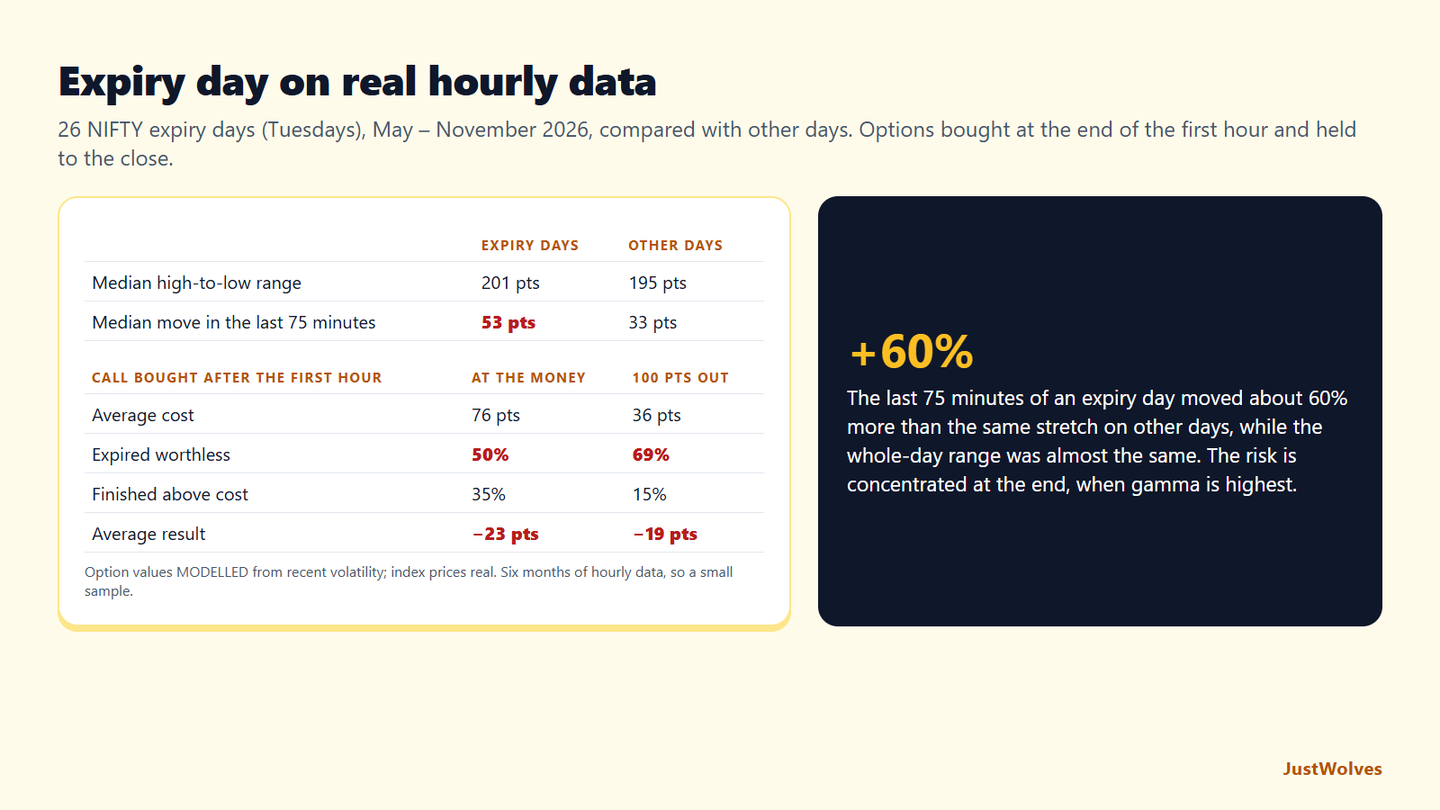
| Expiry days | Other days | |
|---|---|---|
| Days | 26 | 99 |
| Median high-to-low range | 201 points | 195 points |
| Median move in the last 75 minutes | 53 points | 33 points |
| At the money | 100 points out of the money | |
|---|---|---|
| Average cost | 76 points (₹4,900 a lot) | 36 points (₹2,300 a lot) |
| Expired worthless | 50% | 69% |
| Finished above cost | 35% | 15% |
| Doubled in value at some point in the day | 15% | 15% |
| Average result | −23 points | −19 points |
Expiry days were not more volatile overall: their median range, 201 points, was almost the same as other days. But the last 75 minutes moved about 60% more. That fits this lesson's points about gamma and settlement: with time value almost gone, positions are adjusted, closed or defended late in the session, and every point near a strike changes what options settle for.
Expiry-morning calls lost on average. Half of the at-the-money calls and more than two-thirds of the out-of-the-money calls expired worthless. The cheap out-of-the-money call, the trade Mukesh makes in this lesson's example, finished above its cost on only 4 of 26 days. Mukesh's exact story, doubling during the day and then expiring worthless, happened only once in our sample; much more often the option simply faded.
The data also supports the professional habit described in this lesson. If the largest moves of the day tend to come late, the simplest way to avoid expiry-day gamma is not to be holding short-dated, near-the-money positions in the final hour, or to hold them only in a size where a 100-point move at 2:30 pm is affordable.
Common Mistakes
- Buying many lots of cheap OTM options because each one costs little.
- Selling options on expiry day without allowing for gamma.
- Holding to the close without an exit plan.
- Forgetting higher expiry-day margins for short positions.
- Holding stock options into expiry without planning for physical settlement.
Professional Insight
Many experienced traders treat expiry day as a day to reduce risk: they close or roll positions in the expiring contract and avoid opening new short-dated speculative trades. Those who do trade it use small sizes and fixed exits, because outcomes are highly binary.
Risk Considerations
- Binary outcomes for near-the-money options.
- Large losses for sellers from late moves.
- Settlement surprises from closing prices.
Important Terminology
| Term | Meaning |
|---|---|
| Expiry day | The last trading day of a contract. |
| Final settlement price | The price used to settle contracts at expiry. |
| Pin risk | Uncertainty when the underlying closes near a strike. |
| Extreme loss margin | An additional margin layer; raised for short options on expiry day. |
| Calendar spread | Positions in the same underlying across different expiries. |
What happens to options on expiry day?
Their remaining time value disappears. ITM options settle for intrinsic value and OTM options expire worthless.
Why are options so volatile on expiry day?
Gamma is extreme for near-the-money options, so small index moves cause large changes in premium.
Is expiry day trading profitable?
It's high-risk. Outcomes are very binary, and many cheap options expire worthless.
What is the settlement price for Nifty options?
A final settlement price based on the Nifty's closing value on expiry day, as defined in NSE's contract specifications.
Is margin higher on expiry day?
For short options, yes: SEBI rules add an extra extreme loss margin on expiry day and remove calendar-spread benefits for expiring contracts.
Does NIFTY move more on expiry day?
Not over the whole day in our data: the median expiry-day range was 201 points against 195 on other days, May to November 2026. But the final 75 minutes moved about 60% more, a median of 53 points against 33, which is when gamma is highest.
Is buying cheap options on expiry morning a good idea?
In our test of 26 real NIFTY expiry days with modelled values, calls 100 points out of the money bought after the first hour expired worthless 69% of the time and finished above their cost only 15% of the time. On average they lost more than half their cost.
Practical Exercise
Watch an expiry.
Your task
Step 1: Pick three strikes
ATM and 100 points either side, on expiry morning.
Step 2: Record premiums
At the open, midday and 3 pm.
Step 3: Note the close
And each option's final value.
Step 4: Reflect
Which strike changed most, and what would a fixed exit have done?
Check Your Understanding
At the expiry close, an OTM option is worth:
Related Lessons
Previous module: Hedging with Futures and Options. Next: Settlement, Exercise, Assignment and STT in India.