
Futures Contracts Explained: How Index and Stock Futures Work
JustWolves is an educational platform and is not a SEBI-registered investment advisor. Trading financial instruments involves significant risk of loss and may not be suitable for all investors. Past performance is not indicative of future results. Read our full disclaimer →
What you'll learn
- A futures contract is an agreement to buy or sell the underlying at a set price on a future date
- Long futures gain when the underlying rises; short futures gain when it falls; the payoff is linear
- The futures price usually differs from the spot price; the difference is called the basis
- Positions can be closed any time before expiry, or rolled to the next contract
- In India, index futures are cash-settled; stock futures are physically settled if held to expiry
In this article · 16 sections
A futures contract is the simplest exchange-traded derivative: an agreement to buy or sell an underlying at a fixed price on a future date. In practice, most traders never hold futures to that date; they buy and sell the contracts themselves, profiting or losing as the price changes. This lesson explains how futures work, how their price relates to the underlying, and how they settle in India.
What You Will Learn
- What a futures contract is
- Long and short positions and their payoff
- The relationship between futures and spot prices
- Rollover and settlement in India
Before You Start
Read What Are Derivatives? first.
The Contract
A futures contract obliges the buyer to buy, and the seller to sell, a fixed quantity of the underlying (one lot) at the agreed price on the expiry date. Both sides have obligations; neither has a choice, unlike options.
In Indian equity markets, futures trade on indices such as the Nifty 50 and Nifty Bank, and on a list of individual stocks approved for F&O trading.
Long and Short
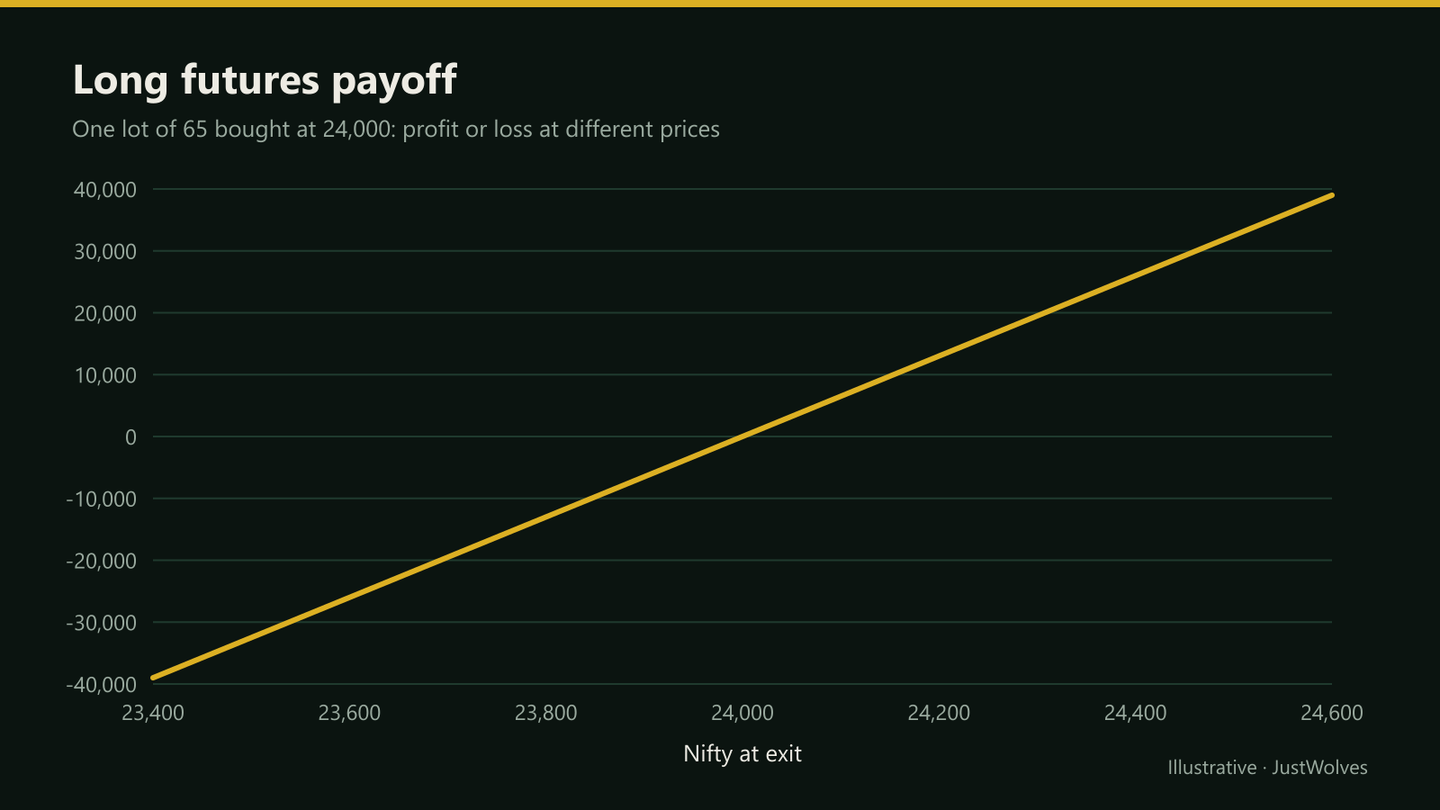
- Long (buy) futures: you profit if the price rises above your entry, and lose if it falls.
- Short (sell) futures: you profit if the price falls below your entry, and lose if it rises.
Selling futures without owning the underlying is normal; it's simply the other side of the contract. That makes futures a common way to take a bearish view or to hedge a portfolio.
Futures Price vs Spot Price
The spot price is the underlying's current price; the futures price is usually a little different. The difference is the basis.
For index and stock futures, the futures price normally trades slightly above spot when interest rates exceed expected dividends: buying the future instead of the shares saves capital that could earn interest. This is called cost of carry. As expiry approaches, the basis shrinks, and on expiry day the futures price converges to the spot price.
Expiry and Rollover
Each futures contract has an expiry date. Several contracts are listed at once, for example the current month, the next month and the month after. If you want to keep a position beyond expiry, you roll over: close the expiring contract and open the same position in the next one.
Rollover has a cost: you pay the difference in prices between the two contracts (the roll spread), plus trading charges on both legs.
Settlement in India
| Contract | Settlement |
|---|---|
| Index futures (Nifty, Bank Nifty) | Cash-settled: the profit or loss is paid in cash; no shares change hands |
| Stock futures | Physically settled: long positions take delivery of shares, short positions must deliver them |
Physical settlement means a stock futures position held to expiry needs the full cash (for longs) or shares (for shorts). Brokers usually require higher margins or close positions before expiry to manage this. Settlement rules are covered in detail in 06.05.
Using Futures to Hedge
Futures aren't only for speculation. An investor holding a diversified portfolio of large Indian companies worth about ₹16 lakh, broadly tracking the Nifty, could sell one Nifty futures lot before an uncertain event. If the market falls, the gain on the short future offsets much of the portfolio's loss; if it rises, the future loses while the portfolio gains.
The hedge is rarely perfect, because a portfolio never moves exactly like the index, but it reduces overall exposure without selling the shares. Hedging is covered in detail in 06.04.
Real Data: A Portfolio Hedge Through a Decline
The chart below uses real NIFTY 50 data, condensed into weekly candles, from November 2024 to March 2025, a period in which the index fell about 11% from its December high. It follows the hedging idea from this lesson with real prices.
Real data: a falling market that a futures hedge would have offset, NIFTY weekly, November 2024 – March 2025
Step 1 of 4
A portfolio near the highs
In early December 2024 NIFTY rises to about 24,770. Imagine an investor holding about ₹16 lakh of large Indian companies that broadly track NIFTY, as in this lesson's hedging section.
- What to observe
- A worry about an uncertain few months ahead.
- Condition
- The investor does not want to sell the shares.
Practical Example
Hypothetically, Nifty spot is at 24,000 and the current-month future trades at 24,090, a basis of 90 points. Arvind expects a rally and buys one lot (65 units) at 24,090.
Six days later, the future trades at 24,350. He sells and makes 260 × 65 = ₹16,900 before costs. If the future had fallen to 23,900 instead, he would have lost 190 × 65 = ₹12,350.
How Well Does a NIFTY Futures Hedge Work? Our Data
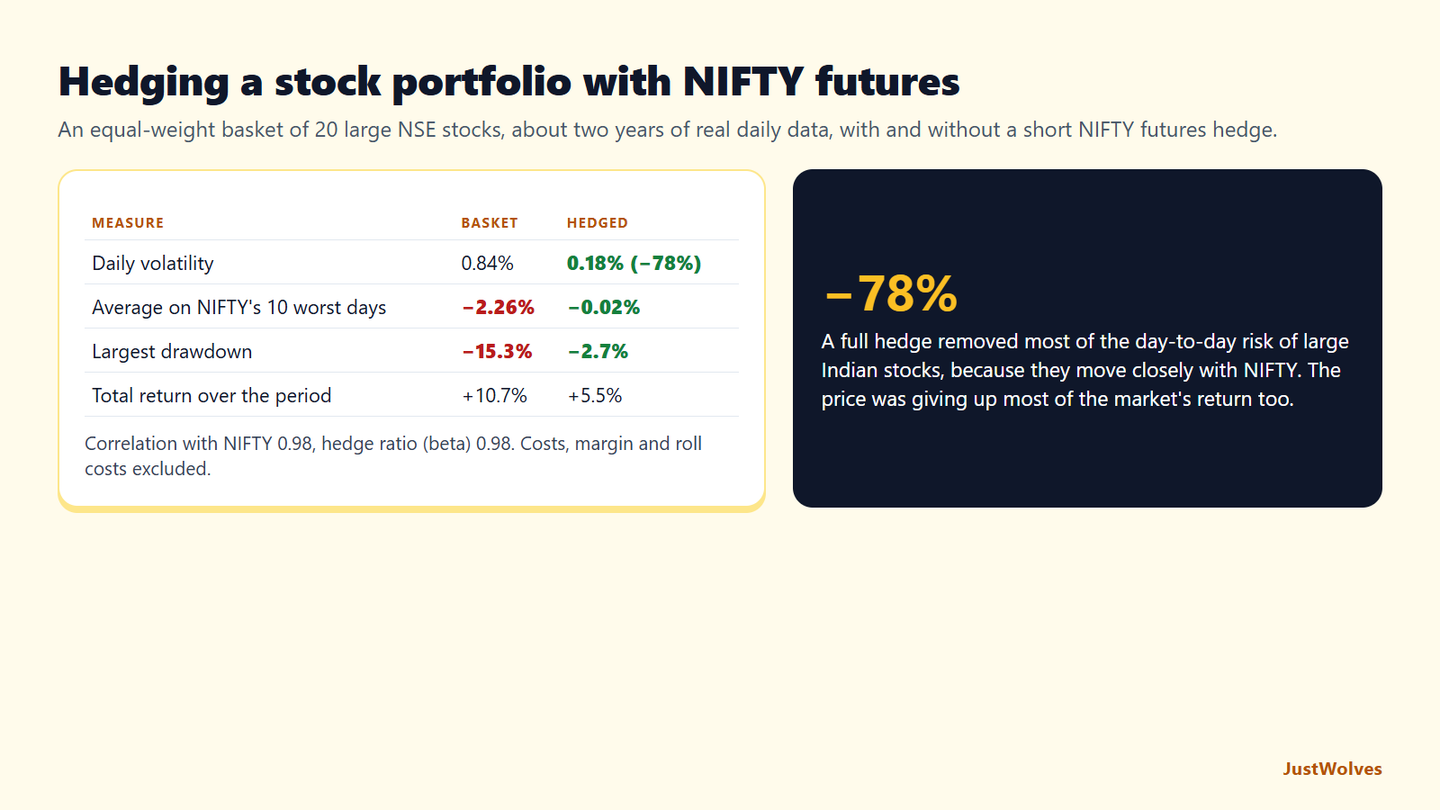
This lesson says a futures hedge "is rarely perfect, because a portfolio never moves exactly like the index". JustWolves measured how close it gets for a typical Indian investor's holdings: an equal-weight basket of 20 large NSE stocks (including Reliance, HDFC Bank, ICICI Bank, Infosys, TCS and others), over about two years of real daily data (November 2024 to November 2026), hedged with a short NIFTY position sized at the basket's beta.
| Measure | Basket only | Hedged with short NIFTY futures |
|---|---|---|
| Correlation with NIFTY | 0.98 | |
| Hedge ratio (beta) | 0.98 | |
| Daily volatility | 0.84% | 0.18% (78% lower) |
| Average move on NIFTY's 10 worst days | −2.26% | −0.02% |
| Largest drawdown | −15.3% | −2.7% |
| Total return over the period | +10.7% | +5.5% |
For a basket of large Indian companies, the hedge worked very well: on NIFTY's ten worst days, the hedged basket was almost flat, and its largest drawdown fell from 15% to under 3%. That is because large stocks move closely with the index they dominate.
The table also shows the cost. The hedged basket kept only the part of the return that came from the stocks beating NIFTY, about 5.5% over two years; the market's own rise was given up. That is the trade-off this lesson describes: a hedge reduces exposure in both directions. In practice, investors hedge for a defined period, such as around an event they are worried about, rather than permanently.
A concentrated portfolio, a few mid-cap stocks or a single sector would track NIFTY much less closely, and the same hedge would leave far more risk behind. Check the correlation of your own holdings before relying on an index hedge.
Common Mistakes
- Forgetting that futures have obligations on both sides.
- Holding stock futures into expiry without planning for physical settlement.
- Ignoring the basis when comparing futures and spot levels.
- Trading too many lots for the account size.
- Forgetting rollover costs for longer-term positions.
Professional Insight
Many professionals prefer futures to options for directional views because the payoff is simple and linear, with no time decay. The trade-off is that there's no built-in limit to the loss, so position sizing and stops do all the work.
Risk Considerations
- Unlimited loss potential in both directions.
- Gaps can move prices past stops overnight.
- Margin calls if the position moves against you.
Important Terminology
| Term | Meaning |
|---|---|
| Futures contract | An obligation to buy or sell at a set price on a future date. |
| Lot | The fixed contract quantity. |
| Basis | The futures price minus the spot price. |
| Cost of carry | The cost of holding the underlying, which affects futures pricing. |
| Rollover | Moving a position from the expiring contract to the next. |
What is a futures contract?
An exchange-traded agreement to buy or sell a set quantity of an underlying at a set price on a future date.
Can I sell futures without owning shares?
Yes. Short futures positions are normal; at expiry, stock futures shorts must deliver shares if not closed.
Why is the futures price different from spot?
Mainly cost of carry: interest on capital minus expected dividends. The gap narrows to zero by expiry.
What happens at futures expiry?
Index futures are settled in cash. Stock futures held to expiry are physically settled.
What is rollover?
Closing the expiring contract and opening the same position in the next one.
Can NIFTY futures hedge a stock portfolio?
For large Indian stocks, closely. In our two-year test, a 20-stock large-cap basket had a 0.98 correlation with NIFTY, and a short NIFTY hedge cut its daily volatility by 78%. Concentrated or mid-cap portfolios track the index less closely, so the hedge is weaker.
Practical Exercise
Track the basis.
Your task
Step 1: Note prices daily
Nifty spot and the current-month future, for two weeks.
Step 2: Calculate the basis
Future minus spot each day.
Step 3: Plot it
Does it shrink as expiry approaches?
Check Your Understanding
A short futures position profits when:
Related Lessons
Previous: What Are Derivatives?. Next: Futures Margin and Mark-to-Market Settlement.