
Range, Breakout and Pullback Scalping
JustWolves is an educational platform and is not a SEBI-registered investment advisor. Trading financial instruments involves significant risk of loss and may not be suitable for all investors. Past performance is not indicative of future results. Read our full disclaimer →
What you'll learn
- Most intraday scalps fall into three types: range fades, breakouts and pullbacks
- The session type decides which is appropriate: ranges for range-bound sessions, breakouts and pullbacks for trending ones
- Range fades enter at the edges with stops just beyond; breakouts enter on a close beyond the range; pullbacks enter as a trend resumes
- Each setup has a natural failure: ranges break, breakouts fail, pullbacks become reversals
- Check that the target is several times your all-in cost before taking any scalp
In this article · 15 sections
Just as swing trading reduces to a few core setups, so does scalping. Most scalps are one of three ideas: sell the top and buy the bottom of an intraday range, trade the break out of a range, or buy a pause in a trending move. The skill is in matching the setup to the kind of session the market is having. This lesson covers each setup, its entry, stop and target, and how to tell which one the session calls for.
What You Will Learn
- The three core scalping setups
- How session type decides which to use
- Entries, stops and targets for each
- How each setup typically fails
Before You Start
Read Visible Reversal Zones and VWAP for Intraday Traders. The Three Core Swing Setups lesson covers the same ideas on daily charts.
The Three Setups
| Range fade | Breakout | Pullback | |
|---|---|---|---|
| Session type | Range-bound, price crossing VWAP | Compression before a move | Trending, price on one side of VWAP |
| Entry | Rejection at the range edge | Close beyond the range | Trigger as the pullback ends |
| Stop | Just beyond the range edge | Back inside the range | Below the pullback low |
| Target | Range midpoint or opposite edge | Range height projected, or the next level | The session high or next level |
| Main failure | The range breaks | False breakout | Pullback becomes a reversal |
Setup 1: Range Fades
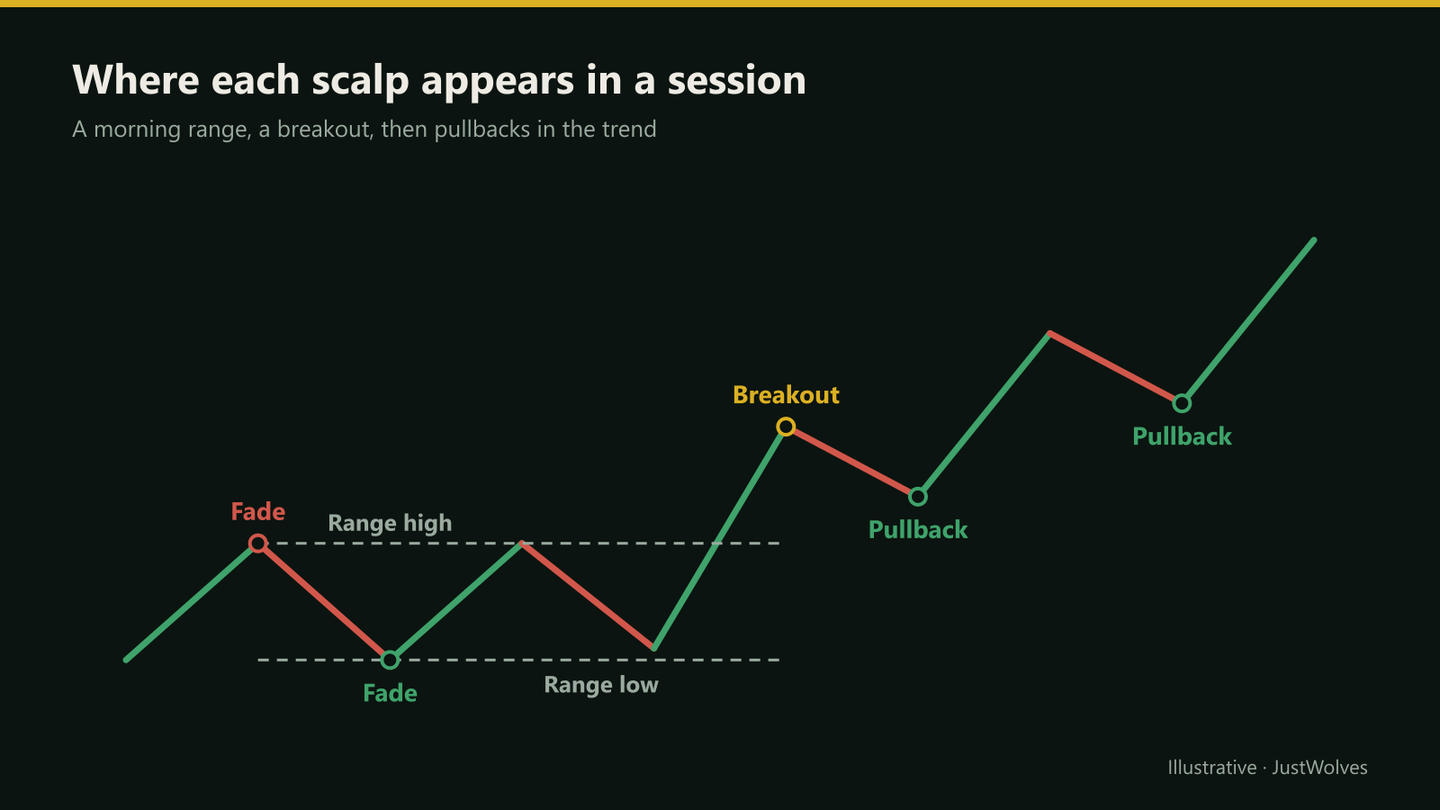
When the session is range-bound, price often oscillates between an intraday high and low, often VRZs or the previous day's levels. The range fade sells near the top and buys near the bottom, after a rejection candle on the trading chart.
Stops go just beyond the edge, because a clean break means the range is ending. Targets are modest: the range midpoint or the far edge. Range fades work best in the quieter midday period and fail when news or a strong move ends the range.
Setup 2: Breakouts
When price compresses into a tight intraday range, often after the opening range or near the previous day's high or low, a close beyond the range can start a quick move. The breakout scalp enters on that close, with the stop back inside the range.
Breakouts work best in the active parts of the session with rising volume. The Breakout Trading course covers confirmation and false breakouts in detail.
Setup 3: Pullbacks
On trending days, price moves in steps: a push, a pause, another push. The pullback scalp waits for a pause to reach a level (VWAP, a VRZ or a broken level) and enters as the trend resumes, with the stop below the pullback low.
Pullback scalps tend to be the most forgiving, because they trade with the session's direction. Their main risk is that a pullback deepens into a reversal, usually signalled by a break of the last higher low on the 5-minute chart.
Reading the Session
- Price crossing VWAP repeatedly, RSI near 50: range-bound. Favour fades or wait.
- Price compressing near a key level with falling ranges: a breakout may be close.
- Price holding one side of a sloping VWAP, RSI pullbacks holding 40–60: trending. Favour pullbacks.
Real Prices: Breakouts in a Range-Bound Session
The chart below shows what this lesson's warning looks like in practice: real Infosys prices from 3 September 2026, a session that crossed VWAP 11 times by 11:00, and three breakout scalps in a row that fell straight back into the range.
Real prices: breakout scalps in a choppy session, Infosys, 3 September 2026
Step 1 of 4
A choppy morning
Infosys gaps lower on 3 September 2026, then spends the morning in a narrow band between about ₹1,124.6 and ₹1,129.2. Price crosses VWAP (about ₹1,127.5) again and again: 11 times by 11:00.
- What to observe
- This lesson's session read: repeated VWAP crosses mean a range-bound session.
- Condition
- The lesson's advice: favour fades, or wait.
Practical Example
Hypothetically, Nifty breaks out of its opening range and holds above a rising VWAP all morning. At 11:20, it pulls back to VWAP and a 3-minute bullish candle forms. Ishaan buys two lots (130 units) of a near-the-money call at 150, with a stop at 143 based on the option's price at the pullback low, and a target of 162 at the session high.
Gross, the trade risks 7 points (₹910) to make 12 (₹1,560). Charges from the brokerage calculator are about ₹96 on a win and ₹92 on a loss, so the net outcome is about +₹1,464 or −₹1,002, roughly 1.5R after costs.
Does Matching the Setup to the Session Work? Our Test
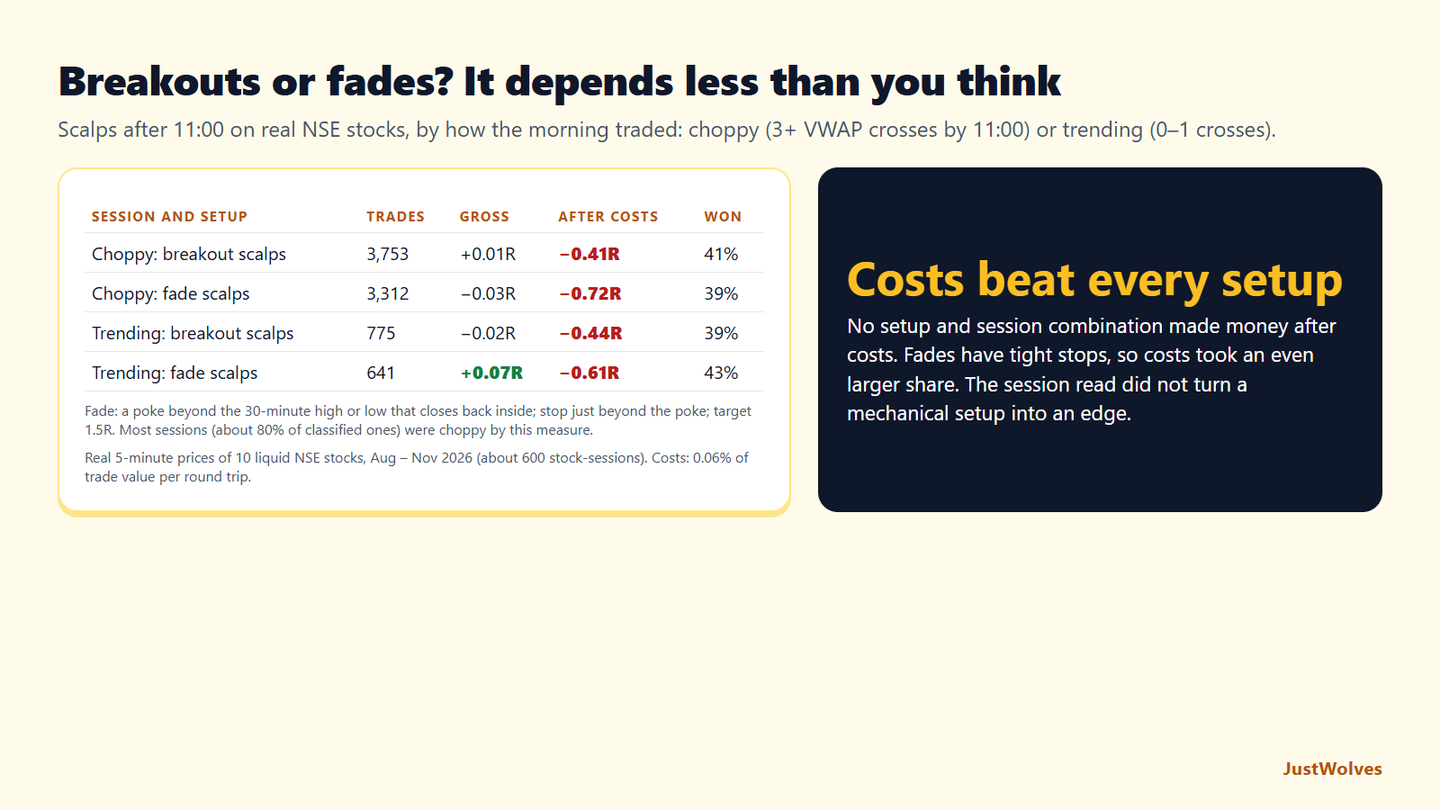
JustWolves tested this lesson's session read on 5-minute prices for 10 liquid NSE stocks, about 58 sessions each from August to November 2026. We classed each session by its morning: choppy if price crossed VWAP three or more times by 11:00, trending if it crossed once or not at all. After 11:00 we ran two setups. Breakout: a close beyond the previous 30 minutes' high or low, stop 1 ATR. Fade: a candle poking beyond the 30-minute high or low and closing back inside, sold or bought at the close with a stop just beyond the poke. Both used a 1.5R target. Costs: 0.06% of trade value per round trip.
| Session and setup | Trades | Gross | After costs | Won |
|---|---|---|---|---|
| Choppy session: breakout scalps | 3,753 | +0.01R | −0.41R | 41% |
| Choppy session: fade scalps | 3,312 | −0.03R | −0.72R | 39% |
| Trending session: breakout scalps | 775 | −0.02R | −0.44R | 39% |
| Trending session: fade scalps | 641 | +0.07R | −0.61R | 43% |
Most sessions were choppy. By the VWAP-cross measure, about four in five classified sessions were range-bound by 11:00, which supports this lesson's view that the trending days a breakout scalper wants are the minority.
The session read did not, on its own, rescue a mechanical setup. In choppy sessions, breakout scalps broke even before costs and fades lost slightly; in trending sessions, the opposite. These differences were small, and none of the four combinations made money after costs. Fades looked worst after costs because their stops, just beyond a small poke, were tight, so the fixed cost was a larger share of each R.
What the data supports is restraint. With costs taking 0.4R or more per trade, the setups that can work are the ones with much larger targets relative to the stop, taken on far fewer occasions. That is the professional insight in this lesson: specialise in one setup, take it only when the session clearly suits it, and trade little or nothing on the other days. Our mechanical rules took every signal; selectivity is exactly what they lacked.
Common Mistakes
- Using one setup in every session.
- Fading strong trends.
- Range fades with targets beyond the midpoint in narrow ranges.
- Breakout scalps during the midday lull.
- Ignoring costs on small targets.
Professional Insight
Many experienced scalpers specialise in one of the three setups and only trade it when the session suits it. On days that don't fit, they trade little or nothing. That restraint usually matters more than any refinement of the setup itself.
Risk Considerations
- Ranges break, often suddenly.
- Breakouts fail, especially midday.
- Pullbacks reverse when the trend ends.
Important Terminology
| Term | Meaning |
|---|---|
| Range fade | Selling the top or buying the bottom of a range. |
| Breakout scalp | Trading a close beyond an intraday range. |
| Pullback scalp | Entering as a trend resumes after a pause. |
| Session type | Whether the day is trending or range-bound. |
| All-in cost | Charges plus spread and slippage per trade. |
What is the best scalping strategy?
There's no single best one. Range fades, breakouts and pullbacks each suit different session types.
How do I know if the session is trending or range-bound?
Trending sessions hold one side of a sloping VWAP with higher lows or lower highs; range-bound sessions cross VWAP repeatedly.
Where should I put my stop on a range fade?
Just beyond the range edge, because a clean break means the range is ending.
Which scalping setup is most forgiving?
Pullbacks in a trending session, because they trade with the day's direction.
Do costs change which setup I should trade?
Yes. Setups with very small targets, such as narrow range fades, are hit hardest by costs.
Do breakout scalps work better on trending days?
Not in our mechanical test. On 10 NSE stocks, 5-minute breakout scalps after 11:00 averaged +0.01R before costs on choppy sessions and −0.02R on trending ones, and both lost about 0.4R per trade after costs.
How often is an intraday session range-bound?
Often. In our sample of 10 NSE stocks from August to November 2026, about four in five classified sessions crossed VWAP three or more times by 11:00, a common sign of a range-bound session.
Practical Exercise
Match setups to sessions.
Your task
Step 1: Review ten sessions
On a 5-minute Nifty futures chart with VWAP.
Step 2: Label each session
Trending, range-bound or mixed.
Step 3: Mark available setups
Fades, breakouts and pullbacks.
Step 4: Check outcomes
Which setups worked in which session types, after costs?
Check Your Understanding
On a range-bound session, the natural setup is:
Related Lessons
Previous: Visible Reversal Zones. Next: EMA Scalping with Supply, Demand and Momentum Candles. See also the Breakout Trading course.