
What Is Scalping?
JustWolves is an educational platform and is not a SEBI-registered investment advisor. Trading financial instruments involves significant risk of loss and may not be suitable for all investors. Past performance is not indicative of future results. Read our full disclaimer →
What you'll learn
- Scalping aims to capture small price moves, holding positions for seconds to minutes
- Because each move is small, costs, spreads and slippage take a large share of every gain
- In Indian markets, scalping is mostly done in liquid index options, index futures and highly liquid stocks
- Scalping needs fast execution, strict stops and a daily loss limit; it is the least forgiving trading style
- SEBI's studies show most individual F&O traders lose money; scalping should be tested on paper with full costs first
In this article · 15 sections
Scalping is trading for very small moves over very short periods: a few points on Nifty options, a rupee or two on a stock, held for seconds to a few minutes. It's popular because it seems to need little capital and offers constant action. It's also the trading style where costs, slippage and emotional mistakes matter most. This lesson explains what scalping actually involves in Indian markets, what it costs, and who it realistically suits.
What You Will Learn
- What scalping is and how it works
- Which instruments are scalped in India
- Why costs dominate scalping results
- Who scalping suits, and who it doesn't
Before You Start
This course assumes you understand basic chart reading and how futures and options work. Read Swing Trading vs Day Trading for the broader comparison of trading styles, and the Futures & Options course if derivatives are new to you.
What Scalping Is
A scalper opens and closes positions within minutes, aiming to capture a small part of a move many times a day rather than a large part of a move once. A typical Nifty option scalp might target 5 to 10 premium points; a stock scalp might target a fraction of a percent.
Scalpers rely on short-term momentum, reactions at intraday levels, and the order flow around them. They usually work on 1, 3 or 5-minute charts, with a higher timeframe such as 15 minutes for context. Every position is closed well before the session ends.
What Gets Scalped in India
| Instrument | Why traders scalp it | Main drawback |
|---|---|---|
| Nifty and Bank Nifty options | Very liquid, low capital per lot, fast premium moves | Time decay, wide swings on expiry days, high risk of losses |
| Nifty and Bank Nifty futures | Tight spreads, direct exposure to the index | Large contract value and costs of about 14 points per Nifty lot round trip |
| Liquid large-cap stocks (intraday) | Tight spreads, no expiry | Price bands and smaller moves |
Nifty's lot size is 65 units and Bank Nifty's is 30. Nifty has weekly options expiring on Tuesdays; Bank Nifty options are monthly only.
Why Costs Dominate
Every round trip pays brokerage, securities transaction tax (STT), exchange charges, GST, SEBI fees and stamp duty, plus the bid-ask spread and any slippage. On a swing trade targeting ₹50 a share, these are a small fraction. On a scalp targeting a few points, they can be most of the profit.
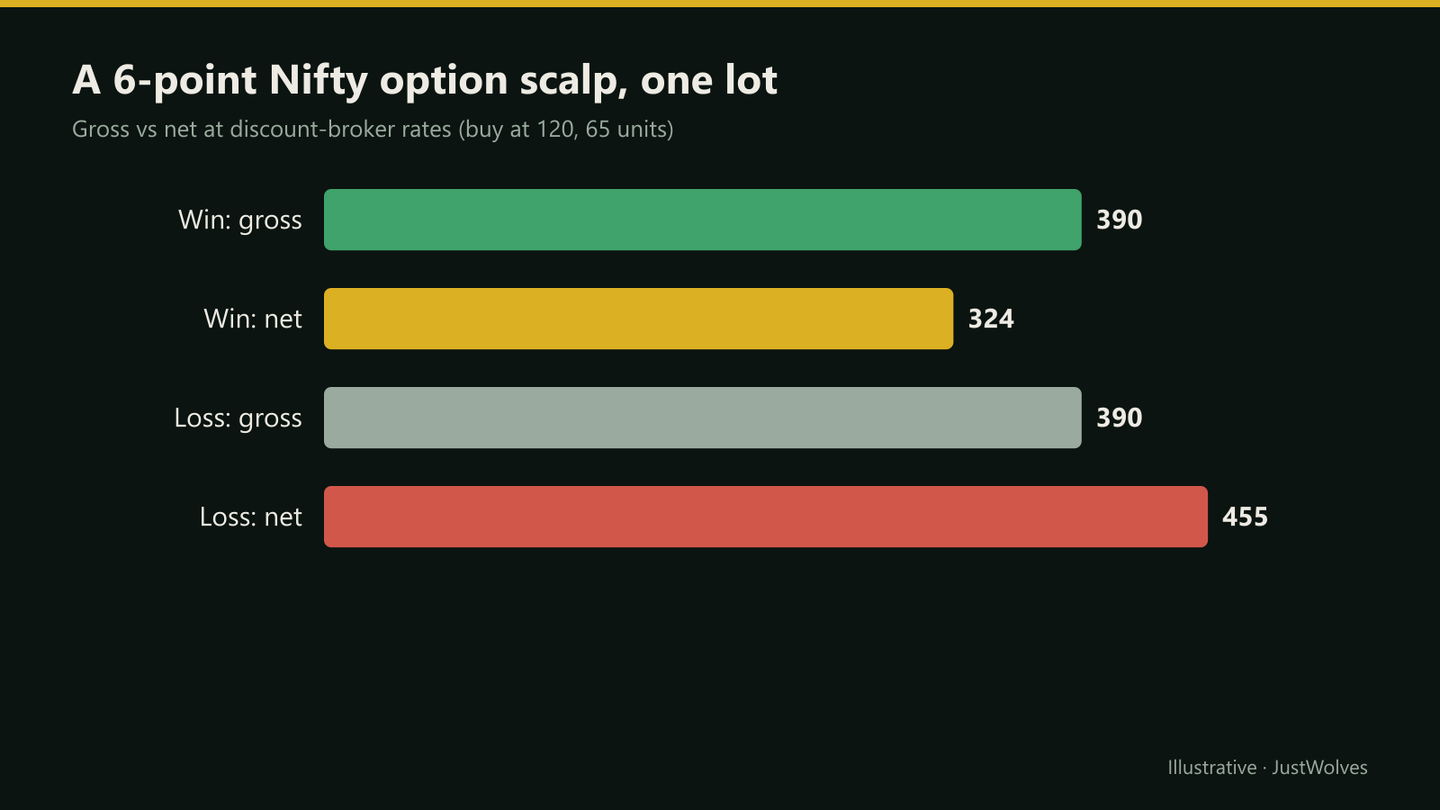
Using the site's Brokerage Calculator at discount-broker rates: one lot of Nifty options bought at 120 and sold at 126 makes ₹390 gross, but charges of about ₹66 leave about ₹324. The same trade losing 6 points costs about ₹455 after charges. Wins shrink and losses grow, so a 1:1 scalper needs to win about 58% of trades just to break even, before slippage.
Real Prices: A Morning of Scalps
Arjun's week in this lesson is hypothetical. The chart below shows what a simple, rule-based scalping morning looked like on real NIFTY 50 prices on 6 November 2026: eight trades, a break-even result before costs, and a clear loss after them.
Real prices: a morning of mechanical scalps on NIFTY 50, 6 November 2026
Step 1 of 4
The rule and the first two scalps
A simple scalping rule: when a 5-minute candle closes above the highest high of the previous 30 minutes, buy; below the lowest low, sell. Target and stop are both 20 points. At 9:45 NIFTY closes at 24,642.1, a new high: the long reaches +20 by 9:52. At 9:50 a second signal at 24,659.8 is stopped out for −20 at 9:57.
- What to observe
- One win, one loss: zero points so far.
- Condition
- Every trade pays costs, win or lose.
What Scalping Demands
- Fast, reliable execution: a stable connection, a responsive platform and order types you know well.
- Strict stops: a scalp that becomes a hope trade can erase many small wins.
- A daily loss limit: a fixed amount after which you stop for the day.
- Full attention: scalping can't be done between meetings.
- Emotional control: dozens of decisions a day, each with immediate feedback.
Who Scalping Suits
Scalping suits people who can be at the screen through the active part of the session, make quick decisions without hesitation, accept many small losses calmly, and follow rules mechanically. It also needs enough capital that position sizes are meaningful after costs.
It doesn't suit people with full-time jobs during market hours, those who find losses hard to accept quickly, or anyone hoping for fast money with little preparation. For many people, swing trading is a more realistic starting point.
Practical Example
Hypothetically, Arjun scalps Nifty options for a week on paper, recording every trade with charges from the brokerage calculator. He takes 52 trades: 29 winners averaging 5 points and 23 losers averaging 6 points, on one lot each.
Gross, he's up 7 points in total: (29 × 5) − (23 × 6) = 145 − 138. But charges of roughly ₹65 per round trip, about 1 point per lot, cost about 52 points across the week. After costs he's down roughly 45 points, about ₹2,900, before any slippage. He concludes he needs fewer, higher-quality trades with larger targets.
Does a Simple Scalp Survive Costs? Our Test
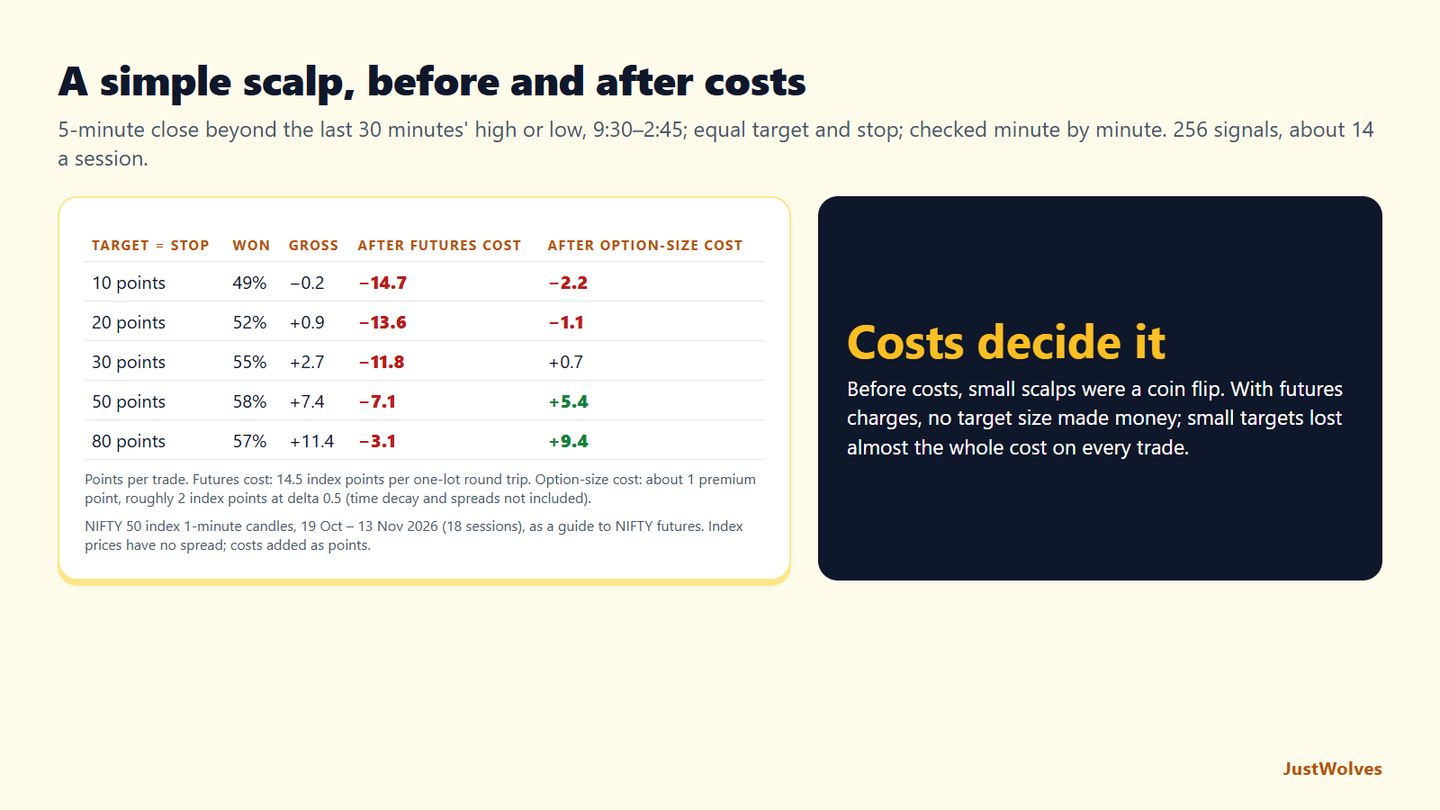
JustWolves tested the rule from the chart above on NIFTY 50 1-minute prices for 18 sessions, 19 October to 13 November 2026, as a guide to NIFTY futures. Signal: a 5-minute close above the highest high, or below the lowest low, of the previous 30 minutes, between 9:30 am and 2:45 pm. Exit: an equal target and stop of 10 to 80 points, checked minute by minute, or the session close. That gave 256 signals, about 14 a session. Costs: 14.5 index points per one-lot futures round trip, and, for comparison, about 2 index points for a one-lot option round trip (roughly 1 premium point at a delta of 0.5, before time decay and spreads).
| Target and stop | Won | Gross per trade | After futures cost | Break-even win rate with futures cost |
|---|---|---|---|---|
| 10 points | 49% | −0.2 pts | −14.7 pts | over 100% |
| 20 points | 52% | +0.9 pts | −13.6 pts | 86% |
| 30 points | 55% | +2.7 pts | −11.8 pts | 74% |
| 50 points | 58% | +7.4 pts | −7.1 pts | 65% |
| 80 points | 57% | +11.4 pts | −3.1 pts | 59% |
Before costs, small scalps were a coin flip. With 10 and 20-point targets, the rule won about half the time and made close to nothing per trade. That is what you would expect from short-term price moves that are close to random, and it is the starting point for most simple scalping rules.
Futures costs made every version lose. At 10 points, the cost of a futures round trip is larger than the target, so even a win loses money; a break-even win rate above 100% is impossible. At 20 points, the trader would need to win 86% of trades. This is the arithmetic in this lesson's cost section, measured on real prices.
Option-sized costs were survivable only for larger moves. With the much smaller cost of a one-lot option trade, targets of 30 points and more came out slightly positive in this sample. But this was a short window in which NIFTY rose from about 22,500 to 25,000, which favoured momentum rules; time decay, spreads and slippage are not included; and 50 to 80-point targets are closer to intraday trading than scalping. Treat these figures as a reason to test with full costs, not as evidence of an edge.
The broader lesson matches this page's callout: most F&O traders lose money, and for scalpers the main reason is visible in this table. The smaller the target, the larger the share that costs take.
Common Mistakes
- Ignoring costs when judging results.
- No daily loss limit.
- Turning losing scalps into longer trades.
- Overtrading to make up for small wins.
- Starting with real money before paper-testing.
Professional Insight
Experienced scalpers often say their edge is mostly in what they don't do: they skip quiet or choppy periods, stop after a set number of losses, and take only the setups they've tested. Many also say they trade fewer times than beginners expect, because each additional trade adds cost.
Risk Considerations
- Costs and slippage can turn a small edge into a loss.
- Leverage in F&O magnifies losses.
- Expiry-day volatility in options can cause sharp moves.
Important Terminology
| Term | Meaning |
|---|---|
| Scalping | Trading for small moves held for seconds to minutes. |
| Round trip | Opening and closing a position. |
| STT | Securities transaction tax. |
| Slippage | The difference between expected and actual fill price. |
| Daily loss limit | A maximum loss after which trading stops for the day. |
What is scalping in trading?
Trading for small price moves, holding positions for seconds to minutes and closing everything before the session ends.
Is scalping profitable?
It can be for a small number of disciplined traders, but costs and slippage are a large share of each gain, and most individual F&O traders lose money.
What do traders scalp in India?
Mainly Nifty and Bank Nifty options and futures, and highly liquid stocks intraday.
How much does a Nifty option scalp cost?
At discount-broker rates, about ₹65 per one-lot round trip, roughly one premium point, before slippage.
Is scalping good for beginners?
It's the least forgiving style. Many beginners do better learning on slower timeframes first.
Is scalping NIFTY futures profitable after costs?
A simple rule was not in our test. Over 18 sessions of NIFTY 50 1-minute data, a momentum scalp with 10 to 80-point targets lost money at every target size once a 14.5-point futures round-trip cost was included; small targets lost nearly the whole cost on each trade.
What win rate does a scalper need to break even?
It depends on target size and costs. With a NIFTY futures cost of about 14.5 points per round trip and equal target and stop, a 20-point scalp needs to win about 86% of trades to break even, and a 50-point trade about 65%.
Practical Exercise
Measure the cost hurdle.
Your task
Step 1: Open the brokerage calculator
Enter a one-lot Nifty option trade at a typical premium.
Step 2: Record round-trip costs
And convert them to premium points per lot.
Step 3: Calculate break-even win rate
For your typical target and stop, after costs.
Step 4: Paper-trade a week
Record every trade with costs and compare.
Check Your Understanding
Scalpers typically hold positions for:
Related Lessons
Next: Scalping vs Intraday Trading. See also Swing Trading vs Day Trading and the Brokerage Calculator.