
Calendar Spreads: Trading Time Decay Across Expiries
JustWolves is an educational platform and is not a SEBI-registered investment advisor. Trading financial instruments involves significant risk of loss and may not be suitable for all investors. Past performance is not indicative of future results. Read our full disclaimer →
What you'll learn
- A calendar spread sells a near-expiry option and buys a later-expiry option at the same strike
- It profits when the near option decays faster than the far one, usually when the underlying stays near the strike
- Maximum loss is roughly the net debit paid; maximum profit can't be fixed in advance
- It's long vega: rising IV in the far expiry helps, falling IV hurts
- Calendar-spread margin benefits don't apply on the expiry day of the near leg under current SEBI rules
In this article · 16 sections
A calendar spread uses two expiries instead of two strikes. You sell an option that expires soon and buy the same strike in a later expiry. Because short-dated options decay faster, the sold option should lose value more quickly than the bought one, especially if the market stays near the strike. This lesson explains how calendars work, what drives their value, and the risks that make them an advanced strategy.
What You Will Learn
- How a calendar spread is built
- Why it profits from differing decay rates
- Its sensitivity to price and volatility
- Risks, margin and management
Before You Start
How It's Built
- Sell a near-expiry option (for example, 7 days) at a strike near the current price.
- Buy the same type and strike in a later expiry (for example, 30 days).
- Pay a net debit, because the longer-dated option costs more.
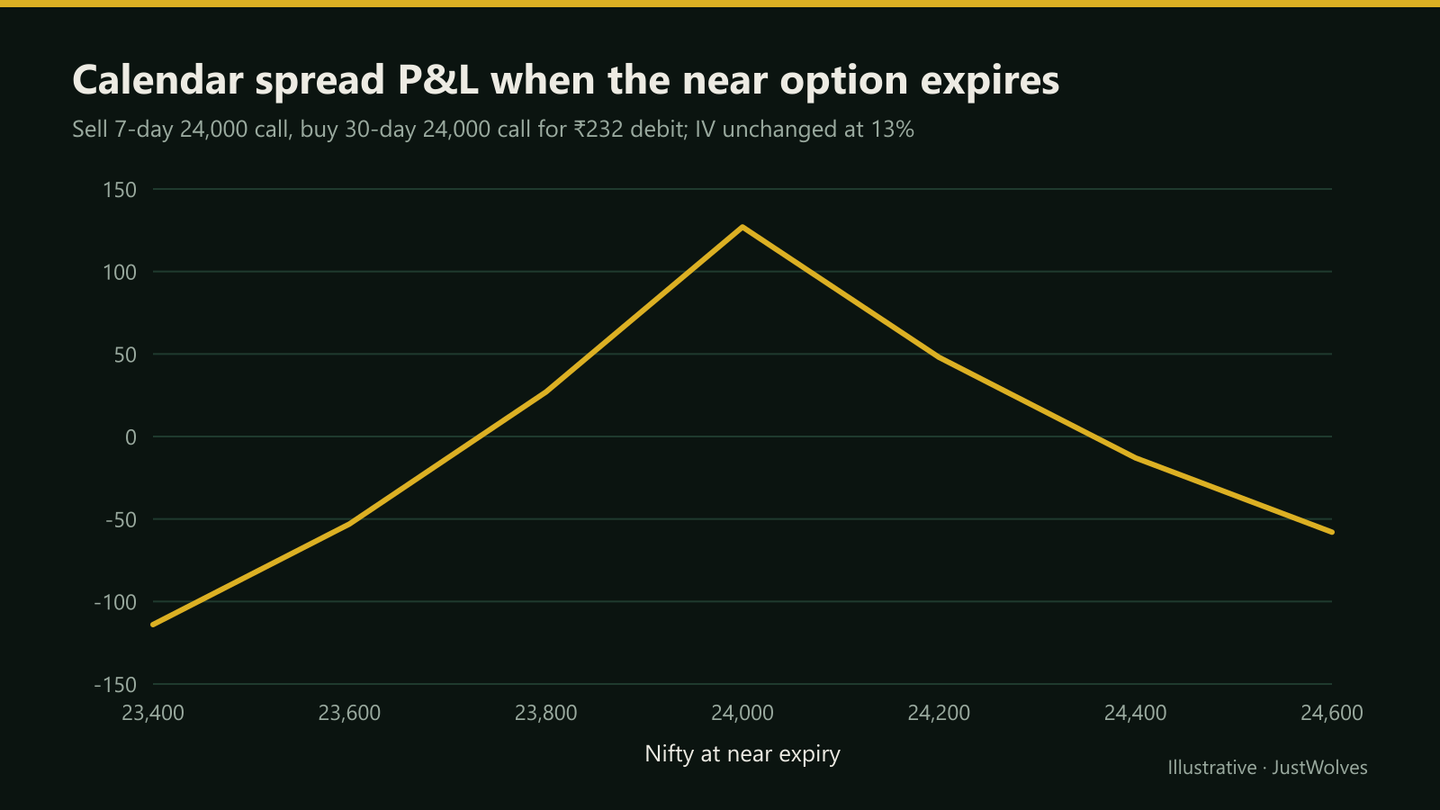
Using model values with Nifty at 24,000 and 13% IV: sell the 7-day 24,000 call at about ₹186, buy the 30-day 24,000 call at about ₹418, for a net debit of about ₹232.
How It Makes Money
If Nifty stays near 24,000, the 7-day call decays to zero by its expiry, while the 30-day call, now with 23 days left, still holds most of its value. The spread's value rises from ₹232 toward the remaining value of the far call. If Nifty moves far away in either direction, both options converge toward intrinsic value (or zero) and the spread loses most of its value.
Sensitivity to Volatility
A calendar is long vega: the far option has more vega than the near one, so a rise in implied volatility increases the spread's value, and a fall reduces it. That's the opposite of most selling strategies in this course.
Calendars can be hurt by an event that falls before the near expiry. IV in the near option may be elevated, which helps the seller, but if IV in the far option drops after the event, the long leg loses value too.
Margin and Expiry Day
Calendar spreads often receive a margin benefit because the legs offset each other. Under SEBI's rules effective from 1 February 2025, that benefit doesn't apply on the expiry day for positions involving the expiring contract, so the short near-expiry leg attracts full margin on its last day. Plan to close or roll the near leg before then, or keep enough margin available.
Managing a Calendar
- Profit target: close at, for example, 25–40% of the debit paid.
- Loss limit: close if the underlying moves outside the profitable range or the spread loses half its value.
- Roll the short leg: if the near option expires worthless, some traders sell the next near-expiry option against the same long option.
- Never leave the short leg naked by closing the long leg first.
Real Prices: A Calendar in a Quiet Week
Shilpa's example in this lesson uses round numbers. The chart below runs a one-week NIFTY call calendar on real prices from January 2025, valued each day by a standard pricing model.
Real NIFTY prices: a one-week calendar in a quiet week, January 2025
Step 1 of 4
A range
In mid-January 2025 NIFTY closes between 23,176 and 23,345. A trader expecting another quiet week looks at a calendar spread, as Shilpa does in this lesson.
- What to observe
- Calendars want the market to stay near the strike.
- Condition
- They lose in weeks with a large move either way.
Choosing the Strike
An ATM calendar profits most if the market stays where it is. An OTM calendar, with the strike above or below the current price, expresses a mild directional view: it profits most if the market drifts toward that strike by the near expiry. Some traders place a call calendar above the market and a put calendar below it, creating a double calendar with a wider profit zone.
Whichever strike you choose, the near option should have enough premium to be worth selling. Far OTM near-expiry options are often too cheap to offset the cost of the longer-dated option.
Practical Example
Hypothetically, Nifty is at 24,000 in a quiet range with no events scheduled. Shilpa buys one 24,000 calendar (sell 7-day, buy 30-day calls) for a debit of ₹232, ₹15,080 per lot.
Six days later, Nifty is at 24,020 and the spread is worth about ₹301. She closes the day before the near expiry for (301 − 232) × 65 = ₹4,485, avoiding the expiry-day margin and gamma.
When Do Calendars Work? Our Test
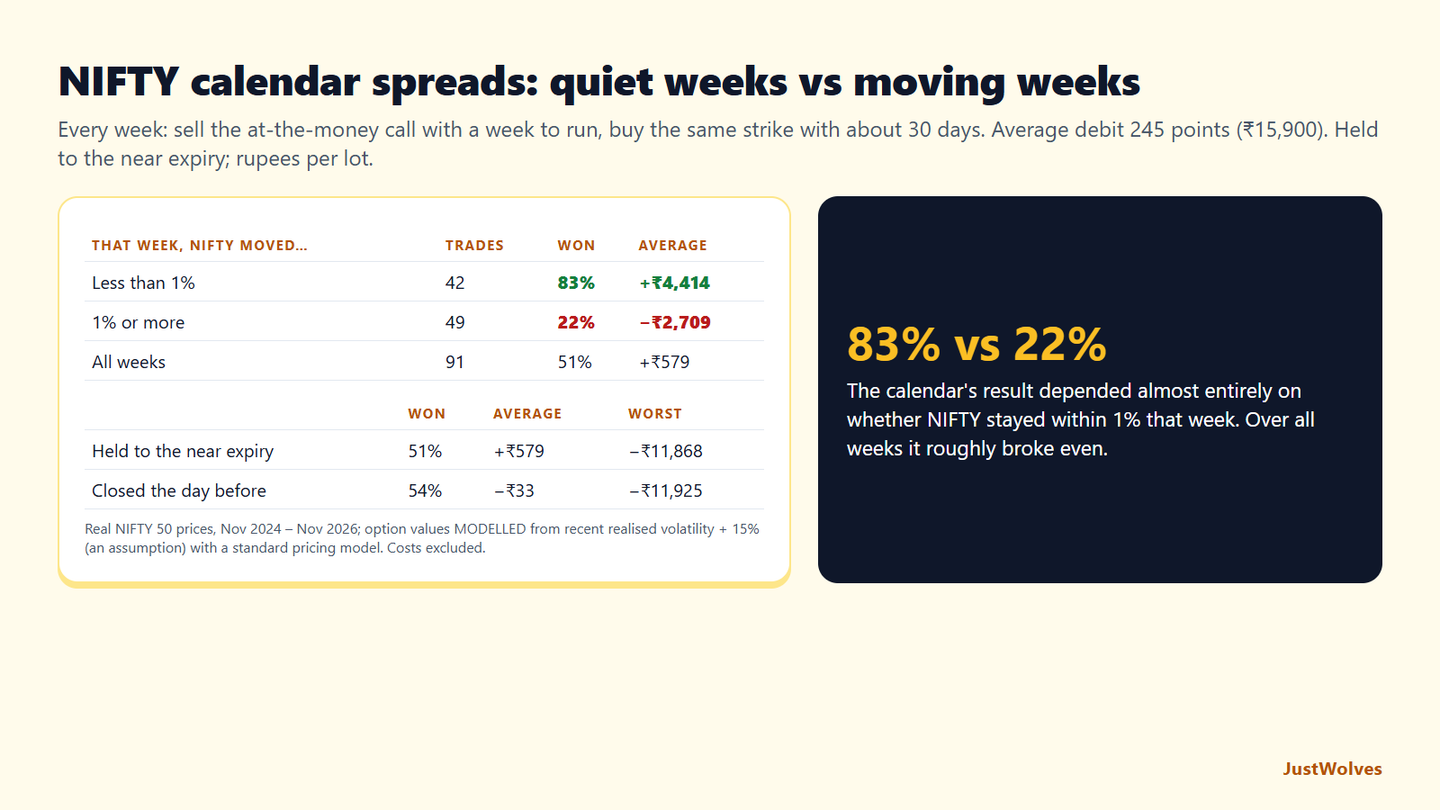
JustWolves bought an at-the-money NIFTY call calendar every week for about two years (November 2024 to November 2026): sell the call with a week to run, buy the same strike with about 30 days, 91 trades. We held each to the near expiry, and separately closed it the day before, and split the results by how far NIFTY moved that week. The average debit was 245 points, about ₹15,900 per lot. Values were modelled from recent realised volatility plus 15%; our data has no separate implied volatility for each expiry, so the test cannot show the term-structure effects this lesson describes.
| That week, NIFTY moved… | Trades | Won | Average |
|---|---|---|---|
| Less than 1% | 42 | 83% | +₹4,414 |
| 1% or more | 49 | 22% | −₹2,709 |
| All weeks, held to the near expiry | 91 | 51% | +₹579 (worst −₹11,868) |
| All weeks, closed the day before | 91 | 54% | −₹33 (worst −₹11,925) |
The calendar was a bet on a quiet week, and the data made that very plain. When NIFTY stayed within 1%, calendars won 83% of the time; when it moved more, they won only 22% and lost on average. Over all weeks the strategy roughly broke even before costs, because about half the weeks in this period moved by 1% or more.
Closing the day before the near expiry did not help on average. It avoids the expiry-day margin and gamma that this lesson's margin section warns about, which is a good reason to do it, but it also gives up the near option's last day of decay, which is when most of a calendar's profit is earned.
The practical use of this result is in the entry decision. A calendar makes sense when there is a reason to expect a quiet week, such as no scheduled events and a recent narrow range, as in the chart above, not as a default weekly trade. The worst calendar lost about ₹11,900 per lot, close to the debit, as this lesson's maximum-loss callout says.
Common Mistakes
- Ignoring volatility when entering.
- Holding the short leg into expiry day without margin.
- Closing the long leg first and leaving a naked short.
- Using calendars in trending markets.
- Mismatched events between the two expiries.
Professional Insight
Professional traders often use calendars to trade the term structure of volatility, buying the expiry where IV looks cheap and selling where it looks expensive. For most individual traders, the simpler use is a low-cost, defined-debit bet that the market stays near a level for a week or two.
Risk Considerations
- Large moves in either direction.
- Falling IV in the far expiry.
- Expiry-day margin on the short leg.
Important Terminology
| Term | Meaning |
|---|---|
| Calendar spread | Short near-expiry option, long later-expiry option, same strike. |
| Net debit | Premium paid minus premium received. |
| Term structure | How IV varies across expiries. |
| Long vega | Gains when IV rises. |
| Roll | Replacing an expired short leg with a new one. |
What is a calendar spread?
Selling a near-expiry option and buying a later-expiry option at the same strike.
How does a calendar spread make money?
When the near option decays faster than the far one, typically if the underlying stays near the strike.
What is the maximum loss?
Roughly the net debit paid, if the market moves far from the strike.
Does volatility affect calendars?
Yes. They're long vega: rising IV helps and falling IV hurts.
What happens to margin on expiry day?
Under SEBI rules, calendar-spread margin benefits don't apply to the expiring contract on its expiry day.
How often does a calendar spread make money?
In our test of weekly NIFTY call calendars on two years of real prices with modelled premiums, about half made money overall, but the result depended on the week: 83% won when NIFTY moved less than 1%, and only 22% when it moved more.
Should I close a calendar before the near expiry?
Closing the day before avoids expiry-day margin and gamma, which is a sound risk choice. In our NIFTY test it slightly reduced the average result, because the near option's final day of decay is where much of a calendar's profit comes from.
Practical Exercise
Price a calendar.
Your task
Step 1: Pick a strike
The ATM Nifty strike.
Step 2: Price both legs
Nearest weekly and the monthly expiry.
Step 3: Model outcomes
Use your broker's strategy builder to see P&L at the near expiry.
Step 4: Plan
Profit target, loss limit and when you'll close the short leg.
Check Your Understanding
A calendar spread uses:
Related Lessons
Previous: Iron Butterfly. Next: Ratio Spreads.