
Cash-Secured Puts: Getting Paid to Wait for a Price
JustWolves is an educational platform and is not a SEBI-registered investment advisor. Trading financial instruments involves significant risk of loss and may not be suitable for all investors. Past performance is not indicative of future results. Read our full disclaimer →
What you'll learn
- A cash-secured put sells a put while keeping enough cash to buy the shares at the strike
- If the stock stays above the strike, you keep the premium; if it finishes below, you buy the shares
- The effective purchase price is the strike minus the premium
- Downside below the strike is the same as owning the shares from that price
- It suits investors who genuinely want to own the stock at the strike
In this article · 16 sections
If you'd like to buy a stock but only at a lower price, you could place a limit order and wait. A cash-secured put is another way: you sell a put at that lower strike, collect the premium, and keep cash ready. If the price falls below the strike by expiry, you buy the shares, effectively at the strike minus the premium. If it doesn't, you keep the premium. This lesson explains how it works in India and where its risks lie.
What You Will Learn
- How a cash-secured put is set up
- The effective purchase price
- Physical settlement in India
- When the strategy fits and its risks
Before You Start
Read Covered Calls and Short Calls and Short Puts first.
How It Works
- Sell one put per lot at a strike below the current price, where you'd be happy to buy.
- Hold cash equal to strike × lot size, so you can buy the shares if assigned.
- Collect the premium.
In India, brokers still require normal short-option margin for the put. 'Cash-secured' describes your own discipline of keeping the full purchase amount available, which removes the leverage that makes naked short puts dangerous.
The Outcomes
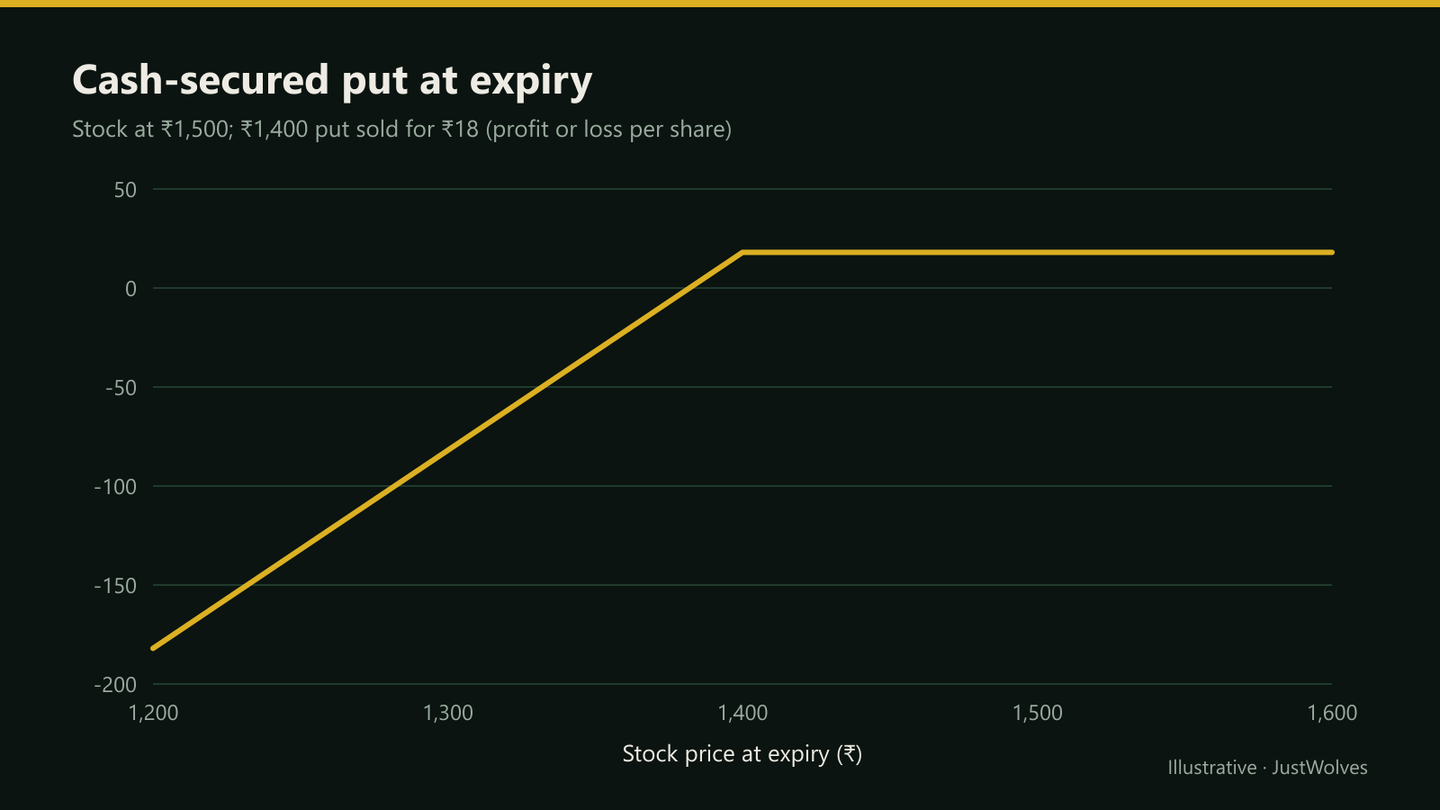
| Outcome | Result |
|---|---|
| Stock above ₹1,400 at expiry | Put expires; keep ₹18 |
| Stock below ₹1,400 at expiry | Buy shares at ₹1,400; effective cost ₹1,382 |
| Stock falls to ₹1,200 | Own shares at an effective ₹1,382, now worth ₹1,200 |
Physical Settlement
Stock options in India are physically settled. If your short put finishes ITM at expiry, you're obliged to buy the shares at the strike, and brokers will require the full purchase value. That's why keeping the cash is essential: without it, the broker may close the position before expiry, possibly at a loss.
Compared with a Limit Order
| Buy limit at ₹1,400 | Cash-secured ₹1,400 put | |
|---|---|---|
| If the price never reaches ₹1,400 | Nothing happens | Keep ₹18 premium |
| If the price dips below ₹1,400 then recovers before expiry | Bought at ₹1,400 | Not assigned (European-style); keep premium |
| If below ₹1,400 at expiry | Bought at ₹1,400 | Buy at ₹1,400, net ₹1,382 |
Choosing Strike and Expiry
Choose a strike at a price you'd buy the shares at anyway: for example, near a major support level or a valuation you consider attractive. Closer strikes collect more premium but are more likely to be assigned; further strikes collect less but give a lower effective price if they are.
Monthly expiries are standard for stock options in India. Avoid selling puts just before a company's results unless you're comfortable buying the shares after a bad announcement, because that's exactly when assignment becomes likely.
After Assignment
If you're assigned, you now own the shares at an effective price below the strike. Some investors then sell covered calls on those shares, collecting more premium while they hold. Alternating between cash-secured puts and covered calls is sometimes called the wheel. It can work in sideways markets, but in a sustained decline you'll hold shares losing value, with small premiums offsetting only part of the fall.
Practical Example
Hypothetically, Rohan wants to own a stock trading at ₹1,500 if it dips to ₹1,400, and the option lot is 500 shares. He sells one lot of the monthly ₹1,400 put at ₹18, collecting ₹9,000, and keeps ₹7,00,000 aside.
If the stock ends at ₹1,450, he keeps ₹9,000. If it ends at ₹1,360, he buys 500 shares at ₹1,400 (₹7,00,000), with an effective cost of ₹1,382 per share after the premium.
Real Prices: Assigned in a Fall
Rohan's example ends neatly at ₹1,360. Real assignments often come in sharper falls. The chart below follows a cash-secured put on Infosys through January and February 2026, with the put valued each day by a standard pricing model.
Real Infosys prices: a cash-secured put assigned in a fall, January–February 2026
Step 1 of 4
Getting paid to wait
On 22 January 2026 Infosys closes at ₹1,663.5. An investor who would like to own it about 5% lower sells a put at about ₹1,580, expiring on 23 February, modelled at about ₹20 per share, and keeps the full ₹1,580 per share in cash. Effective purchase price if assigned: about ₹1,560.
- What to observe
- Like Rohan in this lesson, on a real stock.
- Condition
- Cash-secured: no leverage.
How Did Cash-Secured Puts Do? Our Test on 17 NSE Stocks
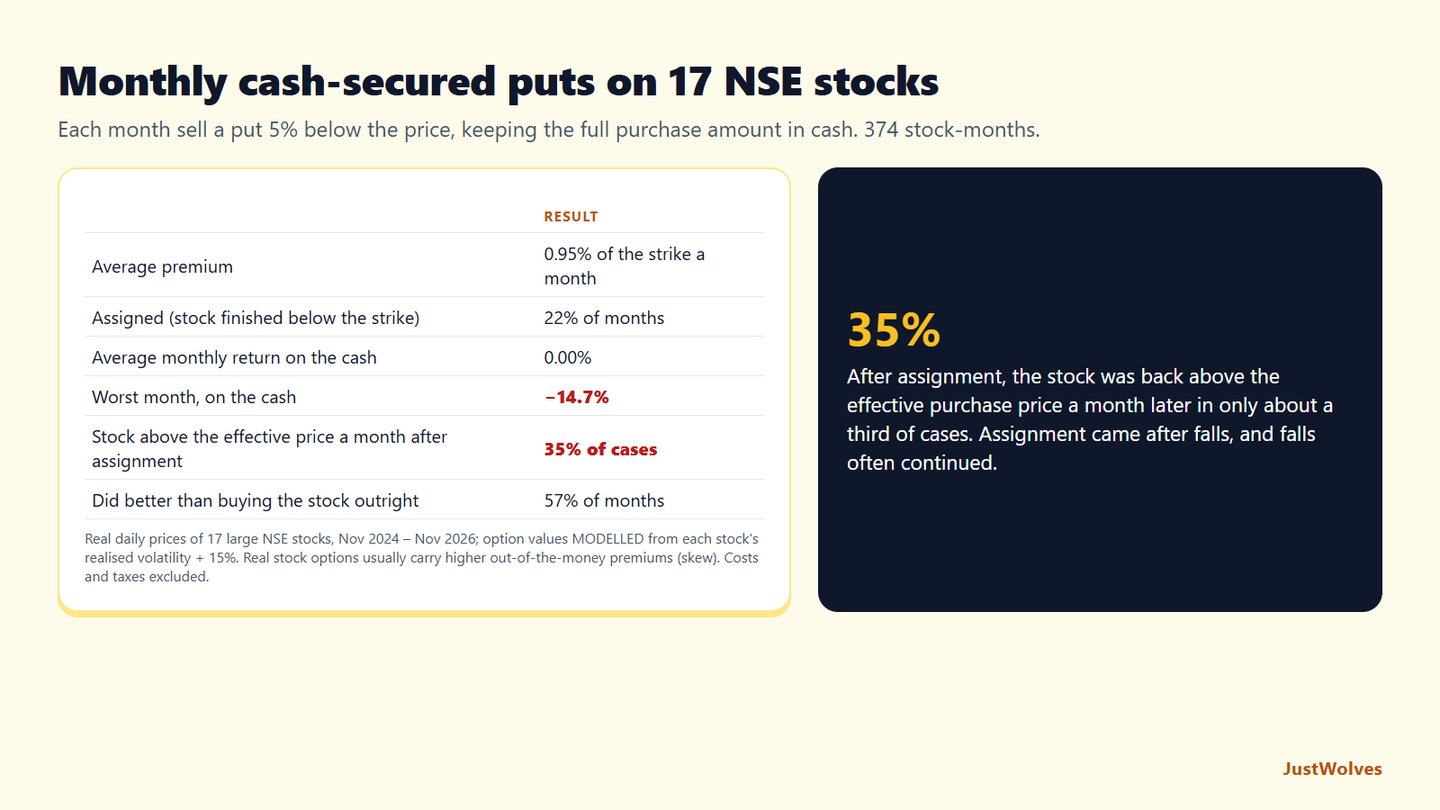
JustWolves ran a monthly cash-secured put on 17 large NSE stocks for about two years (November 2024 to November 2026). Each month we sold a put 5% below the price with about a month to expiry, holding cash equal to the strike, and compared the result with buying the shares outright: 374 stock-months in all. Premiums were modelled from each stock's recent realised volatility plus 15%; real stock options often price out-of-the-money puts higher, which would raise the premium.
| Measure | Result |
|---|---|
| Average premium | 0.95% of the strike a month |
| Assigned (stock finished below the strike) | 22% of months |
| Average monthly return on the cash | 0.00% (stock alone: −0.14%) |
| Month-to-month variation | 2.6% (stock alone: 6.8%) |
| Worst month, on the cash | −14.7% (stock alone: −20.2%) |
| Did better than buying the stock outright | 57% of months |
| Stock above the effective price one month after assignment | 35% of 79 cases; average −1.6% |
The strategy did what this lesson says: it was a calmer way to hold the same risk. Its month-to-month variation was less than half that of owning the stock, and its worst month was smaller. Over the period it roughly broke even on the cash, before the interest the cash could earn, while the stocks themselves slightly lost money.
But assignment was not a discount. The puts were assigned in about one month in five, and a month later the stock was back above the effective purchase price in only 35% of those cases. Falls that took a stock 5% or more below its price in a month tended to continue, as in the Infosys chart above. The premium lowered the purchase price by about 1%; it did nothing about the direction.
That is the professional insight in this lesson, measured. A cash-secured put is worthwhile only when owning the shares at the strike is a result you would welcome, including after bad news. Selling puts for the premium on stocks you do not want to own turns it into a short put with extra steps.
Common Mistakes
- Selling puts on stocks you don't want to own.
- Not keeping the cash, turning it into a leveraged naked put.
- Chasing premium in high-IV stocks before results.
- Ignoring physical settlement requirements.
- Selling too many lots relative to capital.
Professional Insight
Long-term investors use cash-secured puts as a disciplined way to set entry prices on stocks they've already researched. The strategy only makes sense when owning the shares at the strike is a result you'd welcome, not a disaster to avoid. Many also cap the share of their portfolio committed to outstanding puts, so a broad market fall doesn't assign several positions at once and leave them heavily invested at the worst possible moment for them.
Risk Considerations
- Full downside below the effective price.
- Missed upside if the stock rallies.
- Large capital tied up per lot.
Important Terminology
| Term | Meaning |
|---|---|
| Cash-secured put | A short put backed by cash to buy the shares. |
| Effective purchase price | Strike minus premium. |
| Assignment | Being required to buy at the strike. |
| Physical settlement | Delivery of shares at expiry. |
| Wheel strategy | Alternating cash-secured puts and covered calls. |
What is a cash-secured put?
Selling a put while keeping enough cash to buy the shares at the strike if assigned.
What happens if I'm assigned?
In India, you buy the shares at the strike price at expiry, through physical settlement.
Is a cash-secured put risky?
It has the same downside as owning the shares from the effective price, but no leverage beyond that.
Do Indian brokers have a cash-secured put product?
Brokers require normal option margin; holding the full cash is your own discipline.
What is the wheel strategy?
Selling cash-secured puts until assigned, then selling covered calls on the shares.
How often is a cash-secured put assigned?
In our test on 17 large NSE stocks with modelled premiums, monthly puts sold 5% below the price were assigned in about 22% of months. Assignment is most likely after bad news or a sharp market fall.
Is a cash-secured put better than buying the stock?
It is calmer, not reliably better. In our test, cash-secured puts had less than half the monthly variation of owning the stock and did better in 57% of months. But after assignment, the stock was back above the effective price a month later in only 35% of cases.
Practical Exercise
Plan a cash-secured put.
Your task
Step 1: Pick a stock
In the F&O segment that you'd like to own.
Step 2: Choose a strike
At a price you'd be happy to pay.
Step 3: Calculate
Cash required, premium and effective price.
Step 4: Plan
What you'll do if the stock falls 15% after assignment.
Check Your Understanding
A cash-secured put is:
Related Lessons
Previous: Covered Calls. Next module: Credit Spreads Explained.