
Short Calls and Short Puts
JustWolves is an educational platform and is not a SEBI-registered investment advisor. Trading financial instruments involves significant risk of loss and may not be suitable for all investors. Past performance is not indicative of future results. Read our full disclaimer →
What you'll learn
- A short call profits if the underlying stays below the strike; a short put if it stays above
- Maximum profit is the premium; maximum loss is unlimited (short call) or very large (short put)
- Further OTM strikes win more often but collect less and can still lose heavily in a large move
- Exits matter: profit targets, loss limits and rules for events and expiry
- Naked single-leg selling needs large capital; spreads offer similar exposure with capped loss
In this article · 14 sections
The simplest option-selling positions are a single short call or a single short put. They express a straightforward view: the underlying won't rise above, or fall below, a certain level by expiry. They're also the riskiest, because nothing caps the loss. This lesson covers how they work, how sellers choose strikes, how to manage them, and why most individual traders are better served by spreads.
What You Will Learn
- How short calls and short puts work
- How to choose strikes
- Maximum loss and stress scenarios
- Exit and management rules
Before You Start
The Two Positions
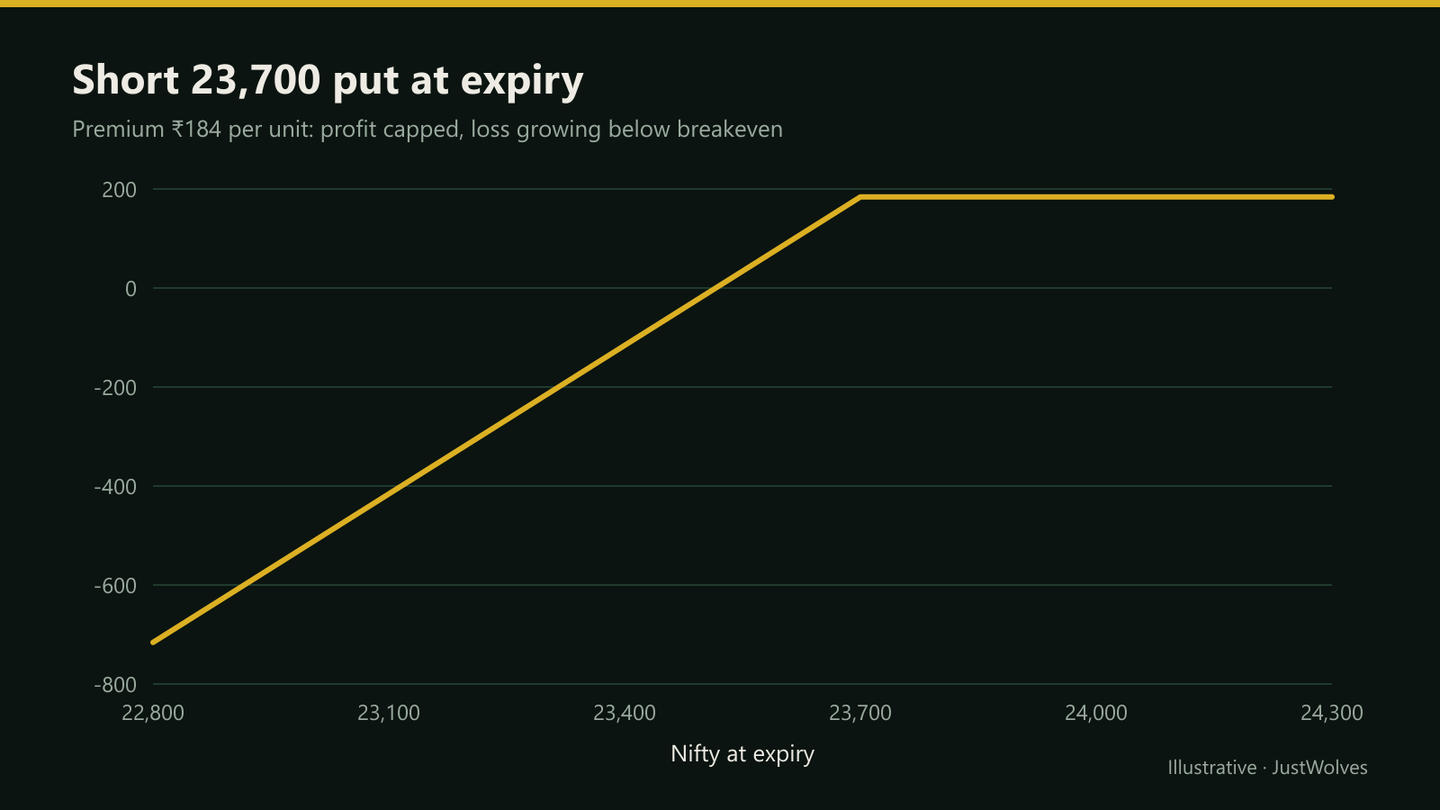
| Short 24,300 call | Short 23,700 put | |
|---|---|---|
| View | Nifty stays below 24,300 | Nifty stays above 23,700 |
| Premium received | ₹275 | ₹184 |
| Breakeven at expiry | 24,575 | 23,516 |
| Maximum profit per lot | ₹17,875 | ₹11,960 |
| Loss per lot at a 5% adverse move | (25,200 − 24,575) × 65 = ₹40,625 | (23,516 − 22,800) × 65 = ₹46,540 |
Choosing Strikes
- By distance: a strike beyond a key level on the chart, such as below major support for a short put.
- By delta: many sellers use delta as a rough probability guide, choosing options with delta around 0.15–0.30.
- By expected move: a strike outside the move implied by IV for the period.
Further OTM strikes are less likely to be reached but collect less, so each loss, when it comes, wipes out more winning trades. There's no strike that's both safe and rewarding.
Managing the Position
- Profit target: close at 50–75% of the premium collected.
- Loss limit: close if the option's value reaches, for example, two times the premium received, or if the underlying breaks a chart level.
- Events: reduce or hedge before results, policy announcements and budget days.
- Expiry: close or roll before expiry day rather than carrying high-gamma risk.
Short Calls vs Short Puts in Practice
The two aren't perfectly symmetrical. Markets tend to fall faster than they rise, and implied volatility usually jumps in sell-offs, so short puts are exposed to sudden, violent losses. Short calls face a different danger: a steady, grinding rally that keeps pushing through strikes, sometimes accelerated by short covering.
Index options also show volatility skew: OTM puts typically carry higher implied volatility than OTM calls the same distance away. Sellers collect more for puts precisely because downside crashes are the bigger risk. The richer premium is compensation, not a free extra.
Neither side is the 'safe' one. A seller who only ever sells puts is effectively running a leveraged bet that the market won't fall sharply, and should size it with that in mind, assuming a crash will eventually come during the life of the strategy, not as a remote possibility.
Real Prices: A Short Call in a Grinding Rally
This lesson says the short call's danger is a steady, grinding rally rather than a crash. The chart below shows exactly that on real NIFTY 50 prices from September and October 2025, with a 0.20-delta short call valued each day by a standard pricing model.
Real NIFTY prices: a short call in a grinding rally, September–October 2025
Step 1 of 4
Selling at 0.20 delta
On 25 September 2025 NIFTY closes at 24,891. A seller writes one lot of the 25,500 call expiring on 28 October, about 0.20 delta and 600 points away, modelled at about 63 points: ₹4,090.
- What to observe
- A common choice in this lesson's strike section.
- Condition
- Maximum loss: unlimited.
Practical Example
Hypothetically, Nifty is at 24,000 in an uptrend, with support around 23,700. Kunal sells one lot of the 30-day 23,700 put at ₹184, collecting ₹11,960. His rules: take profit at ₹70, exit if the put reaches ₹370 or Nifty closes below 23,650.
Two weeks later, the put trades at ₹65 and he closes for (184 − 65) × 65 = ₹7,735. In a different scenario, a weekend gap opens Nifty at 23,450; the put opens near ₹420 as both price and implied volatility jump, and he exits at a loss of about (420 − 184) × 65 = ₹15,340, more than his entire planned profit.
Short Options at 0.20 Delta: Held or Managed? Our Test
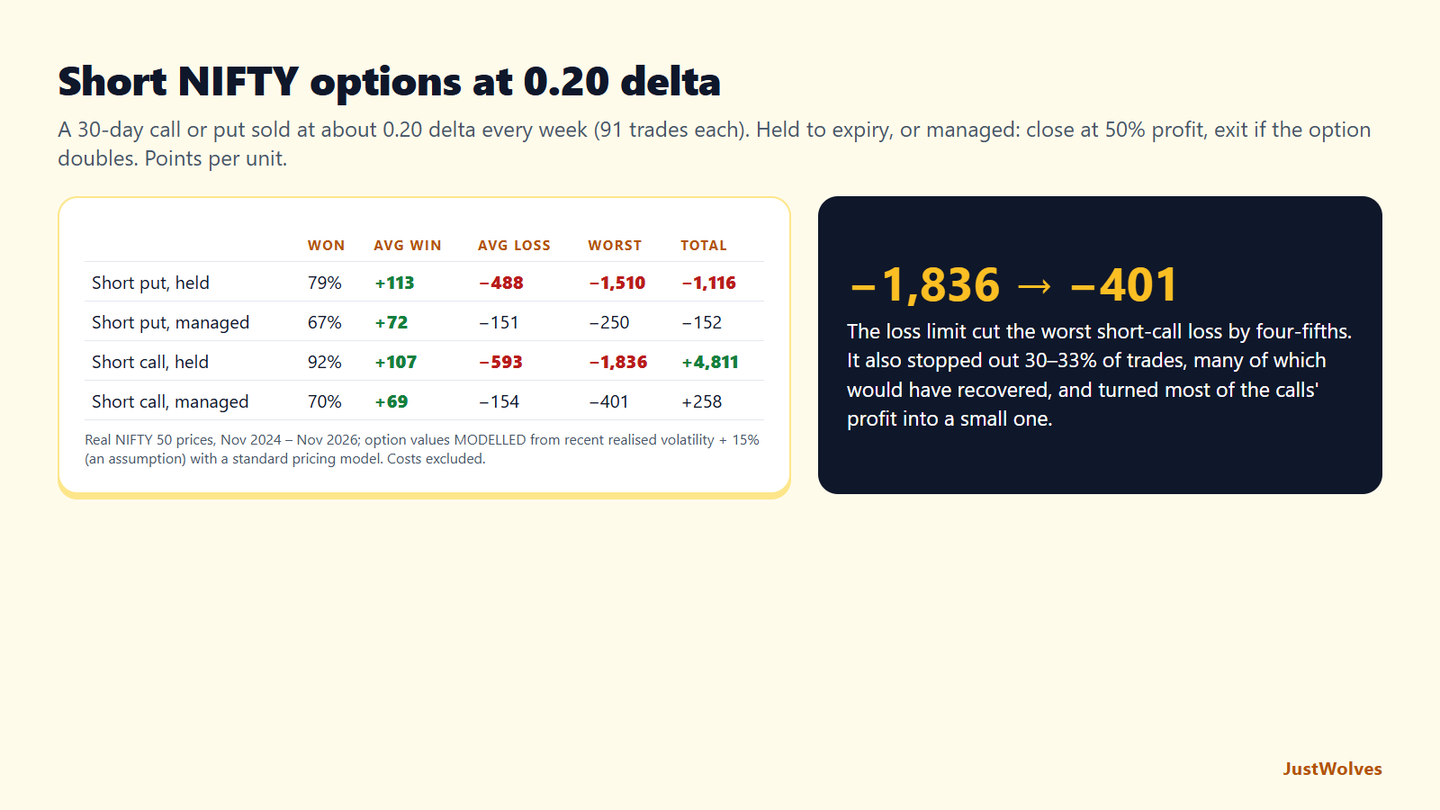
JustWolves sold a 30-day NIFTY call and, separately, a 30-day NIFTY put at about 0.20 delta every week for about two years (November 2024 to November 2026): 91 trades each. We ran each twice: held to expiry, and managed with this lesson's rules, closing at 50% of the premium or exiting if the option's value doubled. Premiums averaged about 110 points, modelled from recent realised volatility plus 15%.
| Won | Average win | Average loss | Worst | Total | |
|---|---|---|---|---|---|
| Short put, held to expiry | 79% | +113 | −488 | −1,510 | −1,116 |
| Short put, managed | 67% | +72 | −151 | −250 | −152 |
| Short call, held to expiry | 92% | +107 | −593 | −1,836 | +4,811 |
| Short call, managed | 70% | +69 | −154 | −401 | +258 |
Held to expiry, both positions won most of the time and still had brutal worst cases. The short put won 79% of trades but lost money overall, because its average loss was more than four times its average win. The short call won 92% of trades and made money in this period, which included more strong rallies than crashes, but its worst trade lost 1,836 points, about ₹1,19,000 per lot, against a typical gain of about ₹7,000.
The loss limit did what it is for. It cut the worst put loss from 1,510 to 250 points and the worst call loss from 1,836 to 401. The cost was large: about a third of trades were stopped out, many of which would have recovered, and the call's profit shrank from 4,811 points to 258. A loss limit turns an unlimited risk into a known one; it does not make a strategy profitable on its own.
One finding ran against the usual story. This lesson notes that markets tend to fall faster than they rise. In our two years, the opposite held: NIFTY had 20 five-day rises of more than 4% and only 6 five-day falls of that size, and the best day (+3.8%) was larger than the worst (−3.3%). Short calls, not puts, met the sharpest moves in this period. A different two years could easily reverse that, which is why the lesson's conclusion stands: neither side is the safe one.
Common Mistakes
- Selling far OTM options for tiny premiums with large size.
- No loss limit, hoping the option will 'come back'.
- Selling calls in strong uptrends or puts in strong downtrends.
- Holding naked positions over events.
- Ignoring gap risk in stop planning.
Professional Insight
Professionals who sell single options naked usually do it with small size relative to large capital, and with hedges elsewhere in the portfolio. For individual traders, the same view is almost always better expressed as a credit spread.
Risk Considerations
- Unlimited or very large losses.
- Gaps skip stop-losses.
- Margin calls in fast markets.
Important Terminology
| Term | Meaning |
|---|---|
| Short call | A sold call; profits if the underlying stays below the strike. |
| Short put | A sold put; profits if the underlying stays above the strike. |
| Naked | Without a protective position. |
| Volatility skew | Higher IV for OTM puts than OTM calls. |
| Loss limit | A preset level at which a losing position is closed. |
What is a short put?
Selling a put option: you receive the premium and profit if the underlying stays above the strike.
What is the risk of a short call?
Unlimited, because the underlying can rise without limit.
Which strike should I sell?
There's no safe strike. Further OTM options win more often but collect less; size and exits matter more than the strike.
When should I close a short option?
Many sellers close at 50–75% of the premium captured, or at a preset loss limit.
Is a short put the same as buying the stock?
It has similar downside below the strike, but profit is capped at the premium.
Does a 0.20-delta short option win 80% of the time?
Roughly. In our test of 30-day NIFTY options on two years of real prices with modelled premiums, 0.20-delta short puts held to expiry won 79% of trades and short calls 92%. But the short puts still lost money overall, because their losses averaged more than four times their wins.
Should I use a stop-loss on short options?
A loss limit is what makes a naked short option's risk known. In our NIFTY test, exiting when the option doubled cut the worst short-put loss from 1,510 to 250 points. It also stopped out about a third of trades, many of which would have recovered, so expect lower average profits.
Practical Exercise
Stress-test a short option.
Your task
Step 1: Pick a short put
One month out, delta around 0.2.
Step 2: Calculate
Premium per lot and breakeven.
Step 3: Stress
Loss per lot at 3%, 5% and 8% falls by expiry.
Step 4: Compare
With a credit spread using a put 200 points lower.
Check Your Understanding
A short call profits if the underlying:
Related Lessons
Previous module: Margin Requirements for Option Sellers in India. Next: Covered Calls. Later: Credit Spreads Explained.