
Position Sizing, Maximum Loss and Stress Testing for Option Sellers
JustWolves is an educational platform and is not a SEBI-registered investment advisor. Trading financial instruments involves significant risk of loss and may not be suitable for all investors. Past performance is not indicative of future results. Read our full disclaimer →
What you'll learn
- Size defined-risk trades from their maximum loss; size undefined-risk trades from stress-test losses
- A stress test asks what the position loses in a large move, such as 5%, 10% or 15%, including a volatility rise
- Set a limit on total stress loss across all positions, not just per trade
- Margin tells you the minimum the exchange needs, not what you can afford to lose
- Correlated positions on the same index count as one large position
In this article · 16 sections
Most option sellers who fail don't fail because they chose the wrong strategy. They fail because they sold too much of it. Win rates are high, losses are rare, and the temptation to add size is constant, until the rare loss arrives on the largest position. This lesson shows how to size option-selling positions from maximum loss and stress tests, so that the worst realistic outcome is survivable.
What You Will Learn
- How to size defined-risk positions
- How to stress-test undefined-risk positions
- Portfolio-level limits
- Why margin isn't a sizing guide
Before You Start
Read Hedged vs Naked Selling and, from the Risk course, Position Sizing.
Defined-Risk Positions
For spreads, condors and butterflies, the maximum loss is known: width minus credit, times the lot size. Lots = risk per trade ÷ maximum loss per lot, rounded down.
With ₹10,00,000 and 2% risk per trade (₹20,000), an iron condor with a maximum loss of ₹4,485 per lot allows four lots (₹17,940 at risk).
Undefined-Risk Positions: Stress Testing
Naked positions have no maximum loss, so you size them from a stress test: the estimated loss if the market moves sharply against you. A simple stress test uses intrinsic value at expiry for moves of 5%, 10% and 15%, then adds a margin for rising volatility and remaining time value.
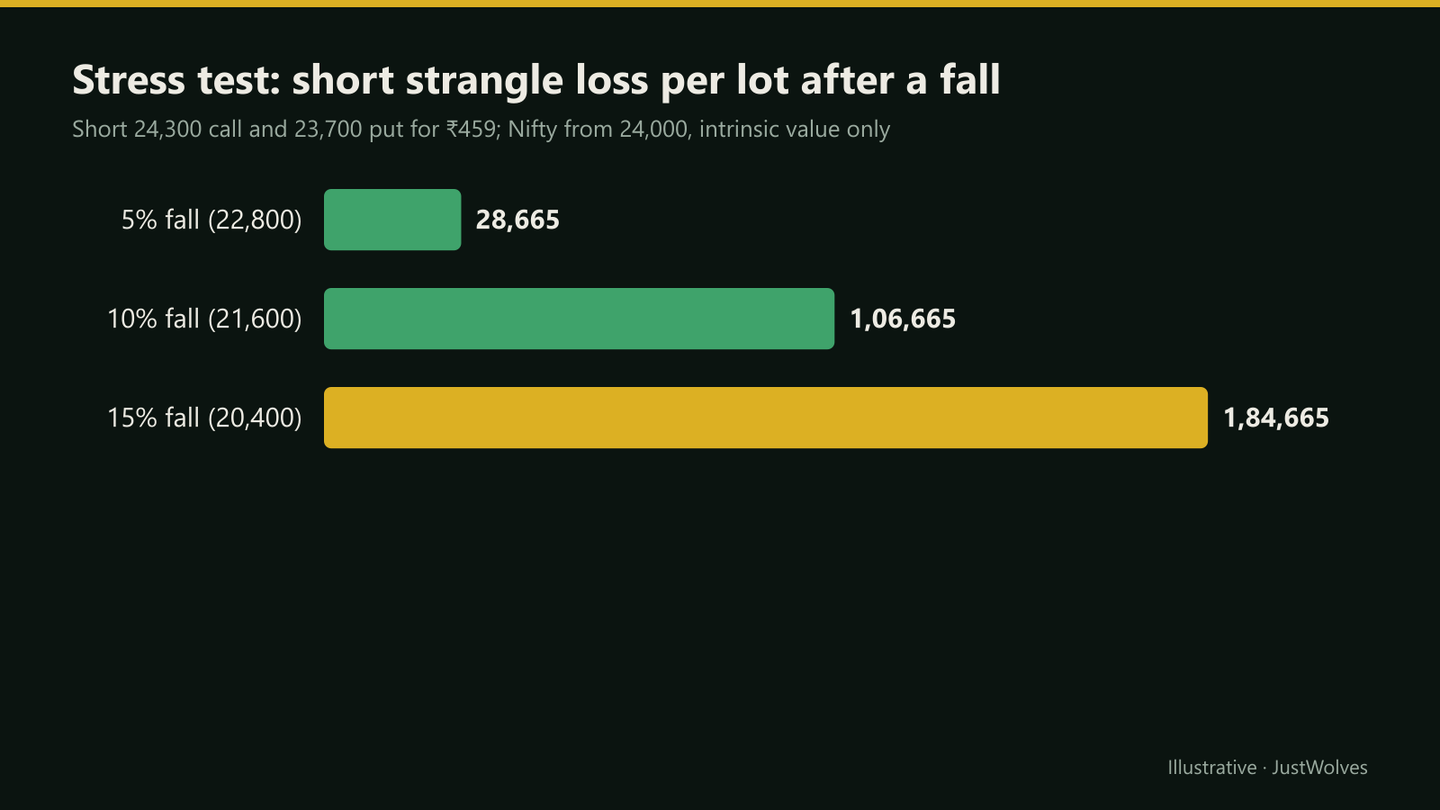
If your maximum acceptable loss in a severe scenario is 10% of capital (₹1,00,000 on ₹10,00,000), even one lot of this naked strangle fails the 10% stress test. That's the arithmetic behind the advice that naked selling needs large capital.
Portfolio-Level Limits
- Total maximum loss: the sum of all defined-risk maximum losses should stay within a set share of capital.
- Total stress loss: for the whole book, the loss in a 10% move (and a volatility spike) should be survivable.
- Correlation: a Nifty condor, a Bank Nifty strangle and short puts on bank stocks all lose together in a crash. Treat them as one position.
- Margin use: keep it well below capital; many sellers aim for under half.
Step by Step: Sizing a New Trade
Before every trade
Step 1: Maximum or stress loss
Calculate per lot.
Step 2: Per-trade limit
Lots that keep it within your risk per trade.
Step 3: Portfolio check
Add it to existing positions' maximum and stress losses.
Step 4: Correlation check
Does it add to the same directional risk?
Step 5: Margin check
Confirm margin use stays within your buffer.
Use the same five steps for every new short-option trade, before you check how much margin is available:
- Write down the structure and strikes, and whether the risk is defined or undefined.
- Defined risk: calculate maximum loss per lot, (width − credit) × 65. Undefined risk: calculate the stress loss per lot for a 10% move against you at expiry values, then add a volatility allowance.
- Divide your per-trade risk limit, for example 2% of capital, by that figure. Round down. If the answer is below one lot, the trade does not fit.
- Add the new position's maximum or stress loss to everything you already hold that would lose in the same move. Check the total against your portfolio stress limit.
- Only now check margin, and confirm the trade leaves a buffer for margin increases.
The order matters. Starting from margin, step 5, is how traders end up sizing to what the exchange allows rather than to what they can afford to lose.
Real Prices: A Stress Test That Missed the Real Risk
The chart below runs a day-one stress test on a real NIFTY strangle from March and April 2025, a month in which the market tested both sides within three weeks, and compares the estimate with what the position actually lost. Option values are modelled each day.
Real NIFTY prices: a strangle stress-tested in both directions, March–April 2025
Step 1 of 4
The stress test on day one
On 17 March 2025 NIFTY closes at 22,509. A seller considers one lot of the 23,350 call and 22,000 put expiring on 21 April, each about 0.20 delta, for a modelled 174 points (₹11,280). An intrinsic-value stress test, as this lesson describes, estimates a loss of about ₹7,200 after a 5% rally and ₹28,800 after a 5% fall.
- What to observe
- The fall looks like the bigger danger.
- Condition
- The test assumes expiry values only.
Adding Volatility to the Stress Test
Intrinsic-value stress tests understate losses before expiry. In a sharp fall, implied volatility usually jumps, raising the value of every short option, including those not yet in the money. A short call far above the market can lose value while the short put gains a great deal.
A practical approach is to stress-test at expiry values and then add an allowance, such as 20–30%, for the volatility effect before expiry, or to use your broker's strategy builder to model a large price move together with a rise in implied volatility of, say, 10 points.
Review Sizing Regularly
Sizing isn't set once. As capital grows or shrinks, as volatility changes and as lot sizes are revised, the number of lots that fits your limits changes too. Many sellers recalculate their maximum position size at the start of each month, and reduce size after a drawdown rather than increasing it to try to recover losses.
Practical Example
Hypothetically, Aarti has ₹15,00,000, risks 2% per trade (₹30,000) and caps total stress loss at 15% (₹2,25,000). She holds three iron condors with a combined maximum loss of ₹27,000.
She considers adding a naked strangle. Its 10% stress loss is about ₹1,06,665 per lot. Combined with her condors, one lot fits her portfolio limit, but it alone exceeds her per-trade limit three times over. She sells a fourth iron condor instead.
Are the Stress-Test Moves Realistic? Our Test
JustWolves checked this lesson's stress sizes against about two years of real NIFTY 50 prices (November 2024 to November 2026). First: how often NIFTY moved more than 5%, 10% and 15% within 21 trading days, roughly the life of a monthly option, measured both at the close and at any point in between. Second: on every day a 0.20-delta strangle was losing on an intrinsic-value basis before expiry, we compared its real-time modelled loss with the intrinsic-only estimate.
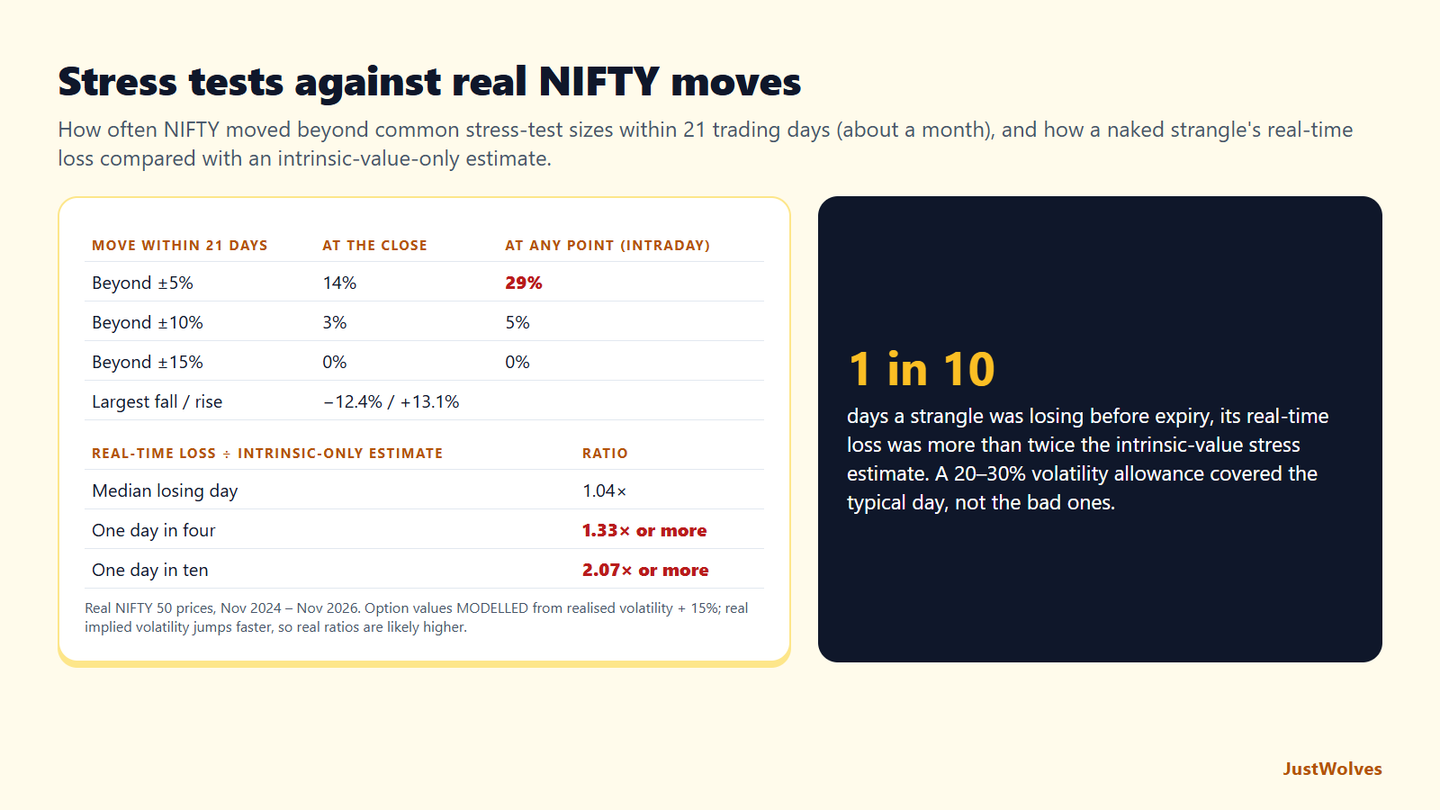
| Move against the position | At the close | At any point during the period |
|---|---|---|
| Beyond ±5% | 14% | 29% |
| Beyond ±10% | 3% | 5% |
| Beyond ±15% | 0% | 0% |
| Largest 21-day fall / rise | −12.4% | +13.1% |
| On days a strangle was losing before expiry | Real-time loss ÷ intrinsic estimate |
|---|---|
| Median day | 1.04× |
| One day in four | 1.33× or more |
| One day in ten | 2.07× or more |
A 5% stress test describes an ordinary month, not a stress. NIFTY moved more than 5% at some point within 21 days in 29% of periods. A 10% move happened in about 5% of periods, roughly once a year, and the largest 21-day moves were 12–13% in each direction. In this period, the 10% test in this lesson was the right minimum, and the 15% test the right severe case.
The intrinsic-value shortcut was fine on a typical day and badly short on the bad ones. On one losing day in four, the position's real-time loss was a third larger than the intrinsic estimate, and on one in ten it was more than double, as on 24 March 2025 in the chart above. This lesson's suggested 20–30% volatility allowance covered the typical day; for a stress limit you intend to rely on, an allowance of 100% is closer to what the data shows.
And the stress came from both sides. In the chart above, the side the day-one test rated as the smaller risk produced almost the whole loss. Stress-test the book against a large rally as carefully as against a fall.
Common Mistakes
- Sizing by margin available.
- Adding size after a winning streak.
- Ignoring correlation across positions.
- Stress-testing only small moves.
- Forgetting volatility in stress tests.
Professional Insight
Professional option-selling desks are run around stress limits: the loss in a crash scenario must stay within a predefined share of capital at all times. Individual sellers who adopt even a simple version of this rule remove the most common path to ruin.
Risk Considerations
- Real crashes can exceed stress scenarios.
- Volatility spikes increase losses before expiry.
- Correlation rises in crises.
Important Terminology
| Term | Meaning |
|---|---|
| Maximum loss | The worst outcome of a defined-risk position. |
| Stress test | Estimating losses in a severe market move. |
| Stress limit | A cap on stress-test losses as a share of capital. |
| Correlation | The tendency of positions to move together. |
| Margin utilisation | The share of capital used as margin. |
How many lots should I sell?
Divide your risk per trade by the maximum loss (or stress loss) per lot, and check the portfolio limits.
What is a stress test?
An estimate of how much a position or portfolio loses in a severe market move, often including a volatility rise.
What move sizes should I stress-test?
Common choices are 5%, 10% and 15% moves in the index, plus a rise in implied volatility.
Can I size by margin?
No. Margin reflects a typical one-day loss, not a crash.
Do different index positions count separately?
Not for risk purposes; positions that fall together should be treated as one exposure.
How often does NIFTY move 10% in a month?
In our two years of real data, NIFTY moved more than 10% from its starting level at some point within 21 trading days in about 5% of periods, roughly once a year. The largest 21-day moves were a 12.4% fall and a 13.1% rise.
Is an intrinsic-value stress test enough?
Not on its own. In our NIFTY test with modelled premiums, a strangle's real-time loss before expiry was more than twice its intrinsic-value estimate on one losing day in ten. Add a generous allowance for volatility and remaining time value.
Practical Exercise
Stress-test your book.
Your task
Step 1: List positions
Current or planned option-selling positions.
Step 2: Calculate
Maximum loss (defined) or 10% stress loss (undefined) for each.
Step 3: Total
Combined loss in a 10% fall and a 10% rise.
Step 4: Compare
With your capital. Would you survive?
Check Your Understanding
Defined-risk positions are sized from:
Related Lessons
Previous: Expiry-Day, Gap and Assignment Risk. Next: Backtesting Option-Selling Strategies. See also Position Sizing.