
Margin Requirements for Option Sellers in India
JustWolves is an educational platform and is not a SEBI-registered investment advisor. Trading financial instruments involves significant risk of loss and may not be suitable for all investors. Past performance is not indicative of future results. Read our full disclaimer →
What you'll learn
- Short options require initial margin (SPAN plus exposure margin) because losses can exceed the premium
- Hedged positions such as spreads usually need far less margin than naked short options
- Margins change with volatility and are higher for short options on expiry day
- Mark-to-market losses reduce available funds and can trigger margin shortfalls
- Margin is a minimum deposit, not a measure of risk; keep a large buffer
In this article · 16 sections
Buyers pay a premium and are done. Sellers must keep margin with their broker for as long as the position is open, because their losses aren't capped. Understanding how option-selling margin is calculated, why hedged positions need less, and how quickly margin can rise is essential before selling a single lot. This lesson covers the Indian framework as of November 2026.
What You Will Learn
- How short-option margin is calculated
- Why hedges reduce margin
- Expiry-day and volatility effects on margin
- How to manage margin safely
Before You Start
Read Futures Margin and Mark-to-Market Settlement and NSE Contract Rules and SEBI F&O Regulations first.
How Short-Option Margin Works
- SPAN margin: the clearing corporation's estimate of the worst likely one-day loss across a set of price and volatility scenarios.
- Exposure margin: an additional buffer on top of SPAN.
- Premium received: credited to your account, but the full initial margin must be available to open the position.
Because SPAN looks at scenarios, margin is higher for options closer to the money, for larger positions and when volatility is high.
Hedges Reduce Margin
| Position | Maximum loss | Margin (relative) |
|---|---|---|
| Naked short call or put | Unlimited or very large | Highest |
| Credit spread (short option + bought option further out) | Width of spread − premium received | Much lower |
| Iron condor (two credit spreads) | Width of one spread − total premium | Similar to one spread in many cases |
The bought option caps the worst-case loss, so the SPAN scenarios produce a much smaller loss, and margin falls. Brokers' margin calculators show the hedge benefit before you trade; check it for your exact strikes.
When Margin Rises
- Volatility spikes: SPAN parameters change and margins can rise sharply within days.
- Expiry day: SEBI rules add extra extreme loss margin on short options expiring that day, and remove calendar-spread margin benefits for expiring contracts.
- Price moves against you: a short option moving toward the money needs more margin, while mark-to-market losses reduce your available funds at the same time.
Margin Shortfalls
If your funds fall below the margin required, you have a shortfall. You must add money or reduce positions, and brokers may close positions on your behalf. Shortfalls can also attract penalties under exchange rules.
For sellers, shortfalls tend to arrive exactly when markets are moving fastest, which is when forced closures are most expensive.
Margin Is Not Risk
A position's margin is the minimum deposit the exchange requires, based on a model of likely one-day losses. It isn't your maximum loss. A naked short option can lose many times its margin in a severe move. Risk should be measured by maximum loss (for defined-risk positions) or by stress tests (for undefined-risk ones), covered later in this course.
Real Prices: Margin Is Not the Maximum Loss
This lesson says a naked short option can lose many times its margin, while a spread's loss is capped. The chart below puts Nikhil's choice on a real month, February to March 2025, with a naked short put and the matching credit spread valued each day. The margin figure is the illustrative one from Nikhil's example, not a broker quote.
Real NIFTY prices: a naked short put vs a credit spread, February–March 2025
Step 1 of 4
Two ways to sell the same put
On 3 February 2025 NIFTY closes at 23,361. Like Nikhil in this lesson, a seller considers the 23,150 put expiring on 5 March, modelled at about 209 points (₹13,550 per lot). Naked, or as a credit spread with the 22,950 put bought for protection: a net credit of about 64 points (₹4,130) and a maximum loss of 136 points (₹8,870).
- What to observe
- The naked put collects three times the premium.
- Condition
- It also carries an open-ended loss and a much larger margin.
Collateral and Cash
Brokers may accept approved securities, such as pledged shares or certain funds, as collateral for part of the margin, after a haircut. Exchange rules typically require a portion of margin to be in cash or cash equivalents, and mark-to-market losses must be settled in cash. Check your broker's collateral rules before relying on pledged holdings.
Practical Example
Hypothetically, Nikhil has ₹5,00,000. His broker's calculator shows a requirement of roughly ₹1.2 lakh to sell one naked OTM Nifty put lot, and roughly ₹40,000 for a credit spread using the same short put with a bought put 200 points lower. (These are illustrative figures; actual margins vary with volatility and change daily.)
He chooses the spread: its maximum loss is defined, and its margin uses less than 10% of his account, leaving a large buffer. Selling three naked lots instead would have used over 70% of his funds and left little room for a volatility spike.
How Large Are Daily Losses for Sellers? Our Test
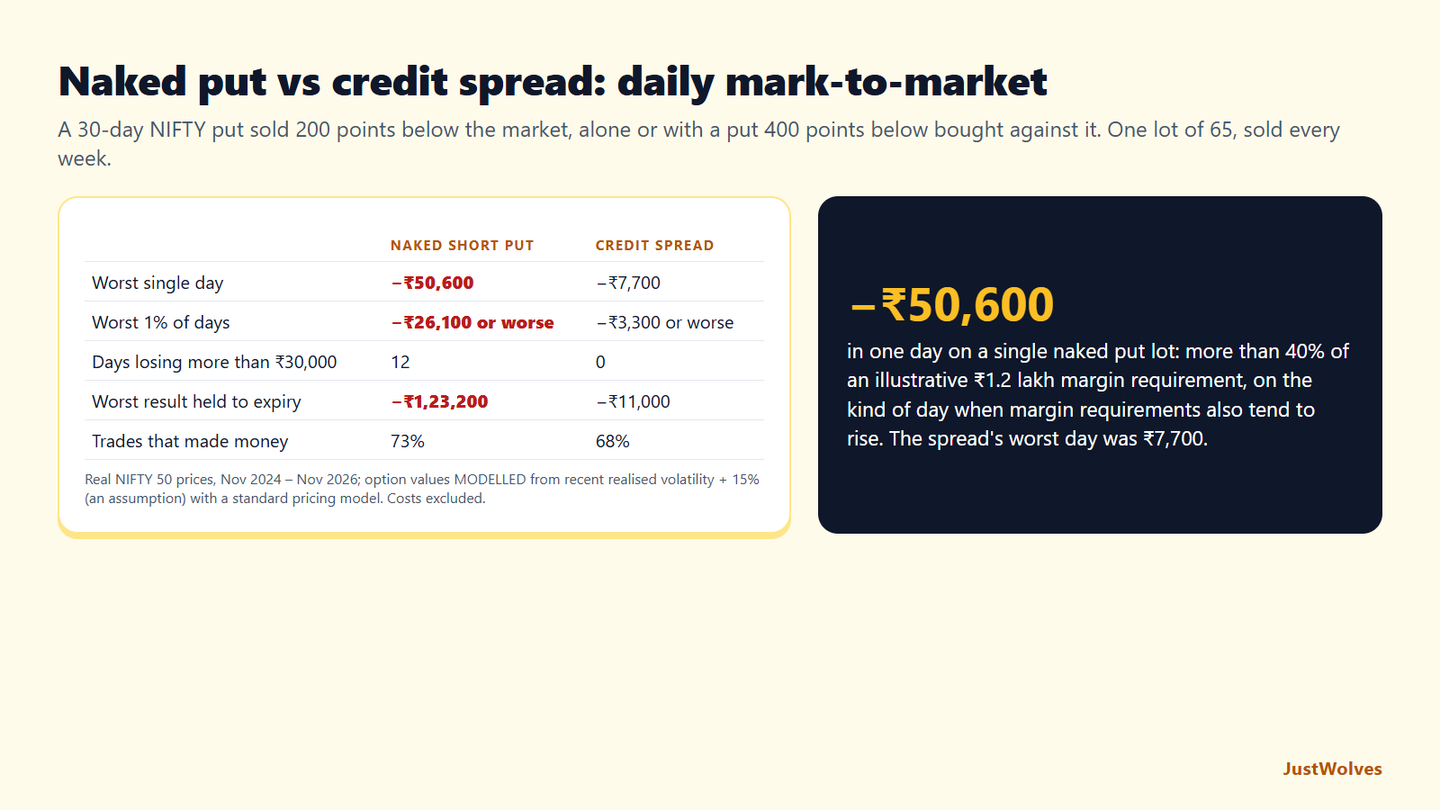
Margin covers the clearing corporation's estimate of a likely one-day loss, so the useful question is how large real one-day losses were. JustWolves sold a 30-day NIFTY put 200 points below the market every week for about two years (November 2024 to November 2026), once naked and once as a credit spread with the put 400 points below bought against it. We recorded the daily mark-to-market change for one lot of 65 over each trade's life: about 1,900 trading days for each structure. Option values were modelled from recent realised volatility plus 15%.
| Naked short put | Credit spread | |
|---|---|---|
| Worst single day | −₹50,600 | −₹7,700 |
| Worst 1% of days | −₹26,100 or worse | −₹3,300 or worse |
| Worst five-day stretch | −₹45,700 | −₹8,000 |
| Days losing more than ₹30,000 | 12 | 0 |
| Worst trade held to expiry | −₹1,23,200 | −₹11,000 |
| Trades that made money | 73% | 68% |
| Average result per trade | +₹850 | −₹65 |
On its worst day, one naked put lot lost about ₹50,600: more than 40% of the illustrative ₹1.2 lakh margin in Nikhil's example, in a single session. On one day in a hundred it lost ₹26,000 or more. Those losses are paid in cash through mark-to-market, and they arrive on the days when the exchange's volatility parameters, and therefore margins, tend to rise. A seller using most of their available margin would face a shortfall exactly then, as this lesson warns.
The spread's worst day was about a seventh as bad, and its worst trade was capped at about ₹11,000 against ₹1,23,200 for the naked put. The price of that protection showed up in the results: the naked put won slightly more often and earned a small positive average, while the spread came out about flat, because the bought put cost money in all the weeks it was not needed.
That trade-off is the core of this lesson. The naked put's extra return was small, and it came with tail losses that a ₹5 lakh account like Nikhil's could not absorb repeatedly. The spread's smaller margin is not a discount; it reflects a smaller maximum loss.
Common Mistakes
- Using all available margin.
- Treating margin as the maximum loss.
- Selling the short leg first and paying naked margin.
- Forgetting expiry-day margin increases.
- Not checking margin daily when volatility rises.
Professional Insight
Professional sellers manage a margin budget well below their capital, often using a fraction of what the broker would allow. They know that margin requirements expand in exactly the conditions that also produce losses, and they plan for both at once. A simple rule many use is to cap total margin use at a set fraction of capital.
Risk Considerations
- Margin can rise suddenly.
- Forced closures at bad prices.
- Losses can exceed margin.
Important Terminology
| Term | Meaning |
|---|---|
| SPAN margin | Scenario-based margin for the worst likely one-day loss. |
| Exposure margin | An additional buffer on top of SPAN. |
| Hedge benefit | Lower margin for positions with protective options. |
| Margin shortfall | Funds below required margin. |
| Margin utilisation | The share of capital used as margin. |
How much margin do I need to sell options in India?
It depends on the strike, expiry, volatility and hedges. Check your broker's margin calculator; naked positions need much more than spreads.
Why do spreads need less margin?
The bought option caps the maximum loss, so the risk model calculates a smaller worst-case loss.
Is margin higher on expiry day?
Yes for short options expiring that day, under SEBI's rules.
Can I lose more than my margin?
Yes. Margin is a minimum deposit, not a cap on losses.
What happens if I can't meet a margin requirement?
Your broker may close positions, and penalties may apply.
How much can a naked short NIFTY put lose in one day?
In our two-year test with modelled premiums, a 30-day NIFTY put sold 200 points below the market lost up to about ₹50,600 per lot in a single day, and ₹26,000 or more on about one day in a hundred.
Is a credit spread worth the lower premium?
For most accounts, yes. In our NIFTY test, a credit spread's worst day was about ₹7,700 against ₹50,600 for the naked put, and its worst trade about ₹11,000 against ₹1,23,200. The naked put earned slightly more on average, at the cost of those tail losses.
Practical Exercise
Compare margins.
Your task
Step 1: Open your broker's calculator
For Nifty options.
Step 2: Price a naked short put
OTM, nearest monthly expiry.
Step 3: Price a spread
The same short put plus a bought put 200 points lower.
Step 4: Compare
Margin and maximum loss for each, as a share of your capital.
Check Your Understanding
Short-option initial margin in India is mainly:
Related Lessons
Previous: Implied Volatility and Volatility Crush. Next module: Short Calls and Short Puts. See also Futures Margin and Mark-to-Market.