
Short Straddle: Selling the At-the-Money Call and Put
JustWolves is an educational platform and is not a SEBI-registered investment advisor. Trading financial instruments involves significant risk of loss and may not be suitable for all investors. Past performance is not indicative of future results. Read our full disclaimer →
What you'll learn
- A short straddle sells a call and a put at the same ATM strike and expiry
- Maximum profit is the total premium, earned only if the underlying finishes exactly at the strike
- Maximum loss is unlimited on the upside and very large on the downside
- It profits from a quiet market and falling IV; it loses from a large move or rising IV
- Because of the open-ended risk, most individual traders should prefer the iron butterfly, its hedged version
In this article · 16 sections
The short straddle sells both an at-the-money call and an at-the-money put. It collects the largest premium of any common option-selling strategy and profits if the market stays near the strike. It's widely discussed in Indian trading communities, often on weekly Nifty expiries. It also carries open-ended risk in both directions. This lesson explains how it works, why it's popular, and why it demands more caution than almost any other strategy in this course.
What You Will Learn
- How a short straddle is built
- Its profit zone, breakevens and maximum loss
- The Greeks of the position
- Management rules and safer alternatives
Before You Start
How It's Built
- Sell one ATM call.
- Sell one ATM put at the same strike and expiry.
- Receive the combined premium.
The Numbers
| Measure | Per unit | Per lot (65) |
|---|---|---|
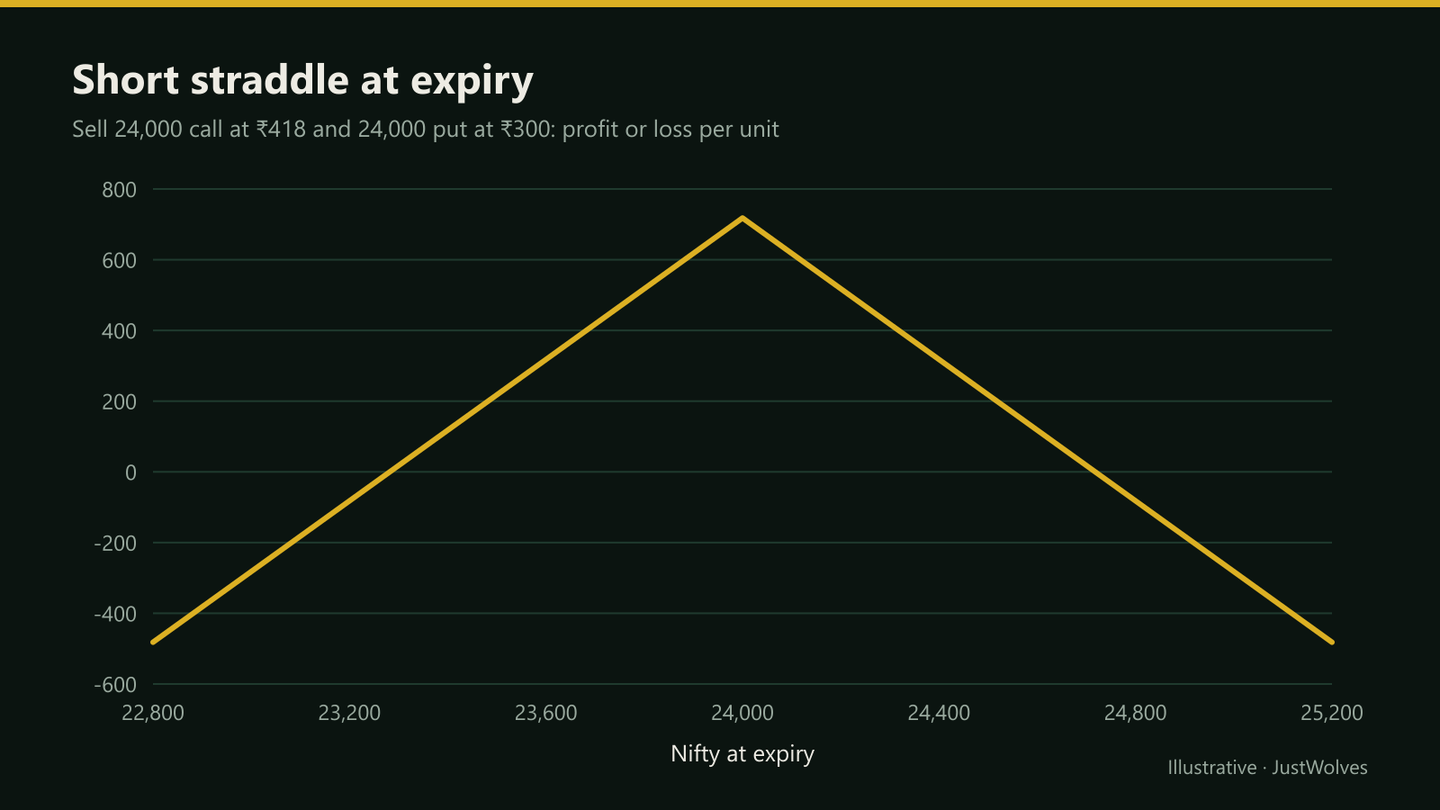
| Premium received (maximum profit) | ₹718 | ₹46,670 |
| Upper breakeven | 24,718 | — |
| Lower breakeven | 23,282 | — |
| Loss at a 5% rise (25,200) | ₹482 | ₹31,330 |
| Loss at a 7% fall (22,320) | ₹962 | ₹62,530 |
The Position's Greeks
| Greek | Exposure | Meaning |
|---|---|---|
| Delta | Near zero at entry | No initial directional bias |
| Gamma | Large and negative | Losses accelerate as price moves either way |
| Theta | Large and positive | Earns the most time decay of common strategies |
| Vega | Large and negative | Loses when IV rises, gains when it falls |
Why It's Popular, and the Catch
The appeal is clear: the largest premium, the fastest decay, and frequent small wins in quiet markets. On short-dated weekly expiries, the premium can decay quickly in calm sessions.
The catch is gamma. The same short-dated ATM options that decay fastest also respond most violently to price moves. A straddle that's up comfortably at midday can be deep in loss by the close after a sharp move, and an overnight gap can skip any stop-loss entirely.
Managing a Short Straddle
- Hedge the wings: buying OTM call and put protection converts it into an iron butterfly with a capped loss.
- Combined stop-loss: exit if the total value reaches, for example, 1.5 times the premium received.
- Profit target: close at a share of the premium, often 25–50%, rather than waiting for the rare finish exactly at the strike.
- Event rule: avoid holding through results, policy announcements and budget days.
- Adjustments: covered in Adjusting Short Option Positions.
Weekly Expiry Straddles
Selling straddles on the Nifty weekly expiry is a common retail practice in India. The premium is smaller, but it decays quickly, and the position is often opened and closed within the same week or even the same day.
The risks are concentrated in exactly those conditions. Gamma is extreme, a single afternoon move can multiply the straddle's value, and since November 2024, SEBI's rules add extra margin on short options on expiry day. Anyone running weekly straddles needs a hard stop, small size and, ideally, bought wings.
Real Prices: A Weekly Straddle After a Quiet Week
The chart below shows the weekly straddle this section warns about, on real NIFTY 50 prices from June 2026: a week of calm that made the trade look safe, followed by a rally that ran through both the breakeven and the stop. Option values are modelled each day.
Real NIFTY prices: a weekly short straddle after a quiet week, June 2026
Step 1 of 4
A quiet range
In early June 2026 NIFTY closes between 23,123 and 23,484 for seven sessions. Recent volatility is low, about 10%. For a straddle seller this looks ideal: a range, no trend, no scheduled event.
- What to observe
- Quiet markets are when straddles feel safest.
- Condition
- Low volatility also means a smaller premium.
Practical Example
Hypothetically, with India VIX moderate and no events scheduled, Sameer sells one lot of the 30-day 24,000 straddle for ₹718, collecting ₹46,670. His stop is a combined value of ₹1,080 (1.5× premium), and his target is ₹470 (about a third of the premium captured).
Eighteen days later, Nifty is at 24,080 and the straddle is worth about ₹463; he closes for about (718 − 463) × 65 = ₹16,575. In another scenario, a sharp 4% fall in a week pushes the straddle above ₹1,080 and he exits for a loss of about (1,080 − 718) × 65 = ₹23,530 plus slippage.
Short Straddles on Two Years of NIFTY: Our Test
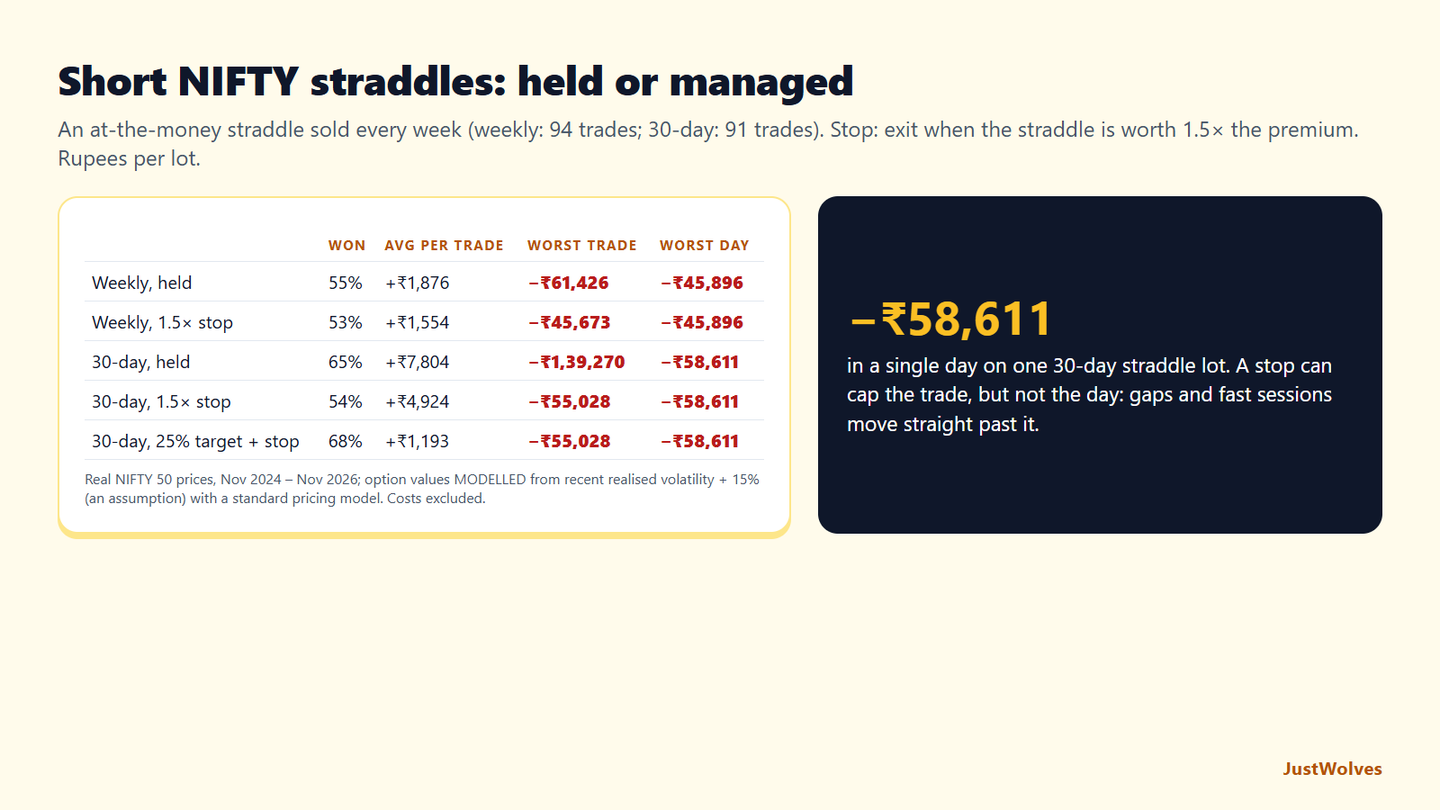
JustWolves sold an at-the-money NIFTY straddle every week for about two years (November 2024 to November 2026), with a week to expiry (94 trades) and with about 30 days (91 trades). We ran each held to expiry, with Sameer's stop at 1.5 times the premium, and with profit targets added. Premiums averaged 381 points weekly and 773 points for 30 days, modelled from recent realised volatility plus 15%: that markup gives every sale a built-in edge, so treat the positive averages with caution.
| Won | Average per trade | Worst trade | Worst single day | |
|---|---|---|---|---|
| Weekly, held | 55% | +₹1,876 | −₹61,426 | −₹45,896 |
| Weekly, 1.5× stop | 53% | +₹1,554 | −₹45,673 | −₹45,896 |
| 30-day, held | 65% | +₹7,804 | −₹1,39,270 | −₹58,611 |
| 30-day, 1.5× stop | 54% | +₹4,924 | −₹55,028 | −₹58,611 |
| 30-day, 25% target and 1.5× stop | 68% | +₹1,193 | −₹55,028 | −₹58,611 |
| 30-day, 50% target and 1.5× stop | 57% | +₹3,516 | −₹55,028 | −₹58,611 |
Short straddles won barely more than half the time, far less than credit spreads or strangles, because a finish near the strike is needed. The weekly straddle won 55% of trades; the 30-day straddle 65%.
The stop capped the trade but not the day. On one 30-day straddle lot, the worst single day lost about ₹58,600, and no stop rule changed that: the move happened within one session, or overnight. The 1.5× stop cut the worst 30-day trade from ₹1,39,270 to ₹55,028, at the cost of exiting 40% of trades, many of which would have recovered.
Profit targets traded return for win rate. A 25% target raised the 30-day win rate to 68% but cut the average profit per trade by more than 80%: winners were small, losers unchanged. With costs on two legs, a 25% target on a straddle leaves very little.
This is the catch this lesson describes: the largest premium comes with the largest gamma. For most individual traders, the iron butterfly lesson's version of this trade, with wings bought, is the one to study first.
Common Mistakes
- Selling naked straddles without wing hedges.
- Large size on weekly expiry days.
- No combined stop-loss.
- Holding through events.
- Treating premium as income.
Professional Insight
Professional desks that sell straddles typically hedge delta continuously and run them inside portfolios with tail protection. Retail traders copying the position without those tools carry the full gamma and gap risk, which is why the hedged iron butterfly is the more practical version.
Risk Considerations
- Unlimited upside risk.
- Large downside risk, especially with IV spikes.
- High margin and margin increases in volatile markets.
Important Terminology
| Term | Meaning |
|---|---|
| Short straddle | Selling an ATM call and put at the same strike. |
| Breakevens | Strike ± total premium. |
| Negative gamma | Losses accelerate as price moves. |
| Combined stop | An exit based on the total value of both legs. |
| Iron butterfly | A short straddle with bought wings. |
What is a short straddle?
Selling an at-the-money call and put at the same strike and expiry to profit from a quiet market.
What is the maximum loss on a short straddle?
Unlimited on the upside and very large on the downside.
When does a short straddle make money?
When the underlying stays between the breakevens and especially near the strike, and when IV falls.
Is a short straddle safe on weekly expiry?
No. Short-dated ATM options have extreme gamma, so small moves can cause large losses.
How can I limit the risk?
Buy OTM options as wings, turning it into an iron butterfly with a capped loss.
How often does a short straddle make money?
In our test on two years of real NIFTY prices with modelled premiums, weekly at-the-money straddles won 55% of the time and 30-day straddles 65%, held to expiry and before costs. A finish close to the strike is needed, so straddles win less often than strangles or spreads.
Does a stop-loss protect a short straddle?
Partly. In our NIFTY test, exiting at 1.5 times the premium cut the worst 30-day straddle loss from about ₹1,39,000 to ₹55,000 per lot. But the worst single day, about ₹58,600, happened regardless, because stops cannot act inside a gap or a one-session move.
Practical Exercise
Stress-test a straddle.
Your task
Step 1: Price a 30-day ATM straddle
From the Nifty option chain.
Step 2: Calculate breakevens
And premium per lot.
Step 3: Stress
Loss per lot at 3%, 5% and 8% moves each way at expiry.
Step 4: Compare
With an iron butterfly using wings 300 points away.
Check Your Understanding
A short straddle sells:
Related Lessons
Previous module: Bear Call Spread. Next: Short Strangle. Later: Iron Butterfly.