
Adjusting Short Option Positions
JustWolves is an educational platform and is not a SEBI-registered investment advisor. Trading financial instruments involves significant risk of loss and may not be suitable for all investors. Past performance is not indicative of future results. Read our full disclaimer →
What you'll learn
- An adjustment changes a position's risk when the market moves against it; it doesn't erase the loss already incurred
- Common adjustments: roll the untested side, roll out in time, add a hedge, or convert to a defined-risk structure
- Each adjustment trades one risk for another and usually adds costs
- Plan adjustment rules before entering, based on price levels or Greek limits
- Often the best adjustment is to close the position and accept a controlled loss
In this article · 14 sections
Short straddles and strangles rarely sit quietly until expiry. When the market moves toward one side, sellers face a choice: hold, adjust or exit. Adjustments can reduce risk and buy time, but they also lock in losses, add costs and sometimes create larger risks than they remove. This professional-level lesson covers the main adjustment techniques for weekly and monthly short positions, and the discipline that keeps them from becoming a way to avoid admitting a loss.
What You Will Learn
- When and why sellers adjust
- The main adjustment techniques
- What each technique trades away
- How to write adjustment rules in advance
Before You Start
Read Position Greeks for Option Sellers, Short Straddle and Short Strangle first.
When to Adjust
- Price trigger: the market reaches a preset level, such as a short strike or a set distance from it.
- Delta trigger: net delta exceeds your limit.
- Loss trigger: the position's value reaches a preset multiple of the premium.
- Time trigger: a short strike is threatened with only a few days to expiry, when gamma is highest.
Adjustment Techniques
| Technique | What you do | What it trades away |
|---|---|---|
| Roll the untested side | Buy back the side the market moved away from; sell a new one closer | Narrows the range; more risk if the move reverses |
| Roll the tested side | Buy back the threatened option; sell one further out | Usually locks in a loss on that leg |
| Roll out in time | Close and reopen in a later expiry | Extends exposure; often small credit for more time |
| Add a hedge | Buy an option or futures to cut delta | Costs premium or margin; limits recovery |
| Convert to defined risk | Buy wings to make an iron butterfly or condor | Costs premium; caps further loss |
| Exit | Close the whole position | Accepts the loss; ends the risk |
Adjusting a Weekly Short Straddle
Weekly straddles leave little time for adjustments to work. A common approach is to set a combined stop-loss on the straddle (for example, 1.3–1.5 times the premium) and, if the market moves halfway to a breakeven, shift the straddle to the new ATM strike or add a hedge on the tested side.
Each shift realises a loss on the original position and opens a new one with new risk. Several shifts in a trending week can add up to a loss larger than a simple stop would have produced. That's why many experienced sellers cap the number of adjustments per position, often at one or two.
Writing Adjustment Rules
Before entering
Step 1: Trigger
Define the price, delta or loss level that triggers action.
Step 2: Action
Choose one technique for each trigger.
Step 3: Limit
Set a maximum number of adjustments.
Step 4: Final exit
Define the level at which you close everything, no further adjustments.
Adjustment rules work only if they are written before the trade, when you are calm and the position is not losing. A useful set answers five questions:
- Trigger: what exactly starts an adjustment? A close beyond a short strike, a delta above your limit, or a loss of a set multiple of the premium.
- Action: what will you do, in order of preference? For example, exit first; adjust only if the new position is one you would open fresh.
- Limit: how many adjustments per position? One is a common maximum.
- Final exit: at what loss or level do you close everything, regardless of further adjustments?
- Time: on which day before expiry do you stop adjusting and simply close?
Write the answers next to the trade in your journal. If a market move tempts you to break a rule, the rule was either wrong, in which case change it after the trade, or right, in which case follow it now.
Real Prices: Exit, Roll or Hold?
The chart below applies a written trigger to a real 0.20-delta NIFTY strangle from August and September 2026, and follows all three choices to expiry: exit at the trigger, roll the untested side once, or hold. Option values are modelled each day.
Real NIFTY prices: exit, roll or hold a tested strangle, August–September 2026
Step 1 of 4
A strangle with rules
On 13 August 2026 NIFTY closes at 24,396. A trader sells one lot of the 25,200 call and 23,850 put expiring on 11 September, each about 0.20 delta, for a modelled 174 points (₹11,300). The rule, written in advance: act at the first close beyond a short strike.
- What to observe
- The 25,200 call is far above the market.
- Condition
- The put is about 550 points below.
Practical Example
Hypothetically, Manoj holds a short 24,300/23,700 strangle, sold for ₹459. Nifty rallies to 24,250 with 14 days left; net delta exceeds his limit. His rule: roll the untested put up to 23,900 for extra premium, once only, and exit everything if Nifty closes above 24,450.
He buys back the 23,700 put cheaply and sells the 23,900 put, collecting extra premium and reducing delta. Two days later Nifty closes at 24,480, triggering his final exit. He closes the position at a loss, smaller than it would have been had he kept rolling or held without a plan.
Does Adjusting Help? Our Test
JustWolves sold a 30-day NIFTY strangle every week for about two years (November 2024 to November 2026), call and put each at about 0.20 delta, 91 trades. When NIFTY first closed beyond a short strike, which happened in 58% of trades, we tried three responses: exit; roll the untested side once to 0.20 delta at the new price and hold; and roll once, then exit if the position's value reached three times the original credit. We compared them with holding to expiry. Values were modelled from recent realised volatility plus 15%.
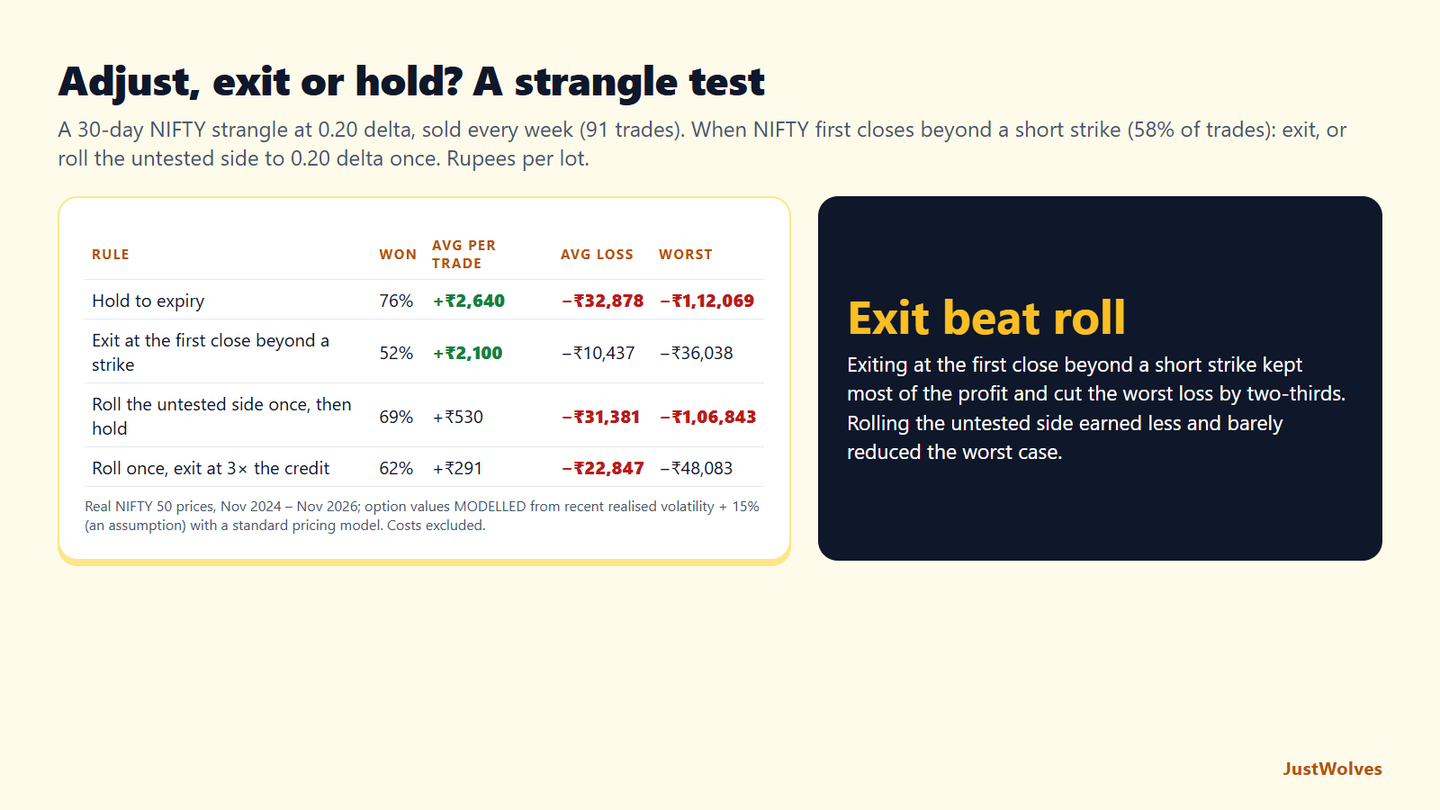
| Rule | Won | Average per trade | Average loss | Worst |
|---|---|---|---|---|
| Hold to expiry | 76% | +₹2,640 | −₹32,878 | −₹1,12,069 |
| Exit at the first close beyond a short strike | 52% | +₹2,100 | −₹10,437 | −₹36,038 |
| Roll the untested side once, then hold | 69% | +₹530 | −₹31,381 | −₹1,06,843 |
| Roll once, exit if value reaches 3× the credit | 62% | +₹291 | −₹22,847 | −₹48,083 |
Exiting was the best risk-adjusted choice. It kept about 80% of the hold-to-expiry average profit while cutting the average loss by two-thirds and the worst loss from about ₹1,12,000 to ₹36,000. Many exits happened while the trade was still slightly profitable, as in the chart above.
Rolling the untested side was the weakest choice. It collected a little extra premium, but the tested side, the one actually losing, was left untouched, so the worst loss barely changed. And moving the untested strike closer narrowed the range, as this lesson's callout warns, which turned some trades that would have been fine into losers. Adding a final exit at three times the credit helped the worst case but left the average lower than simply exiting.
This is the professional test in this lesson, in numbers: a rolled strangle is a new position that most traders would not open fresh at that moment. When the honest answer is no, closing is usually the better adjustment. Costs make the gap wider in practice, because each roll adds two more legs.
Common Mistakes
- Adjusting without a plan, improvising under pressure.
- Unlimited adjustments to avoid realising a loss.
- Rolling the untested side too close, creating a straddle in a trending market.
- Adding naked size to 'repair' a position.
- Ignoring costs of repeated adjustments.
Professional Insight
Experienced sellers judge adjustments by one question: would I open this new position fresh, right now, at this size? If the answer is no, the adjustment is usually a way to avoid admitting a loss, and closing is the better choice. Treating each adjustment as a new trade, with its own risk and reward, keeps the decision honest.
Risk Considerations
- Adjustments can compound losses in trends.
- Gaps skip adjustment triggers.
- Costs accumulate with each change.
Important Terminology
| Term | Meaning |
|---|---|
| Adjustment | A change to a position's legs to alter its risk. |
| Tested side | The side the market is moving toward. |
| Untested side | The side the market is moving away from. |
| Roll | Close one option and open another. |
| Final exit | A preset level at which the whole position is closed. |
How do I adjust a short straddle?
Common methods include shifting it to the new ATM strike, adding a hedge on the tested side, buying wings to convert it to an iron butterfly, or exiting at a combined stop.
What is rolling the untested side?
Buying back the option the market moved away from and selling a new one closer to the price, collecting extra premium.
Do adjustments reduce risk?
They change the shape of the risk. Some reduce delta but narrow the profit range or extend exposure.
How many adjustments should I make?
Many experienced sellers cap it at one or two per position, with a final exit level.
When should I just close the position?
When the market reaches your final exit level, or when you wouldn't open the adjusted position fresh.
Is it better to roll or exit a tested strangle?
In our test of 30-day NIFTY strangles on two years of real prices with modelled premiums, exiting at the first close beyond a short strike gave a better average result (₹2,100 vs ₹530 per lot) and a much smaller worst loss (₹36,000 vs ₹1,07,000) than rolling the untested side once.
How often does a short strangle need adjusting?
Often. In our NIFTY test of 0.20-delta strangles with about 30 days to expiry, NIFTY closed beyond one of the short strikes in 58% of trades before expiry, so plan your adjustment rule before every trade, not after the first scare.
Practical Exercise
Write an adjustment plan.
Your task
Step 1: Choose a position
A monthly short strangle on Nifty.
Step 2: Define triggers
Price and delta levels on each side.
Step 3: Choose actions
One technique per trigger, maximum adjustments, final exit.
Step 4: Backtest by hand
Apply the plan to three past months with large moves.
Check Your Understanding
An adjustment:
Related Lessons
Previous: Position Greeks for Option Sellers. Next: Hedged vs Naked Selling.