
Common ICT Mistakes and Why Setups Fail
JustWolves is an educational platform and is not a SEBI-registered investment advisor. Trading financial instruments involves significant risk of loss and may not be suitable for all investors. Past performance is not indicative of future results. Read our full disclaimer →
What you'll learn
- Most ICT failures come from process errors: wrong bias, wrong time, forced setups and poor risk control
- Time zone and daylight saving errors are especially common for traders in India
- Very tight stops make costs a large share of risk and raise the win rate you need
- Using too many concepts invites hindsight and inconsistency
- Separate valid losses from rule breaks, and fix the process before changing the rules
In this article · 18 sections
ICT setups fail for two kinds of reason. Some are simply valid setups that lost: every method has them. Many others are process failures: the bias was never really there, the time was wrong, the setup was forced, or the stop was so tight that costs decided the outcome. This final lesson in the ICT course lists the most common failures and how to fix each one.
What You Will Learn
- The most common ICT process mistakes
- Why tight stops and costs are a hidden problem
- How to classify losing trades
- A simple checklist to avoid repeat mistakes
Before You Start
Read How to Backtest ICT Setups and When SMC Setups Fail first.
Mistake 1: No Real Bias
Many ICT models only make sense in the direction of a pre-set bias. Without one, every sweep looks like a Judas swing and every shift looks like a trigger, in both directions. Fix: write the bias before the session, using the checklist in lesson 03.02.05, and allow 'neutral'.
Mistake 2: Wrong Time
ICT windows are defined in New York time. Traders in India often use IST times memorised for the wrong half of the year, putting them an hour early or late around US daylight saving changes. Fix: anchor to New York time, or use the market hours tool, and check each March and November.
Mistake 3: Forcing Setups
When a kill zone passes without a trade, it's tempting to accept a weaker sweep, a smaller gap or a trigger outside the window. Those are the trades most likely to fail. Fix: a written rule that no setup means no trade, and a log of skipped days to show the discipline is working.
Spot the Mistakes on a Chart
The chart below packs three of the mistakes in this lesson into one hour of trading. Step through it and decide what the trader should have done before each click.
Spot the mistakes: two losses from one non-setup
Step 1 of 5
Mistake 1: outside the window, without a bias
The New York AM window closed at 11:00 without a setup. At 11:30, price dips below the morning low and closes back above it. It looks like a sweep, so the trader buys, without a bias written before the session.
- What to observe
- A "sweep" after the window has closed.
- Condition
- No window, no bias: no trade.
Mistake 4: Stops So Tight That Costs Decide
Low-timeframe ICT entries can have very small stops. A fixed cost, such as a 1-pip spread, is then a large share of the risk. Here's the win rate needed to break even on a 2R trade with a 1-pip round-trip cost, by stop size:
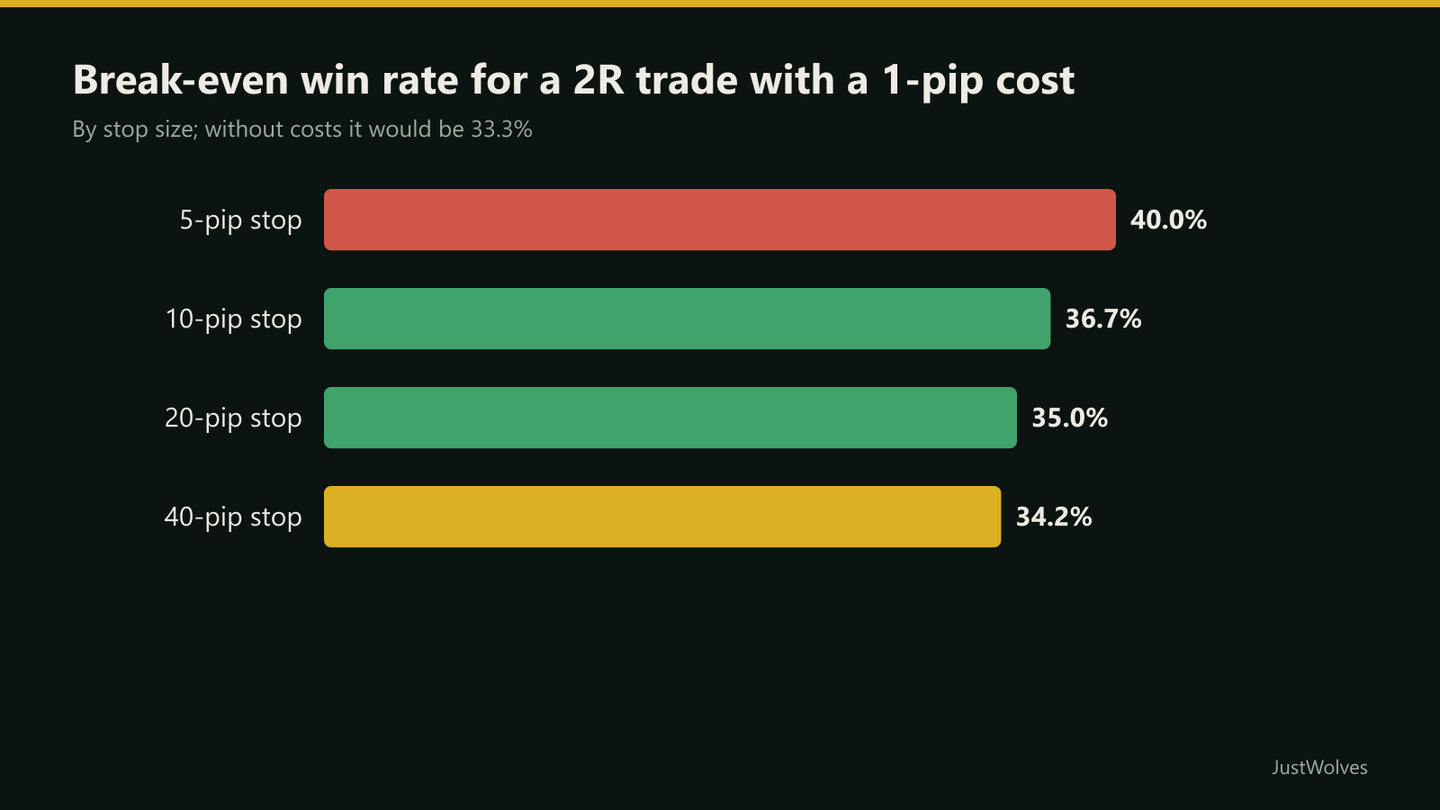
Tighter stops look efficient but quietly demand a higher win rate. Fix: include costs in every backtest, and avoid entries whose stop is only a few times the spread.
Mistake 5: Concept Overload
With dozens of ICT concepts available, there's always one that explains a trade afterwards, which makes it easy to fool yourself. Fix: choose one model and the few concepts it needs; ignore the rest until that model is tested.
Mistake 6: Hindsight Learning
Studying only finished charts, or only other people's winning examples, builds confidence in setups that are much harder to see live. Fix: practise with bar replay, record calls before outcomes, and seek out failed examples deliberately.
Mistake 7: Risk Escalation
After a few wins, traders increase size; after losses, they try to win it back. Either way, the account takes a bigger hit from the next normal losing streak. Fix: fixed risk per trade, daily loss limits, and the rules in FOMO, Revenge Trading and Overtrading.
What Our Tests Say About These Mistakes
Throughout the ICT course, JustWolves tested ICT ideas on real market data. Several results speak directly to the mistakes in this lesson. Each row links to the lesson with the full method and caveats.
| Mistake | What our data showed | Lesson |
|---|---|---|
| Trading without a real bias | Simple bias rules predicted the next day no better than chance, so bias needs more than one mechanical rule, and its accuracy needs tracking. | Daily and Weekly Bias |
| Treating the time window as the signal | Fair value gaps formed inside Silver Bullet windows did no better than the same rule at other hours in our sample. | ICT Silver Bullet |
| Stops so tight that costs decide | With a 1-pip spread, a 10-pip stop costs 0.1R per trade, often more than a model's whole edge. | How to Backtest ICT |
| Concept overload | Single ingredients were flat or negative; only the full 2022 sequence came out positive. | ICT 2022 Model |
| Hindsight learning | The Judas swing and Power of Three day shapes appeared as often in randomly shuffled data as in real data. | Judas Swing; Power of Three |
| Chasing the far target | Fixed 1R–2R targets did better than holding for the draw on liquidity. | ICT Entry and Exit Framework |
The common thread is that most ICT mistakes come from trusting what looks convincing on a finished chart. The patterns are real in the sense that they happen often. What they rarely do, on their own, is predict. The habits that protect you are the boring ones: a written bias, a fixed window, stops sized for costs, one model at a time, and a log of every setup.
Step by Step: Reviewing a Losing Trade
Five questions
Step 1: Was the bias written before the session?
If not, it's a process error.
Step 2: Was it inside the correct window, in New York time?
Check daylight saving.
Step 3: Did every rule in the model pass before entry?
Any 'almost' is a rule break.
Step 4: Was the stop beyond invalidation and the size correct?
Risk errors magnify everything.
Step 5: Was the plan followed after entry?
No widened stops or early exits.
If all five are yes, it was a valid loss. Change nothing. If any is no, fix that process step.
Practical Example
Sanya reviews her last 20 ICT trades: 11 losses. Four were valid losses. Three were taken outside the window after a quiet kill zone. Two used an IST time that was an hour off after the US clock change. Two had stops of 4 pips, where the 1-pip spread consumed a quarter of the risk.
She adds three rules: no trades outside the window, New York time as the reference with automatic conversion, and a minimum stop of 8 pips on EUR/USD. Her setups fall from about five a week to three, and her journal becomes much easier to judge.
Common Mistakes
- Changing the model after every loss.
- Blaming 'manipulation' for process errors.
- Not tracking skipped setups.
- Copying entries from social media without the context.
- Paying for signals based on selected screenshots.
Professional Insight
Experienced traders expect a method to lose regularly and focus on executing it the same way every time. The question after a loss isn't 'what was wrong with ICT?' but 'did I do what my plan said?'. Over months, that question improves results more than any new concept.
Risk Considerations
- Normal losing streaks feel like failure; size so you can survive them.
- Low-timeframe trading magnifies cost and execution errors.
- Overconfidence after a run of wins precedes many drawdowns.
Important Terminology
| Term | Meaning |
|---|---|
| Process error | A loss caused by not following your own rules. |
| Valid loss | A loss on a setup that met every rule. |
| Concept overload | Using so many ideas that any trade can be justified. |
| Risk escalation | Increasing size after wins or to recover losses. |
| Break-even win rate | The win rate at which expectancy is zero. |
Why do my ICT trades keep failing?
Common causes are trading without a pre-set bias, taking setups outside the model's time window, stops so tight that spreads decide the result, and combining too many concepts. In our tests, single ICT ingredients were close to break-even on their own; only complete sequences showed any edge. Review each loss against your written plan.
Is ICT a scam?
The concepts are widely used chart-reading ideas. Be wary of anyone selling guaranteed results; judge any method by your own tested results.
How tight should my stops be?
Beyond the level that invalidates the idea, and large enough that costs are a small share of risk. Very small stops raise the win rate you need.
How do I avoid forcing trades?
Use a written rule that no setup in the window means no trade, and log skipped days.
Should I change my model after losses?
Only after a meaningful sample shows a real problem with the rules, not after a few losses.
Is it a mistake to take a second trade after a loss?
Taking another valid setup is fine. Re-entering to win back a loss, especially when the first trade broke a rule, is one of the most expensive habits. Many traders stop for the session after any rule-breaking loss.
How many ICT concepts should a beginner use at once?
As few as possible. Start with one complete model, such as a session, a liquidity target and one entry pattern, and learn it thoroughly. Adding more concepts usually adds more reasons to take a trade, not better trades, and makes your results harder to review.
Practical Exercise
Audit your ICT trades.
Your task
Step 1: Collect 20 trades
Live, demo or backtest.
Step 2: Ask the five questions
For every loss.
Step 3: Count
Valid losses vs process errors by type.
Step 4: Add one rule
That addresses the most common process error.
Check Your Understanding
Which is a process error?
Related Lessons
Previous: How to Backtest ICT Setups. You've completed the ICT Trading course. See also When SMC Setups Fail and FOMO, Revenge Trading and Overtrading.