
Currency Pairs Explained: Base and Quote, Majors, Minors and Exotics
JustWolves is an educational platform and is not a SEBI-registered investment advisor. Trading financial instruments involves significant risk of loss and may not be suitable for all investors. Past performance is not indicative of future results. Read our full disclaimer →
What you'll learn
- A currency pair shows how much of the quote currency buys one unit of the base currency
- Buying a pair means buying the base and selling the quote; selling does the opposite
- Major pairs include the US dollar and are the most liquid and cheapest to trade
- Minor (cross) pairs exclude the dollar; exotic pairs involve an emerging-market currency and cost more to trade
- Indian residents can trade rupee pairs and permitted crosses as futures and options on Indian exchanges
In this article · 16 sections
In forex you never trade a single currency on its own. You always trade one currency against another, and the price tells you how many units of one it takes to buy a unit of the other. Reading pairs correctly is the foundation of every forex decision: which direction you're betting on, what it costs to trade, and how different positions relate to each other.
What You Will Learn
- How to read a currency pair and what the price means
- What buying and selling a pair actually do
- The three families of pairs: majors, minors and exotics
- Which pairs Indian residents can trade, and how pairs relate to each other
Before You Start
Read What Is Forex Trading? first. You only need the idea that currencies are exchanged against each other.
Base and Quote Currency
Every pair is written as BASE/QUOTE. The first currency is the base; the second is the quote. The price is the number of quote units needed to buy one base unit.
EUR/USD at 1.0850 means one euro costs 1.0850 US dollars. USD/JPY at 150.00 means one dollar costs 150 Japanese yen. USD/INR at 83.20 means one dollar costs ₹83.20. When the price rises, the base currency has strengthened against the quote; when it falls, the base has weakened.
| Pair | Price | Meaning |
|---|---|---|
| EUR/USD | 1.0850 | 1 euro = 1.0850 US dollars |
| USD/JPY | 150.00 | 1 US dollar = 150 Japanese yen |
| USD/INR | 83.20 | 1 US dollar = 83.20 Indian rupees |
What Buying and Selling a Pair Means
Buying (going long) a pair means buying the base currency and selling the quote currency at the same time. You profit if the price rises. Selling (going short) means selling the base and buying the quote; you profit if the price falls.
So every forex trade is two opinions at once. Buying EUR/USD is a bet that the euro will strengthen *and* that the dollar will weaken relative to it.
The Three Families of Pairs
Major pairs
The majors pair the US dollar with another heavily traded currency: EUR/USD, USD/JPY, GBP/USD, USD/CHF, AUD/USD, USD/CAD and NZD/USD. They are the most liquid pairs, with the tightest spreads. The US dollar is on one side of close to nine in ten forex trades in recent BIS surveys, and EUR/USD is consistently the most traded pair.
Minor pairs (crosses)
Minors, also called crosses, pair two major currencies without the dollar, such as EUR/GBP, EUR/JPY, GBP/JPY and AUD/JPY. They are liquid but usually a little more expensive to trade than majors, and some, especially the yen crosses, can move sharply.
Exotic pairs
Exotics pair a major currency with an emerging-market currency, such as USD/INR, USD/TRY, USD/ZAR or USD/MXN. They tend to have wider spreads, lower liquidity, bigger gaps and more sensitivity to local politics and policy, including capital controls.
| Majors | Minors (crosses) | Exotics | |
|---|---|---|---|
| Example | EUR/USD | EUR/JPY | USD/ZAR |
| Includes US dollar? | Yes | No | Usually |
| Liquidity | Highest | High | Lower |
| Typical spread | Tightest | Wider | Widest |
| Best for beginners? | Yes | After majors | Rarely |
Currency Pairs You Can Trade in India
On NSE, BSE and MSE, Indian residents can trade currency futures and options in rupee pairs (USD/INR, EUR/INR, GBP/INR and JPY/INR) and in permitted cross pairs (EUR/USD, GBP/USD and USD/JPY). The RBI lists hedging as the purpose for rupee-pair derivatives, while the exchange-traded cross pairs have no purpose restriction.
Exchange contracts have fixed sizes: a USD/INR contract is 1,000 US dollars, with the same 1,000-unit size for EUR/INR and GBP/INR, and 100,000 yen for JPY/INR. Check the exchange's current contract specifications before trading, because these details can change.
Is Forex Trading Legal in India? explains why offshore spot forex is not a legal route for residents.
How Pairs Relate to Each Other
Pairs that share a currency often move together. EUR/USD and GBP/USD both rise when the dollar weakens broadly. USD/JPY and EUR/JPY both fall when the yen strengthens.
That matters for risk. Buying GBP/JPY and selling EUR/JPY at the same time in the Asian session isn't two independent trades: both are driven largely by the same yen moves, so one tends to win while the other loses, and you pay two spreads for little net exposure. Lesson 01.04.01 covers currency correlation in depth.
Real Data: One Dollar Move, Three Pairs
The chart below uses real daily EUR/USD candles from late April and May 2025. Step through it to see a single dollar move on 12 May hit EUR/USD, GBP/USD and USD/JPY at the same time, which is exactly the risk in this lesson's practical example.
Real data: a dollar rally hits every dollar pair at once, EUR/USD, May 2025
Step 1 of 3
A drift lower
In early May 2025, EUR/USD eases from 1.1425 to 1.1254: the dollar is slowly strengthening against the euro.
- What to observe
- A gentle trend in the dollar's favour.
- Condition
- Imagine a trader holding three "sell dollar" positions.
| Pair | Previous close → close | Change | Result on 0.1 lots of a "sell dollar" position |
|---|---|---|---|
| EUR/USD (long) | 1.1254 → 1.1090 | −164 pips (−1.45%) | about −$164 |
| GBP/USD (long) | 1.3305 → 1.3175 | −130 pips (−0.98%) | about −$130 |
| USD/JPY (short) | 145.32 → 148.44 | +312 pips (+2.15%) | about −$210 |
| All three | about −$504 in one day |
Step by Step: Choosing a Pair to Learn On
Picking your first pair
Step 1: Start with one major
EUR/USD (or USD/INR futures if you trade on Indian exchanges): liquid, well covered and cheaper to trade.
Step 2: Learn its rhythm
Note when it's active, its typical daily range and how it reacts to data releases.
Step 3: Know both currencies' drivers
Central banks, interest rates and major data for each side of the pair.
Step 4: Add a second pair only later
And check it isn't highly correlated with the first.
Practical Example
Rahul expects the US dollar to weaken after a soft US jobs report. He considers buying EUR/USD, GBP/USD and AUD/USD all at once. Each is a 'sell dollars' trade, so together they're one large bet on the dollar.
Instead, he picks EUR/USD only, sizes it with his normal risk, and treats the other two as confirmation rather than extra positions. When the dollar unexpectedly rebounds, he loses 1R instead of 3R.
How Closely Do Pairs Move Together? Our Data
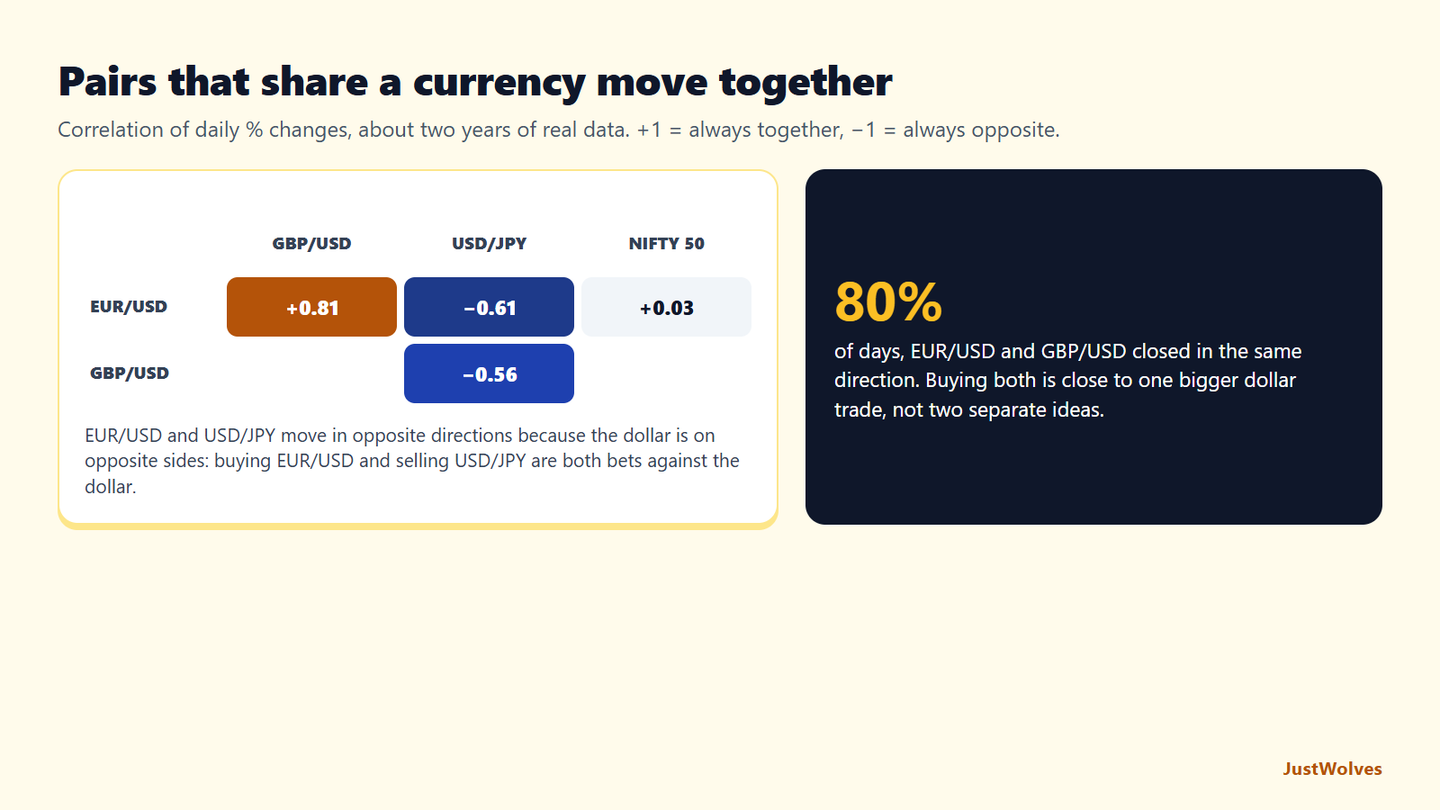
JustWolves measured about two years of real daily closes (November 2024 to November 2026) and calculated the correlation of daily percentage changes between pairs. A correlation of +1 means two pairs always move together in proportion; −1 means always in opposite directions; 0 means no relationship.
| Pairs | Correlation | Closed in the same direction |
|---|---|---|
| EUR/USD and GBP/USD | +0.81 | 80% of days |
| EUR/USD and USD/JPY | −0.61 | 29% of days |
| GBP/USD and USD/JPY | −0.56 | 30% of days |
| EUR/USD and gold | +0.31 | 62% of days |
| EUR/USD and NIFTY 50 | +0.03 | 54% of days |
Three points connect directly to this lesson.
Pairs with the dollar on the same side move together. EUR/USD and GBP/USD, where the dollar is the quote currency in both, closed in the same direction four days out of five. Buying both is, most of the time, one bigger bet against the dollar, as Rahul realises in the example below.
Pairs with the dollar on opposite sides move in opposite directions. USD/JPY has the dollar as its base currency, so it tends to rise when EUR/USD falls. A negative correlation does not make the positions independent: long EUR/USD and short USD/JPY are both "sell dollar" trades, and they lose together, as they did on 12 May 2025.
Currency pairs are largely unrelated to Indian stocks day to day. EUR/USD and NIFTY 50 had a correlation close to zero. For an Indian investor, that can make currency exposure a genuine diversifier, but it also means a stock-market view tells you almost nothing about tomorrow's EUR/USD.
Common Mistakes
- Reading the pair backwards. Buying USD/INR is a bet on the dollar, not the rupee.
- Trading exotics because they move a lot. Their costs and gaps can outweigh the movement.
- Holding several pairs with the same currency. It concentrates risk.
- Ignoring the second currency. News in either country moves the pair.
- Trading pairs offshore from India. Use permitted exchange-traded contracts instead.
Professional Insight
Professional currency traders often think in terms of individual currencies first: is the dollar strong or weak today, is the yen being bought? Then they choose the pair that best expresses that view, usually pairing the strongest currency against the weakest. It's a useful habit even for beginners.
Risk Considerations
- Correlated positions behave like one larger trade.
- Exotic pairs can gap sharply on local political or policy news.
- Contract sizes differ between offshore lots and Indian exchange contracts; always calculate your exposure.
Important Terminology
| Term | Meaning |
|---|---|
| Base currency | The first currency in a pair; one unit of it is being priced. |
| Quote currency | The second currency; the price is in units of it. |
| Major pair | A pair of the US dollar with another heavily traded currency. |
| Minor (cross) pair | A pair of two major currencies without the US dollar. |
| Exotic pair | A pair involving an emerging-market currency. |
| Correlation | How closely two pairs tend to move together. |
What is a currency pair?
Two currencies quoted together, showing how much of the second (quote) currency buys one unit of the first (base) currency.
What are the major currency pairs?
EUR/USD, USD/JPY, GBP/USD, USD/CHF, AUD/USD, USD/CAD and NZD/USD.
Which currency pair is best for beginners?
A liquid major such as EUR/USD, or USD/INR futures for traders using Indian exchanges, because costs are lower and behaviour is well documented.
What is a cross currency pair?
A pair of two major currencies that doesn't include the US dollar, such as EUR/GBP or EUR/JPY.
Which currency pairs can I trade in India?
USD/INR, EUR/INR, GBP/INR and JPY/INR, plus EUR/USD, GBP/USD and USD/JPY, as futures and options on NSE, BSE or MSE.
Do EUR/USD and GBP/USD move together?
Usually. Over about two years of real daily data, their daily changes had a correlation of +0.81 and they closed in the same direction on 80% of days, because both are driven largely by the US dollar.
Why does USD/JPY move opposite to EUR/USD?
Because the dollar sits on opposite sides of the two pairs. When the dollar strengthens, EUR/USD falls and USD/JPY rises. In our data their daily changes had a correlation of −0.61.
Practical Exercise
Practise reading pairs and spotting overlaps.
Your task
Step 1: Classify ten pairs
Sort EUR/USD, USD/INR, EUR/JPY, GBP/USD, USD/TRY, AUD/USD, EUR/GBP, USD/CHF, USD/ZAR and GBP/JPY into majors, minors and exotics.
Step 2: Describe two trades in words
What are you long and short when you sell USD/JPY? When you buy EUR/INR?
Step 3: Spot the overlap
Which two of the ten pairs would you avoid holding together, and why?
Check Your Understanding
In GBP/USD, which is the base currency?
Related Lessons
Previous: How the Forex Market Works. Next: What Is a Pip in Forex?. See also Is Forex Trading Legal in India?.