
Forex Position Sizing: Calculating Lot Size from Pip Value
JustWolves is an educational platform and is not a SEBI-registered investment advisor. Trading financial instruments involves significant risk of loss and may not be suitable for all investors. Past performance is not indicative of future results. Read our full disclaimer →
What you'll learn
- Lots = money at risk ÷ (stop in pips × pip value per standard lot)
- Pip value in dollars is $10 for USD-quoted pairs, 10 ÷ rate for USD-based pairs, and converted via the quote currency for crosses
- Pip value for non-USD-quoted pairs changes with the exchange rate
- On NSE cross-currency futures, one EUR/USD pip is $0.10 per contract, settled in rupees
- Always round down, and check the total risk across correlated positions
In this article · 14 sections
Position sizing is where risk management becomes a number on the order ticket. Lesson 12.01.03 introduced the 1% rule and lesson 01.01.05 showed sizing for EUR/USD. This lesson completes the picture for forex: how to find the pip value for any pair, including yen and cross pairs, and how to size trades in a rupee account or on Indian exchange contracts.
What You Will Learn
- How to find pip value for any type of pair
- The position-size formula, applied to different pairs
- How to size in a rupee account
- How to size NSE cross-currency futures in whole contracts
Before You Start
Read Lot Size in Forex and Position Sizing and the 1% Rule first.
The Formula
Every forex position size comes from one formula: lots = money at risk ÷ (stop distance in pips × pip value of one standard lot).
Money at risk comes from your account and risk per trade (say 1%). Stop distance comes from the chart. The only part that changes from pair to pair is the pip value, expressed in your account currency.
Pip Value for Each Type of Pair
Pairs quoted in US dollars (EUR/USD, GBP/USD, AUD/USD)
The quote currency is the dollar, so one pip on a standard lot is always $10 for a dollar account.
Pairs based in US dollars (USD/JPY, USD/CHF, USD/CAD)
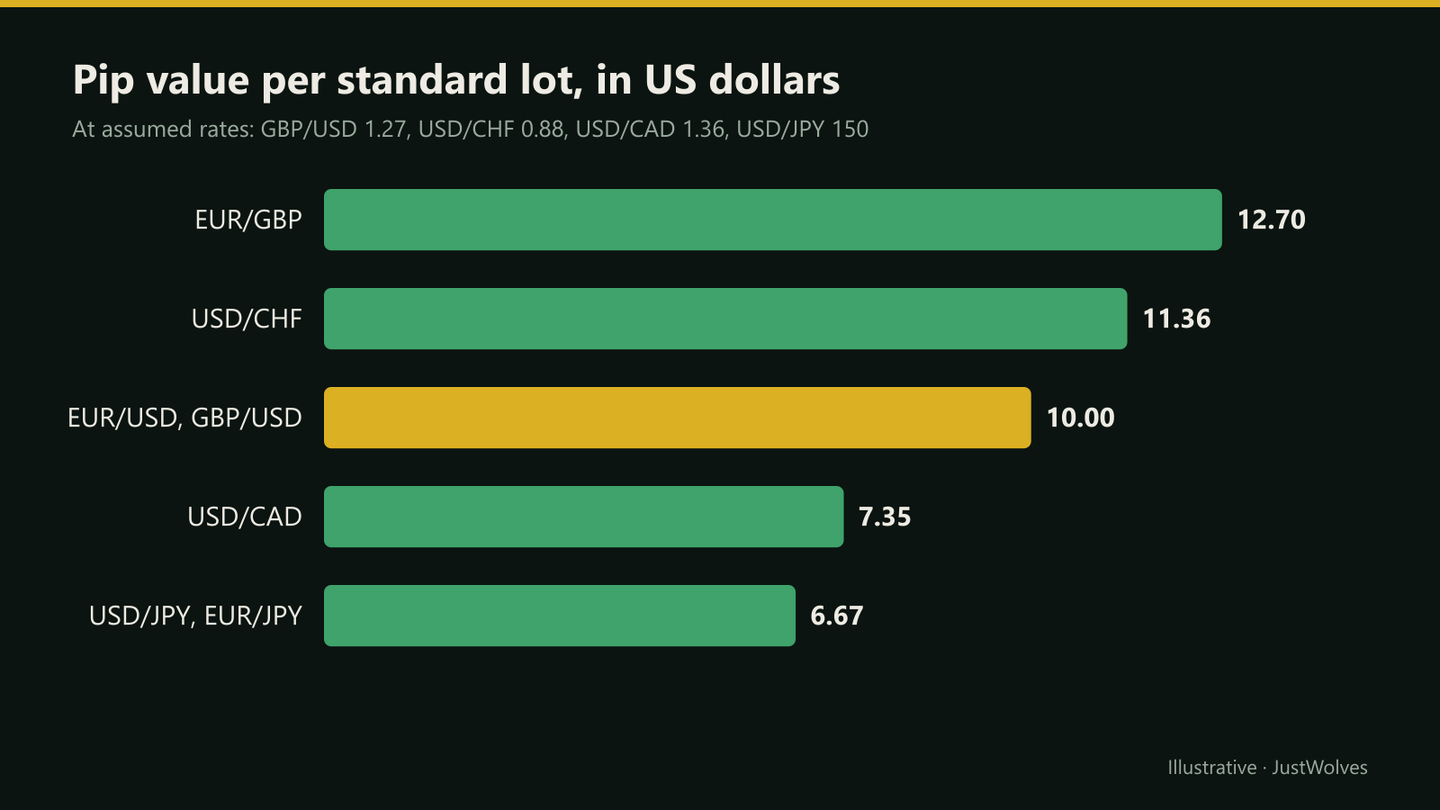
Pip value is first in the quote currency: 10 francs or Canadian dollars, or ¥1,000 for yen. Divide by the exchange rate to get dollars. USD/CAD at 1.3600: 10 ÷ 1.36 = $7.35. USD/CHF at 0.8800: 10 ÷ 0.88 = $11.36. USD/JPY at 150.00: 1,000 ÷ 150 = $6.67.
Cross pairs (EUR/GBP, EUR/JPY, GBP/JPY)
Pip value is in the quote currency; convert it with that currency's rate against the dollar. EUR/GBP: £10 per pip; with GBP/USD at 1.2700, that's $12.70. EUR/JPY: ¥1,000 per pip; at USD/JPY 150, that's $6.67.
Real Data: How Far Can Pip Value Drift?
This lesson notes that pip value for yen and cross pairs changes with the exchange rate. The chart below shows how much, using real USD/JPY prices from December 2024 to October 2026, condensed into monthly candles.
Real data: two years of USD/JPY and its changing pip value, monthly candles
Step 1 of 4
Two years of USD/JPY
At the end of 2024 USD/JPY trades around 155 to 158. One pip on a standard lot is ¥1,000, worth about $6.40 at 156.
- What to observe
- Pip value depends on the rate.
- Condition
- Watch what happens to it as the rate moves.
Step by Step: Sizing Any Forex Trade
Five steps
Step 1: Money at risk
Account × risk per trade, e.g. $5,000 × 1% = $50.
Step 2: Stop distance in pips
From the chart, including a spread buffer.
Step 3: Pip value per standard lot
In your account currency, using the rules above.
Step 4: Divide
Lots = risk ÷ (stop × pip value).
Step 5: Round down and verify
Round to your broker's lot step, then check the actual risk.
The site's pip calculator and position size calculator do this arithmetic for you, but work through it by hand a few times so you can spot a wrong input.
Worked Examples
USD/CAD. A $5,000 demo account risking 1% ($50), with a 25-pip stop. Pip value at 1.3600 is $7.35, so one lot risks 25 × 7.35 = $183.75. Lots = 50 ÷ 183.75 = 0.272, rounded down to 0.27 lots, risking $49.63.
EUR/GBP. Same account, 20-pip stop. Pip value $12.70, so one lot risks $254. Lots = 50 ÷ 254 = 0.197, rounded down to 0.19 lots, risking $48.26. Note the smaller size despite a tighter stop: each EUR/GBP pip is worth more.
Sizing in Rupees and on NSE
If your account is in rupees, convert the pip value into rupees with the USD/INR rate. On NSE, the cross-currency EUR/USD futures contract is 1,000 euros with a tick of 0.0001, so one pip is worth $0.10 per contract. Profit and loss is in dollars and settled in rupees.
Example: a ₹3,00,000 account risking 1% (₹3,000) on an NSE EUR/USD futures trade with a 30-pip stop. Per contract that's 30 × $0.10 = $3, about ₹264 at an illustrative ₹88 per dollar. Contracts = 3,000 ÷ 264 = 11.4, rounded down to 11 contracts, risking about ₹2,904. Check the margin your broker requires for 11 contracts, and keep plenty of free margin, as lesson 01.01.07 explains.
Pip Value Over Two Years: Our Data
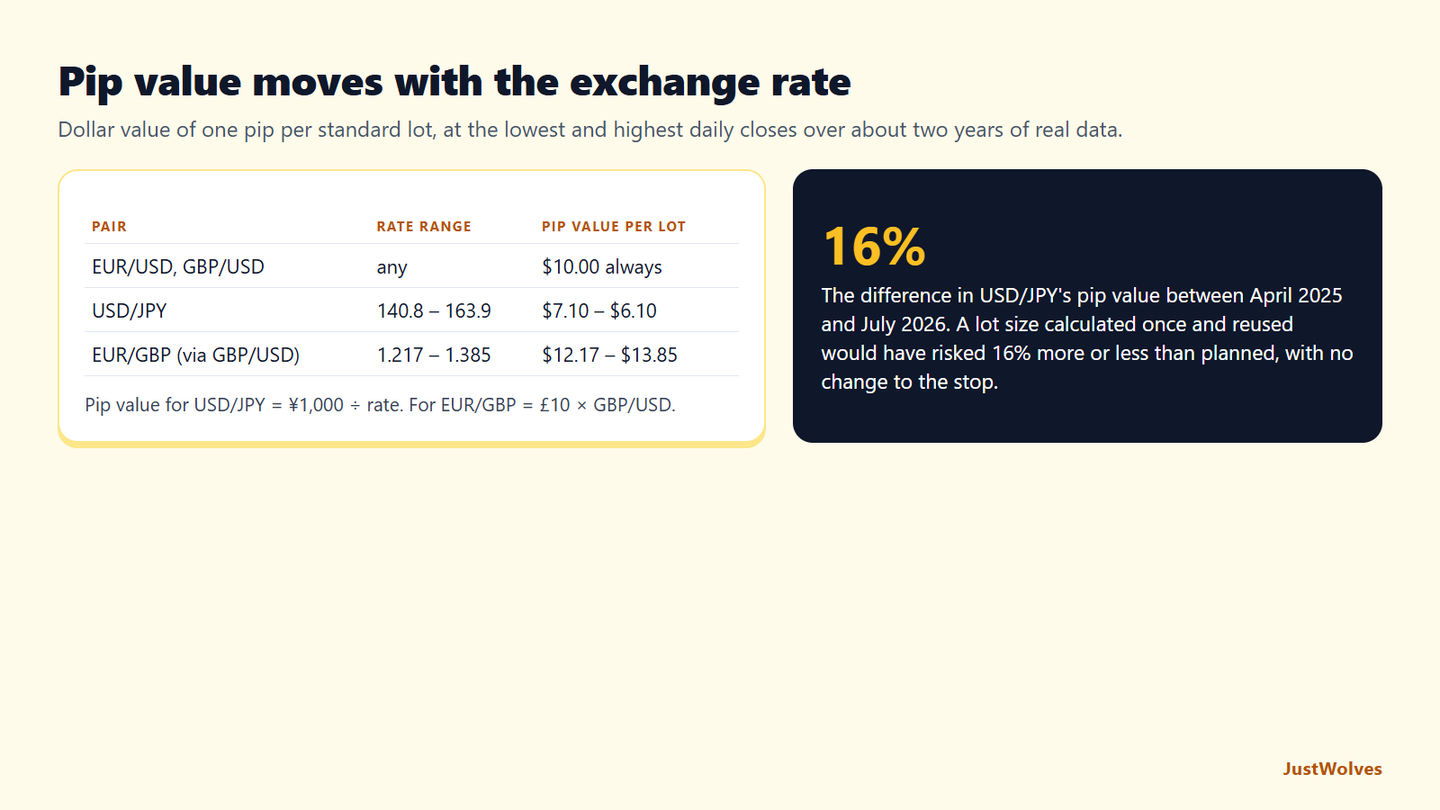
JustWolves took the lowest and highest daily closes over about two years of real data (November 2024 to November 2026) and worked out the dollar value of one pip per standard lot at each, using the formulas from this lesson.
| Pair | Lowest close | Highest close | Pip value range | Change |
|---|---|---|---|---|
| EUR/USD, GBP/USD | — | — | $10.00 (fixed) | none |
| USD/JPY | 140.83 (21 Apr 2025) | 163.85 (23 Jul 2026) | $7.10 to $6.10 | about 16% |
| EUR/GBP (via GBP/USD) | 1.2170 (17 Jan 2025) | 1.3850 (27 Jan 2026) | $12.17 to $13.85 | about 14% |
A 14–16% change over two years sounds small, and on a single trade it is: a $50 risk becomes $57 or $43. But this lesson's mistakes list includes "using an old exchange rate for pip value" for a reason. Traders who save a lot size for each pair, or keep a printed pip-value table, slowly drift away from their planned risk without noticing. Over many trades, consistently risking 14% more than planned is the same as quietly raising your risk per trade from 1% to 1.14%.
There is also a second-order effect inside a single trade. If you hold a USD/JPY position while the rate moves several hundred pips, its pip value in dollars changes during the trade. For normal stop distances this is minor, but it is one more reason the formula should be run fresh for every order, with the rate at the time of entry, as the site's position size calculator does.
Common Mistakes
- Assuming $10 per pip for every pair.
- Using an old exchange rate for pip value on yen and cross pairs.
- Forgetting the account currency. A rupee account needs a rupee pip value.
- Sizing each trade alone when several correlated trades are open (lesson 12.02.06).
- Rounding up to a 'nicer' number.
Professional Insight
Professional desks size by risk, never by lots, and they think about risk across the whole book. Three long-dollar trades sized at 1% each are closer to one 3% bet on the dollar. Before adding a position, check what you already hold in the same currency.
Risk Considerations
- Gaps and slippage can make real losses larger than the formula assumes.
- Exchange-rate moves change pip value for non-USD-quoted pairs during a trade.
- Correlated positions multiply risk.
Important Terminology
| Term | Meaning |
|---|---|
| Position size | How many lots or contracts you trade. |
| Money at risk | Account × risk per trade. |
| Pip value | The money value of one pip for a given size, in your account currency. |
| USD-quoted pair | A pair with the dollar as quote currency, e.g. EUR/USD. |
| USD-based pair | A pair with the dollar as base currency, e.g. USD/JPY. |
| Cross pair | A pair without the US dollar, e.g. EUR/GBP. |
How do I calculate position size in forex?
Divide the money you're risking by the stop distance in pips multiplied by the pip value of one standard lot.
How do I calculate pip value for USD/JPY?
One pip on a standard lot is ¥1,000. Divide by the USD/JPY rate for dollars: about $6.67 at 150.
How do I calculate pip value for cross pairs?
Take the pip value in the quote currency and convert it to your account currency at the current rate.
How do I size trades in a rupee account?
Convert the pip value into rupees with the USD/INR rate, then apply the same formula.
What is a pip worth on NSE EUR/USD futures?
One contract is 1,000 euros, so one pip (0.0001) is $0.10 per contract, settled in rupees.
Does pip value change in forex?
For pairs not quoted in your account currency, yes. Over about two years of real data, a USD/JPY pip on a standard lot was worth between about $6.10 and $7.10 in dollars, and a EUR/GBP pip between about $12.17 and $13.85. EUR/USD and GBP/USD pips stay at $10 for a dollar account.
Practical Exercise
A $4,000 account risking 1% ($40). Size each trade.
Your task
Step 1: GBP/USD
Stop 32 pips.
Step 2: USD/JPY at 150
Stop 20 pips.
Step 3: EUR/GBP with GBP/USD at 1.27
Stop 16 pips.
Step 4: Verify
Check that each risk is at most $40.
Check Your Understanding
What is one pip worth on a standard lot of USD/CHF at 0.8000, in dollars?
Related Lessons
Previous: Forex Trading Costs. Next: Executing a Forex Trade from Entry to Exit. See also Portfolio Exposure and Correlation Risk.