
Executing a Forex Trade from Entry to Exit: A Complete Walkthrough
JustWolves is an educational platform and is not a SEBI-registered investment advisor. Trading financial instruments involves significant risk of loss and may not be suitable for all investors. Past performance is not indicative of future results. Read our full disclaimer →
What you'll learn
- Plan the entry, stop, target and size before you open the order ticket
- Attach the stop-loss when the order is placed, not after
- Manage the trade by pre-set rules, not by watching every tick
- Know in advance what ends the trade: stop, target, time or a change in the setup
- Journal every trade, including the costs and your reasons
In this article · 16 sections
The earlier lessons in this module covered the pieces separately: platforms, order types, costs and position size. This lesson puts them together into one trade, from the idea to the journal entry. The goal isn't a particular strategy; it's a repeatable process, so every trade you take is planned, sized and recorded the same way.
What You Will Learn
- A pre-trade checklist to use before every trade
- How to enter the order with protection attached
- How to manage an open trade without improvising
- How to exit and record the trade for review
Before You Start
Read Forex Order Types and Forex Position Sizing first.
The Five Stages of a Trade
From idea to journal
Step 1: Plan
Setup, entry, stop, target, and why. Check the economic calendar.
Step 2: Size
Money at risk ÷ (stop × pip value).
Step 3: Enter
Choose the order type and attach the stop-loss and take-profit.
Step 4: Manage
Follow pre-set rules for moving the stop or taking partial profits.
Step 5: Exit and record
Close by plan and journal the result, costs and lessons.
Stage 1: The Pre-Trade Plan
Write the plan down before touching the order ticket. At minimum: the pair and direction, the setup you're trading, the entry price and order type, the stop-loss and why it's there, the target, the risk-reward ratio, and what would make you cancel the idea. Then check the economic calendar for high-impact releases in that pair's currencies during the time you'll be in the trade.
Stage 2: Sizing
Use the formula from lesson 01.02.04. Include a buffer for the spread in the stop distance, round down, and check your total exposure if you already hold trades in the same currencies. If the stop needed for the setup makes even the smallest size too risky, skip the trade.
Stage 3: Entering the Order
Choose the order type that matches the idea: a limit order for a pullback, a stop order for a breakout, a market order only if you need to be in now. Fill in the size, then attach the stop-loss and take-profit on the same ticket.
Before you send it, read the ticket back: pair, buy or sell, size, entry, stop, target. Most order errors, such as a sell instead of a buy or an extra zero on the size, are caught by this five-second check.
Stage 4: Managing the Trade
Management rules should be decided in the plan, not invented during the trade. Common rules include moving the stop to breakeven after price moves 1R in your favour, taking partial profit at a first target, or trailing the stop behind new swing points. Trailing Stops and Taking Profit covers the options. What you should not do is widen the stop because the trade is going against you.
Stage 5: Exiting and Journalling
A trade ends in one of four ways: the stop is hit, the target is hit, a time limit is reached (for example, closing before a major release or before the weekend), or the reason for the trade no longer holds. Decide which apply before you enter.
Then journal it: date and time, pair, setup, entry, stop, target, exit, size, result in money and in R, costs, a screenshot, and one line on what you did well or badly. The Trading Journal gives a template.
Real Case: One Trade Through All Five Stages
The chart below uses real daily EUR/USD candles from September and October 2026. Step through a short trade from the written plan to the journal entry, following the same five stages as Meera's example in this lesson, but on a real chart.
Real case: a short EUR/USD trade, all five stages, September–October 2026
Step 1 of 5
Context: a downtrend
From 1.1559 on 16 September 2026, EUR/USD makes lower highs and lower lows, reaching 1.1317 on 29 September.
- What to observe
- The direction favours shorts.
- Condition
- Wait for a setup on a bounce.
A Complete Example
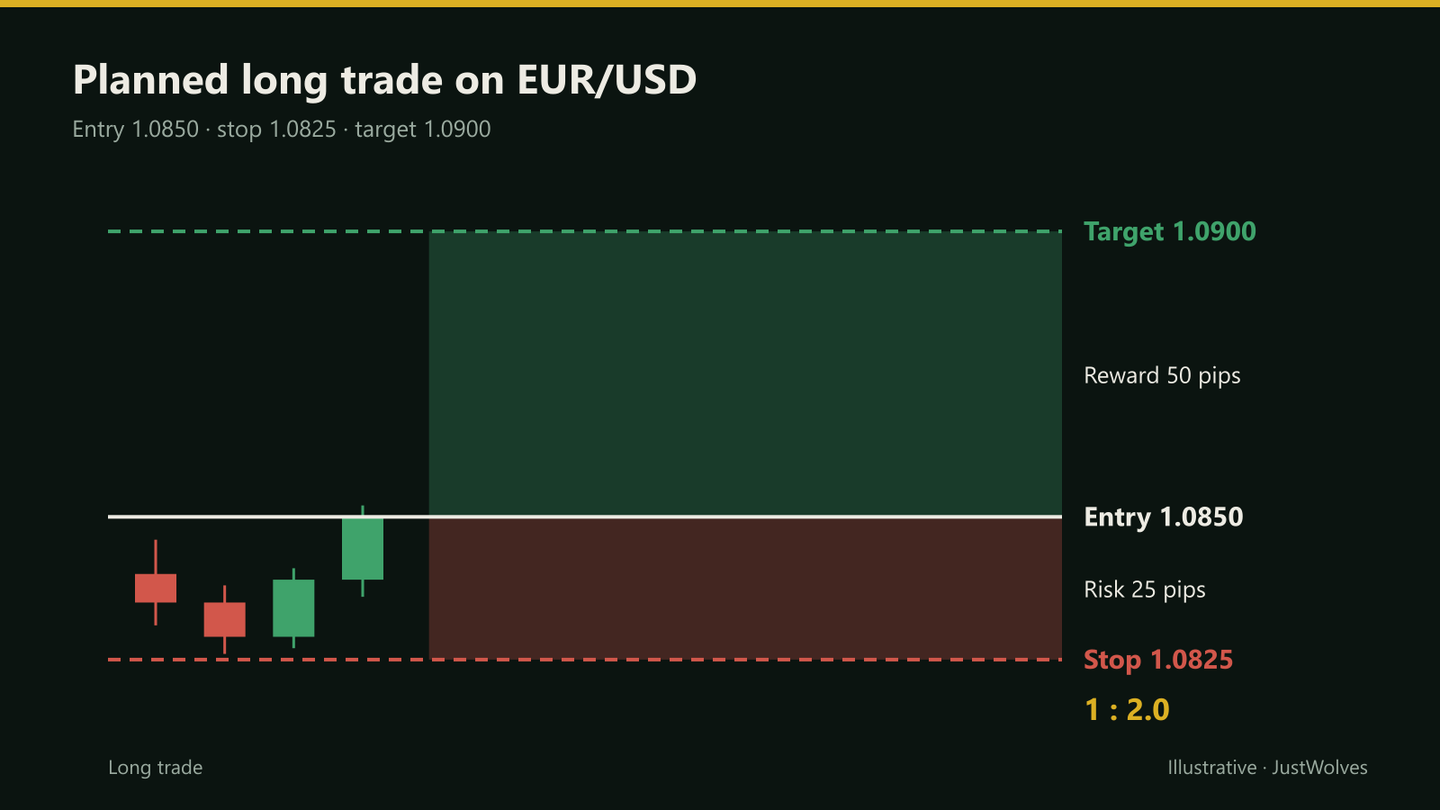
Plan. Meera sees EUR/USD dip to 1.0826, hold above support and recover. She plans a long at 1.0850 with a stop at 1.0825, just below the low, and a target at 1.0900, the next resistance: 25 pips of risk for 50 pips of reward, 1:2. The calendar shows no major release for the next eight hours.
Size. Her $5,000 demo account risks 1%: $50 ÷ (25 × $10) = 0.2 lots, worth $2 per pip.
Enter. A market order at 1.0850 fills at 1.0851 with 1 pip of slippage. The stop and target are attached on the ticket.
Manage. Her rule: at +25 pips (1R), move the stop to breakeven. Price reaches 1.0876 and she moves the stop to 1.0851.
Exit. The target fills at 1.0900: 49 pips × $2 = $98, about 1.96R after slippage. The spread was paid on entry and is already reflected in her fill. She journals the trade with a screenshot and notes that the breakeven rule was followed.
Does Moving the Stop to Breakeven Help? Our Test
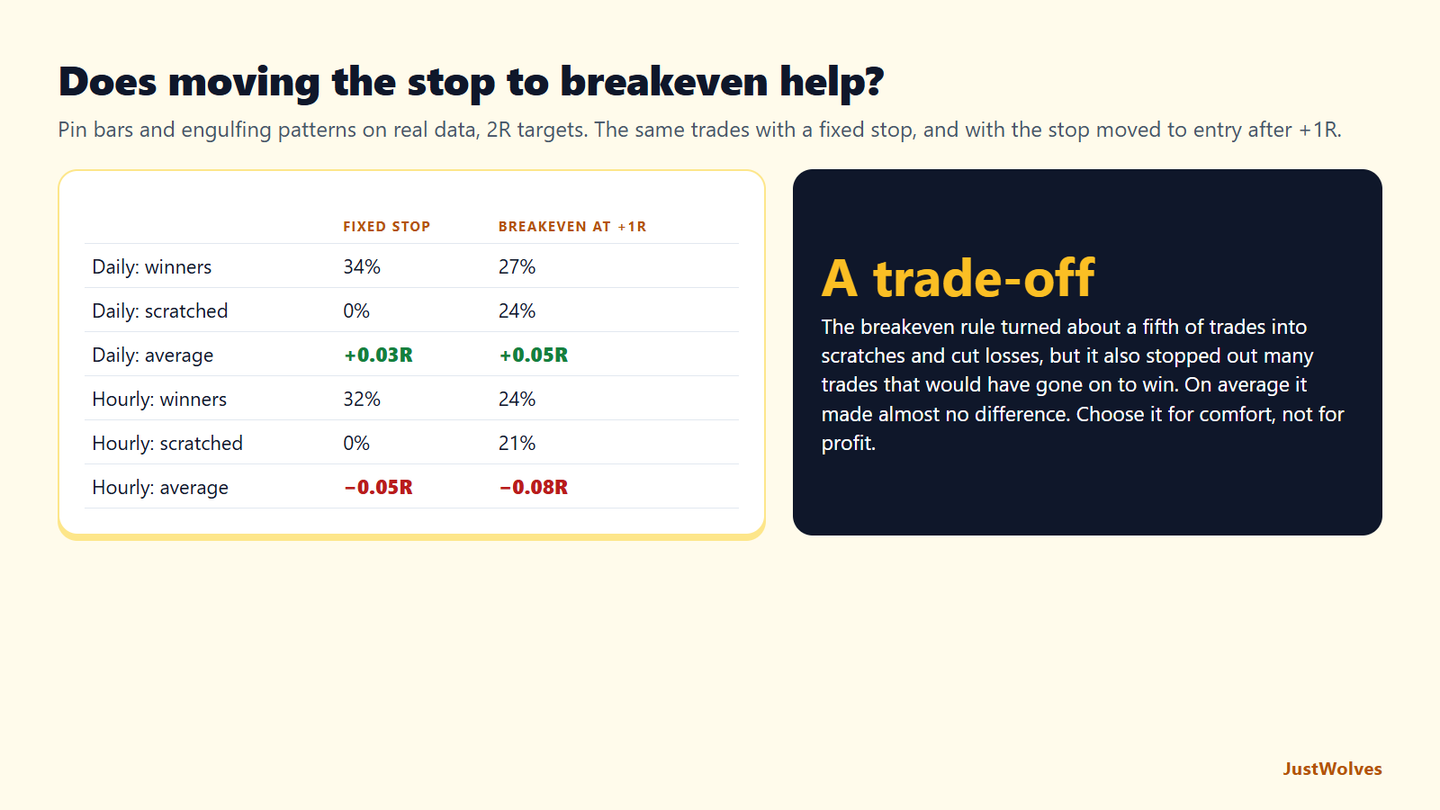
Moving the stop to breakeven after +1R is one of the most common management rules, and the one Meera uses in this lesson's example. JustWolves tested it on real data: about two years of daily candles for 20 large NSE stocks, NIFTY 50, four currency pairs and gold, and six months of hourly candles for the five markets. Entries: pin bars and bullish engulfing patterns (bearish versions on mirrored prices), entered at the close with the stop beyond the pattern and a 2R target. Rule: once price reaches +1R, the stop moves to the entry price from the next candle. The same trades were run with and without the rule.
| Daily: fixed stop | Daily: breakeven rule | Hourly: fixed stop | Hourly: breakeven rule | |
|---|---|---|---|---|
| Trades | 358 | 365 | 561 | 575 |
| Reached the 2R target | 34% | 27% | 32% | 24% |
| Closed at breakeven | 0% | 24% | 0% | 21% |
| Lost 1R | 66% | 49% | 68% | 55% |
| Average result | +0.03R | +0.05R | −0.05R | −0.08R |
The rule did exactly what it promises, and not much more. It turned about a fifth of all trades into breakeven scratches and cut the share of full losses sharply. But about a fifth of the trades that would eventually have reached 2R were stopped at breakeven on the way, because price often comes back to the entry before going on. The two effects nearly cancelled: on average, a tiny improvement on daily charts and a tiny deterioration on hourly ones.
So the choice belongs in the plan, as this lesson says, and it can be made on temperament. If watching a +1R trade turn into a loss affects your decisions, the breakeven rule is a reasonable price to pay. If you are comfortable with the full loss, leaving the stop alone kept more winners in our data. What did not work for anyone was the mistake listed below: changing the stop mid-trade without a rule.
Common Mistakes
- Entering first and planning later.
- Adding the stop-loss after the order fills, or never.
- Widening the stop when price approaches it.
- Closing winners early out of nervousness and letting losers run.
- Skipping the journal after losing trades, which are the ones with the most to teach.
Professional Insight
Professional traders treat execution as a routine, the same checklist every time, so that their decisions go into the plan and their attention during the trade goes into following it. Many find that most of their improvement comes not from better setups but from fewer execution errors.
Risk Considerations
- News and weekends can gap price past stops.
- Platform or connection failures can stop you managing a trade; your stop-loss must already be on the server.
- Order errors such as the wrong side or size can be expensive; read the ticket back.
Important Terminology
| Term | Meaning |
|---|---|
| Trade plan | Entry, stop, target, size and reasons, written before entering. |
| R | The amount risked on a trade; results are measured in multiples of it. |
| Breakeven stop | A stop moved to the entry price. |
| Partial profit | Closing part of a position at a first target. |
| Time stop | Closing a trade at a set time regardless of price. |
| Trading journal | A record of every trade for review. |
How do I place a forex trade?
Plan the entry, stop and target, calculate the size, choose the order type, attach the stop-loss and take-profit, and check the ticket before sending.
When should I set my stop-loss?
When you place the order, so it's active from the moment the trade opens.
Should I move my stop to breakeven?
It's a common rule once a trade moves about 1R in your favour, but decide it in your plan; moving it too early can cut good trades short.
When should I close a trade?
At your stop, your target, a pre-set time, or when the reason for the trade no longer holds.
What should a trading journal record?
Date, pair, setup, entry, stop, target, exit, size, result in money and R, costs, a screenshot and a short note.
Should I move my stop-loss to breakeven?
It is a valid rule, but not a profitable one on its own in our data. Moving the stop to breakeven after +1R changed the average result from +0.03R to +0.05R on daily charts and from −0.05R to −0.08R on hourly charts, while turning about a fifth of trades into scratches. Decide it in your plan and apply it consistently.
Practical Exercise
Walk one practice trade through all five stages.
Your task
Step 1: Plan
Pick a pair, write the setup, entry, stop, target and reason.
Step 2: Size
For a practice account risking 1%.
Step 3: Enter
On a demo or paper account, with SL and TP attached.
Step 4: Manage and exit
Follow your written rules only.
Step 5: Journal
Record the trade, including slippage and costs.
Check Your Understanding
What should you do before opening the order ticket?
Related Lessons
Previous: Forex Position Sizing. Next module: Sessions and Fundamentals, starting with Forex Trading Sessions and Market Hours (01.03.01). See also Trailing Stops and Taking Profit.