
Spot Forex vs CFDs vs Currency Futures: What You're Actually Trading
JustWolves is an educational platform and is not a SEBI-registered investment advisor. Trading financial instruments involves significant risk of loss and may not be suitable for all investors. Past performance is not indicative of future results. Read our full disclaimer →
What you'll learn
- Spot forex is an over-the-counter exchange of currencies that normally settles in two business days
- A CFD is a contract with a broker that pays the price difference; you never own the currency
- Currency futures are standardised exchange contracts cleared through a clearing corporation
- Who your counterparty is shapes your risk as much as the price chart
- For Indian residents, exchange-traded currency futures and options within RBI rules are the legal route
In this article · 17 sections
Three people can all say they 'trade EUR/USD' and be holding completely different things. One has a spot position with a dealer, one has a contract for difference with a broker, and one has a futures contract on an exchange. The price chart looks almost the same, but the counterparty, costs, protections and legal position are not. This lesson explains the differences, with the Indian rules in mind.
What You Will Learn
- How spot forex, CFDs and currency futures work
- Who your counterparty is in each case
- How costs, leverage and protections differ
- Which of them Indian residents may legally use
Before You Start
Read Is Forex Trading Legal in India? first.
Spot Forex
A spot trade is an agreement to exchange two currencies at today's price, normally settled two business days later (T+2; a few pairs, such as USD/CAD, settle T+1). Banks, corporations and funds trade spot in the over-the-counter interbank market.
Retail 'spot forex' accounts offered by brokers usually don't settle at all: positions are rolled forward each night, with a swap charge or credit (lesson 01.02.03). In practice, the retail trader has a contract with the broker that tracks the spot price.
Contracts for Difference (CFDs)
A CFD is a contract between you and a broker to exchange the difference between the opening and closing price of an underlying instrument. You never own the currency. The broker is your counterparty, either holding the other side itself or passing it on to other firms.
CFDs are popular because they're flexible: small sizes, high leverage and thousands of markets in one account. That flexibility is also the risk. Regulators in several regions have restricted retail CFDs: the European Union, for example, caps leverage at 1:30 on major currency pairs, requires brokers to close positions when margin falls to 50% of the requirement, and requires negative balance protection. Retail CFD trading isn't permitted in the United States.
Currency Futures
A futures contract is a standardised agreement, traded on an exchange, to exchange a fixed amount of currency at a set price on a set date. In India, NSE, BSE and MSE list currency futures and options, such as USD/INR and EUR/USD.
The exchange's clearing corporation stands between buyers and sellers, so you don't depend on one broker's solvency to receive your profits in the same way. Positions are marked to market daily: profits and losses are settled every day, and margins are set by the exchange. Contracts have fixed sizes and expiry dates, and there's no overnight swap, because the interest-rate difference is in the futures price.
Real Data: The Overnight Move a Futures Trader Cannot Trade
Exchange-traded currency futures solve the counterparty and legal problems of offshore CFDs, but they trade only during exchange hours. The chart below uses real hourly EUR/USD candles from 16–17 September 2026 to show what that means on a night with a major US announcement.
Real data: what happens while Indian currency contracts are closed, EUR/USD, 16–17 September 2026 (IST)
Step 1 of 3
The exchange closes
Cross-currency contracts on Indian exchanges trade from 09:00 to 19:30 IST. On 16 September 2026, EUR/USD is around 1.1535 at the close.
- What to observe
- The global market keeps trading after the Indian close.
- Condition
- A futures position is now exposed overnight.
Side-by-Side Comparison
| Retail spot / rolling spot | CFD | Exchange currency futures | |
|---|---|---|---|
| Where it trades | Over the counter, with a broker | Over the counter, with a broker | On a recognised exchange |
| Your counterparty | The broker | The broker | The clearing corporation |
| Price transparency | Broker's quote | Broker's quote | Public order book |
| Size | Flexible (micro lots) | Flexible | Fixed contract size |
| Holding cost | Overnight swap | Overnight financing | Built into futures price |
| Leverage set by | Broker, within local rules | Broker, within local rules | Exchange margin requirements |
| Legal for Indian residents? | Not with offshore brokers | No (offshore leveraged CFDs) | Yes, within RBI rules |
Why the Counterparty Matters
With an OTC broker, your profits are a claim on that broker. If it's poorly capitalised, unregulated or dishonest, you may not be able to withdraw them, and some offshore firms have refused withdrawals outright. Exchange-traded contracts reduce that risk: trades are cleared centrally, positions are visible to the exchange, and client money rules apply to brokers. That doesn't remove market risk, but it removes a large layer of firm risk.
The Indian Position
Under FEMA and RBI directions, Indian residents may trade forex only with authorised persons, and on exchanges or electronic trading platforms authorised by the RBI. In practice, for individual traders that means exchange-traded currency futures and options through a SEBI-registered broker. Rupee pairs come with the RBI's rules on underlying exposure; cross-currency pairs do not.
Leveraged spot forex or CFD trading with offshore brokers isn't a permitted route, and the Liberalised Remittance Scheme can't be used to fund margin for it. Is Forex Trading Legal in India? covers the rules and the RBI Alert List.
Step by Step: Checking What You'd Be Trading
Before opening any account
Step 1: Ask what the product is
Spot, CFD, futures or options? Read the product disclosure.
Step 2: Ask who the counterparty is
The broker, or an exchange's clearing corporation?
Step 3: Check the regulator
For Indian residents: a SEBI-registered broker on NSE, BSE or MSE.
Step 4: Check costs
Spread, commission, swap or financing, exchange charges.
Step 5: Check protections
Client money rules, negative balance protection, grievance redress.
Practical Example
Sneha compares two ways to trade a view that the euro will rise against the dollar. An offshore app offers EUR/USD CFDs at 1:500 leverage with a deposit by UPI to an individual's account. Her broker offers NSE EUR/USD futures: 1,000 euros per contract, exchange margins, and settlement in rupees.
The app looks cheaper and more flexible, but its counterparty is an unregulated firm, the payment route is a red flag, and the trading isn't permitted for her as a resident. She uses the exchange contract and sizes it in whole contracts as in lesson 01.02.04.
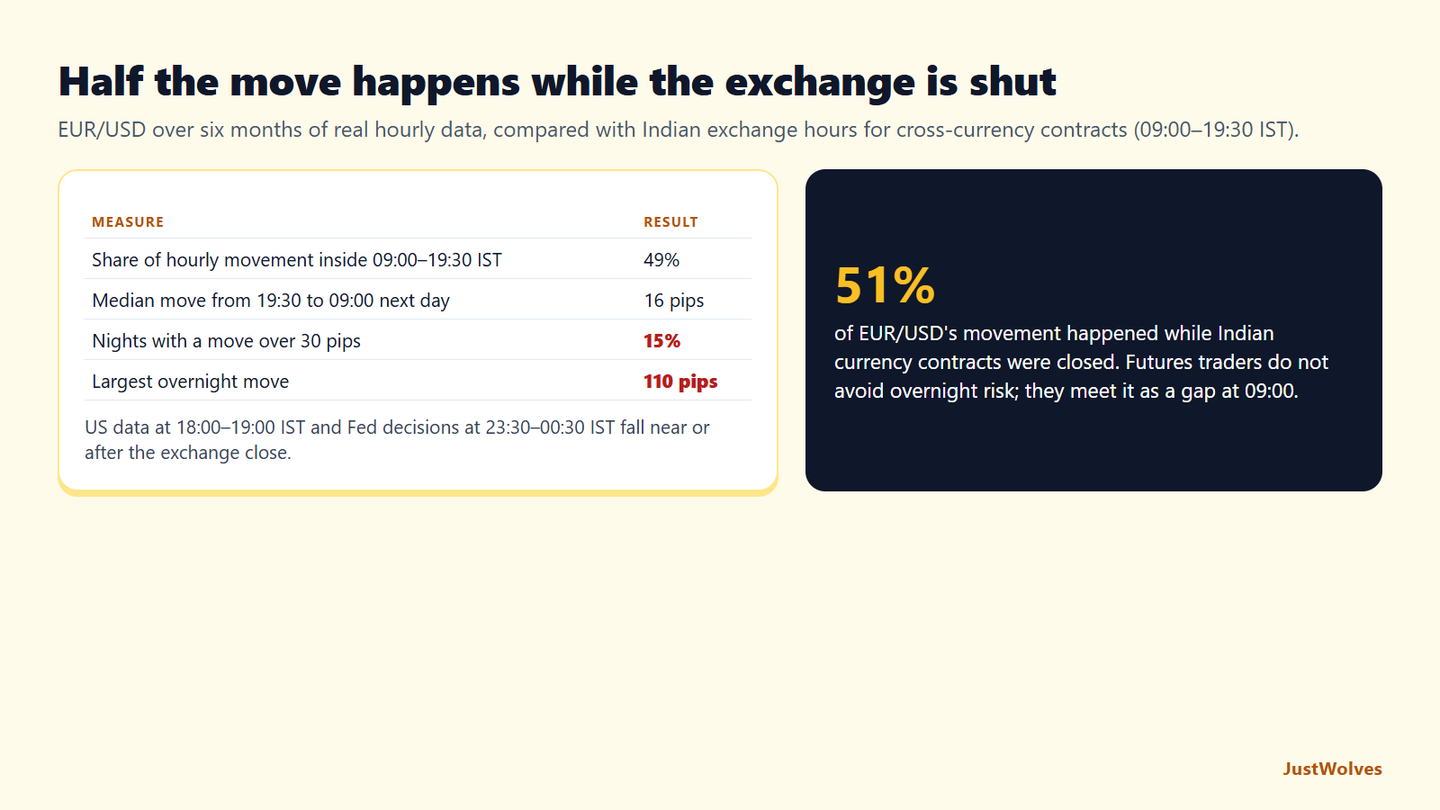
How Much Happens Outside Exchange Hours? Our Data
Indian cross-currency contracts such as EUR/USD trade from 09:00 to 19:30 IST; the underlying global market trades around the clock on weekdays. JustWolves measured six months of real hourly EUR/USD data (May to November 2026) to see how much movement falls outside exchange hours, and how large the overnight change typically is.
| Measure | Result |
|---|---|
| Share of hourly movement inside 09:00–19:30 IST | 49% |
| Median change from the 19:30 close to the 09:00 open | 16 pips |
| 90th percentile overnight change | 41 pips |
| Nights with a change of more than 30 pips | 15% (about one in seven) |
| Largest overnight change | 110 pips (night to 15 October 2026) |
This adds a practical point to the comparison table above. About half of EUR/USD's movement happens while Indian currency contracts are closed, including every US Federal Reserve decision and most of the New York afternoon. An exchange trader cannot react to these moves; they arrive as a gap at 09:00.
That does not make spot or CFDs safer. A trader who can react at 23:30 IST also faces the widest spreads and worst fills of the day, and an offshore CFD adds counterparty and legal risk that an exchange contract does not. But it does change how exchange positions should be sized: plan for an overnight change of 30 to 40 pips happening fairly often, and occasionally more than 100, rather than sizing only for the stop you can see during the session.
Common Mistakes
- Assuming all 'forex' is the same product.
- Ignoring counterparty risk because the chart looks the same.
- Believing a foreign licence makes offshore trading legal in India.
- Overlooking financing costs on CFDs held for weeks.
- Forgetting futures expiry and rollover.
Professional Insight
Institutional traders pay close attention to where their trades are held and settled, because counterparty failures have caused large losses even when trades were right. Retail traders should apply the same thinking: a correct view is worthless if the firm holding your money can't or won't pay.
Risk Considerations
- Broker insolvency or fraud on OTC products.
- Leverage on all three can magnify losses.
- Legal risk for Indian residents using unauthorised platforms.
Important Terminology
| Term | Meaning |
|---|---|
| Spot | Exchange of currencies at today's price, normally settled in two business days. |
| Rolling spot | A retail spot position rolled forward daily with a swap. |
| CFD | A contract with a broker paying the difference in price. |
| Futures contract | A standardised exchange contract for a future date. |
| Clearing corporation | The entity that guarantees and settles exchange trades. |
| Counterparty | The party on the other side of your trade. |
What is the difference between forex and CFDs?
Retail forex usually means rolling spot positions with a broker; CFDs are contracts paying the price difference. Both are OTC and the broker is the counterparty.
Are CFDs legal in India?
Leveraged CFD trading with offshore brokers isn't a permitted route for Indian residents.
What are currency futures?
Standardised exchange contracts to exchange a fixed amount of currency at a set price on a future date, cleared by a clearing corporation.
Which is safer, CFDs or futures?
Futures remove much of the broker counterparty risk through central clearing, though market risk remains.
Do currency futures have swap charges?
No. The interest-rate difference is reflected in the futures price.
Do currency futures in India trade overnight?
No. Cross-currency contracts such as EUR/USD trade from 09:00 to 19:30 IST and rupee pairs until 17:00 IST. In our six months of EUR/USD data, about half of all movement happened outside those hours and arrived as a gap at the next open.
Practical Exercise
Read one real contract specification.
Your task
Step 1: Find the specification
On NSE's website, open the EUR/USD futures contract specification.
Step 2: Note the details
Contract size, tick size, trading hours, expiry and settlement.
Step 3: Compare
List three ways it differs from a CFD on EUR/USD.
Step 4: Check your broker
Confirm your broker is SEBI-registered for the currency segment.
Check Your Understanding
Who is your counterparty in a CFD?
Related Lessons
Previous: Forex Trading Strategies. Next: Choosing a Forex Broker (01.04.05). See also Is Forex Trading Legal in India?.