
Forex Trading Costs: Spreads, Commissions, Swaps and Slippage
JustWolves is an educational platform and is not a SEBI-registered investment advisor. Trading financial instruments involves significant risk of loss and may not be suitable for all investors. Past performance is not indicative of future results. Read our full disclaimer →
What you'll learn
- Forex costs come from four places: spread, commission, overnight swap and slippage
- Add them up per round trip and compare with your average win
- Swaps reflect interest-rate differences and can be paid or received
- Indian currency futures have no swap; the interest difference is built into the futures price
- Indian exchange trades also carry brokerage, exchange and regulatory charges, stamp duty and GST
In this article · 17 sections
Trading costs feel small on any single trade, which is exactly why they're dangerous. Over a few hundred trades, costs can turn a strategy that looks profitable on the chart into one that loses money. This lesson lists every cost you'll pay, shows how to add them up for a single trade, and explains how costs work differently on Indian exchange-traded contracts.
What You Will Learn
- The four main costs of a forex trade
- How overnight swaps work and when they're charged
- How to total your cost per trade and compare it with your edge
- What you pay on Indian currency futures
Before You Start
Read Bid, Ask and Spread and Forex Order Types first.
1. The Spread
You buy at the ask and sell at the bid, so every round trip costs the spread. On 0.5 lots of EUR/USD, a 1-pip spread costs 1 × $5 = $5. Spreads widen around news, at the daily rollover and in less liquid pairs, so your real average spread is usually higher than the advertised minimum.
2. Commission
Some accounts charge a commission per lot in addition to a tight spread. It's usually quoted per side or per round trip, so read carefully. If a broker charges $7 per standard lot per round trip, 0.5 lots costs $3.50. To compare accounts, convert everything to cost per round trip on the same position size, as in lesson 01.01.06.
3. Overnight Swap (Rollover)
Spot forex positions held past the daily rollover, usually around the end of the New York day, are charged or credited a swap. It reflects the difference between the interest rates of the two currencies: holding the higher-yielding currency can earn a small credit, holding the lower-yielding one costs a debit, and brokers add a markup, so both sides are often negative in practice.
Because spot forex settles two business days after the trade, many brokers charge three nights of swap on Wednesday to cover the weekend. Check your broker's swap table: rates change with interest rates and can be significant for positions held for weeks. The site's swap calculator shows the cost for a given rate.
4. Slippage
Slippage is the difference between the price you expected and the price you got. It mostly affects market and stop orders, and is largest around news and in thin markets. A stop-loss at 1.0800 filled at 1.0797 has 3 pips of slippage. Slippage can occasionally be positive, but plan for it to cost you on average.
Adding It Up: One Trade's Cost
Here is an illustrative breakdown for a 0.5-lot EUR/USD trade held for three nights, using assumed rates: a 1-pip spread, $7 commission per lot, half a pip of average slippage, and an $8 swap debit per lot per night.
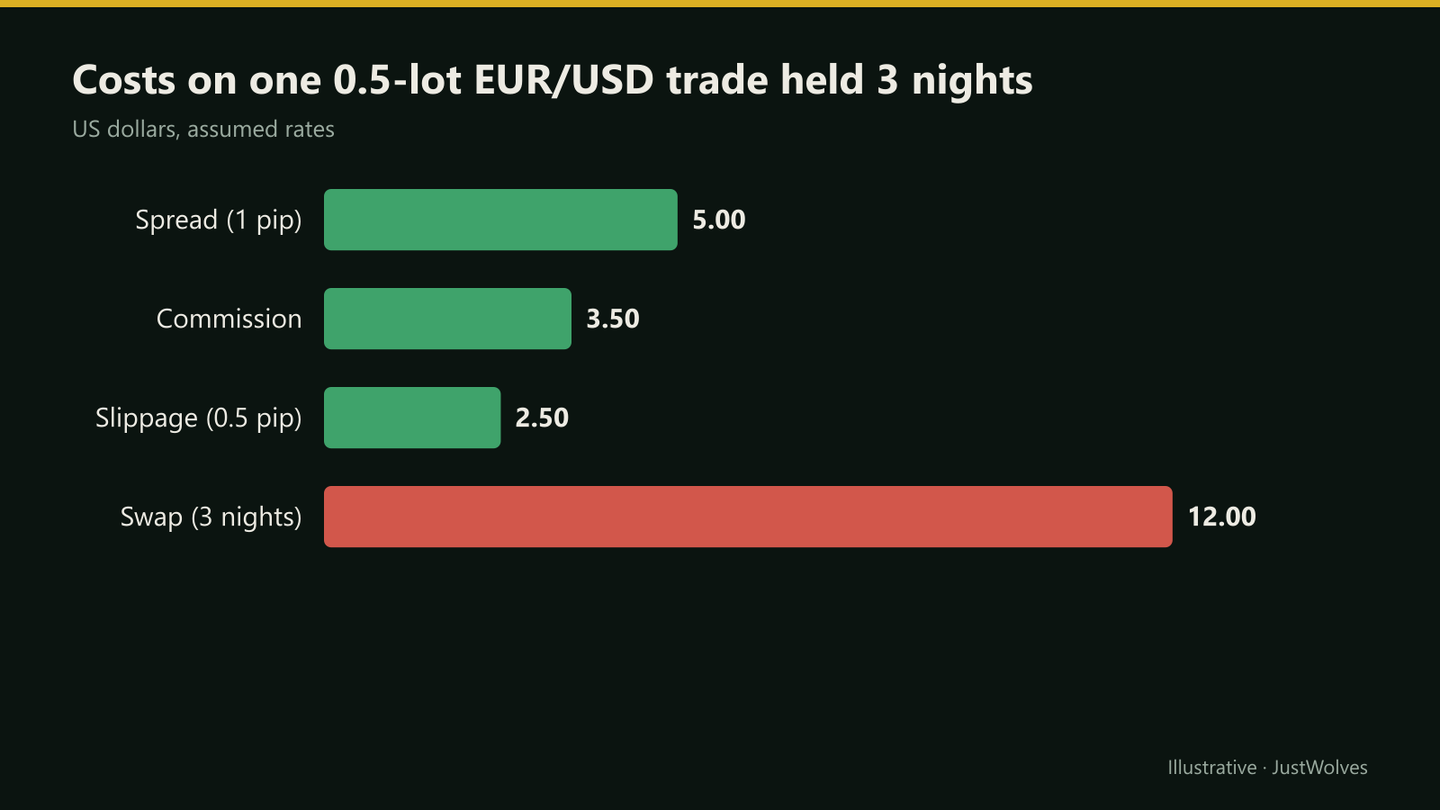
$23 on a 0.5-lot position is 4.6 pips. If this trade's target were 30 pips, costs would take about 15% of the win. For a day trade closed before rollover, the swap disappears and costs fall to $11, or 2.2 pips.
Real Case: A Three-Week Trade and Its Costs
The chart below uses real daily EUR/USD candles from July and August 2026. Step through a swing trade held for 20 nights, then see the cost breakdown underneath, using the same illustrative rates as the example above.
Real case: a three-week EUR/USD trade and what it cost, July–August 2026
Step 1 of 4
The setup
After rising from 1.1357 to 1.1539 in three sessions, EUR/USD dips to 1.1461 on 31 July 2026 and closes back at 1.1533: a bullish pin bar.
- What to observe
- A pullback rejected within the day.
- Condition
- A swing trade, likely to be held for days.
| Cost | Calculation | Amount |
|---|---|---|
| Spread | 1 pip × $1 | $1.00 |
| Commission | $7 per lot round trip × 0.1 | $0.70 |
| Slippage | 0.5 pips × $1 | $0.50 |
| Swap | $8 per lot per night × 0.1 × 20 nights | $16.00 |
| Total | about $18, or 12% of the $154 gross profit |
Costs on Indian Currency Futures
Exchange-traded currency futures don't have an overnight swap. Instead, the interest-rate difference between the two currencies is built into the futures price, which is why a USD/INR futures contract for a later month usually trades at a premium to the spot rate. You pay for it through the price, not through a nightly charge.
Your costs are the bid-ask spread in the order book, plus brokerage, exchange transaction charges, a SEBI turnover fee, stamp duty on the buy side, and GST on brokerage and exchange charges. Securities transaction tax doesn't apply to currency derivatives. The site's brokerage calculator estimates the total for a trade; check the exact rates with your broker.
Step by Step: Your Cost per Trade
Work it out once, then reuse it
Step 1: Average spread
Measure it at the times you actually trade, not the advertised minimum.
Step 2: Commission or exchange charges
Per round trip, for your usual size.
Step 3: Swap
Per night held, from your broker's table; zero for intraday or exchange futures.
Step 4: Slippage allowance
Half a pip to a pip for market and stop orders in majors is a reasonable starting assumption; track your real figure.
Step 5: Express in pips and in R
Compare the total with your stop and your average win.
Practical Example
Imran's backtest of a day-trading strategy shows an average win of 12 pips, an average loss of 10 pips and a 48% win rate. Before costs, that's an expectancy of (0.48 × 12) − (0.52 × 10) = +0.56 pips per trade.
His real costs are 1.2 pips of spread plus 0.3 pips of slippage: 1.5 pips per round trip. After costs, expectancy is 0.56 − 1.5 = −0.94 pips per trade. A strategy that looked slightly profitable loses money in practice. Win Rate, Expectancy and Profit Factor covers expectancy in depth.
How Costs Compare With Real Moves: Our Data
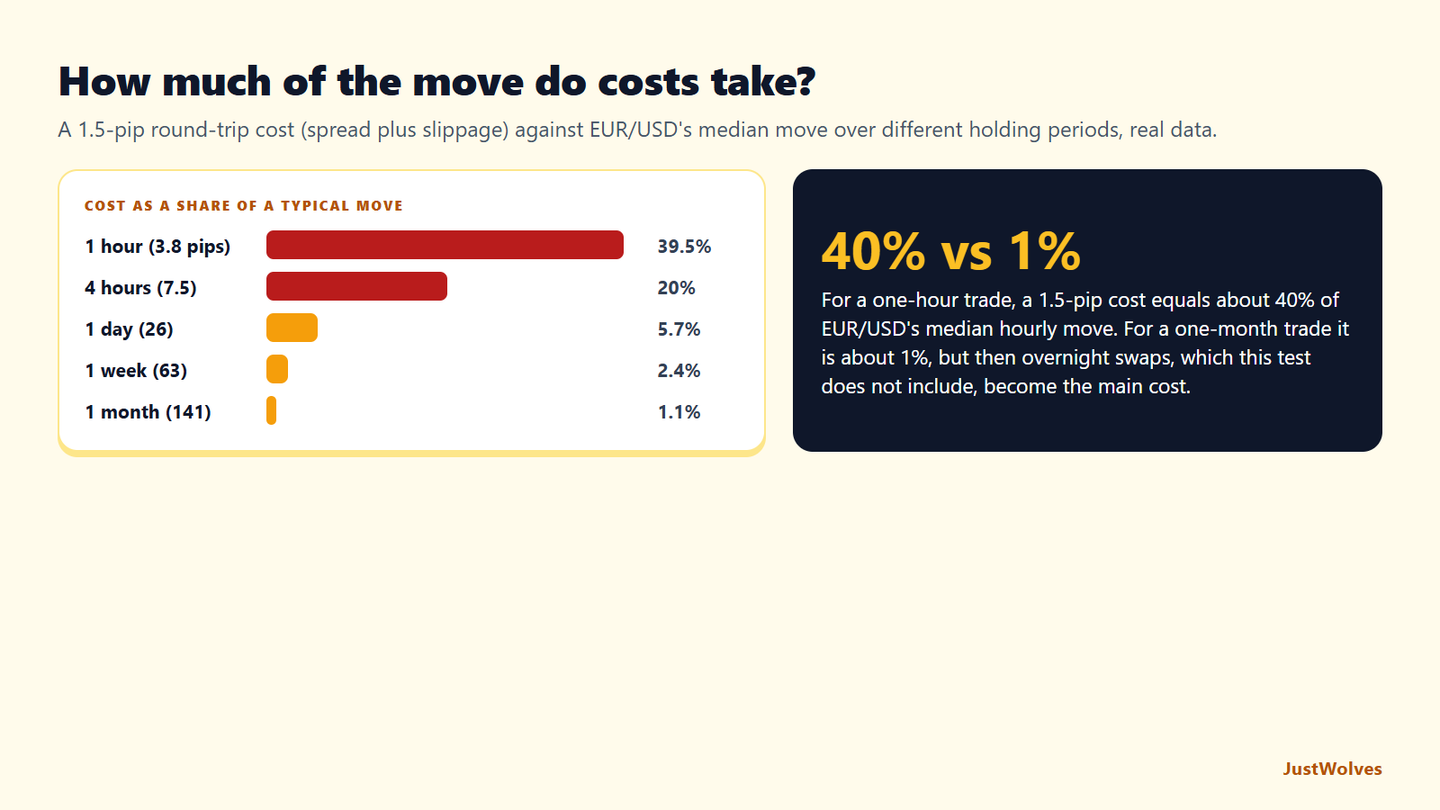
Whether a cost is large or small depends on how much the market moves while you hold the trade. JustWolves measured the median move in EUR/USD over different holding periods, using six months of real hourly data and about two years of real daily data, and compared it with a 1.5-pip round-trip cost: the 1.2-pip spread plus 0.3 pips of slippage from Imran's example.
| Holding period | Median move | Cost as a share of the move |
|---|---|---|
| 1 hour | 3.8 pips | 39.5% |
| 4 hours | 7.5 pips | 20% |
| 1 day | 26 pips | 5.7% |
| 1 week (5 days) | 63 pips | 2.4% |
| 1 month (21 days) | 141 pips | 1.1% |
The pattern explains Imran's problem in the example below. His day-trading strategy averaged 12-pip wins and 10-pip losses, so its trades were only a little larger than a typical four-hour move. A 1.5-pip cost on trades that size takes a large share of every result, and it turned a small edge into a loss.
For longer trades the picture flips. Spread and slippage become almost irrelevant over a week or a month, but swaps grow with every night held, as the three-week trade above shows. Short-term traders should obsess about spread and slippage; swing and position traders should check the swap table. Either way, measure costs as a share of your typical trade, as this lesson's professional insight recommends, not in absolute dollars.
Common Mistakes
- Backtesting without costs. Always include spread and slippage.
- Using the advertised minimum spread instead of the average at your trading times.
- Ignoring swaps on swing trades, especially the triple-swap day.
- Comparing brokers on spread alone.
- Overtrading: costs scale with the number of trades.
Professional Insight
Professionals measure cost as a share of their edge, not in absolute dollars. A strategy with a large average win can absorb high costs; a scalping strategy with tiny wins lives or dies by a fraction of a pip. The shorter your holding period, the more time you should spend reducing costs.
Risk Considerations
- Cost spikes around news can be several times normal.
- Swap rates change with central bank decisions.
- Hidden costs such as currency conversion on deposits and withdrawals add up.
Important Terminology
| Term | Meaning |
|---|---|
| Spread | Ask minus bid, paid every round trip. |
| Commission | A separate fee per lot or per trade. |
| Swap (rollover) | An overnight interest charge or credit on spot positions. |
| Triple swap | Three nights of swap charged on one day, often Wednesday. |
| Slippage | The difference between the expected and actual fill. |
| Futures premium | The amount by which a futures price exceeds spot, reflecting interest rates. |
What are the costs of forex trading?
The spread, any commission, overnight swaps on positions held past rollover, and slippage.
What is a swap in forex?
An overnight charge or credit for holding a position, based on the interest-rate difference between the two currencies plus a broker markup.
Why is swap tripled on Wednesday?
Spot forex settles two business days later, so positions held through Wednesday's rollover settle over the weekend; many brokers charge three nights then.
Do Indian currency futures have swap charges?
No. The interest difference is reflected in the futures price instead.
What charges apply to currency futures in India?
Brokerage, exchange transaction charges, SEBI fees, stamp duty and GST. Securities transaction tax doesn't apply to currency derivatives.
Which forex cost matters most?
It depends on how long you hold. In our EUR/USD data, a 1.5-pip spread-and-slippage cost was about 40% of the median one-hour move but only about 1% of the median one-month move, so spread matters most for short trades and swaps for long ones.
Practical Exercise
Work out the cost of one trade.
Your task
Step 1: The trade
0.2 lots of GBP/USD, spread 1.5 pips, commission $6 per lot round trip, slippage 0.5 pips, held 2 nights at a $10 swap debit per lot per night.
Step 2: Total cost
Add the four costs in dollars.
Step 3: In pips
Divide by the pip value of 0.2 lots.
Step 4: Compare
What share of a 40-pip target is that?
Check Your Understanding
Which cost applies only to positions held past rollover?
Related Lessons
Previous: Forex Order Types. Next: Forex Position Sizing. See also Win Rate, Expectancy and Profit Factor.