
Forex Order Types: Market, Limit, Stop and Stop-Loss Orders
JustWolves is an educational platform and is not a SEBI-registered investment advisor. Trading financial instruments involves significant risk of loss and may not be suitable for all investors. Past performance is not indicative of future results. Read our full disclaimer →
What you'll learn
- A market order fills now at the best available price; a limit order fills only at your price or better
- Buy limits sit below the market, buy stops above it; sell limits above, sell stops below
- A stop-loss is a stop order that closes a losing position; it can slip in fast markets
- A stop-limit order controls price but may not fill at all
- On Indian exchanges, stop-loss orders usually carry a limit price; check which types your broker allows
In this article · 18 sections
Knowing where you want to trade is only half the job; you also have to tell the platform how. Order types are the instructions you give: buy now, buy only if price falls to my level, sell if price breaks below this point. Choosing the wrong one is a common and expensive beginner mistake, so it's worth getting these exactly right.
What You Will Learn
- The difference between market, limit, stop and stop-limit orders
- When to use a buy limit, buy stop, sell limit or sell stop
- How stop-loss and take-profit orders protect and close trades
- Order validity, and how orders work on Indian exchanges
Before You Start
Read Bid, Ask and Spread first. Which side of the spread an order uses decides when it triggers and where it fills.
Market Orders
A market order says: trade now at the best price available. A market buy fills at the ask; a market sell fills at the bid. It's the simplest order and it almost always fills, but you don't control the exact price.
In calm, liquid markets the fill is usually at or very near the quote you saw. In fast markets, such as just after a major data release, the price can move between clicking and filling. That difference is slippage.
Limit Orders
A limit order says: trade only at this price or better. It controls price but doesn't guarantee a fill: if the market never reaches your level, nothing happens.
A buy limit is placed below the current price: you want to buy cheaper, for example on a pullback to support. A sell limit is placed above the current price: you want to sell higher, for example into resistance. Limit orders are also how take-profit orders work.
Stop Orders
A stop order waits until price reaches a trigger level, then becomes a market order. It's used when you want to act only once price moves *through* a level.
A buy stop is placed above the current price, for example to buy a breakout above resistance. A sell stop is placed below it, for example to sell a breakdown or to close a long trade at your stop-loss. Because a triggered stop becomes a market order, it can fill worse than the trigger price when the market moves fast or gaps.
| Order | Placed | You expect price to | Typical use |
|---|---|---|---|
| Buy limit | Below current price | Dip to your level, then rise | Buy a pullback |
| Sell limit | Above current price | Rise to your level, then fall | Sell into resistance; take profit on a long |
| Buy stop | Above current price | Keep rising through the level | Buy a breakout; stop-loss on a short |
| Sell stop | Below current price | Keep falling through the level | Sell a breakdown; stop-loss on a long |
Stop-Limit Orders
A stop-limit order has two prices: a trigger and a limit. When the trigger is reached, a limit order is placed instead of a market order. That stops you being filled at a terrible price in a gap, but if price jumps straight past your limit, the order won't fill and your position stays open. It trades the risk of slippage for the risk of no fill.
Stop-Loss and Take-Profit
A stop-loss (SL) is a stop order attached to an open position that closes it if price moves against you to a set level. A take-profit (TP) is a limit order that closes it at a set profit. On most forex platforms you can attach both to the order ticket, so they're in place the moment the trade opens.
Remember the spread: a long position's sell stop triggers on the bid, and a short position's buy stop triggers on the ask. Placing stops exactly at a chart level, with no buffer for the spread, causes many avoidable stop-outs. Stop-Loss Orders: Where and How to Place Them covers placement in depth.
Order Validity and OCO
- Day: cancelled at the end of the trading day if not filled.
- Good till cancelled (GTC): stays until filled or cancelled.
- Good till date: expires on a date you choose.
- Immediate or cancel (IOC): fills what it can at once, cancels the rest.
- One-cancels-the-other (OCO): two linked orders; when one fills, the other is cancelled. An SL and TP on the same trade behave like this.
Real Case: An OCO Breakout on EUR/USD
The chart below uses real hourly EUR/USD candles for 10 November 2026, in IST. It puts four order types from this lesson to work in one plan: two stop orders linked as an OCO pair, a stop-loss, and a take-profit limit.
Real case: an OCO breakout of the Asian range, EUR/USD, 10 November 2026
Step 1 of 5
The Asian range
From 05:30 to 12:29 IST on 10 November 2026, EUR/USD trades between 1.1220 and 1.1235: a 15-pip range.
- What to observe
- A quiet range with a clear high and low.
- Condition
- Plan two orders before London opens.
Orders on Indian Exchanges
On NSE and BSE currency derivatives, orders go into the exchange order book. Brokers offer limit and market orders, and stop-loss orders that usually carry a limit price (often shown as SL or SL-L). Exchanges have restricted stop-loss-market (SL-M) orders in several derivatives segments to prevent freak trades, and broker policies differ, so check which types your broker allows for currency contracts.
Because a stop-loss limit order may not fill in a fast move, many traders set the limit a few ticks beyond the trigger to give it room. Indian exchange orders are also generally day orders unless your broker offers a longer validity.
Step by Step: Picking the Right Order
Match the order to the idea
Step 1: Want in right now?
Market order, accepting some slippage.
Step 2: Want a better price on a pullback?
Limit order at your level.
Step 3: Want in only if price breaks a level?
Stop order beyond the level.
Step 4: Protect the trade
Attach a stop-loss, with a buffer for the spread.
Step 5: Plan the exit
Attach a take-profit, or decide how you'll manage the exit.
Practical Example
EUR/USD trades at 1.0850. Priya sees support at 1.0820 and resistance at 1.0880. She has two ideas.
Pullback idea: a buy limit at 1.0822, just above support, with a stop-loss at 1.0805 and a take-profit at 1.0870. Breakout idea: a buy stop at 1.0885, just above resistance, with a stop at 1.0862. If one fills she cancels the other, so she places them as an OCO pair. Using a buy limit at 1.0885 would have been a mistake: a buy limit above the market would fill immediately at the current price.
Does the OCO Breakout Plan Work? Our Test
Order types organise a trade; they don't make it profitable. To show the difference, JustWolves tested the exact plan from the chart above on six months of real hourly data (May to November 2026) for three major pairs. Each weekday: mark the high and low from 05:30 to 12:29 IST; at 12:30 IST place a buy stop one pip above the high and a sell stop one pip below the low as an OCO pair; stop-loss at the other side of the range; take-profit at 1R; close any open trade at 21:30 IST. A candle that touched both the stop-loss and target was counted as a loss.
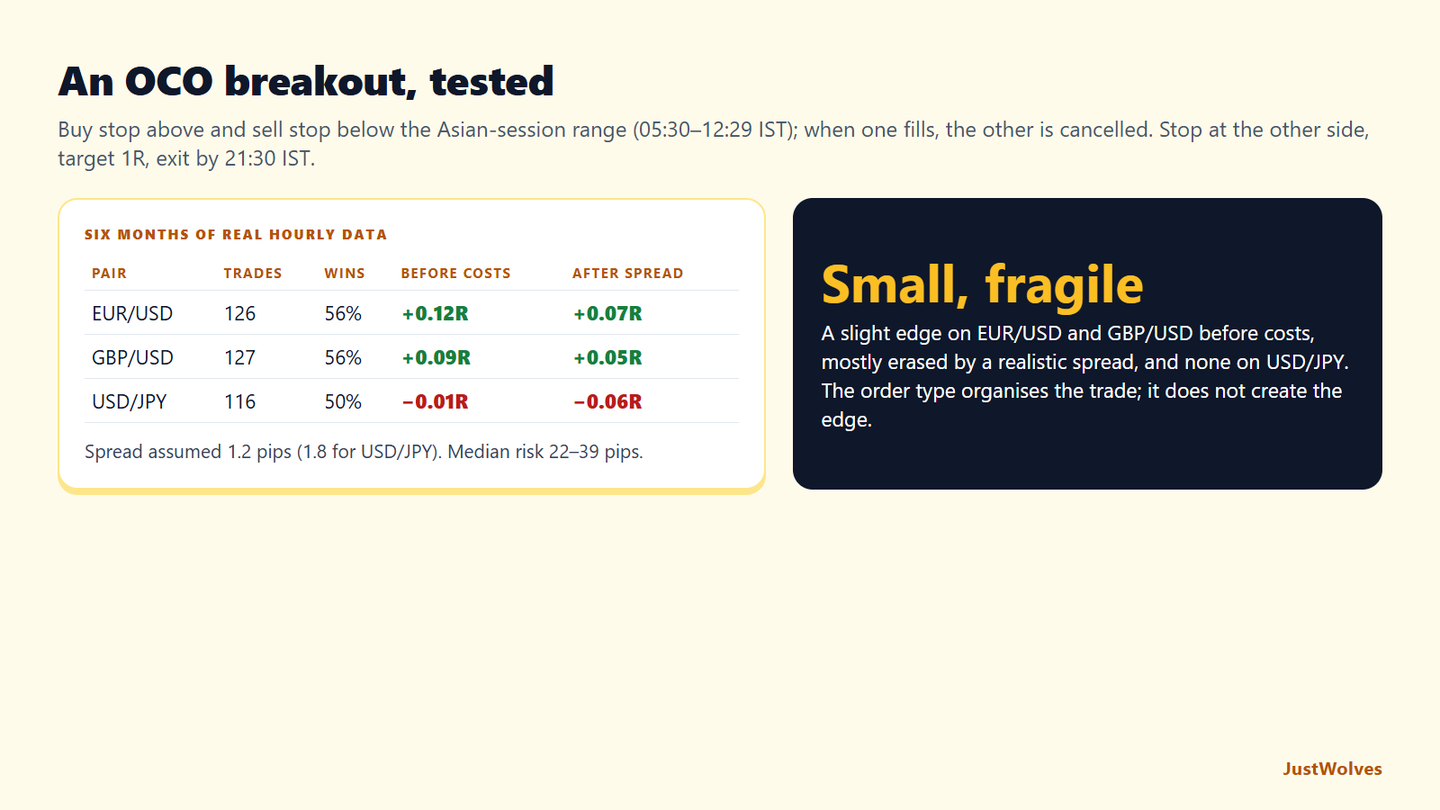
| Pair | Median range | Days with no breakout | Trades | Wins | Before costs | After spread |
|---|---|---|---|---|---|---|
| EUR/USD | 20 pips | 5 | 126 | 56% | +0.12R | +0.07R |
| GBP/USD | 25 pips | 4 | 127 | 56% | +0.09R | +0.05R |
| USD/JPY | 38 pips | 15 | 116 | 50% | −0.01R | −0.06R |
Three things stand out.
The orders behaved exactly as designed. The OCO link meant only one side was ever traded, and only one or two days per pair triggered both stop orders within the same hour. Price usually broke one side of the Asian range: on EUR/USD, 127 of 132 days.
The edge, where there was one, was small. EUR/USD and GBP/USD made about a tenth of the risk per trade before costs. A realistic spread removed about 40% of that, and stop orders also suffer slippage, which we did not include. On USD/JPY there was nothing to remove.
The example day was not typical. On 10 November 2026 the breakout reached its target and the market then reversed sharply. Some days the breakout failed at once; many days it drifted until the 21:30 IST exit. Six months of data is also short. Treat this as an illustration of how to test an order plan honestly, not as a strategy to trade.
Common Mistakes
- Confusing buy limit and buy stop. A buy limit above the market fills straight away.
- Using market orders around news, where slippage is largest.
- Trading without a stop-loss order and relying on closing manually.
- Stops with no spread buffer.
- Assuming a stop-loss guarantees the price. It can fill worse in gaps.
Professional Insight
Professionals choose order types around liquidity. They prefer limit orders when they can be patient, because they avoid paying the spread and slippage, and accept market or stop orders only when getting the trade on matters more than the exact price. Before every order, ask: is it more important to get the price, or to get the fill?
Risk Considerations
- Slippage and gaps affect market and stop orders.
- Unfilled orders can leave you out of a trade, or worse, with an open position and no exit if a stop-limit doesn't fill.
- Forgotten pending orders can fill days later when conditions have changed.
Important Terminology
| Term | Meaning |
|---|---|
| Market order | Trade now at the best available price. |
| Limit order | Trade only at your price or better. |
| Stop order | Becomes a market order once price reaches a trigger. |
| Stop-limit order | Becomes a limit order once price reaches a trigger. |
| Stop-loss / take-profit | Orders that close a position at a set loss or profit. |
| OCO | One-cancels-the-other: two linked orders. |
| Slippage | The difference between the expected and actual fill price. |
What are the main forex order types?
Market, limit, stop and stop-limit orders, plus stop-loss and take-profit orders attached to positions.
What is the difference between a buy limit and a buy stop?
A buy limit is placed below the current price to buy a dip; a buy stop is placed above it to buy a breakout.
Does a stop-loss guarantee my exit price?
No. A standard stop-loss becomes a market order when triggered and can fill worse in fast markets or gaps.
What is a stop-limit order?
An order that becomes a limit order at a trigger price. It limits slippage but may not fill.
Can I use SL-M orders on Indian currency derivatives?
Exchanges have restricted SL-M orders in several derivatives segments, and brokers differ. Check with your broker; SL-L orders are the usual alternative.
What is an OCO order in forex?
One-cancels-the-other: two linked pending orders where filling one automatically cancels the other, such as a buy stop above a range and a sell stop below it. In a real EUR/USD example from 10 November 2026, the buy stop filled at London's open and the sell stop was cancelled.
Is an Asian-range breakout profitable?
Only marginally in our test. Over six months of real hourly data, an OCO breakout of the 05:30–12:29 IST range made +0.07R per trade on EUR/USD and +0.05R on GBP/USD after the spread, and lost on USD/JPY, before slippage.
Practical Exercise
GBP/USD is at 1.2700. Name the order type for each idea.
Your task
Step 1: Idea 1
Buy if price dips to 1.2660.
Step 2: Idea 2
Sell if price breaks below 1.2640.
Step 3: Idea 3
Sell if price rallies to 1.2750.
Step 4: Idea 4
Buy if price breaks above 1.2735.
Check Your Understanding
Which order guarantees a fill but not a price?
Related Lessons
Previous: Forex Trading Platforms. Next: Forex Trading Costs. See also Stop-Loss Orders: Where and How to Place Them.