
Leverage and Margin in Forex: How They Work and Why They're Risky
JustWolves is an educational platform and is not a SEBI-registered investment advisor. Trading financial instruments involves significant risk of loss and may not be suitable for all investors. Past performance is not indicative of future results. Read our full disclaimer →
What you'll learn
- Leverage lets you control a position larger than your deposit; margin is the deposit required
- Required margin = position value ÷ leverage
- Leverage doesn't change how much a trade risks per pip; your lot size does
- Brokers issue margin calls and close positions automatically when equity falls too far
- Use leverage only so your stop-based position fits; never to make positions bigger
In this article · 16 sections
A standard lot of EUR/USD is worth more than $100,000. Very few retail traders have that much to put into one position, which is why forex is usually traded with leverage: you deposit a fraction of the position's value as margin, and the broker or exchange lets you control the whole thing. That makes forex accessible. It also makes it easy to take positions far too large for your account.
What You Will Learn
- What leverage and margin are and how they're calculated
- Free margin, margin level, margin calls and stop-outs
- Why leverage doesn't change risk per pip, but does change how much you can lose
- How leverage limits and exchange margins work
Before You Start
Read Lot Size in Forex first. This lesson covers the mechanics; Leverage and Margin Risk in the Risk Management course covers the risk in depth.
Leverage and Margin
Margin is the deposit your broker or exchange requires to open and hold a position. It isn't a fee; it's set aside from your balance while the position is open.
Leverage is the ratio of the position's value to that margin. At 1:30, every $1 of margin controls $30 of currency. The formula is: required margin = position value ÷ leverage.
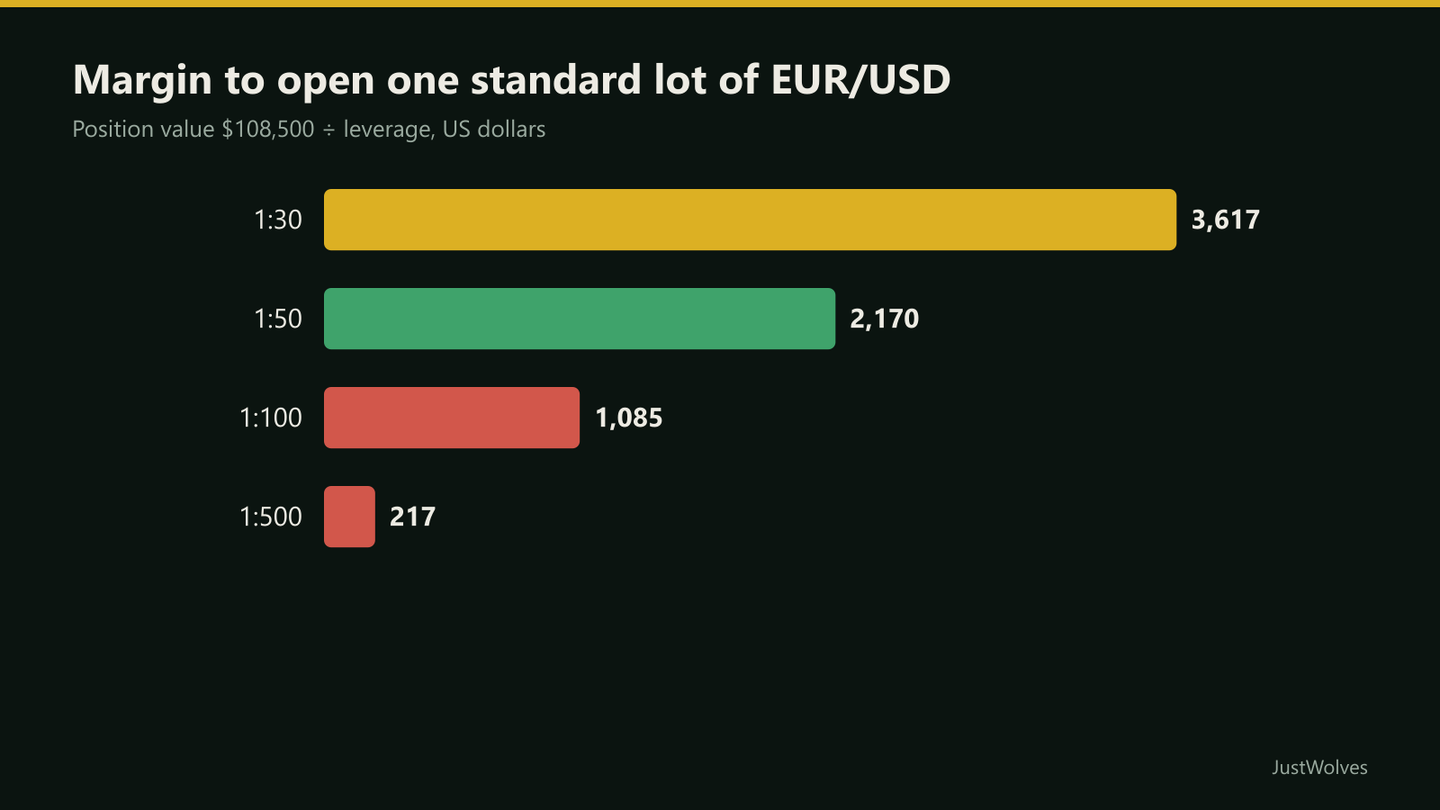
One standard lot of EUR/USD at 1.0850 is worth $108,500. Here's the margin needed to open it at different leverage levels:
| Leverage | Margin required |
|---|---|
| 1:1 (no leverage) | $108,500 |
| 1:30 | $3,617 |
| 1:50 | $2,170 |
| 1:100 | $1,085 |
| 1:500 | $217 |
Leverage Doesn't Change Risk per Pip
This point is often misunderstood. A standard lot of EUR/USD is worth $10 a pip whether you opened it at 1:30 or 1:500. Leverage only changes how much margin is set aside.
What leverage *does* change is how large a position you're able to open. With $2,000 at 1:500, you could open several standard lots, where a 50-pip move against you would cost $500 per lot. The danger isn't the ratio itself; it's using it to trade sizes your account can't absorb.
Real Data: One Bad Day at Three Levels of Leverage
This lesson says leverage doesn't change risk per pip, but it does change how large a position you can open. The chart below shows what that means on a real bad day, using real daily USD/JPY candles from April and May 2026 and three hypothetical traders with the same $2,000 account.
Real data: one bad day at three levels of leverage, USD/JPY, April–May 2026
Step 1 of 5
A calm month
Through April 2026 USD/JPY drifts between about 157.6 and 160.5, with daily ranges mostly 40 to 100 pips. On 29 April it closes at 160.43, a new high for the month.
- What to observe
- Nothing on the chart suggests danger.
- Condition
- Three traders, each with $2,000, buy at the next open.
Equity, Free Margin and Margin Level
- Balance: your account value from closed trades.
- Equity: balance plus or minus the profit or loss on open positions.
- Used margin: the margin set aside for open positions.
- Free margin: equity minus used margin, i.e. what's available for new positions or to absorb losses.
- Margin level: equity ÷ used margin × 100%. It falls as open losses grow.
Margin Calls and Stop-Outs
If losses push your margin level down to a level your broker sets, you'll get a margin call: a warning to add funds or reduce positions. If it keeps falling to the stop-out level, the broker automatically closes positions, usually starting with the largest loser, to protect itself and you from a negative balance. Levels differ by broker; check yours.
Exchange-traded futures work similarly: profits and losses are settled daily (mark-to-market), and if your balance falls below the maintenance margin, your broker will ask for more money or close the position.
Leverage Limits Around the World and in India
Many regulators cap retail forex leverage. In the European Union, for example, retail traders are limited to 1:30 on major pairs; in the United States the limit for major pairs is 1:50. Offshore brokers advertising 1:500 or 1:1000 operate outside those protections, and for Indian residents they are not an authorised route at all.
In India, leverage on exchange-traded currency futures isn't chosen by you or the broker: the exchange sets margin requirements based on the contract's risk, and brokers must collect them. Your effective leverage comes from those exchange margins, and they change with volatility.
Step by Step: Using Leverage Sensibly
Before every leveraged trade
Step 1: Size from the stop
Calculate lots from your risk per trade and stop distance.
Step 2: Check the margin required
Position value ÷ leverage. Make sure it's a modest share of your equity.
Step 3: Keep free margin
Leave plenty of free margin so ordinary losses and spread spikes don't trigger a margin call.
Step 4: Check effective leverage
Total position value ÷ equity across all open trades. Keep it low, especially overnight.
Step 5: Know your stop-out level
And make sure your stop-loss would be hit long before it.
Practical Example
Aisha has a $2,000 demo account at 1:30 leverage. Her EUR/USD setup needs a 50-pip stop, and she risks 2.5% to see the arithmetic clearly: $50. Position size: $50 ÷ (50 × $10) = 0.1 lots. Margin required: $10,850 ÷ 30 ≈ $362, leaving about $1,638 free.
Her friend, with the same $2,000 at 1:500, opens 2 standard lots on the same setup because the margin ($434) 'fits'. At the 50-pip stop he would lose $1,000, half his account. The leverage ratio was the same tool; the position size was the difference.
What Real Bad Days Do at Each Leverage Level: Our Data
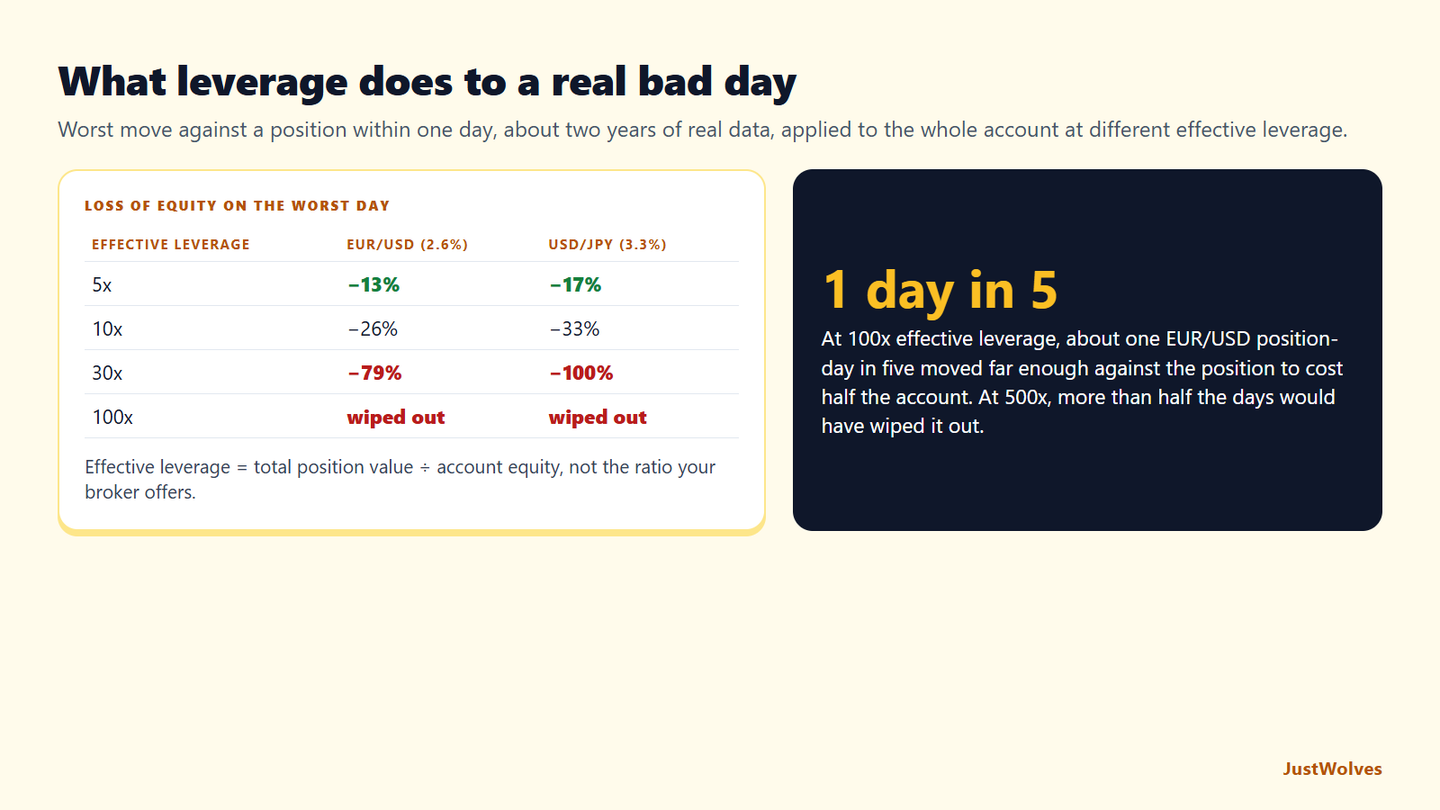
JustWolves measured about two years of real daily candles (November 2024 to November 2026) for three major pairs. For every day, we recorded the largest move against a long position (open to low) and against a short position (open to high): over 1,000 "position-days" per pair. We then applied each move to an account at different effective leverage, the total value of open positions divided by account equity.
| Effective leverage | EUR/USD | GBP/USD | USD/JPY |
|---|---|---|---|
| 5x | 0% | 0% | 0% |
| 10x | 0% | 0% | 0% |
| 30x | 0% | 0% | 1% |
| 100x | 19% | 20% | 29% |
| 500x | 77% | 76% | 80% |
| Effective leverage | EUR/USD (2.6% move) | GBP/USD (2.0%) | USD/JPY (3.3%) |
|---|---|---|---|
| 5x | 13% | 10% | 17% |
| 10x | 26% | 20% | 33% |
| 30x | 79% | 59% | 100% |
| 100x | over 100% | about 197% | over 100% |
Two findings matter for this lesson.
At low effective leverage, ordinary and even extreme days were survivable. At 5x, the worst day in two years cost 10–17% of the account. That is painful but recoverable, and with a stop-loss sized as in Lot Size in Forex it would have been far less.
At high effective leverage, bad days are not rare events. At 100x, about one day in five would have cost half the account on the euro and pound, and more than one in four on the yen. At 500x, a typical day was enough. This is the arithmetic behind the leverage limits described above: regulators who cap leverage at 1:30 or 1:50 are, in effect, capping how close an account can get to these numbers.
Note what this table is not saying. A broker offering 1:500 does not force you to use 500x; Aisha in the example below uses 1:30 and runs about 5x. The danger comes when the available leverage, rather than your stop and risk per trade, decides the position size.
Common Mistakes
- Thinking margin is the maximum loss. Losses can exceed the margin used.
- Choosing high leverage to 'make more'. It only lets you take bigger risks.
- Using most of your free margin. It leaves no buffer.
- Ignoring overnight and weekend gaps, which can jump past stops.
- Trading leveraged forex offshore from India. It is not a permitted route for residents.
Professional Insight
Professional currency traders often run low effective leverage, frequently only a few times their capital across all positions, despite having access to much more. Their position sizes come from risk limits, and leverage is simply the plumbing that lets those positions exist.
Risk Considerations
- Leverage magnifies losses as much as gains.
- Margin requirements can rise suddenly in volatile markets.
- Forced closures happen at market prices, often poor ones.
Important Terminology
| Term | Meaning |
|---|---|
| Leverage | Position value compared with the margin deposited, e.g. 1:30. |
| Margin | The deposit required to open and hold a position. |
| Equity | Balance plus or minus open profit or loss. |
| Free margin | Equity minus used margin. |
| Margin level | Equity ÷ used margin × 100%. |
| Margin call / stop-out | A warning / automatic closure when margin level falls too low. |
What is leverage in forex?
The ability to control a position larger than your deposit. At 1:30, $1 of margin controls $30 of currency.
What is margin in forex?
The deposit set aside from your account to open and hold a leveraged position. It is not the most you can lose.
What leverage should a beginner use?
The leverage matters less than position size. Size each trade from its stop so it risks 0.5–1% of your account, and keep effective leverage low.
What happens in a margin call?
You're asked to add funds or reduce positions. If losses continue to the stop-out level, the broker closes positions automatically.
Is high-leverage forex trading allowed in India?
Leveraged trading with offshore forex brokers isn't permitted for Indian residents. Exchange-traded currency futures use margins set by the exchange.
What is effective leverage?
The total value of your open positions divided by your account equity. A $2,000 account holding $10,000 of EUR/USD runs 5x effective leverage, whatever maximum leverage the broker offers.
How much leverage is safe in forex?
No level is safe without a stop-loss and proper position sizing. In our data, at 5x effective leverage the worst day in two years cost 10–17% of the account, while at 100x about one day in five would have cost half of it.
Practical Exercise
Work these out for a $3,000 account at 1:30 leverage, with EUR/USD at 1.1000.
Your task
Step 1: Position value
What is 0.2 lots of EUR/USD worth?
Step 2: Margin
How much margin does it require?
Step 3: Free margin
How much is left if the position is flat?
Step 4: A loss
The trade moves 40 pips against you. What is the loss and the new equity?
Check Your Understanding
A position worth $50,000 at 1:50 leverage needs how much margin?
Related Lessons
Previous: Bid, Ask and Spread. The site's forex margin calculator works out required margin for any pair. Next: Is Forex Trading Legal in India?. For the risk side, read Leverage and Margin Risk.