
Forex Trading Sessions and Market Hours in IST
JustWolves is an educational platform and is not a SEBI-registered investment advisor. Trading financial instruments involves significant risk of loss and may not be suitable for all investors. Past performance is not indicative of future results. Read our full disclaimer →
What you'll learn
- Forex trades 24 hours a day, five days a week, through four overlapping sessions
- In IST, London opens at 12:30 or 1:30 pm and New York at 5:30 or 6:30 pm, depending on daylight saving
- The London–New York overlap is usually the most liquid time of day
- Session times are conventions; liquidity changes gradually, not at a bell
- NSE rupee pairs trade 9:00 am–5:00 pm IST; cross-currency pairs until 7:30 pm
In this article · 16 sections
Unlike a stock exchange, the global forex market has no single opening bell. Trading follows the sun from Sydney to Tokyo to London to New York, so somewhere in the world a major centre is open almost all week. For traders in India, knowing when each session runs in IST, and how daylight saving in other countries moves those times, decides when your pairs are liquid, when spreads are tight, and when big moves are likely.
What You Will Learn
- The four main forex sessions and their times in IST
- How daylight saving in the UK, US and Australia shifts those times
- Why the London–New York overlap matters
- How to choose trading hours that fit your pairs and your day
Before You Start
Read How the Forex Market Works first. It explains why forex trades over the counter, across many centres, rather than on one exchange.
The Four Sessions
The trading day is usually described as four sessions named after the main financial centres: Sydney, Tokyo, London and New York. The hours below use common conventions for each centre's local business day (7 am–4 pm in Sydney, 9 am–6 pm in Tokyo, 8 am–5 pm in London and New York), converted to Indian Standard Time.
India doesn't use daylight saving, but the UK, US and Australia do, so the IST times move twice a year.
| Session | Northern winter (approx. Nov–Mar) | Northern summer (approx. Apr–Oct) |
|---|---|---|
| Sydney | 1:30 am – 10:30 am | 2:30 am – 11:30 am |
| Tokyo | 5:30 am – 2:30 pm | 5:30 am – 2:30 pm |
| London | 1:30 pm – 10:30 pm | 12:30 pm – 9:30 pm |
| New York | 6:30 pm – 3:30 am | 5:30 pm – 2:30 am |
The site's market hours tool shows which sessions are open right now in your timezone, adjusted for daylight saving automatically.
What Each Session Is Like
Sydney and Tokyo (the Asian session)
The week opens in Sydney. Liquidity is thinner, and moves in the major pairs are often smaller, though the yen, Australian dollar and New Zealand dollar are more active, and Japanese and Australian data releases can move them. For Indian traders, the Asian session covers early morning to early afternoon.
London
London is the largest trading centre for currencies, so the London open usually brings a jump in volume and volatility, especially in euro and pound pairs. In IST, it starts in the early afternoon, a convenient time for many traders in India.
New York
New York brings US data releases, usually at 8:30 am New York time (6:00 pm or 7:00 pm IST), and the US equity open. Activity in dollar pairs is high in the first half of the session and fades after London closes.
The London–New York Overlap
When both London and New York are open, roughly 5:30 pm to 9:30 pm IST in the northern summer and 6:30 pm to 10:30 pm IST in the winter, the two biggest centres trade at the same time. This is typically the most liquid part of the day for major pairs, with the tightest spreads and the largest moves.
That makes it attractive for day traders, but it's also when major US data comes out. Liquidity is high, but so is the chance of sharp, fast moves.
Real Data: One Day of GBP/USD, Session by Session
The chart below follows real hourly GBP/USD candles through 6 October 2026, from the Asian morning to after midnight IST. It shows each session's character on an ordinary day, and also that a single day does not always match the averages.
Real data: one day of GBP/USD through the sessions, 6 October 2026 (IST)
Step 1 of 4
Asian session: a narrow range
From 05:30 to 12:29 IST, GBP/USD trades between 1.3202 and 1.3232: 30 pips in seven hours, most of it in one dip at 11:30. Most hours move less than 10 pips.
- What to observe
- Thin trading in a European pair.
- Condition
- Little reason to trade the pound here.
The Weekly Open and Close
The spot forex week is usually counted from 5:00 pm New York time on Sunday to 5:00 pm New York time on Friday. In IST, that's from about 2:30–3:30 am on Monday to about 2:30–3:30 am on Saturday, depending on US daylight saving. Spreads are often wide at the weekly open, and prices can gap from Friday's close if news broke over the weekend.
Indian Exchange Hours
Exchange-traded currency derivatives in India keep their own hours. On NSE, rupee pairs (USD/INR, EUR/INR, GBP/INR, JPY/INR) trade from 9:00 am to 5:00 pm IST, and cross-currency pairs (EUR/USD, GBP/USD, USD/JPY) from 9:00 am to 7:30 pm IST, Monday to Friday. The 7:30 pm close means the cross-currency contracts catch the start of the London–New York overlap but not most US data releases. Exchanges can change hours by circular, so check the current specification.
Step by Step: Choosing Your Trading Hours
Match your hours to your pairs
Step 1: List your pairs
Euro and pound pairs are most active in London; yen and Aussie pairs also move in Asia; dollar pairs peak in the overlap.
Step 2: Check your availability
Pick hours you can trade consistently without disrupting work or sleep.
Step 3: Note the calendar
Mark when major releases for your currencies come out, in IST.
Step 4: Track spreads
Record the spread at your chosen times for a week.
Step 5: Fix a routine
Trade the same window each day, and set your chart timezone to IST.
Practical Example
Ananya works until 6:00 pm and trades EUR/USD. In July, she can be at her screen from about 7:00 pm IST, during the London–New York overlap, which ends around 9:30 pm. That gives her two and a half hours of the most liquid trading.
In January, the overlap runs to about 10:30 pm, giving her an extra hour, but US data releases move from 6:00 pm to 7:00 pm IST. She updates her routine twice a year, on the dates the US changes its clocks.
How Much Does Each Session Move? Our Data
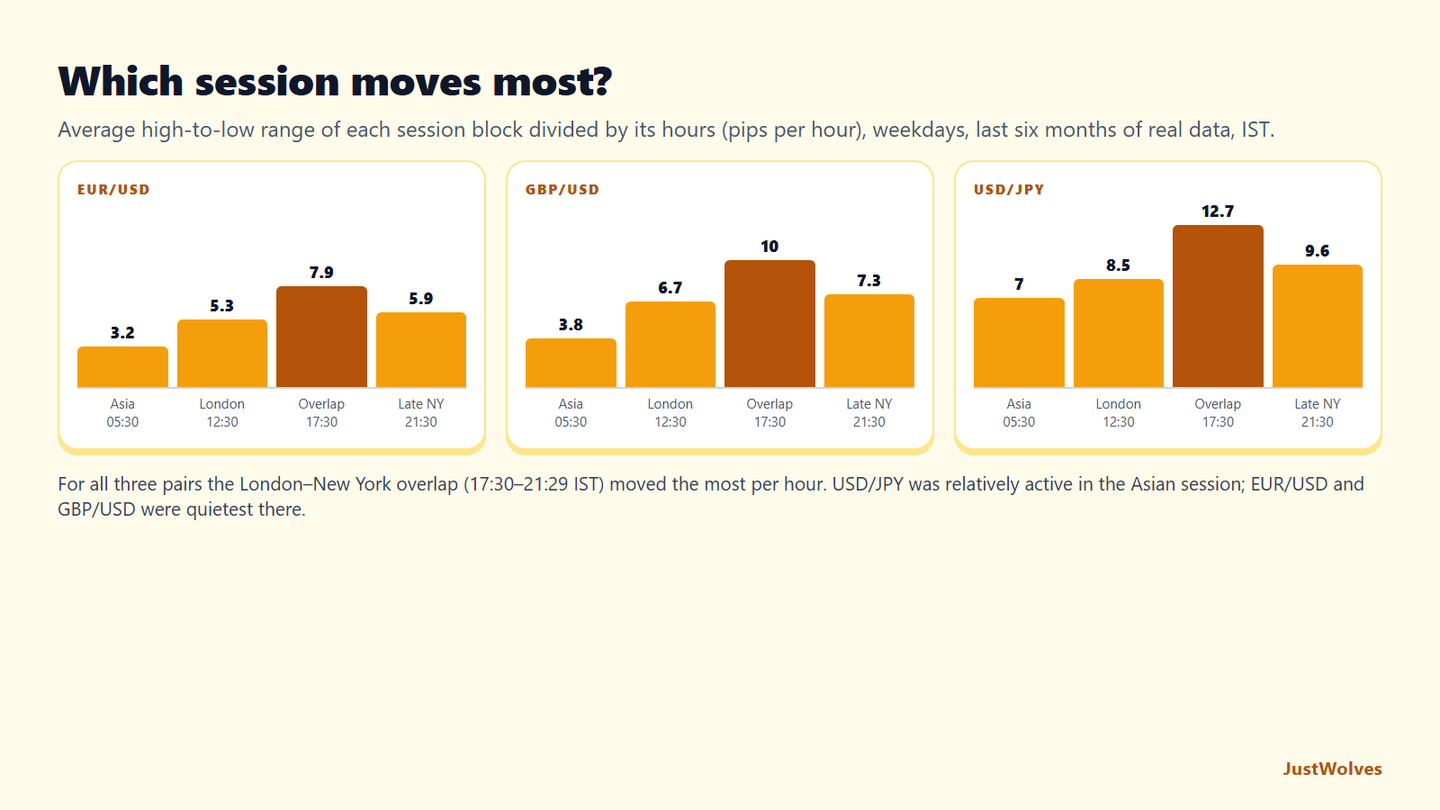
JustWolves measured six months of real hourly data (May to November 2026, mostly northern summer time) and split each weekday into four blocks in IST. For each block we took the high-to-low range and averaged it across days. Because the blocks are different lengths, the table also shows the range per hour.
| Block (IST) | Hours | EUR/USD | GBP/USD | USD/JPY |
|---|---|---|---|---|
| Asia, 05:30–12:29 | 7 | 22 pips (3.2/h) | 26 pips (3.8/h) | 49 pips (7.0/h) |
| London, 12:30–17:29 | 5 | 26 pips (5.3/h) | 33 pips (6.7/h) | 43 pips (8.5/h) |
| London–New York overlap, 17:30–21:29 | 4 | 32 pips (7.9/h) | 40 pips (10.0/h) | 51 pips (12.7/h) |
| Late New York, 21:30–00:29 | 3 | 18 pips (5.9/h) | 22 pips (7.3/h) | 29 pips (9.6/h) |
The data supports this lesson's description closely. The London–New York overlap moved the most per hour for all three pairs, about two and a half times the Asian session's rate for EUR/USD and GBP/USD. USD/JPY was the exception in Asia: it moved about twice as much per hour in the Asian session as the euro or the pound, because Tokyo is its home market.
There is a practical lesson for Ananya's example too. Her evening window (about 19:00 to 21:30 IST in summer) sits inside the busiest block of the day, which is good for opportunity. But that block also contains the hour of most US data releases and, eight times a year, the US Federal Reserve's decisions at 23:30 IST in summer (see Central Banks and Monetary Policy). The busiest hours are also the ones where planning around the calendar matters most.
Common Mistakes
- Forgetting daylight saving. Session times in IST move by an hour twice a year.
- Trading illiquid hours with short-term strategies, paying wider spreads.
- Ignoring the weekly open, when spreads are wide and gaps are common.
- Charts in the wrong timezone, which misplaces session opens and daily candles.
- Trading every session. Fatigue hurts decisions; pick a window.
Professional Insight
Many professional traders specialise in one session rather than trying to trade all of them. They learn how their pairs typically behave at the open of that session, around its data releases and at its close, and they stop trading when liquidity fades. Consistency of timing makes it much easier to compare one day's trading with another.
Risk Considerations
- Thin markets mean wider spreads and more slippage.
- Overlap volatility can move price through stops quickly.
- Late-night trading in India can lead to tired decisions.
Important Terminology
| Term | Meaning |
|---|---|
| Trading session | The business hours of a major forex centre. |
| Session overlap | A period when two centres are open at once. |
| Daylight saving time | A seasonal one-hour clock change used in the UK, US and Australia, but not India. |
| Weekly open | The start of the forex week, Sunday 5 pm New York time. |
| Liquidity | How easily you can trade without moving the price. |
What are forex market hours in India?
The global market runs from about 2:30–3:30 am IST on Monday to the same time on Saturday. NSE currency derivatives trade 9:00 am–5:00 pm (rupee pairs) and to 7:30 pm (cross pairs).
When does the London session open in IST?
At about 12:30 pm IST in the northern summer and 1:30 pm IST in the winter.
What is the best time to trade forex in India?
For major pairs, the London–New York overlap, roughly 5:30–9:30 pm IST in summer and 6:30–10:30 pm in winter, is usually the most liquid.
Does daylight saving affect forex times in India?
Yes. India doesn't change its clocks, but the UK, US and Australia do, so session times in IST shift by an hour.
Is forex open on weekends?
No. The spot market closes on Friday evening New York time and reopens on Sunday evening New York time.
Which forex session is most volatile?
In our six months of real data, the London–New York overlap (about 17:30 to 21:30 IST in summer) moved the most per hour for EUR/USD, GBP/USD and USD/JPY: about 8, 10 and 13 pips per hour respectively.
Practical Exercise
Build your own session plan.
Your task
Step 1: Today's sessions
Using the market hours tool, write down today's session times in IST.
Step 2: Your window
Mark the two hours you can trade most consistently.
Step 3: Spread check
Record the EUR/USD spread at the start, middle and end of that window for five days.
Step 4: Calendar check
Note any high-impact releases in that window this week.
Check Your Understanding
In July, roughly when does the London session open in IST?
Related Lessons
Previous module: Executing a Forex Trade from Entry to Exit. Next: Central Banks and Monetary Policy (01.03.02). See also Bid, Ask and Spread.