
Forex Trading Platforms: Broker Terminals, Charting Tools and Indian Brokers
JustWolves is an educational platform and is not a SEBI-registered investment advisor. Trading financial instruments involves significant risk of loss and may not be suitable for all investors. Past performance is not indicative of future results. Read our full disclaimer →
What you'll learn
- A platform is software for charts and orders; the broker behind it is what holds your money
- Forex and CFD brokers supply trading terminals; web charting platforms are mainly for analysis
- Indian residents trade exchange currency derivatives through a SEBI-registered broker's terminal
- A familiar platform name or logo says nothing about whether a broker is authorised
- Set the chart time zone to IST and practise on a demo or paper account before risking real money
In this article · 13 sections
Every trade you place goes through a trading platform: the software that shows you prices and charts and sends your orders. Beginners often spend a long time choosing between platforms, but the more important decision is the broker or exchange behind it. This lesson explains what the common platforms do, how they differ, and how to pick and set one up sensibly.
What You Will Learn
- What a trading platform does, and what it doesn't
- How broker forex terminals, web charting platforms and Indian broker terminals differ
- Why the platform and the broker are separate decisions
- How to set up a platform for practice before trading real money
Before You Start
Read Is Forex Trading Legal in India? first. Which platform you can use for real money depends on which route is legal for you.
What a Trading Platform Does
A trading platform is the software between you and the market. It typically does four jobs: it streams prices, draws charts, lets you place and manage orders, and shows your account: balance, open positions, margin and history.
A platform does not hold your money, set your prices or decide whether your trading is legal. Those depend on the broker (or exchange) the platform is connected to. The same software can be offered by a well-regulated firm and by an unauthorised one, and it will look identical on your screen.
The Main Types of Platform
Broker forex terminals
Most forex and CFD brokers give clients a downloadable desktop and mobile terminal, often the same third-party software used by hundreds of firms around the world. These terminals offer charts, indicators, one-click trading, automated strategies and a built-in strategy tester. Each broker runs its own server, so you log in to a specific broker's account, not to the software itself. Many of the offshore brokers that advertise to Indians use exactly the same terminal software as regulated firms, which is why it's important to separate the software from the firm.
Web charting platforms
Web charting platforms run in a browser and on mobile and are built mainly for analysis: charts, drawing tools, alerts, custom scripts and usually a paper-trading account for practice. Some brokers connect to them so you can trade from their charts, and several Indian brokers build web-style charts into their own terminals. Free tiers usually limit the number of indicators and alerts.
Indian broker terminals
For Indian residents, the legal route to currency trading is exchange-traded currency derivatives on NSE, BSE or MSE, through a SEBI-registered stockbroker. You trade from that broker's web, desktop or mobile terminal, usually after activating the currency segment on your account. These terminals show market depth (the order book), support exchange order types, and report positions and margins as the exchange calculates them.
| Broker forex terminal | Web charting platform | Indian broker terminal | |
|---|---|---|---|
| Main use | Charting and order execution with a forex/CFD broker | Charting, analysis, alerts | Trading exchange contracts through a SEBI-registered broker |
| What you trade | Whatever that broker offers | Depends on the connected broker | NSE/BSE/MSE currency futures and options |
| Automation | Automated strategies, strategy tester | Custom scripts and alerts | Varies by broker; mostly manual |
| Practice mode | Demo accounts | Paper trading | Varies; often none for currency |
| Legal for Indian residents? | Depends entirely on the broker | Charting yes; trading depends on the broker | Yes, when used within RBI rules |
Step by Step: Choosing and Setting Up a Platform
Five checks, in order
Step 1: Decide the legal route first
For Indian residents, that means a SEBI-registered broker and exchange-traded contracts. The platform follows from the broker.
Step 2: Check what you can trade
Confirm the pairs, contract sizes and trading hours. NSE rupee pairs trade 9:00 am–5:00 pm IST; cross-currency pairs until 7:30 pm.
Step 3: Check the order types
Make sure the terminal supports the orders you need: limit, market and stop-loss (lesson 01.02.02).
Step 4: Set up the workspace
Add your pairs to a watchlist, set the chart timezone to IST, and keep the indicator set small.
Step 5: Practise first
Use a demo or paper account, or chart-only practice, until placing, modifying and closing orders is second nature.
The site's market hours tool shows when each session is open in IST.
Real Data: Where Does the Trading Day Start?
One platform setting quietly changes what you see: the time zone, and with it the moment each daily candle begins. The chart below uses real hourly EUR/USD candles from the night of 9–10 November 2026, in IST, to show three possible starts of "10 November".
Real data: where does "10 November" start? EUR/USD hourly, 9–10 November 2026
Step 1 of 4
Midnight in India
At 00:30 IST on 10 November 2026, EUR/USD is at about 1.1208 and rising. A chart that starts each day at IST midnight would open its "10 November" candle around here.
- What to observe
- One possible start of the day.
- Condition
- Most forex charts do not use this one.
Practical Example
Rohan wants to learn currency trading. An Instagram ad offers a 'pro forex terminal with 1:500 leverage'. The familiar software makes it look established, but he checks the firm: it isn't a SEBI-registered broker, and it isn't offering exchange-traded contracts. He skips it.
Instead he activates the currency segment with his existing SEBI-registered broker, uses its terminal for orders, and does his chart analysis on a web charting platform set to IST. For his first month he only paper-trades there, logging every trade, before placing a single real order.
Does the Chart Setting Change What You See? Our Data
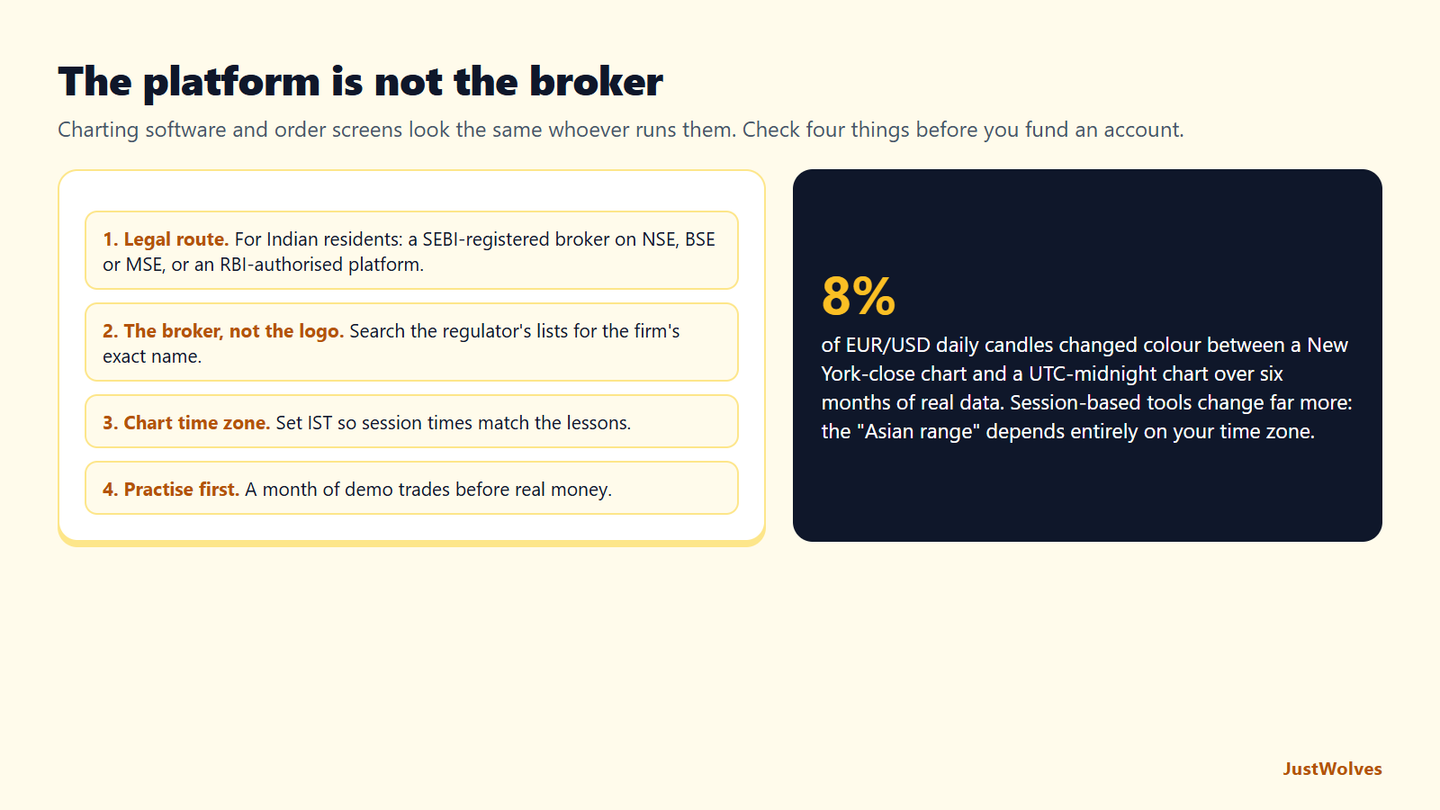
JustWolves rebuilt six months of real EUR/USD and GBP/USD daily candles (May to November 2026) two ways: starting each day at the New York close, which is the forex market's convention and the method used in this course, and starting each day at midnight UTC, a common default on charting platforms. We then compared the two versions day by day.
| Pair | Days compared | Candle colour different | Median difference in close |
|---|---|---|---|
| EUR/USD | 131 | 11 days (8%) | about 2.6 pips |
| GBP/USD | 131 | 9 days (7%) | about 2.7 pips |
For daily candles, the setting mattered less than many traders fear: most days looked almost the same either way. But one candle in twelve or so changed colour, and a candle-pattern trader reading those days would have seen a different signal. The difference grows for anything defined by clock time: session highs and lows, opening ranges and "previous day" levels all move when the day boundary moves.
The practical rule from this lesson's exercise stands: set your chart to IST, then check where the platform starts its daily candle, and keep that the same on every platform you use. If you chart on one platform and place orders on another, as this lesson's professional insight describes, make sure both use the same settings.
Common Mistakes
- Choosing a broker because of its platform. Check the regulator first.
- Assuming familiar software means forex is legal. The software is legal; trading with an unauthorised broker isn't, for Indian residents.
- Cluttering charts with a dozen indicators.
- Leaving the chart in another timezone, which misplaces session opens and daily candles.
- Skipping practice and learning the order ticket with real money.
Professional Insight
Many experienced traders separate analysis from execution: they chart on one platform and place orders on another. That's fine, as long as both show the same prices and you know which platform's data is the one you're actually trading. Always check the price on the order ticket before you send it.
Risk Considerations
- Unauthorised brokers can freeze withdrawals regardless of how good the platform looks.
- Connection or platform outages can leave you unable to manage open trades; know your broker's phone dealing number.
- Automated strategies can place large or repeated orders quickly if set up wrongly.
Important Terminology
| Term | Meaning |
|---|---|
| Trading platform | Software that shows prices and charts and sends orders. |
| Broker | The firm that holds your account and executes or routes your orders. |
| Broker terminal | The desktop or mobile trading software a broker provides to its clients. |
| Web charting platform | A browser-based charting and analysis platform. |
| Market depth | The list of buy and sell orders waiting at different prices. |
| Paper trading | Simulated trading with no real money. |
Which is the best forex trading platform?
There's no single best one. Choose the legal broker first, then use its platform; many traders also chart separately on a web charting platform.
Is forex trading software legal in India?
The software is legal, but trading leveraged forex through an unauthorised offshore broker is not permitted for Indian residents, whichever platform it uses.
Can I trade forex from a charting platform?
Web charting platforms are mainly for analysis. You can trade from one only through a connected broker, and the broker's legal status is what matters.
How do I trade currency in India?
Through a SEBI-registered broker on NSE, BSE or MSE, after activating the currency derivatives segment and within RBI rules.
Should I use a demo account?
Yes. Practise order entry and your strategy rules on a demo or paper account before risking money.
Which time zone should my forex chart use?
Set the chart to IST so session times match your day, and check where the platform starts each daily candle. Most forex charts start the day at the New York close (02:30 or 03:30 IST); some default to midnight UTC (05:30 IST). In our data, the two versions differed in colour on about 8% of days.
Practical Exercise
Set up a practice workspace.
Your task
Step 1: Open a paper or demo account
On any platform with simulated trading.
Step 2: Build a watchlist
EUR/USD, GBP/USD, USD/JPY and USD/INR.
Step 3: Set the timezone
Change the chart timezone to Asia/Kolkata and confirm the daily candle start.
Step 4: Place three practice orders
A market order, a limit order and an order with a stop-loss attached. Then modify and close each one.
Check Your Understanding
What does a trading platform do?
Related Lessons
Previous: Is Forex Trading Legal in India?. Next: Forex Order Types. Later: Forex Trading Sessions and Market Hours (01.03.01).