
Lot Size in Forex: Standard, Mini and Micro Lots Explained
JustWolves is an educational platform and is not a SEBI-registered investment advisor. Trading financial instruments involves significant risk of loss and may not be suitable for all investors. Past performance is not indicative of future results. Read our full disclaimer →
What you'll learn
- A lot is a standard position size: standard 100,000, mini 10,000, micro 1,000 and nano 100 units
- Lot size sets your money per pip: $10, $1, $0.10 and $0.01 on dollar-quoted pairs
- Choose lot size from your stop distance and risk per trade, never from how much margin allows
- Fractional lots such as 0.07 let you size precisely
- Indian exchange currency contracts have fixed sizes, such as 1,000 US dollars for USD/INR
In this article · 14 sections
Pips measure how far price moves. Lot size decides how much each of those pips is worth to you. Two traders can take the identical trade on the same chart and end up with results ten or a hundred times apart, purely because of the lot size they chose. Understanding lots is what lets you control that number deliberately.
What You Will Learn
- What standard, mini, micro and nano lots are
- How lot size translates into money per pip
- How to choose a lot size from your stop and risk per trade
- How Indian exchange-traded contract sizes compare
Before You Start
Read What Is a Pip in Forex? first. You'll need pip value to make sense of lots.
The Standard Lot Sizes
| Lot | Units of base currency | Written as | Pip value on EUR/USD |
|---|---|---|---|
| Standard | 100,000 | 1.00 | $10.00 |
| Mini | 10,000 | 0.10 | $1.00 |
| Micro | 1,000 | 0.01 | $0.10 |
| Nano | 100 | 0.001 | $0.01 |
Platforms write position size as a decimal of a standard lot. 0.25 lots is 25,000 units, worth $2.50 per pip on EUR/USD. That flexibility is useful: it lets you size a position to match your stop exactly rather than rounding to a whole lot.
How Lot Size Changes Your Outcome
Here is the same 50-pip move on EUR/USD at four lot sizes:
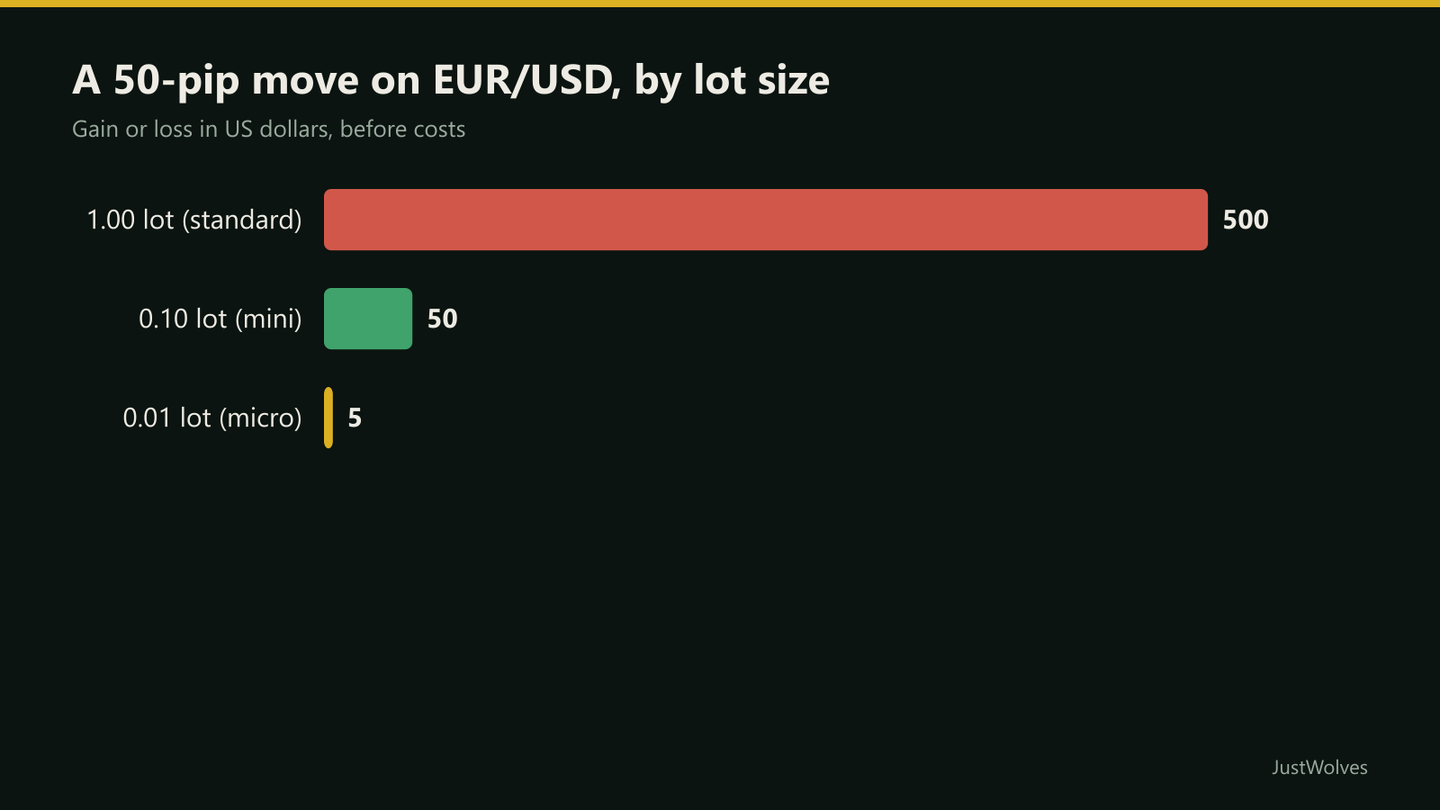
For a trader with a $2,000 account, a 50-pip loss on one standard lot would cost a quarter of the account; on a micro lot, a quarter of one percent. Nothing about the trade idea changed.
Real Case: One Stop, Three Lot Sizes
The chart below uses real daily GBP/USD candles from August and September 2026. Step through it to see a trade that lost, and how the same 50-pip loss looked at three different lot sizes.
Real case: a 50-pip stop sized three ways, GBP/USD, September 2026
Step 1 of 5
A slow decline
GBP/USD drifts from 1.3675 on 21 August 2026 to the 1.35 area in early September, with small daily ranges of 30 to 60 pips.
- What to observe
- A quiet, gently falling market.
- Condition
- A trader is looking for a bounce.
Step by Step: Choosing a Lot Size
From stop to lot size
Step 1: Set the stop from the chart
Measure the distance in pips, e.g. 25 pips.
Step 2: Decide your risk in money
For example 1% of a $2,000 account = $20.
Step 3: Find the cost per standard lot
25 pips × $10 = $250 per standard lot.
Step 4: Divide
$20 ÷ $250 = 0.08 lots (8 micro lots), worth $0.80 per pip.
Step 5: Round down and check
If your broker's minimum step doesn't allow 0.08, round down, never up. Confirm: 25 pips × $0.80 = $20.
This is the forex version of Position Sizing and the 1% Rule. The site's position size calculator does the same arithmetic, and Forex Position Sizing extends it to yen and cross pairs.
Lot Sizes on Indian Exchanges
Exchange-traded currency contracts in India come in fixed sizes rather than fractional lots. A USD/INR contract is 1,000 US dollars; EUR/INR and GBP/INR are 1,000 euros and pounds; JPY/INR is 100,000 yen; and the cross-currency contracts (EUR/USD, GBP/USD, USD/JPY) are 1,000 units of the base currency. Always confirm the current specification on the exchange's website.
Because the smallest position is one contract, sizing works like Nifty futures in lesson 12.01.03: work out the loss per contract at your stop, then trade the whole number of contracts that fits your risk, rounding down. If even one contract risks too much, skip the trade.
Practical Example
Arjun has a $5,000 practice account and risks 1% ($50). His GBP/USD setup needs a 40-pip stop. One standard lot would risk 40 × $10 = $400, so he trades $50 ÷ $400 = 0.125 lots, rounded down to 0.12 lots ($1.20 per pip, risking $48).
The next day a USD/JPY setup needs only a 15-pip stop. With USD/JPY at 150, a pip on a standard lot is worth about $6.67, so one lot risks about $100; 0.5 lots risks $50. Different pairs and stops, different lot sizes, the same $50 of risk.
What Lot Size Do Real Stops Require? Our Data
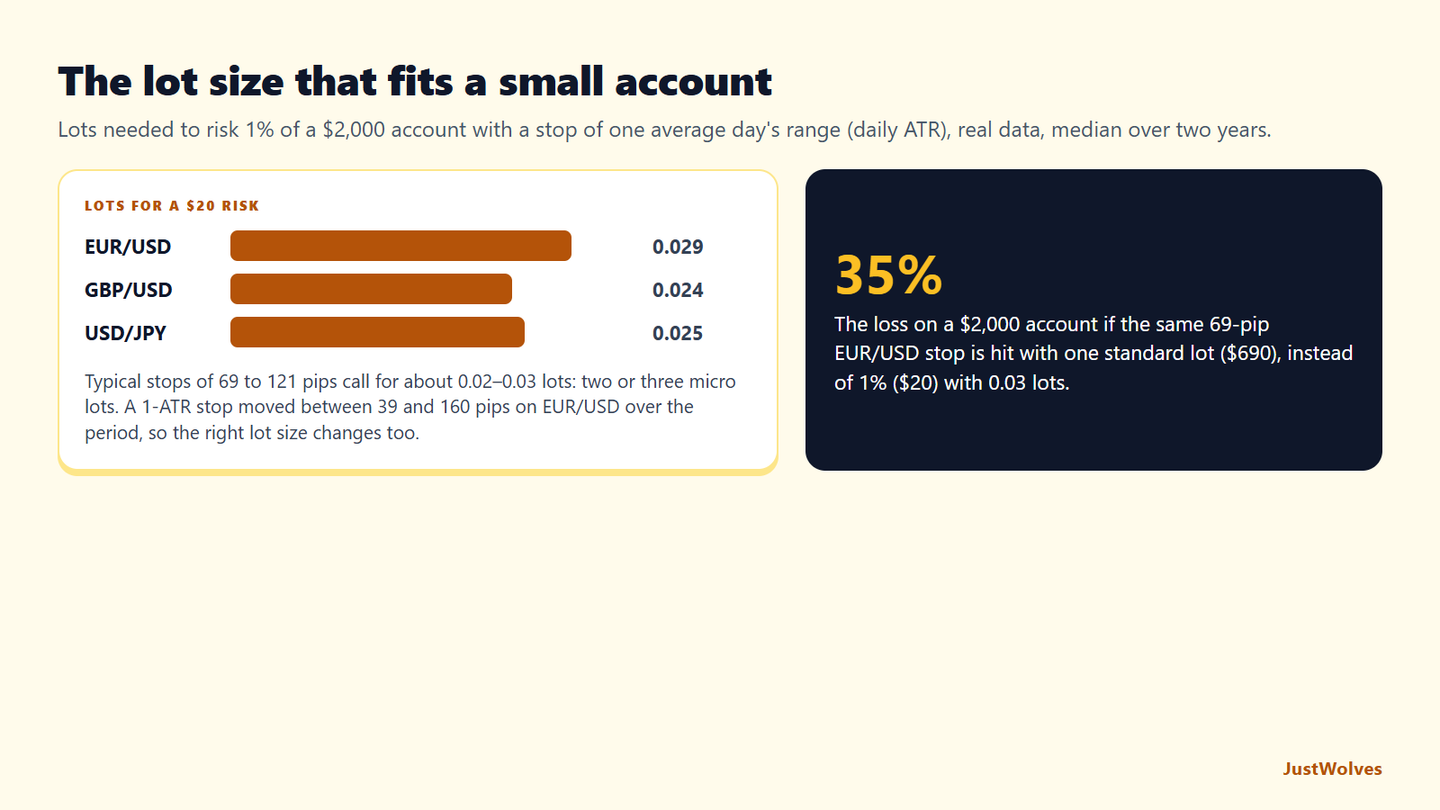
A lot size only makes sense next to a stop distance. To see what typical stops mean for small accounts, JustWolves measured the average daily range (14-day ATR) of three major pairs over about two years of real data (November 2024 to November 2026), and worked out the lot size that would risk exactly 1% of a $2,000 account with a stop of that size.
| Pair | Median daily ATR | ATR range over the period | Lots to risk $20 (1% of $2,000) | Loss on one standard lot at that stop |
|---|---|---|---|---|
| EUR/USD | 69 pips | 39–160 pips | 0.029 (about 3 micro lots) | about $690 (35%) |
| GBP/USD | 82 pips | 47–138 pips | 0.024 (about 2 micro lots) | about $820 (41%) |
| USD/JPY | 121 pips | 47–239 pips | 0.025 (about 2–3 micro lots) | about $780 (39%) |
Three conclusions follow.
Small accounts need micro lots. With stops of a normal day's range, a $2,000 account risking 1% needs about two or three micro lots. A single mini lot would already be three to four times the intended risk; a standard lot would be thirty times it.
The right lot size keeps changing. EUR/USD's average daily range varied between 39 and 160 pips over these two years. A stop that suited a quiet month would be far too tight in a volatile one, and a lot size fixed in a quiet month would be too large in a volatile one. Recalculating for every trade, as this lesson's step-by-step method does, handles that automatically.
Rounding matters at this scale. The difference between 0.02 and 0.03 lots is 50% more risk. Round down, as Arjun does in the practical example below, so the loss at your stop is never more than you planned.
Common Mistakes
- Trading one standard lot because it's the 'normal' size. For most retail accounts it's far too large.
- Using the same lot size for every trade. Stops differ, so lots should too.
- Sizing by available margin. Margin shows what you can open, not what you can afford to lose.
- Rounding up. It quietly increases risk.
- Ignoring pip value differences between pairs. Yen pairs and crosses are worth different amounts per pip.
Professional Insight
Professionals rarely say 'I traded two lots'; they say 'I risked half a percent'. Lot size is the output of the risk calculation, not a choice in itself. When you catch yourself picking a lot size before you've placed the stop, that's the moment to stop and redo the order of operations.
Risk Considerations
- Leverage makes large lots easy to open; see lesson 01.01.07 for what that means for margin.
- Gaps and slippage can make the real loss larger than lots × stop.
- Minimum sizes: if your broker's or exchange's minimum is too large for your stop and risk, the trade doesn't fit your account.
Important Terminology
| Term | Meaning |
|---|---|
| Lot | A standardised position size in forex. |
| Standard / mini / micro / nano lot | 100,000 / 10,000 / 1,000 / 100 units of the base currency. |
| Fractional lot | A position written as a decimal of a standard lot, e.g. 0.08. |
| Contract size | The fixed number of units in one exchange-traded currency contract. |
| Money per pip | Pip value for your actual position size. |
What is a lot in forex?
A standard unit of position size. A standard lot is 100,000 units of the base currency; mini, micro and nano lots are 10,000, 1,000 and 100.
What lot size should a beginner use?
Whatever size makes a stop-out cost about 0.5–1% of your account. For small accounts that is usually micro lots.
How much is 0.01 lot worth per pip?
On a pair quoted in US dollars, 0.01 lots (1,000 units) is worth $0.10 per pip.
How do I calculate lot size?
Divide the money you're willing to risk by (stop distance in pips × pip value of one standard lot).
What is the lot size for USD/INR futures?
One contract is 1,000 US dollars on Indian exchanges. Check the current contract specification before trading.
What lot size should I use for a $1,000 or $2,000 forex account?
It depends on your stop, but with typical stops of one average daily range (about 60 to 120 pips on major pairs in our data), risking 1% of a $2,000 account needs about 0.02–0.03 lots. For $1,000, roughly half that: one or two micro lots.
How much do I lose if my stop is hit on one standard lot?
Stop distance in pips × $10 on a dollar-quoted pair such as EUR/USD or GBP/USD. A 50-pip stop costs $500 per standard lot, $50 per mini lot and $5 per micro lot.
Practical Exercise
Size three trades for a $3,000 account risking 1% ($30).
Your task
Step 1: EUR/USD
Stop 20 pips.
Step 2: GBP/USD
Stop 60 pips.
Step 3: AUD/USD
Stop 12 pips.
Step 4: Check
Confirm each loss at the stop is at most $30.
Check Your Understanding
How many units is a mini lot?
Related Lessons
Previous: What Is a Pip in Forex?. Next: Bid, Ask and Spread. See also Position Sizing and the 1% Rule.