
Forex Trading Risks: Leverage, Gaps, Liquidity and Counterparty Risk
JustWolves is an educational platform and is not a SEBI-registered investment advisor. Trading financial instruments involves significant risk of loss and may not be suitable for all investors. Past performance is not indicative of future results. Read our full disclaimer →
What you'll learn
- Market risk is only one of several risks; leverage, gaps, liquidity, counterparty and legal risks matter too
- Effective leverage multiplies every price move into a larger account move
- Gaps can jump past stop-losses, so a stop isn't a guaranteed maximum loss
- Counterparty risk is reduced by using regulated, exchange-traded products
- Manage risk with position sizing, low effective leverage, event awareness and a legal broker
In this article · 17 sections
Forex attracts traders with leverage, liquidity and round-the-clock trading. The same features create risks that are easy to underestimate. This lesson brings the Forex course's risk threads together: what can go wrong beyond a trade simply moving against you, real examples of when it did, and practical ways to keep each risk small.
What You Will Learn
- The main categories of forex trading risk
- How leverage turns small moves into large account losses
- Why stops don't guarantee your maximum loss
- Practical controls for each risk
Before You Start
Read Leverage and Margin in Forex first.
1. Leverage Risk
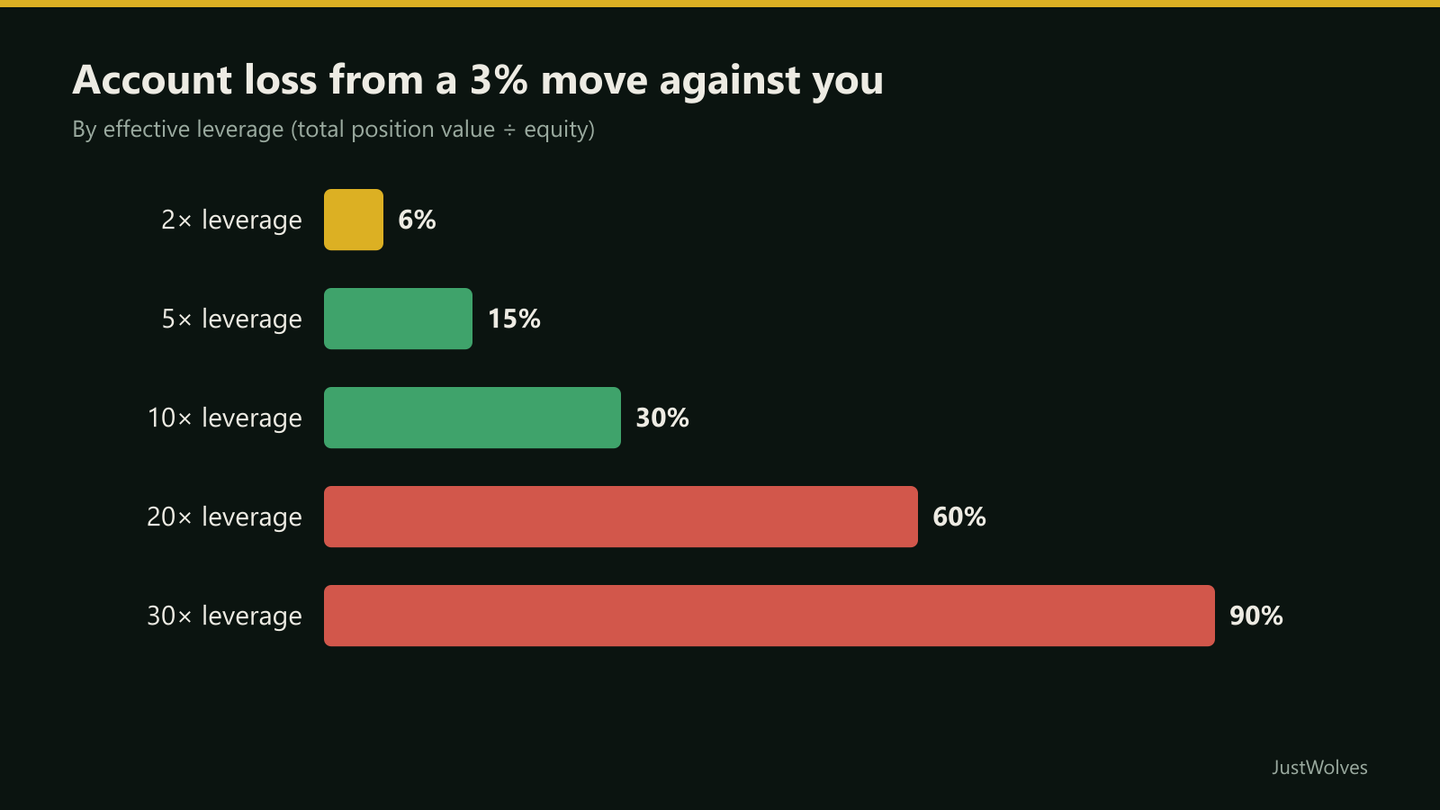
Effective leverage is your total position value divided by your account equity. At 10× effective leverage, a 1% move in the pair is a 10% move in your account. High available leverage makes it easy to reach effective leverage far beyond what a sound plan would use.
The chart shows what a sudden 3% move against you does to an account at different effective leverage levels:
2. Gap and Slippage Risk
A stop-loss becomes a market order when triggered. If price jumps past it, over a weekend, at a major release or in a shock, the fill can be far worse than the stop price.
The best-known example is 15 January 2015, when the Swiss National Bank unexpectedly removed its cap on the franc. EUR/CHF fell from around 1.20 to well below 1.00 within minutes, with almost no liquidity in between. Many stop orders filled far beyond their levels, some retail traders lost more than their account balances, and several brokers suffered large losses, with at least one becoming insolvent.
Real Data: A Weekend Gap Through a Stop
The 2015 franc event is the extreme example of gap risk. Smaller versions happen far more often. The chart below uses real hourly GBP/USD candles across the weekend of 22–25 May 2026, with times in IST.
Real data: a weekend gap through a stop, GBP/USD, 22–25 May 2026 (IST)
Step 1 of 3
Friday close
GBP/USD ends the week on Friday 22 May 2026 (02:30 IST on Saturday) at 1.3433, after a quiet evening.
- What to observe
- Nothing unusual before the weekend.
- Condition
- A trader holds a short over the weekend.
3. Liquidity Risk
Even in the world's most liquid market, liquidity varies. Around the daily rollover, at the weekly open, in exotic pairs and during market stress, spreads widen and slippage rises. A strategy that works with a 1-pip spread can fail when the real spread is 5 pips. Trade liquid pairs at liquid times, particularly with short-term strategies.
4. Counterparty and Broker Risk
With over-the-counter products, your broker is your counterparty. If it's insolvent, unregulated or fraudulent, you may lose money regardless of your trades. Exchange-traded futures and options, cleared by a clearing corporation and traded through a SEBI-registered broker, reduce this risk considerably. Choosing a Forex Broker covers the checks.
5. Legal and Regulatory Risk
For Indian residents, trading leveraged forex through unauthorised platforms can lead to penalties under FEMA, and funds sent to such platforms may be impossible to recover. Rules can also change: contract specifications, margins, trading hours and permitted products are set by regulators and exchanges, so keep up with circulars from your broker and exchange.
6. Operational and Behavioural Risk
- Platform or internet failure while a trade is open.
- Order-entry errors: wrong side, extra zero, wrong pair.
- Overtrading and revenge trading after losses.
- Ignoring your own plan under pressure.
Step by Step: A Risk Control Checklist
Controls for each risk
Step 1: Size by risk
0.5–1% per trade, sized from the stop (lesson 01.02.04).
Step 2: Cap effective leverage
Keep total position value to a low multiple of equity, lower overnight and at weekends.
Step 3: Respect events
Reduce or close positions before high-impact releases and central bank decisions.
Step 4: Limit currency exposure
Cap total risk per currency (lesson 01.04.01).
Step 5: Use a legal, regulated route
Exchange-traded products through a SEBI-registered broker.
Step 6: Have a backup
Keep your broker's phone dealing number and a second device ready.
Practical Example
Two traders each have ₹2,00,000. Ravi holds positions worth 25 times his equity over a weekend, with stops 30 pips away. Over the weekend, news breaks and the pair opens 2% lower. His stops fill at the open price, and the 2% gap costs him about 50% of his account.
Nisha holds positions worth 3 times her equity, with the same stops. The same gap costs her about 6%. Both had stop-losses; only Nisha's position size made the stop meaningful.
The Moves a Risk Plan Must Survive: Our Data
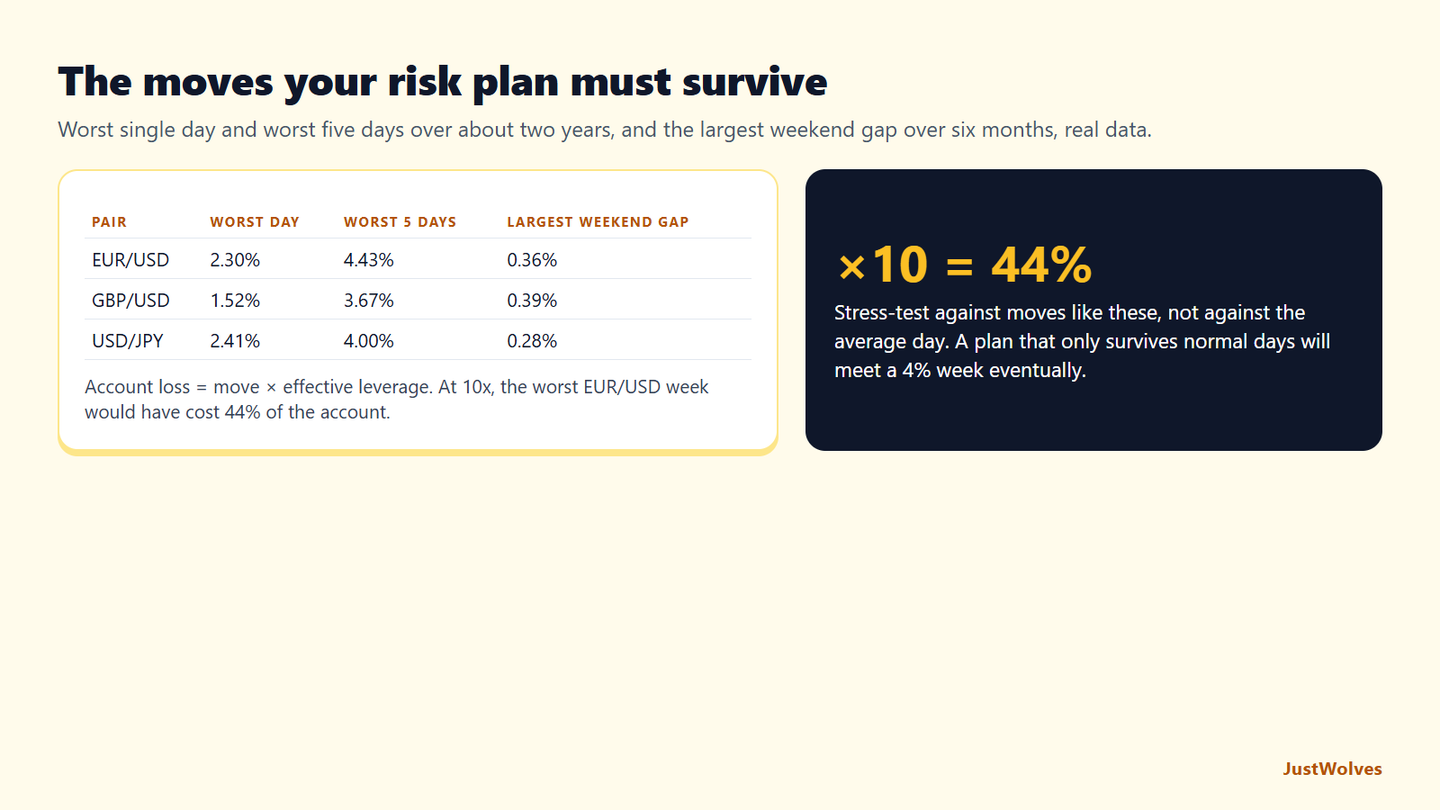
This lesson's professional insight is to ask "what is the worst plausible move, and could we survive it?". JustWolves measured the worst moves in real data for the three major pairs: the largest single-day and five-day changes over about two years (November 2024 to November 2026), and the largest weekend gap over six months.
| Pair | Worst day | Worst five days | Largest weekend gap |
|---|---|---|---|
| EUR/USD | 2.30% | 4.43% | 0.36% (25 May 2026) |
| GBP/USD | 1.52% | 3.67% | 0.39% (25 May 2026) |
| USD/JPY | 2.41% | 4.00% | 0.28% (28 Sep 2026) |
| Effective leverage | Worst day (about 2.4%) | Worst week (about 4.4%) | Largest weekend gap (about 0.4%) |
|---|---|---|---|
| 3x (Nisha) | 7% | 13% | 1% |
| 10x | 24% | 44% | 4% |
| 25x (Ravi) | 60% | over 100% | 10% |
Three points follow for the risk checklist in this lesson.
The worst week was nearly twice the worst day. A plan that only asks about single-day shocks underestimates risk for positions held for several days. EUR/USD moved 4.4% in five days at its worst.
Weekend gaps were small in this period, but large relative to stops. A 0.4% gap is only about 50 pips, yet it is larger than many intraday stops, as the GBP/USD example shows. Gaps make the stop distance a minimum loss, not a maximum.
Effective leverage decides whether the plan survives. Nisha's 3x positions in the example below would have lost 13% even in the worst week, painful but survivable. Ravi's 25x would have lost the whole account. The 2015 franc move was several times larger than anything in our data, which is why professionals keep exposure small enough to survive moves they have not yet seen.
Common Mistakes
- Treating a stop-loss as a guaranteed maximum loss.
- Measuring risk per trade but not effective leverage.
- Holding large positions through weekends and major events.
- Using an unregulated broker to get higher leverage.
- Ignoring operational risks until they happen.
Professional Insight
Professional risk managers ask 'what's the worst plausible move, and could we survive it?', not just 'where's the stop?'. They stress-test positions against historical shocks, such as the 2015 franc move, and keep exposure small enough that one rare event can't end the business.
Risk Considerations
- Rare events happen; plan for them, not around them.
- Several risks can strike together: a gap in a thin market with a broker under strain.
- Risk controls only work if followed every time.
Important Terminology
| Term | Meaning |
|---|---|
| Effective leverage | Total position value ÷ account equity. |
| Gap | A price jump with no trading in between. |
| Slippage | The difference between the expected and actual fill. |
| Liquidity risk | The risk of trading at poor prices because few orders are available. |
| Counterparty risk | The risk that the other party to a trade fails to pay. |
| Stress test | Checking how positions would fare in an extreme move. |
What are the main risks of forex trading?
Market risk, leverage, gaps and slippage, liquidity, counterparty or broker risk, legal risk, and operational and behavioural risks.
Can I lose more than my deposit in forex?
With some products and brokers, yes, if a gap moves price past your stop. Some regulators require negative balance protection; check what applies to you.
Does a stop-loss guarantee my maximum loss?
No. In gaps and fast markets it can fill at a worse price.
What happened in the 2015 Swiss franc event?
The Swiss National Bank removed its cap on the franc, EUR/CHF fell sharply within minutes, and many stops filled far beyond their levels.
How do I reduce counterparty risk?
Use regulated, exchange-traded products through a SEBI-registered broker rather than offshore OTC platforms.
How much effective leverage is reasonable for a forex trader?
There is no single safe number, but keep it low enough that the worst real moves are survivable. In our data, the worst EUR/USD week moved 4.4%: at 3x effective leverage that is about 13% of the account, at 10x about 44%. Many careful traders stay in low single digits, and lower still over weekends and major events.
How big can forex weekend gaps be?
Usually small, but larger than many stops. In six months of real data the largest weekend gap was 0.39% on GBP/USD, 53 pips, and 0.36% on EUR/USD. Rare events such as the 2015 Swiss franc move have been many times larger.
Practical Exercise
Stress-test your positions.
Your task
Step 1: Effective leverage
Add up the value of all open or planned positions and divide by equity.
Step 2: Gap test
Calculate the account loss from a 2% and a 5% gap against you.
Step 3: Event check
List releases and weekends your positions will cross.
Step 4: Decide
If any result would be unacceptable, reduce size now.
Check Your Understanding
At 10× effective leverage, a 2% adverse move costs:
Related Lessons
Previous: Choosing a Forex Broker. See also Leverage and Margin Risk and Capital Preservation and Risk of Ruin.